

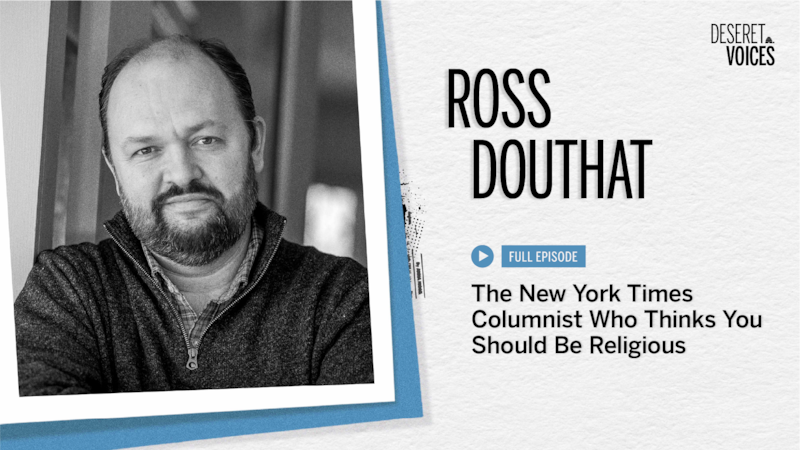


In this episode of “Deseret Voices,” New York Times columnist Ross Douthat describes Salt Lake City as a “biblical America window” where a group of people made their exodus and found the Promised Land.
Host McKay Coppins and Douthat talk about the role of religion in society and how religion is influencing America right now.
Douthat, author of the new book, “Believe: Why Everyone Should Be Religious” and a devout Catholic, makes what he calls the rational case for believing in God.
Subscribe to “Deseret Voices” on YouTube, Apple Podcasts or Spotify.
Note: Transcript edited by Steven Watkins
McKay Coppins:
If you talk to people who study the role of religion in society, they will tell you that something strange is happening right now in America. After decades of secularization, of shrinking churches and ascendant atheism, there are suddenly signs of a growing interest in the mystical and divine.
This week on “Deseret Voices” — we welcome author and New York Times columnist Ross Douthat — whose new book, “Believe: Why Everyone Should Be Religious,” is pitched to secular people who find themselves searching for meaning and connection. As a devout Catholic, he makes what he calls the rational case for believing in God.
McKay Coppins: Ross, thank you for coming on “Deseret Voices.”
Ross Douthat: It is my pleasure, McKay. Thank you so much for having me.
MC: You have spent much of this past year on a book tour talking about why people should be religious, and you have been making this case often in fairly secular venues or in interviews with, you know, very erudite, enlightened people who might not be inclined to that argument.
And I’m curious, if anything surprised you in making this case in any of these conversations? Like what happened that was unexpected on this book tour?
RD: So the premise of the book and part of the reason that I wrote it was this sense that American culture and maybe especially elite culture was becoming more open to religious ideas and arguments, more interested in religion at least, than it had been, over the last 10 or 15 years.
So I guess, in a way, it shouldn’t be a surprise that was what I found to be the case in my conversations. But I still was a little bit surprised by how difficult it was to kind of gin up a really hard core, stringent atheist attack on the book.
I would say it was fairly striking that I’ve had only a few engagements, most of them kind of publicly scheduled debates, where we just went at it hammer and tongs over whether religion is ridiculous and God is a myth.
And most of the conversations were more in the vein of, you know, Ross, I am persuaded by this third of your argument and not sure about that third, but I think you’re on to something here.
Do we have to call it God? That kind of thing.
MC: Well, you write in the introduction of your book that you have written, obviously, about religion a lot, in your column for The New York Times and, that you’ve noticed a change in the reader letters that you get over the last, like 10 or 15 years, whereas maybe a decade ago, a lot of the more secular liberal readers would write to you in this kind of tone of triumphalist New Atheism that was, you know, kind of ridiculing your belief in God and dismissing all of it and that now you’re detecting more of a kind of mournful yearning for faith, even among those who don’t believe. I’ve certainly noticed that myself as somebody who writes about religion.
What is it about, you know, what you perceive to be the failures of secularism and atheism that is leading so many of your New York Times readers to yearn for Roman Catholicism.
RD: First of all, no, not, no to that, for many of them. And I don’t want to overstate the case. You know, I’m just coming off a Sunday column that I wrote where the argument in the column was, you know, that liberals accused the Trump administration of being Christian nationalists.
And in fact, the problem with the Trump administration is that it’s not Christian enough. You know, these various critiques. Definitely a number of New York Times readers were not — even if they agreed with all of my critiques of the Trump administration — were not interested in the idea that you just need a little more Christianity and conservative politics.
But I do think there’s also been a change. And I suppose I would attribute that change to, let’s say three factors. The first is just the basic reality that the New Atheist movement, the, you know, set of intellectuals and journalists who are, you know, really giving it to religion with both fists for a while made some reasonably concrete predictions about how much more enlightened and peaceful and rational the world would be as organized religion diminished.
Get rid of doctrines. World will be a better place. Was a pretty commonplace argument. I don’t think anyone believes that in the 2020s.
Or maybe a few people believe it, but, hardly.
MC: It’s been a pretty a pretty strong retreat from those arguments.
RD: Yes. I think you have a fair amount of data to demonstrate that people who no longer go to church are just as capable of hating each other or being polarized against each other, developing reasons to reject science and reason.
And throwing themselves into crazy ideological causes. Don’t need religion for any of that. So that realization I think has weakened some of the attractions of atheism. At the same time, I think there’s also been a, you know, a loss of faith in a certain kind of liberal and secular narrative of progress, right? So if you tell yourself we don’t need religion but the good news is the arc of history bends toward some kind of, you know, progressive, liberal utopia. And then suddenly you start losing elections to right-wing populists. And the world of politics and culture seems to turn against you in various ways. Then you’re going to have more pessimism, more anxiety, even more political despair.
And certainly, I think liberal politics in the 2020s, especially since the 2024 election, has more outright darkness and despair in it than at any point in my own lifetime. And that doesn’t, you know, compel everyone back toward religion. But there is a kind of dark night of the soul experience. I think that a certain kind of, again, sort of secular progressivism has had to reckon with over the last five or 10 years in the age of populism, that, yeah, undermines the way that politics had been substituting, I think, for religion.
Then finally, the world. As you may have noticed, McKay, has just gotten a bit weirder and has 10 or 15 years. And some of that weirdness is, just in things that are happening in the secular or political sphere. Politics, ideological battles have become more intense. Some of it is in the realm of apocalyptic events like we had.
We did have the first global pandemic in 100 years or so. And then some of it is just a kind of creep of the supernatural and paranormal thing back into, I don’t know. No, I don’t want to say everyday life, but let’s just say there’s been a kind of partial return of supernatural and paranormal interest in a way that at the very least resembles the 1970s, you know, people are into astrology and UFOs and psychedelics and all these things. And you have AI as this kind of scientific but also quasi supernatural shadow over things. But again, I think naturally, a renewed interest in religion is what you would expect in that kind of climate of, weirdness and supernatural interest.
MC: I want to return to the weirdness in a moment because I have a question for you about that I’d be interested in getting your answer to.
But first, let me ask you this. So a lot of writing about religion, in this kind of new, more welcoming era, in the media focuses on the prosocial aspects of organized religion, right? Like, and I’ve been guilty of this.
What your book does and what you do more generally in your writing is kind of more interesting and more provocative. You kind of confidently make the rational case for religious belief because it’s true, not because, you know, it’s good for, politics and community and society, but because God actually does exist. Why was it important to you to do that?
RD: To be clear, I have made those prosocial arguments myself on many occasions over the years. And it’s not, there’s nothing wrong with those kind of arguments. I do think they are something of a crutch sometimes for religious writers operating in a secular environment where it’s like, well, I don’t want to be too embarrassing or too impolitic by going after the truth claims or making supernatural arguments or anything crazy bad like that.
I think it’s important to push further, but you also have to have the right environment and moment. And again, I think this is a moment where the world seems weirder. And for that reason, among others, even secular writers and thinkers are a bit more open to arguments that ask you to consider the more fundamental question of does God actually exist?
Are miracles actually possible? Is there actually evidence that the world was made in some way with human beings in mind? So yeah, I think timing is important. You’re trying to, as a writer, you’re trying to find a receptive audience. And my sense was that the mid 2020s, there would be more receptivity to that kind of argument than there would have been if I’d written this book in 2014.
So that’s part of it. But then also, obviously, it matters a great deal whether, you know, those considerations matter a great deal. And they are at issue even in the kind of sociological aspects of religion, because in the end, you’re never going to get a big religious revival driven by people who have read the works of Robert Putnam and who are, right?
I mean, not that you, I want to be clear, people do make religious choices on the basis of some kind of prosocial impulse. People do decide to go back to church when they have a kid or, you know, decide to, you know, get married in their ancestral religion, even if they haven’t practiced it for a while. And people can be drawn into religion through kind of communitarian and social channels.
But there is still some hard limit on that pull, unless they also eventually decide it might be real.
MC: So I will admit that I came to your book with a little bit of skepticism. Not because, I mean, obviously I believe in God like you do, but I was skeptical that the project would work. Meaning like I’ve always held on to this belief that it’s very difficult, if not impossible, to think your way into belief in God, right? And I even remember when I was a young Latter-day Saint missionary, when I would encounter people knocking on doors who wanted to, you know, get into philosophical debates with me. And, you know, this was 2006, 2007, so kind of the peak of New Atheism. You would find these people, I would kind of be like, look, I’m not wasting my time here, or even when I would encounter, you know, evangelicals who wanted to Bible bash.
RD: Who wanted to talk the Bible, right?
MC: Exactly. Like, I mean, it’s interesting and I could get into it, but I’m like, you know, ultimately this is not going to be that fruitful. And maybe, you know, as you were talking about that kind of defense mechanism that people of faith have and trying to make the case to a secular audience, you know, maybe this was me, kind of giving myself an out, right, saying, there’s no point in trying to litigate truth claims of people who don’t believe.
Anyway, I was thinking, though, as I started to read your book about, actually, the Book of Mormon, there’s a treatise on faith where one of the one of the verses says that if you only have a desire to believe, let that desire work within you. And it seems to me that this book is targeting that group of people, the people who might not believe, but might have a desire to believe.
And so you in the book, lay out a series of rational claims for believing in God. And we’ll go through some of them. I want to start by just asking you, do you have a favorite? Is there a favorite argument for the existence of God in your book?
RD: It’s a subtheme of a larger argument about the nature of consciousness and the sort of both the resilient mystery of consciousness, but also the way that things we know about consciousness suggest a kind of supernatural pattern and supernatural origin to the human mind, basically.
And one of the pieces of that argument has to do with the really striking fact that whatever human consciousness is, it has turned out to have a remarkable capacity to unlock mysteries seemingly well above the paygrade of, you know, the kind of early hominid environment in which consciousness is understood to have evolved, right? So it isn’t that hard to tell, a kind of just so story about the benefits of, you know, conscious deliberation when it comes to figuring out how to survive on the savanna or how to, you know, dodge predators and so on.
And I think a lot of people assume that just kind of scales up naturally, that it’s like, well, you have, you know, you have these skills. Consciousness helps you with these, helps you build fires. And so eventually it helps you create agriculture. And then eventually it helps you split the atom, figure out E equals MC squared and do gene editing.
And I don’t think that scaling up, I think we take it for granted, but there’s no inherent reason why you would expect this, a tool that evolved purely for survival, to find the invisible order of the cosmos to be so discoverable and, you know, essentially, that we could crack open the user manual of the world that we’re in and, both plumb these kind of remarkable mysteries of how physics works, how the physical world works, but also then manipulate and do all the remarkable things that are, frankly, still ongoing in human science today. But part of the larger argument that I’m making in the book is that there isn’t sort of one slam-dunk, you know, medieval scholastic theorem that settles the debate over God once and for all.
There’s just a lot of converging lines of evidence, converging aspects of our reality that just make it all make a lot more sense. If you just say, hey, there’s probably a God, there was probably some kind of intentionality behind this system and our existence within it than if you set that argument aside.
But the ability of the human mind to unlock the mysteries of the cosmos is what you would expect in a world where as the book of Genesis has it, human beings were made in some way in the image of the mind that created the whole system, and it’s just much more likely under those conditions than under strictly materialist conditions, I think.
And there’s I think a lot of examples of this, things that we accept as part of our world that are just more likely given theism then given atheism.
MC: Right. Well, you I mean, you write about in the book the neuroscientist who kind of triumphantly declared in the 90s that they could explain all human consciousness through science now, right? And then you know that in the preceding years, even some neuroscientists have sort of conceded that their explanations have a lot to do with simply identifying the locations in the brain where certain, you know, feelings occur and ultimately don’t provide a very satisfying explanation for what you and I would call the soul, right? And there are a bunch of examples of this in the book where you kind of walk through what I think maybe a modern, educated secular person who has kind of washed their hands of the idea of religion a long time ago have come to accept as the default truth, right? Oh, neuroscience explains human consciousness. The Big Bang and evolution explain, you know, the existence of the Earth and humanity, and then, you know, even just, like, poke at those ideas a little bit and you realize they’re actually a lot more complicated and less satisfying than maybe we have been led to believe.
To that end, I want to ask you to tell a story that you have in your book about an old clock radio.
Tell that story and what it’s meant to convey.
RD: So this is not my story. This is a story from the sort of professional atheist and skeptic, Michael Shermer, who was actually one of the people with whom I did have, a, you know, a fairly straightforward debate about religion in the course of promoting this book.
Shermer is a very smart guy who has been writing about these issues for a long time. And one thing that distinguishes him is that he’s always been interested in the stuff that the atheist world picture doesn’t adequately explain. He himself has had a particular experience that he’s written about a number of times now where, he and his wife were getting married and his wife had this radio that had been given to her by a relative who had passed away, who had basically been, I think, a father figure to her.
And so this radio never worked. It was broken. And no way to get it to work. Shermer had tried and it was in a drawer in the back of their home. And after they came back from the wedding to the reception, Shermer heard music playing from somewhere in the house and they went all around and couldn’t find anything. And finally they found the radio playing and it was playing sort of love songs or, you know, suitable music for the occasion. And it continued playing into the evening through the end of the wedding. And then it stopped. And after that, Shermer could never get it to work ever again.
And this is used by him as an example of, again, this kind of residual set of things that happen to people. That are, you know, challenging to fit into a purely materialist framework. You can sort of fall back on some kind of law of large numbers hypothesis in that circumstance and say, well, you know, given an infinite number of clock radios, one will have its wiring fuse in such a way that it works temporarily.
And one out of a billion of those clock radios will happen to work on the day of a wedding, when it’s for a man, anyway. But at some point, that kind of argument becomes difficult, I think, for people to accept, especially if there are enough of these kind of things that happen. And one of the claims I make in the book. There’s a lot of weird stuff that happens to people. Some of it incredibly intense, falling into the categories we call mystical experience, some of it just bizarre and peculiar. Some of it things like the Shermer radio and these things are just consistent features of human life.
And they persist even under officially disenchanted conditions. People keep having religious and mystical experiences, even if they’re in cultures that don’t think that they happen, even if they themselves are not especially religious. And there’s some of these things can be studied a bit and we have actually learned more about them under modern technological conditions. We know more about the weirdness of near-death experiences, for instance, in the 21st century than we did back when we brought fewer people back from the brink of death.
Essentially there’s a lot of stuff here that’s part of part of what it is to be a human being. And a lot of it was predicted to sort of melt away under more secular conditions. If you read, you know, David Hume or Thomas Paine or Voltaire or these kind of late 18th-century atheists they don’t think people will stop believing in the supernatural, but they really think a lot of stuff will just sort of go away once you don’t have priests empowered to tell you what to believe or force you to read scripture.
And if anything, I think, you know, 19th- and 20th-century history have proven the opposite, that as institutional religion decays you get actually often wilder expressions of sort of spirituality and mystical experience, weirder expressions than you did before. And again, does this prove absolutely that these things are real connections to a higher realm of reality? I don’t think you can prove that absolutely. But the persistence and resilience of mystical experience is what the religious person would have predicted. Going into a more secular age, the secular person would have, would have, and did predict the opposite. And so the more resilience you have, the more Michael Shermer’s radios and near-death experiences you have, the more you have to give a kind of point to the religious perspective.
MC: To me, one of the most surreal moments of watching your book tour as just a kind of spectator was your, I think, now famous among a certain audience interview with Ezra Klein, your fellow New York Times columnist, where it started as I think a very, you know, what you would expect kind of interesting, analytical, intellectual, you know, debate about your book and the various ideas within it. And then kind of veered off into Ezra talking about, you know, religious visions he had during an ayahuasca retreat. And, yeah, you’re on, and then, you know, it got it got weird and, but to me, I think, illustrates, something you alluded to earlier and kind of the backdrop, that your book is coming out against, which is that it would have been unfathomable, I think, 15, 20 years ago, to see an interview like that with two esteemed New York Times columnists talking about, you know, religious visions and fairies and demons and ayahuasca.
We hear a lot about now the Great Re-enchantment, right? This kind of, Western interest in you alluded to tarot cards, astrology, ayahuasca, and I think that a lot of people of faith are kind of welcoming that interest in the mystical and the position that I hear a lot from other religious people is, look, that stuff isn’t for me, but it’s going to break the back of the New Atheists and, you know, dominate so much of Western thought in the 21st century that inevitably it will lead a great number of people back to God.
And I guess I’m curious if you think that is true, because I’m sympathetic to that view myself. And your book does seem to flirt with it as well. But isn’t there also a danger that, you know, people of faith cheerleading this turn toward the mystical might not end up where they think they will. That the interest in Wiccans and horoscopes will not lead to another Great Awakening.
RD: I think it’s a concern. I guess essentially when you’re enchant the world, you play for higher stakes, I think. And generally since, Christians believe that God is sovereign over every level, natural and supernatural. They should have a certain confidence that if you play for higher stakes, there’s more to be won than to be lost.
But I also think the concerns are understandable and valid, like, Christianity in its own origins is a partially disenchanted religion, right? It says like, look, there’s all this enchantment in the world, but a lot of it is bad or dangerous or demonic or fake. And you need to focus on the one true God, and you need to focus on Jesus Christ, and you need to not be sacrificing to idols and going to oracles and so on.
This is not a new question.
MC: Yeah.
RD: Essentially, what you’ve had in most of Western history in the last 200 years is these kind of cycles of supernatural interest that partially redound to the benefit of Christian churches and partially go veering off into other ways and thoughts, right? And, you know, if you look at the history of spiritualism in the late Victorian era, right, this is very clearly a post-Christian fascination with the supernatural.
If you look at forms of neo-paganism in the early 20th century, some of which ended up in some pretty dark places, that’s also a kind of re-enchantment. The 1970s, which I mentioned earlier, also provide a framework, right, for understanding the renewed interest in these things, the whole New Age movement and so on. It’s not the first time we’ve experienced something like this.
I think there are obviously opportunities for traditional believers and traditional churches to sort of interact fruitfully with these impulses that people have. When I talk to priests and pastors, they will say things like, yeah, it used to be 15 years ago, someone would come, you know, and become interested in Christianity because they’d read, you know, C.S. Lewis’ “Mere Christianity” or something, right? And then, you know, or they had a spouse and their spouse is religious.
And now, suddenly, we’re getting more people who come in and saying, hey, man, I had a really dark supernatural experience, and I’m looking for something to make sense of it. So you have these cycles over the last 200 years. In none of the cycles have you had a full restoration of the kind of medieval and pre-modern assumption that the supernatural is just real, the secular frame kind of reasserts itself. There’s at least in official knowledge, I think. I think disenchantment is fake as a description of human reality, like it’s always enchanted. There’s always religious and mystical experience, but it’s real. It’s a statement of like, what is official knowledge? Believe what the official institutions believe.
And the official rule of disenchantment has been pretty resilient against these kind of waves of supernaturalist interest. And that may be true again, like we may sort of cycle for 20 years through the mystical and then, you know, downstream from here, we’ll get another high rationalist moment. I’m interested in the scenarios where things go a bit further, right, where, you know, you get like, something happens to people that then makes the supernatural harder to deny, harder, even for official knowledge to deny.
Maybe it’s just the part of me that likes reading, you know, sci-fi and fantasy and speculative fiction. But you can imagine a timeline where you go back to a world where people just sort of take for granted that there are supernatural powers out there, even distinguished university professors and New York Times journalists. But something weirder than just my colleagues taking ayahuasca would have to happen for us to get there.
MC: Well, can you elaborate what kind of weirdness would we have to encounter for that timeline to occur?
RD: So two examples, right? So speaking of Yale professors, there’s a professor at Yale named Carlos Eire, who wrote a book called “They Flew,” that has gotten a fair amount of attention in this kind of disenchantment discourse.
And “They Flew” is a book about saints who levitated during the Reformation, in 16th- and 17th-century Europe. And it’s a great book because Eire is, you know, a great historian, sort of steeped, he’s a historian of the Reformation, steeped in, you know, the rhetoric and practices of his guild.
So you read the book and for a while, if you come to it cold, you think, well, this is an interesting survey of what people thought happened in a climate of, you know, intense religious fervor. But you go further through the book and eventually you realize, no, actually, professor Eire thinks that the saints really levitate it, right? He thinks that this happened. That you just have, you know, so many witnesses to these things.
These things happen in public. They are a subject of Protestant versus Catholic polemic. You have multiple witnesses who say the same thing. You know, it’s a little bit like the debates about the authorship and veracity of the New Testament, except it’s much closer to the present. There’s more documentation and if these weren’t supernatural happenings, everyone would accept that they really happened.
Now, if you say that, someone might say, well, it’s very interesting professor Eire, but, why don’t we have any levitating saints now? And, you know, why — one of the final case studies in his book that he mentioned, I don’t think he talks that much about her — but is a nun, who was in the resistance to the French Resistance in World War II.
And my understanding is she had might not have been levitation just by location, but she had some crazy stuff associated with her, so much that in his account, the Vatican became a little embarrassed about pursuing her cause for canonization was just a little bit too crazy what was claimed. But we don’t have any videos of this, and that’s sort of at the tail end of the age when you don’t have video.
So the age of video comes along and suddenly we don’t have flying saints. That would be a point for the skeptic of these things. But what if professor Eire is correct? What if people fly occasionally under, you know, particular project, particular religious climates that obtained in 17th-century monasteries and don’t obtain very often now. But what if we generated some of those climates?
And what if you had a few flying saints in the middle of the 21st century? Now people would just say it was AI, deepfake, you know?
MC: I mean, I was just going to say that in the current information, in the current environment, miracles would have the same effect.
RD: They would be very polarizing, let’s put it that way. But they would impose a harder test for the consensus of secularism.
Then the other example just quickly, is the UFO stuff, right? The UFO, I don’t want to derail us with a UFO conversation, but just to say that —
MC: We’ll have you back for the UFO conversation.
RD: It’s a realm of sort of paranormal meets supernatural stuff. There is a strangely substantial cluster of people making claims about what the U.S. government knows about this stuff and so on.
You could imagine a world where there was some kind of revelation about that stuff that changed people’s fundamental perspectives on reality. I’m not, yeah, just to be just to be purely spectator. No. What would what would have to happen to get a full paradigm shift? Those would be two examples. Some kind of crazy paranormal UFO disclosure and or flying saints, you know, I mean, I would add this to this whole thing.
MC: This is exactly what I was hoping I get from you. But I mean, it does make me think, though, the UFO case is an interesting one because to me, and I think this is almost become, you know, so commonly observed that it’s a cliche, but the relatively muted reaction to the various UFO disclosures over the last seven or eight years, both in the mainstream media and in the public, does make me wonder about, you know, what kind of reaction there would be if there were genuine, largely observed public miracles that occurred.
It seems like that we as a people, or so many of us, have been kind of conditioned to just shrug at them, write them off, make excuses. Maybe it has to do with the kind of media institutions that we have, and maybe that’s changing, but I do wonder if they would have the effect that you’re describing.
RD: I don’t know. There are ways in which these shifts sort of make people shrug at things. There’s no central authority that they trust. The New York Times running a story about Navy pilots seeing weird things seems no different, maybe, to a lot of people than some random person tweeting a possibly AI-generated image of it.
So yeah, that’s definitely true. And any kind of quasi miraculous event now would fall into that media landscape and be interpreted that way. I do think this shift has, though, changed people’s priors to some reasonable degree. Like, I feel like in the world of smart rationalist writers, there is more curiosity about this stuff because of some of the weird.
So someone like Scott Alexander, the leading rationalist blogger of Substack or whatever, right, of Silicon Valley, just wrote a 20,000-word essay trying to come up with a non-supernatural explanation for the miracle of the sun at Fatima. He’s not a believer in the miracle of the sun at Fatima, but in this information environment, he feels like he has to wrestle with the best miracle stories out there.
Wouldn’t have been the case 10 or 15 years ago. So if you’re asking me to imagine something more, I’m imagining something that sort of makes skepticism a little harder than it is even with the weird stuff we have floating around now. Whatever God is up to, he has tended to accommodate skeptics over the course of recorded human history, not in the sense of making it easy for them, but in the sense of like, there’s always a little space left, for people who don’t want to believe in God.
So I’d be maybe a little worried about where we were headed if too much of that space started being closed off.
MC: Let me ask you about my own faith tradition.
So I’m a, you know, Latter-day Saint, as are many of our listeners. And I want to ask you about where you place the, you know, what’s popularly known as Mormonism in the context of your arguments. Because in the book, even as you’re laying out your case that miracles and mysterious divine acts have continued to occur in modernity, you seem to gesture toward the purported miracles of the founding of The Church of Jesus Christ of Latter-day Saints as maybe a fair data point in the skeptics counter argument, right?
I think you grouped Joseph Smith alongside Scientology’s founder, L. Ron Hubbard.
More recently, on X you posted a really interesting thread and I think a lot of people, I would be interested in your elaboration on this — because this was in the wake of the attack on The Church of Jesus Christ of Latter-day Saints in Michigan.
A kind of debate erupted once again about whether, that attack constituted an attack on Christianity because, “Are Mormons really Christian?” And you came in with what I thought was a very characteristically thoughtful thread and take on this. But you ended with a really interesting kind of cryptic note where you said, I’m paraphrasing, but something along the lines of, I think God is not done with the Latter-day Saints story.
And then you said, but that’s a private theological opinion. So, now that we’re here in private, you and I, can you elaborate on that private theological opinion?
RD: Well, so the private the private opinion is just, you know, you have to think about God to some degree as someone who’s telling a story, right? That is certainly in the Christian tradition. God’s revelation is presented to most people in the form of stories, right? That there is a narrative here, a narrative of the Jewish people in the Old Testament. The Gospels are narratives that are not theological arguments. You get, Jesus makes theological arguments, Paul makes theological arguments.
But in the end, Christianity is telling a story. And I think it is completely reasonable to think of the whole thing, the whole shebang that we’re inside as a story with an author in which we are characters. You know, I read — maybe more than I should — fantasy novels, which are places where the novelist is doing a kind of trying to play God a little more than than the realistic novelist is in the sense of like doing some sub creation, creating like a macro-level world.
Often these novels fail at what they’re trying to do. Great. Most famously with George R.R. Martin being unable to finish “Game of Thrones,” right? But if you’re reading the George R.R. Martin novels, your assumption as a reader is any, you know, any thread, does that seem sort of weird and interesting?
It’s going to pay off somehow. And Martin, you know, Martin is in a prison of his own making as too many of these threads, right, to get them to all pay off. But if you’re like, oh, there’s this curious religious sect over here in Essos that, you know, seems to have some teachings that relate to the role of the dragons in Westeros or something. And what’s going to happen with them?
That’s how I feel about The Church of Jesus Christ of Latter-day Saints, right? I mean, this is just a remarkable story that, you know, in the middle of the United States of America in the Victorian age, in the 19th century. You get this claim of a biblical style, you know, angelic revelation, complete with an extra testament of Jesus Christ, an alternative history of the Americas.
And then out of that, you get this kind of miniature recapitulation of a biblical narrative where a bunch of people go out on this long journey in search of a Promised Land. And I’ve been to Utah, you know, I’ve seen Salt Lake City. It is like stepping into this kind of little, you know, biblical America window, where, you know, my gosh — as a good Mormon would say, you know, not a good Catholic, right?
They went and did it. They had an exodus and they found the Promised Land. And it’s, you know, it’s very American in this distinctive way, very apart from American culture in its own distinctive way. I don’t know, I think God is up to something interesting with that story.
And to your original question, I don’t have a perfect distinction here, but to me, the fundamental implausibilities have to do with its material, like, this-world claims. The claims about the ancient Americas and the prehistory of the Americas, for which there seems to me to be such minimal evidence.
I know you can, you know, there’s like, the limited geography hypothesis, and you can I mean, I got into this stuff.
MC: I’m going to send you some links after this.
RD: Yeah, send me some links.
MC: There’s some Latter-day Saint apologetics that I think you might find —
RD: I’ve read some. It’s been a while. If Romney had been elected president, I would have.
MC: You would be much more steeped in the history, in the apologetics, I understand.
RD: But I feel like there is like, you know, one of the core things that I appreciate as a Christian, and one of the things that makes me a Christian is, you know, this basic historical credibility in the Gospels themselves, in the New Testament, where there’s really good arguments that these books clearly originate in this particular history, in this particular place that is part of recorded history that we all agree exist and so on.
And I think Mormonism’s account of its own history struggles with that.
MC: Your issue is with the historicity of the Book of Mormon as an account, primarily.
RD: Yeah. And and if tomorrow, you know, a team of archaeologists found, I’m going to, I’ve forgotten all the details from when I … At one point, I would have been —
MC: Zarahemla. I appreciate the effort.
RD: This is, I try, I’m trying. OK. I would, you know, I don’t know if I would convert to Mormonism tomorrow, but my perspective on it would change.
MC: I guess what needs to happen is I need to send you a copy of the Book of Mormon.
Some very nice young men with nametags.
RD: I have a copy of the Book of Mormon. They are welcome at my home.
MC: I want to end this conversation, more or less where you end your book. You kind of make the case that people who want to begin on a spiritual journey, on a religious journey, should basically start with the tried and true organized religions that have stood the test of time and that they’re most culturally connected to, right? If you have a Christian background, start with Christianity. If you have a Muslim or Hindu background, maybe start there and then be open to new experiences and take your religious study seriously and see where it guides you. But then at the very end, you kind of, you know, shed the pretense of objectivity and kind of make the case directly for Christianity.
And it’s Christmastime. Make the rational case, in the last couple minutes of our conversation here, for Christianity.
Why should people be Christian?
RD: Suppose that you decide that this God might well be interested in human beings, and be interested in some kind of relationship with human beings and be playing some kind of guiding role in history.
Then I think as a curious person, looking over the world we find ourselves in and the history of religion and religious experience. Ideally, when you look for a church or a religion, you’re looking for something that offers itself as the place that seems like the most important place where God stepped in, sent a message, right, delivered a revelation.
And you can say, there have been a lot of revelations, and God has revealed himself in lots of different times and places, but you’re looking for the one that you think is the most important one. That can be then the kind of controlling revelation that you use to interpret the rest of the religious data. And, you know, again, allowing for my own inherent biases as someone who was raised Christian in a Christian culture and so on, I just think there’s a really, really strong case for that being the story of Jesus of Nazareth, the four Gospels, the New Testament, the story of his life, death and alleged resurrection.
And I think there’s a number of reasons for that.
I think you can sort of make a historical argument where this is the religious event that has had by far the biggest impact on the history of the world, in terms of sort of setting the world on a pretty different course. Changing, sort of transmuting and transforming human life at the basic level of values and hierarchies and aspirations.
Crucifixion and resurrection looms very large. But I also think just the historical events themselves are the accounts, the narratives, the presentation, are extremely credible.
And this is, again, a case where I think we’ve had this kind of sort of arc of, claimed historical reassessment of the New Testament, where a lot of people think, you know, we’ve done all this historical work and now we know that the Gospels were all written decades or centuries later, and they all contradict each other and they’re all fundamentally unreliable.
I basically think none of that is true.
The weight of evidence suggests that these Gospels are what they purport to be, they’re eyewitness or close to eyewitness accounts of events that a lot of people experienced and that have at their center. This crazy event, the resurrection that, you know, cries out for an explanation and doesn’t have a great one if you think it didn’t happen.
So I could go on further, but that’s the basic argument that there is something historically distinctive and distinctive in historical credibility about the New Testament that, for me, stands out starkly among the religious competitors.
Doesn’t mean that God isn’t present in other revelations and other religious texts. But if you’re looking for a moment when you know God reaches in and sort of grabs you by the lapels and says, OK, listen to me, and now do this, I think that’s it. I think that’s the place.
MC: Well, Ross, thank you for coming on. I encourage people, if they’re interested in learning more about this, to buy Ross’ book, “Believe why Everyone Should Be Religious.” I actually just gave a copy to my mother in law for St. Nicholas Day and, I think she’ll enjoy it.
Ross, thank you for coming on “Deseret Voices.”
RD: McKay, thank you so much for having me.