



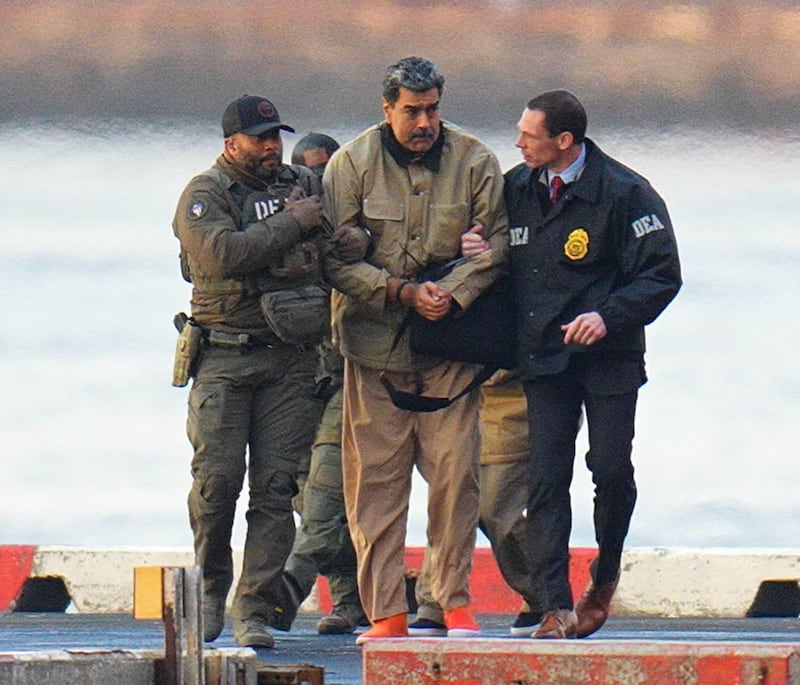
Richard Fontaine, foreign policy expert and CEO of the Center for a New American Security, recently penned an article in The Atlantic saying that the capture of Nicolás Maduro on Jan. 3 should make the world a better place and serve U.S. interests. However, it all depends on what happens next.
President Donald Trump said that “we will run the country” and Venezuela’s vice president, Delcy Rodríguez, has been sworn in as president.
On this episode of “Deseret Voices,” host McKay Coppins talks with Fontaine about what success or failure would look like and how this operation impacts America’s stance on Russia’s war with Ukraine and China’s interest in Taiwan.
Subscribe to “Deseret Voices” on YouTube, Apple Podcasts or Spotify.
Note: Transcript edited by Steven Watkins
McKay Coppins: Richard Fontaine, thank you for coming on “Deseret Voices.”
Richard Fontaine: Thank you for having me. It’s great to be here.
MC: So when Nicolás Maduro’s arrest was first announced last week, a lot of the reactions in the U.S. that I saw kind of revolved around Donald Trump, right? At least at first, the reactions were generally shaped by domestic political divisions and existing perceptions of Trump. And I do want to get to Trump in a minute, but the Venezuelans I know almost universally were celebrating Maduro’s fall, regardless of where they fell on the U.S. political spectrum.
So let’s start this conversation with the man who was, until a few days ago, leading Venezuela with an iron fist and who is now sitting in a New York City jail cell. What kind of leader was Maduro? And how was he viewed in his own country and around the world? How will his reign be remembered?
RF: Well, he was maybe in the broadest sense kind of a bad Hugo Chávez, which is not a compliment to say the least. He was a hard-left leader, but more importantly, he was a corrupt leader involved in drug trafficking and human trafficking.
He was a terrible manager of the economy and especially of the oil economy that really drove the Venezuelan economy into the ground. For many years they had horrible food shortages. They still are in very dire straits — repressive, you know — and stole the election in 2024, which most international observers agree he lost, only getting about a third of the vote.
Well, the opposition candidate got about two thirds of the vote and the opposition candidate Edmundo González is in exile in Maduro’s state. So that’s the kind of leader he was and it’s not hard, one to imagine the delight with which many Venezuelans greeted the news.
But the other thing is, 8 million Venezuelans are outside their country right now. That’s a fourth of the entire population and there’s a reason for that. So his departure from power is a good thing.
MC: One of the more surprising things about this move and something that even many of President Trump’s allies are having a harder time defending has to do with the question of who will run the country now that Maduro is gone, right?
When Trump was asked about this in his press conference this past weekend, he initially said, “we’ll run the country,” indicating his Cabinet officials standing with him, Marco Rubio, Pete Hegseth, et cetera. This was kind of interpreted as, like, a shocking demonstration of raw imperial power. Then you had Secretary Rubio backpedal from that position, saying the U.S. wouldn’t govern Venezuela itself, but would influence the country through an oil blockade.
But in effect, the U.S. — and tell me if you think this is wrong — the U.S. seems to have left in power the rest of the Maduro regime, right? So Trump is currently backing Delcy Rodríguez, Maduro’s vice president. The various strongman ministers who have aided Maduro’s reign over the last decade are still in power. And so it does almost seem like the Trump administration has removed the dictator while leaving in place the dictatorship.
And I want to ask you about that from both a strategic perspective and from the perspective of, kind of, American ideals, right? So first strategic, why do you think the Trump administration made this decision to leave in place Maduro’s regime? And what does America have to gain from that position, at least in the short term?
RF: I think there was both the lesson of previous regime change operations the United States had been involved in. We saw in places like Afghanistan and Iraq at least potential consequences of completely destroying a regime and its governing structure and trying to start with something completely new and a democracy and so forth. So I think that was part of it. There also reportedly was an intelligence community assessment that said that Delcy Rodríguez would be a more able sort of leader in the short term than Machado or González, who had less support. I don’t know how they came to that assessment, but reportedly that is the assessment they came to. I think third, there had been conversations with well, with Maduro too, but also with Delcy Rodríguez, who I think was seen as corrupt and part of the Maduro regime, but at least potentially a better manager than Maduro if she could be made to be compliant with U.S. demands on the policy side.
So I think if you put all of that together, those are the reasons why the focus was get Maduro out and leave the regime in place. And so thus far, it has amounted not to a regime change operation, but a change of head of state operation, which has, which certainly limits some of the risks that you have of trying to, you know, completely remove a bad regime. But on the other hand, you do have to ask yourself what you think can be accomplished through that and what this ultimately means for the Venezuelan people. And those, you know, I think that all remains to be seen.
MC: Right, I mean, when you look at the reaction from Venezuelans, especially outside of the country, those who have kind of fled the country or living in exile, a lot of them would describe the last several days of developments as kind of a roller-coaster ride, right? The celebration of Maduro’s fall followed by news that, oh wait, his regime is still remaining in place and what does that actually mean for the people there? We have not seen, you know, calls for the release of political prisoners or journalists. We have not seen a lot of pressure from the Trump administration on this new regime to kind of make right a lot of the human rights abuses that defined the Maduro regime’s reign.
And so I guess that brings us to the kind of more idealistic question, right? There is, of course, some precedent in Latin America over the last century or so of the U.S. overthrowing leaders it doesn’t like and replacing them with strong men and military juntas who align with U.S. interests. But even in those cases in the ’60s, ’70s, ’80s, in the 20th century where there was a pro-democracy rationale for the moves, the regimes the U.S. was helping to overthrow were Soviet-allied communists. And the argument was basically that these moves were made in service to the global cause of democracy.
And you really don’t see any kind of pro-democracy rationale coming from the Trump administration right now, at least initially. President Trump is not speaking in the language of liberty, right? He’s talking a lot about oil and he’s currently backing the corrupt regime for reasons that may be sound as you just mentioned, but that are not particularly idealistic. And I wonder if you think it’s naive to object to this on idealistic grounds, right? Shouldn’t America be supporting the legitimately elected pro-democracy leaders that the Maduro regime disenfranchised? Shouldn’t the U.S. be calling for the release of all political prisoners and journalists? You know, why are we not seeing that? And do you think it’s, you know, kind of quaint to be worrying about optics like that?
RF: It’s not quaint and I don’t think it’s just optics. I think this is really the substance of what the U.S. policy toward Venezuela should involve itself with. The things that a country does are important and the reasons it does it are also important and the objectives it has for that thing that it did is important. And so if you look, as you alluded to, at President Trump’s long press conference announcing the Maduro operation, the word democracy did not appear once. He didn’t say it once. Now he said oil over and over and over again. But it should not be the objective of U.S. policy to take another country’s oil and I don’t know, what, sell it and sort of keep the revenue for ourselves? I mean, that’s not what the United States should be in the business of doing. If we want to have a policy that’s rooted both in our interests and in our values, and, frankly, that is sustainable for the Venezuelan people, then yes, it should be focused on putting in place a politically legitimate government, which means a transition to democracy.
Now Edmundo González can’t take over the government tomorrow, so you know, working through existing structures for some period of time does have a certain pragmatic sense to it. But the United States should make clear, as we did before, that there was a recognized winner of the 2024 election. And we ultimately want to see a transition from the current instantiation to a government that is responsive to the democratic wishes of the Venezuelan people.
Now that is what we should try to do, but it also puts pressure on another set of objectives that the administration seems to have, which is to actually get satisfaction from working through the existing government, because what one has to do then is tell Delcy Rodríguez and the secretary and the minister of defense and all of these other people in charge, work with us, do what we want, but you’re not gonna be around maybe even by the end of 2026. You’ve got to give up power in order to allow a democratically elected government to take root. And by the way, all of the benefits and protections that go along with being in power, those may go away too. And that’s not necessarily an easy task. I mean, we’ve been through this before.
MC: There’s been a line of criticism in the last few days that’s emerged that essentially argues that, you know, by violating Venezuelan sovereignty to capture the president through this, you know, pretty bold military operation, America has undermined its credibility in dealing with Russia’s invasion of Ukraine or China’s threats against Taiwan. What do you say to that line of criticism? Are you persuaded by that?
RF: I think as an argument, it certainly has resonance and we will see many countries making the argument that how would we possibly have standing to object to Russia going after Zelenskyy or going after Ukraine or China going after Taiwan after what we did in Venezuela? I don’t think that actually — so that’s a set of arguments and you will hear that — but I think it’s largely a rhetorical set of arguments as opposed to something that genuinely changes the calculation of Beijing and Moscow. I saw in the immediate aftermath some commentators said, well, you how would we feel if Moscow went in and just tried to kill or kidnap Zelenskyy? Well, guess what? They already did that way before the Maduro operation. So they didn’t need some sort of American excuse to hide behind.
With China, their decision about whether to take military action against Taiwan is gonna be driven by a number of factors, including their reading of the politics in Taiwan, their degree of international support, and the efficacy of what they believe their military operation might look like. I think it’s very, very hard to imagine China saying, well, we wouldn’t have invaded Taiwan, but after the Maduro operation, it now looks like a really good idea, and so we’ll go ahead and do it. And so I think it’s not nothing. I mean, it is a set of arguments, but I think it’s largely more about the third countries that are sort of looking at, they want to accuse double standards and hypocrisy, and you don’t have the standing to criticize this. But even with that, I mean, you know, and the legality of all this is obviously going to be very highly contested, already is. But again, the reasons why we do things have a lot to do with whether they’re right or wrong or whether they’re legitimate or not. And, you know, to enforce an indictment and to arrest an individual who was not recognized by the United States or other countries as the legitimate leader of Venezuela because González had been recognized, seems to me quite different than if we decapitated the Venezuelan government because we want to take their oil.
MC: Well, right. I know this is always kind of a dangerous game to play, but I’m going to ask you to try to get inside the mind of President Trump and the minds of his Cabinet and his advisers. You, of course, advised a president, President George W. Bush. You’ve been around Washington for a while. You know how some of these decisions are made. To your best guess, what is motivating these actions? What did motivate this decision to go in and take Maduro? I think we’ve established it probably wasn’t the cause of Venezuelan democracy, at least for President Trump. That doesn’t seem like something he especially cares about. He’s not talking about it. He’s not used it as a stated rationale. Maybe there are people in his administration who do care about that more. But what is the goal here? What is President Trump trying to accomplish?
RF: I think there’s two different things. One’s the motivation for going in and the other is the goal, right? And the motivation for going in, I think, was a perfect storm of factors, both probably in the minds of the president, but also among his advisers or some of his advisers who cared about Maduro’s rule because they would like to send lots of the Venezuelan migrants into the United States home. OK, well, that’s an argument for having a more compliant government in Venezuela will allow you to do that. There’s others who cared a lot about the drug situation that points in the same direction. I think someone like the Secretary of State, Marco Rubio, has shown over the years that he does actually care a lot about the democracy issues in Venezuela. That pointed in the same direction. This was a head of state who had not only been indicted in the United States, you know, sort of declared the non-legitimate leader of Venezuela, but also it sort of brazenly defied the United States. I mean, when, you know, Trump was trying to persuade him to give up power and he records videos dancing and, you know, and all this other kind of stuff. Now that’s probably not the thing that’s persuasive to a lot of Cabinet officers, but for a particular president I have in mind, that probably is galling enough to get you to do something. And so I think all those factors kind of come together. I mean, in a way, it’s a little reminiscent of, you know, what everybody, you know, after 2003, why did we invade Iraq? Was it the oil? Was it the democracy? Was it the human rights? Was it the weapons of mass destruction? Well, it depended on what people in the Bush administration kind of cared about the most. If you thought that establishing a democracy in the heart of the Middle East might spread democracy, everywhere else, well then you wanted to do this. And if you thought the weapons of mass destruction were probably there and were so dangerous, couldn’t live in a world without it, then you probably wanted to do that. If you thought that after 9/11 we had to have a show of strength somewhere and show that you couldn’t defy the United States, well, you know. And so was different factors and they all kind of came together in Iraq and here I think they came together with respect to the Maduro operation.
MC: I think that’s right. I think actually this is true of almost every major decision made by a president or politician. It’s always a confluence of factors and it’s very rarely one single factor. But what I think is interesting about this is that when it comes to President Trump, you know, he is somebody who kind of rode into power on a wave of populist rejection of American interventions abroad, right? In 2016, he ran quite explicitly against the kind of interventions that defined recent administrations. He was viciously critical of the Bush administration for its interventions in the Middle East and nation-building efforts in Iraq and Afghanistan. The whole America first foreign policy idea was kind of built around this notion that America needed to spend less time worrying about other countries’ problems, right? Now in the wake of this operation in Venezuela, you have Trump saber-rattling about regime change in Cuba and Colombia. He’s saying something has to be done about Mexico, whatever that means. His allies are talking about seizing Greenland. So what is going on here? Have we reached Trump’s kind of inevitable evolution toward hawkishness, or is this maybe more strategic rhetoric intended as leverage over these other countries?
RF: I think there’s two things going on. One, I think the initial takes on Trump as maybe an isolationist or really against intervention were misguided. It turns out that he’s not against military intervention. He is against the kind of military intervention that we did in Iraq and Afghanistan, these sort of long-ended, very expensive, difficult, on the ground sorts of operations. But it’s not just Venezuela, of course. He attacked the nuclear sites in Iran. That was a military intervention. He’s now saying that he will protect the people, the protesters in Iran. We had a military operation to attack sites in Nigeria after the killing of Christians in Nigeria. That was a military intervention. And so, just in the past 11 months, this sort of, I don’t intervene president has launched military attacks in like eight countries, right? About as many, guess, as supposedly the peace deals that he’s created. So he’s sort of, I guess maybe the ledger is sort of even from that sense. So I think it’s a particular kind of military intervention that he’s trying to avoid. And this is going to, again, in Venezuela, potentially rub up against the overall objective, because how do you run a country if you’re not there? How do you run a country if you’re obviously not willing to really use military force of long run and don’t have a sustained presence on the ground? That remains to be seen, whether that’s possible. I think that is, I think that’s part of it. The other thing, and you know, this is speculative for sure, but again, I look back a little bit to the Iraq experience, well really the Afghanistan experience after 2001. When presidents engage in successful military operations, they tend to feel emboldened and it tends to have a certain momentum. We would not have done Iraq in 2003 if Afghanistan in 2001 had not gone really, really well. Now it turned out it wasn’t gonna go well forever, but it did at the beginning. At the beginning of Iraq, it’s hard to remember, but Baghdad fell in three weeks. And suddenly that looked like it was going really well. And what did the Bush administration do? The first thing it did was start threatening Syria publicly and then saying, well, know, you guys may be next if you’re not on your best behavior. And then a few people started hinting, well, Tehran’s not that far away, and things like that, right? Well, of course, once Iraq went south, we weren’t gonna do anything in Syria and Iran and all these other kind of things. So success and failure both have kind of a momentum on one’s willingness, especially a president’s willingness to do more of this. Maduro went, that operation was so brilliant. 1989, it took 28,000 U.S. troops, weeks and weeks to get Manuel Noriega out of Panama. It took the American Special Forces two hours and 20 minutes to get Maduro out of Venezuela. What was the response? President Trump says, well, I mean, look at that. There’s lots of other problems around the world. And so these guys better be careful too, because we could do Colombia, we could do the Panama Canal, we could do Cuba, we could do Greenland, I don’t know.
In that sense, how Venezuela goes will affect the calculations on all those other things, even things that seem totally unrelated. I mean, if, God forbid, Venezuela collapses into itself and becomes a quagmire in a civil war and all this other kind of stuff, you’re not going to hear nearly as much talk about how great it would be to go toppling governments in other places.
“That operation was so brilliant. In 1989, it took 28,000 U.S. troops, weeks and weeks to get Manuel Noriega out of Panama. It took the American Special Forces two hours and 20 minutes to get Maduro out of Venezuela.”
— Richard Fontaine, CEO of Center for New American Security
MC: So we’re in this strange era where you can apparently now place bets on, you know, various geopolitical outcomes. In fact, we saw reporting that somebody created a, I think it was a polymarket account and made quite a lot of money on a bet that Maduro would be gone by a certain date, which suggested some inside information. But if you were a betting man, and if you were placing bets on these things, I’m sure you wouldn’t, Richard. But if you were, would you bet on U.S. boots on the ground in Caracas, you know, within the next month?
RF: I would not.
MC: Why not?
RF: Because I think the antipathy toward doing that would be really strong. I mean, Trump obviously doesn’t even want to do the so-called second attack that had been planned, if necessary, on Venezuela, which they haven’t specified what that would have been or what it would have accomplished. But I presume it would have been another tailored kind of attack that would not have resulted in some sort of permanent U.S. presence. And so if what you’re asking about is, you know, are we going to kind of have the indefinite deployment of American troops in Venezuela in order to, I don’t know, occupy the country, stabilize the country, run the country? I think the answer is no. One, because we would need to do that. The numbers of troops that would, you know, we would have to deploy a lot of troops down there in order to do it.
And two, I think frankly, unless the situation gets wildly out of control, I think that the administration would prefer to stay out and let it sort of fester than to try to run some sort of American style, you know, coalition provisional authority Caracas kind of operation.
MC: OK, well one more betting question then. Would you bet on a similarly audacious operation in Cuba or Colombia or one of these other countries mentioned?
RF: That is a harder question. I don’t know. Well, I wouldn’t bet on it, but I wouldn’t exclude it. So there’s some non-zero chance that Venezuela, at least over the short to medium term, turns out to be a relatively happy story and that the president who did the unthinkable in Venezuela wishes to do the unthinkable in Cuba and in Colombia or Cuba or Colombia. The one thing I would just say about the Cubans is we’re already hearing in addition to the, you know, kind of some of the belligerent talk about Cuba, this notion that, well, that they’re on their last legs, they’re about to collapse and, you know, this can’t stand forever. And when they lose their patron and all that stuff, the only thing I’d point out there is the first president who said that was Dwight Eisenhower in 1959. And every president has more or less said something like that. You know, this is an anachronistic, leftist, repressive communist government. When it loses its Soviet patron, when it loses its whatever patron, you know, it can’t survive. These guys have survived in place for a long time. It’s not a good thing. It’s a bad thing. But there’s a certain resilience to some of these governments, just as there was with Hugo Chávez and Maduro. I mean, there’s a reason why it took, you know, the U.S. military to get them out of there even though a fourth of the population had departed the country because they didn’t like it.
MC: You have in recent days weighed in on the growing calls from many on the MAGA right to simply seize Greenland, right? This is a line of discourse that I think a lot of people sort of dismissed as fanciful and absurd and has come to be treated more and more seriously in Washington circles, at least the people I talk to in President Trump’s orbit talk about it quite seriously. And so from your perspective, how seriously should we be taking the prospect of the U.S. actually, I mean, it sounds absurd to say, invading and conquering Greenland?
RF: Unfortunately, I think you have to take it seriously now. I still think it’s extraordinarily unlikely, but you can’t rule it out. It’s just so ridiculous that it would never happen. If for no other reason, then the commander in chief keeps talking about it. And, know, in this administration that he has, unlike the first administration, when he would say something like, really need Greenland and, you know, they better watch out. He would have usually Cabinet officers and advisers say, well, you know, what the president meant is we should have a good relationship with Denmark, which, you know, I mean, they would sort of qualify it, walk it back here. Most of the advisers go out and double down on it because, you know, they say, well, of course we’ve always needed Greenland. Only weak presidents before have not been able to deliver it or whatever the arguments they have to come up with. But there are no good arguments for the United States’ seizing Greenland. And there’s a lot of very bad arguments for it. I mean, they’re very good arguments against doing it, but that’s not enough to say it won’t happen.
MC: Well, can you just run through the best argument for not doing it quickly? I mean, why shouldn’t? Play devil’s advocate here. President Trump says the U.S. needs Greenland for national security purposes to counter Russia, etc. What’s the counterpoint?
RF: There’s a, in 1951, the U.S. and Denmark secured a Greenland Defense Agreement, so-called, which was then updated again in 2004 to include the government of Greenland itself. Under that agreement, the United States can do effectively anything it wants or thinks it needs to do with respect to national security in Greenland today without taking anything. So the United States at one point had 10,000 troops in Greenland. We’re very worried apparently now about Greenland and it could be, I don’t know, overrun by the Russians or the Chinese. We now have about 200 troops in Greenland. So one would think if we are so concerned about national security in Greenland that we’re prepared to invade the island, let’s go to 400, I don’t know. I mean, we’ve got a long way to go before we’re anywhere close to what we used to have. If you wanna build a new American base somewhere in Greenland, you don’t even need the consent of the Danish government. You just need to inform the Danish government. Another claim is that there are Russian and Chinese ships that have now surrounded Greenland. I don’t think that that’s accurate, but let’s say for the sake of argument it is. The U.S. Navy could dispatch and sail around Greenland all day long, tonight, indefinitely. So it doesn’t give the U.S. any advantage in terms of national security to have Greenland as opposed to its current status. And in a way, I mean, if you really were just really trying to kind of add things up, the pluses and the minuses, if we bought Greenland, then we would pay for something we’re getting for free, which is base access and all of that. And also, the Danes provide about $600 million a year to Greenland and sort of subsidies and things like that. I mean, there are no advantages and there would be costs. That’s about a pretty clear reason not to do something, generally speaking.
MC: OK, back to Venezuela, just to wrap up the conversation. You wrote a piece for The Atlantic, where I work, in which you said, “The world should be better off after Maduro’s departure. Whether the world will be better off, however, depends on what happens next.” Tell us, in these last few minutes, what will you be looking for in the coming weeks and months? Ripple effects, unintended consequences, what should we be paying attention to?
RF: Yeah, I think there’s a couple of near-term indicators that will suggest whether the objectives of this are successful. Immediately the president has said that 30 to 50 million barrels of oil are going to go from Venezuela to the United States. The United States is going to sell all those into the international market. And then depending on who’s talking about it, those revenues will be used for the good of Venezuela and or the good of the American people. Well, there’s tankers steaming their way to Venezuela right now to pick up that oil. Is it gonna happen? If it does, then that’s an indication that the Delcy Rodríguez government is willing to work with the United States on sort of things. The harder and the more important things are, you know, the U.S. wants the regime to kick out the Iranians, the Cuban intelligence, stop cooperating with the Russians and the Chinese. We will know very soon whether they do that or not. And so that will be a test. They haven’t called for things like the release of political prisoners, but they should, and that should be another near-term test. And then on the drug side, this is a regime that engages in narcotrafficking. Are they going to stop or not? So those are the things that I would look for in the near term. And then over the longer term, you know, sort of the rest of 2026, are we going to actually see some kind of transition to a democratic government? Are we going to see either the scheduling of free and fair elections, or are you going to see a negotiation by which the current regime either cedes power or to or shares power with the government that was the president was elected in 2024. I mean that we should know within a matter of months. And if the answer to all those things both in the short run and the long run is no, well that’s a big failure. If the answer is yes, then it would be certainly better for the United States and better for the Venezuelan people. So that would be the test.
MC: We’ll have lots more to talk about. Hopefully we can have you back on. Richard, thank you for coming on “Deseret Voices.”
RF: Pleasure to be here. Thank you.