



Following the shooting of Renee Good in Minneapolis on Jan. 7, The Atlantic’s Caitlin Dickerson had officers walk her through the video evidence.
Dickerson says the officers she spoke with questioned the tactics that were employed and pointed out the instructions immigration agents are given in the ICE manual.
On this episode of “Deseret Voices,” Dickerson joins colleague McKay Coppins to talk about the immigration debate in America and the way the Trump administration is policing the issue.
Subscribe to “Deseret Voices” on YouTube, Apple Podcasts or Spotify.
Note: Transcript edited by Steven Watkins
McKay Coppins: Caitlin Dickerson, thank you for coming on “Deseret Voices.”
Caitlin Dickerson: Thanks for having me, McKay.
MC: So Caitlin, you and I work together at The Atlantic, where you cover immigration and something that I have always really appreciated about your reporting on this very complicated subject is that you talk to everyone, right? You have sources in the Trump administration, you have sources in the Biden administration, you talk to advocates and lawyers who are focused on immigrants’ rights, you talk to current and former law enforcement and, of course, you’ve talked to many, many immigrants themselves over the years. And, you know, we are obviously in a very volatile moment as a country over immigration right now. And I think that a lot of our understanding of what’s coming out of Minneapolis, for example, where we’ve had two U.S. citizens shot to death, we have protesters clashing with law enforcement in the streets and growing civil unrest is that a lot of our understanding of it is kind of shaped by these short viral videos, right, that are circulating on social media. And I think it’s really natural to have an emotional response to those videos wherever you come down on the immigration issue.
But I think what I’d like to do with you here, since you’ve spent so much time reporting on these issues with a lot of nuance and complexity, I want to talk about where we are and how we got here from the perspective of three different groups of stakeholders, right? The politicians in the Trump administration who are shaping the immigration policies, the ICE and Border Patrol who are enforcing those policies on the ground, and then the immigrants themselves who are most directly affected by the policies. So why don’t we start with the White House, if that’s OK?
From your understanding, at the most basic level, what is the Trump administration trying to accomplish with its immigration policy in the second term?
CD: I actually think what the Trump administration is trying to do first and foremost in some ways is unrelated to immigration. And that’s because in my years of reporting on Trump and the people closest to him, it’s really become clear immigration is not his personal passion project. It’s not what the president inherently cares about most. But he’s latched onto this issue of immigration ever since his campaign for president in 2015 and 2016, when his speeches were being written by this young man who very few people knew by name, Stephen Miller. Stephen Miller had a background in the kind of fringe far right of anti-immigration politics. And so he infused his personal views into Trump’s speeches and what Trump responded to was the enthusiastic reaction of the crowds. I mean, he could tell right away that playing into a kind of nativist narrative, as well as one that painted immigrants as the scapegoat, really, for all of our societal issues, was really working. And so he took it and ran with it and really embraced it for that reason.
And so I think that’s why Trump has remained as impassioned as he has on the subject of immigration while also saying things that really confuse people at times. Certainly recently he’s softened his language around these deadly incidents in Minneapolis. But even before that, he did a recent interview with The New York Times where he talked about having sympathy for dreamers, people brought to the United States as children without authorization. He’s talked about wanting to create reprieves for farm workers in the past, things that just completely fly in the face of his stated platform on the issue. And so that’s why I think his record and his goals are a little bit more complicated than they seem on the surface.
MC: From what your reporting has revealed, is this immigration policy focused primarily on deporting violent criminals, deporting all undocumented immigrants, or is it the case that members of this administration just want fewer immigrants in general in the U.S., regardless of status?
CD: No. 3. And the reason I say that is because even though Trump at times talked in more narrow ways on the campaign trail about focusing on violent criminals, when you look at the numbers of people who’ve been arrested, the vast majority of them have no interaction with the criminal justice system at all whatsoever. And it was always the case that Trump was never going to be able to follow through on his promise of deporting millions of people and focusing on people with violent criminal records. There just aren’t that many people who fit that description to be deported in the first place. And I think that the administration has only become more focused on numbers, just getting high numbers, as high as they possibly can, and often inflating the numbers of deportations that they’ve achieved or self-deportations that they’ve achieved to try to present this issue as one that they’ve been successful on.
The reason I said category three and not two is because in addition to going after people who don’t have legal status, they’ve really worked to claw legal status back from people who had it and started describing those people as illegal or just using vaguely incriminating language against them. The first category is those million and a half people who entered the United States legally under the Biden administration went online and applied to enter the United States, attended an interview, were vetted and then were allowed in. Trump described them as illegal, inaccurately from the very beginning, and then took their status away and moved to deport them. And now the administration is actually moving to denaturalize U.S. citizens. This is something that’s mostly they’ve mostly talked about at this point because denaturalization is really difficult. They’ve certainly said it’s a goal and they’ve reopened the cases of refugees and even detained some refugees, which is unprecedented. And I just find fascinating because I’ve reported on the process that people go through to be resettled as refugees. It’s extensive. It can take years. It involves multiple government agencies and just an incredible amount of vetting. So to then arrest those people who are clearly here legally, I think, suggests that this isn’t just about unauthorized immigrants. It’s about a much larger group and has more to do perhaps with the people’s country of origin, their race, their nationality, than it does their status.

MC: You know, when you talk to Republican allies of this administration, even those who are maybe a little uncomfortable with how far things have gone in immigration enforcement, they will say, look, this president ran on this issue. He promised mass deportations and he got elected. It’s what the American people wanted. Elections have consequences, right? We’ve heard all of these kind of talking points. And I will say, I remember being at the Republican National Convention in Milwaukee in 2024. I remember the signs being passed around to the delegates that said mass deportations. I mean, this was a centerpiece of his campaign.
Is anything that the administration is doing now different from what he talked about on the campaign trail? Has his approach shifted meaningfully from the rhetoric that he used when he was running for office?
CD: So I think what happened is that when Trump was running for president, he said anything and everything that different types of voters needed to hear to justify their vote, whether it was a vote that was primarily cast based on immigration or if you’re talking about people who supported Trump based on other policy issues and they just needed to make sure that they could stomach whatever immigration enforcement he was going to pursue. So I hear people very frequently saying to me, and this actually includes lots of immigrants who I reported on leading up to the 2020 election who supported Trump. They’re saying now, “He said he was going to focus on violent criminals. I never thought that would have included me.”
But he also said on the campaign trail, as did Tom Homan, Trump’s border czar, Stephen Miller, of course has been consistent about this that anyone without legal status should consider themselves vulnerable. I think that there is another really important reason for the kind of disconnect between the fact that Trump indeed centered immigration when he was running for president and now this public opinion that seems to be turning against what the enforcement operation actually looks like. And this is a kind of longstanding contradiction that I’ve thought a lot about. I think it has to do with the fact that the public generally struggles to understand the way that our immigration system works. And I think that politicians, frankly, on both sides can play into the gaps in knowledge that exist.
So to give you a sense of what I mean, if you look at polling, you ask Americans, “If people came to the United States illegally, should they be deported?” Most people will say yes. But then if you say, “If someone’s been in the United States legally for 10 years and they’ve never committed a crime, should they be able to stay?” and most Americans will say yes. Or you ask them, “If someone’s been in the United States and has adult United States citizen children who they raised here, should they be able to stay?” People will say yes. You can ask, “If an immigrant has committed a crime, should they be deported?” Most people will say yes. But then if you ask them, OK, if an immigrant has committed a crime in the United States, but they paid their dues to society and they haven’t committed another crime in five years or 10 years, then people will start to say no, that they shouldn’t be deported. So there’s a lot of inherent contradictions in our views. And I really do think that they come down to the fact that people don’t realize — and I’m actually getting emails about this every day right now that are quite stunning to me because I spend so much time looking so closely at our laws.
It’s a shock to a lot of Americans that there is no legal pathway to come to the United States to do most of the work that we rely on our undocumented population to do. Farm work, landscaping, house cleaning, any kind of domestic labor, hospitality, tourism, there’s no visa for these jobs. And so the only way to do it is to do it illegally. And these are jobs that American employers court people to come to the United States to do. And the other thing that I think people are realizing now for the first time is that once you’re here and you’re established in the United States as an undocumented person, there’s almost no legal way for you to convert your status, for you to ultimately gain citizenship. I think that’s a big surprise to people, and that’s why so many are feeling uncomfortable with this campaign they voted for, because I think they inherently assumed that if someone was eligible for deportation, that it was because they had not only come to the U.S. without authorization, but also done other terrible violent things when that’s just not the case.
MC: You know, one thing I’ve learned from your reporting is just the massive scale of money that is flowing toward this agency in this second administration. Tell me a little about how much the budget has increased in the past year and where that money is going.
CD: So with the One Big Beautiful Bill Act that President Trump ushered through Congress last year, more than $170 billion were dedicated to immigration enforcement. And for context, that’s a number that’s higher than the military budgets of every country in the world, except for the United States and China. So just a completely staggering figure. You know, it’s more than every other federal law enforcement agency spends combined. Prior to that bill being passed, DHS and all of its components, you know, not just ICE, but also the Secret Service and the FBI, they were together the highest funded law enforcement agency in the country. Gone are those days. Now ICE on its own is by far the highest funding law enforcement agency in the country, and it’s just one portion of the overall department. So ICE’s budget has more than tripled. They’re working with about $28 billion a year, and $45 billion have been dedicated to expanding immigration detention centers.
There are yet more pockets of money for ICE’s technology, gear, weapons, for reimbursing local governments who agree to work with ICE to make deportations happen more quickly and to get more of them done. So the other thing to note about this money is just how limited the language is around requirements, right? So appropriators, they don’t just hand out money, they explain very clearly what that money is intended to be used for. And in appropriations bills, they will often require things like oversight, like training, like vetting, you know, policies to limit use of force, etc. You see none of that in the One Big Beautiful Bill Act. For as much money as it distributes, it’s amazing how few limitations there are. There are really almost none. I think the one limitation I noted is that there was a cap on the number of immigration judges that could be hired, which is sort of confusing because the administration wants to deport as many people as possible, but they’re also pursuing deportations in a way that is extra legal, trying to get around the immigration courts to make them happen more quickly.

MC: So with all of this money flowing into ICE, the agency has obviously hired quite a few new agents. What percentage of ICE officers have joined in the past year?
CD: More than half. So at the end of the Biden administration, I think we had about 7,000 deportation officers working in the United States and the Trump administration says they’ve since hired 12,000 more. So that gives you a sense of just how many people are new. Some of those folks are gonna be retired ICE officers who came back because they were offered significant signing bonuses up to $50,000. I think those officers are allowed to continue accepting their government pensions and being paid for work for ICE again, so it’s a really good deal, but most people are new and they’re getting less than half the amount of training that they did in the past. The Border Patrol and ICE training has now been limited to, I think it’s 47 days, and in that amount of time someone is supposed to learn the immigration law, constitutional law, and just how to be a law enforcement officer in general. How to use a weapon, how to interact with the public. It’s a lot of information and less time than even a local police department would spend on training. So I think there’s a real disconnect when it comes to how ICE feels about these changes and feels about this administration between kind of the old guard at ICE, which I’m hearing is very, very skeptical. I can’t tell you how many ICE officials, a few who remain at the agency, but most of whom have retired very recently and are deeply troubled by the lack of professionalism that they’re seeing in the streets and just the abandonment of all the training that was drilled into them when they started out at the agency.
And then you have this really enthusiastic new guard of officers who we really don’t know. You know, and I think that what we know about the limited vetting that is taking place suggests that even the Trump administration doesn’t necessarily know very much about these people.
MC: Let’s talk about the types of people who are joining ICE. I think intuitively, given that immigration was a centerpiece of this president’s platform, given how politicized the issue always is, frankly, but especially has become in recent years, it would stand to reason that a certain portion of new ICE recruits are going to be motivated by kind of a political ideological agenda. And that that could kind of complicate the professional standards and the tendency toward de-escalation that has traditionally been central to the training that ICE officers get.
Am I speculating too much there, or is there evidence that at least some portion of the new recruits are basically Trump supporters who are really on board with this hyper aggressive approach to immigration enforcement?
CD: I think you’re spot on for a couple of reasons. One is that working at ICE has always been controversial. As long as I’ve covered ICE, I’ve heard from ICE officers, and it doesn’t matter who’s president, if it’s a Republican or a Democrat, they often don’t tell their friends and neighbors what they do for a living. Because even in a really conservative kind of pro-enforcement part of the country, it’s just a different proposition when you realize that your friend is the one who’s responsible for deporting your employee, your friend from church, your kid’s best friend’s parent. It’s very tense and fraught.
So for that reason, ICE agents tend to keep their work really close to the chest. And ICE has also struggled with attrition over the years because people don’t think that it’s worth it. If they can get out and move over to another federal law enforcement job or another government job where they get the same benefits and they don’t have to deal with the blowback, they do. And so that was the situation going into this administration. And you can only imagine how much more controversial this work is now. The administration has talked about fears of ICE agents being doxed. I think that language is kind of intentionally misleading, right? When people are asking for law enforcement to identify themselves, it’s not for the purposes of doxing, it’s for the purposes of accountability. But I think they are right that the public is really upset with ICE right now. And so it takes somebody who’s willing to accept that backlash to sign up for this job in the first place. And the other reason why I think you probably have a good number of people who are ideologically driven in these roles now is because from everything that I’ve heard, that is part of the standard day-to-day conversation within ICE now is the political goals that they have. You know, every field office in the country is under pressure, has been given intense pressure to hit very high quotas that are almost impossible to make, to be as aggressive as possible in carrying out this law enforcement mission. And it’s been made really clear to the boots on the ground, if you will, that there is no room for skeptics, that people who hesitate, people who ask too many questions or who are unsure are going to be dismissed or they’re not going to be invited in the first place. So that’s why I think those are safe assumptions to make.
MC: When you talk to retired ICE officers, what do they say about some of these now infamous altercations, confrontations that have captured the national attention. For example, with the shooting of Renee Good, what do retired ICE officers say about that interaction and how it aligns with the training that they received when they were working?
CD: These officers — and I’m talking about people who’ve spent 20-plus years in immigration and enforcement, even before ICE was created and they worked for the INS in some cases — they’re completely flabbergasted by these incidents. From the very beginning, I’ve heard questions raised about why ICE is out in the streets stopping people at random anyway. They’re in Minneapolis supposedly pursuing people who’ve been part of a fraud scheme, which is a white-collar crime that you research on the computer and then you go out and target people personally. These officers have also told me that the way that they were always trained to work was to make arrests happen as quickly and quietly as possible for the purposes of public safety. So, again, you’d have lots of work done in advance before you even go out to arrest somebody to confirm their identity. Make sure that they don’t have any claims for legal status or citizenship that you’re not aware of because it can get complicated when someone spent a long time in the United States, they might have a claim and even one that they don’t know about, know, figuring out where this person lives, when they leave for work. What’s a safe time that you can expect to encounter them and hopefully make an arrest if you’re an ICE officer? That’s how they did their work previously. And so they really are struggling to wrap their minds around why officers are in the streets stopping people.
But then too, when it comes to the interactions, like with Renee Good, I had officers walk me through the video that we all saw. And from the very beginning, they said, you know, why would somebody run up to this woman’s car and start yelling expletives at her and try to force open her door? That’s a surefire way to get somebody to panic and for them to have the wrong reaction, you know, one that’s not safe and she’s behind the wheel of a car. Then on top of that, they pointed out that Jonathan Ross, the officer who shot Good, was standing in a position that any law enforcement agent in the country knows you shouldn’t be standing, you shouldn’t stand in front of a car that’s turned on and that can easily become dangerous.
And then lastly, they pointed to the ICE use of force manual, which clearly states that you should not use deadly force just to disable a vehicle, that you should not put yourself in harm’s way or in a position that makes deadly force the only reasonable option. There are two or three other lines that address what happened specifically in the policy manual that really just make very clear that Jonathan Ross, rather, seems to have been in violation several times over.

MC: Sen. Jon Ossoff, a Democrat, had his office conduct basically a probe collecting reports of alleged human rights abuses in ICE detention facilities and found some pretty alarming things. First of all, 32 people died in ICE custody last year. That’s more than any year in the past two decades. The probe found pregnant women sleeping on the ground, being refused medical attention, allegations of sexual assault by staff and guards, widespread overcrowding. And then of course there are some anecdotes that have made it into the news. An 11-year-old U.S. citizen girl recovering from a brain tumor was denied medical care and allegedly kept in deplorable conditions. A 4-year-old U.S. citizen boy with Stage 4 cancer who was removed to Honduras without access to his medicine when immigration authorities deported his mother. Department of Homeland Security has denied any reports of inhumane conditions.
But here’s my question. President Trump, you know, tripled the budget for ICE. How much of that money is going toward oversight and, and you know, efforts to curtail these kinds of abuses or at least investigate them.
CD: The One Big Beautiful Bill Act that’s funding ICE currently did not dedicate any money toward detention oversight specifically. There are some offices within ICE that have done that work in a long-standing way and should continue to, but at the same time that the administration increased funding for ICE and for detention, they actually not just didn’t add to oversight, but they cut back on oversight. So for example, within DHS, there was an Office for Civil Rights and Civil Liberties. That was an office you could contact if you were detained in ICE custody and make a complaint about some of these very issues that you’re describing. There was also, separate from that, a detention ombudsman that the Trump administration also cut significantly in the last year. So, you know, I want to point out, having looked at immigration detention facilities for years, there are longstanding health and safety issues. These are facilities that are really difficult to maintain. A lot of times they’re privately run and the way that you save money and maximize profits as a private company is you spend less. So you spend less on things like health and safety and there’s that constant tension there when you have this massive detained population that has more than doubled during the current administration.
So it’s always difficult work and I think that’s why you had all of these layers that existed, especially after the family separations in the Trump administration, there was this real effort to try to facilitate direct communication from headquarters in D.C. to people inside of detention centers so that they could immediately flag an urgent issue. You know, people who in the past whose complaints might have fallen on deaf ears if they were just reporting them to correctional officers on the ground in the facility. Those offices have been gutted and so a lot of times there’s no phone number to call at this point and I think it’s no surprise that you’re seeing these health and safety issues grow as a result of that. And I think it’s also sort of an inevitable result of a detained population growing this much and this quickly. I mean, we don’t have the infrastructure to detain this many people safely because a year ago we weren’t even trying.
MC: In these last few minutes, I want to shift to the perspective of immigrants in the United States. You have spent a lot of time talking to immigrants in your time as a reporter. You wrote the definitive story about the family separation policy for The Atlantic.
Tell me what this moment feels like from the perspective of immigrant families in the U.S. What are you hearing from the sources and subjects that you talk to?
CD: I think it’s of course a profoundly disheartening moment and a really scary moment, not just for people who have no legal status or whose relatives have no legal status, but even for people who are green card holders, who are naturalized citizens and have been in the United States for a long time. Coast to coast, frankly, I’ve heard people describe to me carrying around documentation with them on a daily basis. Children monitoring their parents’ location all day using the Find My app on their iPhone to make sure that they haven’t been arrested by ICE. You know, it’s this overwhelming fear that hangs over people. There’s lots of research actually that’s been done on how this fear of detention and deportation impacts even people who haven’t come into the enforcement dragnet yet, but they just fear it. I mean, real evidence that suggests that it affects the healthy development of a child, that it can impact things like your blood pressure, you know, create other health problems. And of course mental health issues.
These are things that have come out of studies based on communities that experienced a significant raid, for example, a discrete incident. The whole country is in that scenario now. And so you think about just the profoundness of the impact. I think it’s so large that it’s hard to really put words to right now.
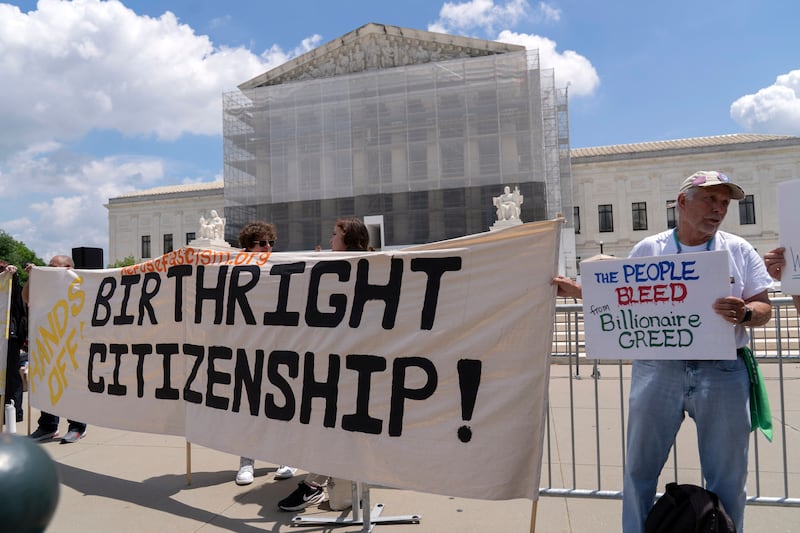
MC: You know, when I talk to conservatives, immigration hawks, they will often say, “Look, I feel for those people. I get it. It’s scary. It’s hard. But if you came to this country illegally, you shouldn’t be here, right? You should just go home. You broke the law and there are consequences to that.”
But the more time anyone spends looking into this issue, the clearer it becomes that it’s a lot more complicated than that. These enforcement tactics are not just affecting undocumented immigrants, right?
CD: That’s right. They’re not just affecting undocumented immigrants like we talked about. The administration is actively trying to claw legal status back from legal immigrants and also just targeting people who are United States citizens and kind of openly talking about doing so because of their race or their ethnicity or their accent. You know, I think that what’s also becoming clear right now is those contradictions that we talked about in the polling, where people will at once say, if you came here illegally, you should be deported. But also, if you followed the rules since then and haven’t done anything else wrong, you shouldn’t be. There’s some of that going on.
There’s also the fact that this is a two-way street. And I notice in covering immigration that we often talk about this issue politically as if we’re talking about a bunch of people who want to come to the United States and do we want to let them do that or not? Do we want to give them that opportunity? When you actually look at our behaviors, the behaviors of our politicians, our behaviors as consumers, we are a powerful draw for immigrants in the United States. When people arrive across the southern border, they tend to have a job within 72 hours. And then within a week or two, they have a better job. And then within a month, they have a second job. Undocumented immigrants are employed at significantly higher rates than native-born Americans because that’s why people come here, but also because we as consumers are so eager for their presence. So I think there’s a hypocrisy that’s built into the framing that I think we’re starting to grapple with a little bit now. But Trump himself knows this well. Reporters have revealed in the past that he’s employed undocumented immigrants on his properties as cleaners, as construction workers. And that’s really true in every community in America. And so I think the point you’re making that hawks talk about is valid as is this other point, that it’s not just a one-way street and that we are playing a role in the system just as much as the immigrants are.
MC: You mentioned Stephen Miller earlier. I profiled Stephen Miller earlier in the first Trump administration and this was a time when he was just starting to gain some kind of public notoriety. And, you know, at the time it was not yet clear when I started interviewing him just how much influence he would eventually come to have over immigration policy. But one thing that I was really struck by in talking to him and talking to people who had known him throughout his life, was that he was kind of a master provocateur in a way, right? There was always, he was like the conservative contrarian kid who was always trying to say things in class to kind of get under his liberal classmates’ skin.
I remember asking him about this and he actually said, you know, “I do think that there is a place for provocation for the sake of enlightenment.” That was his term. And I feel like now in the second Trump administration, Stephen Miller has been promoted to deputy White House chief of staff. He’s clearly overseeing a lot of the rollout of the immigration policy in this administration and there is something performative about the way the enforcement is happening, right? Talk a little about how the tactics and behaviors of ICE and Border Patrol over the past year differ from years past and, you know, to what extent you think that the Trump administration is trying to kind of make a point, be provocative, kind of put on a show for lack of a better phrase.
CD: I’ve seen a really big shift and not just from different administrations into Trump, but even from Trump 1 into Trump 2. And I think that is largely attributed to Miller’s rise and Miller’s growing influence. So when I reported on him as I was trying to go back and understand that first Trump administration’s family separation policy, how it came to be and who was responsible, Miller played a big role there. And what I kept hearing was that he kind of stood on this hollowed ground even in the first administration because remember the results of that election surprised Trump in his inner circle as you well know, McKay, they didn’t think they were gonna win and when they did, they gave a lot of credit to Miller. And so he had influence at the time, but there were at the same time so many establishment Republicans in that administration who were pushing back against him not only because of his ideological views, but because he was young. He had no experience. He had no technical authority in the chain of command. And so he was doing things like calling Cabinet secretaries and making demands. But these things were largely viewed as absurd during the first administration. What a lot of the Cabinet secretaries did was try to box themselves off from Miller as much as they possibly could. Those skeptical voices are gone. So, too, is the kind of benign bureaucratic language that the first Trump administration used to describe some of its most controversial policies. I mean, remember when they would talk about family separations, they would say, “We are simply trying to enforce the law. We are pursuing misdemeanor violations. As a result of that, when people are prosecuted, they are temporarily separated from their children and ultimately reunited, but this is not a policy that is intended to be cruel.” They were very, very cold about the way that they described it. And really it seemed like their PR tactic was to make the media and anyone who was skeptical of the policy seem sort of hysterical for thinking that there was some sinister intent behind these policies. All of that is gone.
You know, and the current Trump administration is actively, as you know, taunting undocumented immigrants, you know, using memes to make fun of people, really trying to fight chaos and terror in the streets and then post videos of these violent interactions online to try to encourage people to leave the country, certainly to discourage would-be immigrants from coming here. I think Miller would have been comfortable with that kind of language and imagery from the very beginning, but he just simply didn’t have the power and the influence to elevate it in the way that he’s been able to do now. The last thing I’ll say is when you were talking about profiling Miller, it reminded me of interviewing John Zadrozny, one of his close allies who’s still working in the Trump administration. I remember him saying to me that they were happy to invite provocation. And in fact, kind of to be invited into that inner circle of Miller’s, you had to show your willingness to, as he put it, take a few arrows. You know, he talked about how if people are gonna struggle to sleep at night because of pursuing the policies that we wanna pursue, we don’t want them as part of this group. We want people who know that facing criticism, intense criticism, being called names, being called xenophobic and racist and all these things, that’s part of the job. They welcome it and they’re not trying to shy away from it at all.
MC: Caitlin, there’s so much more to talk about, but you are very busy right now and have a lot more reporting to do. I hope you’ll come on again in the future. Thank you for making time for this.
CD: Absolutely. Thanks for having me.