

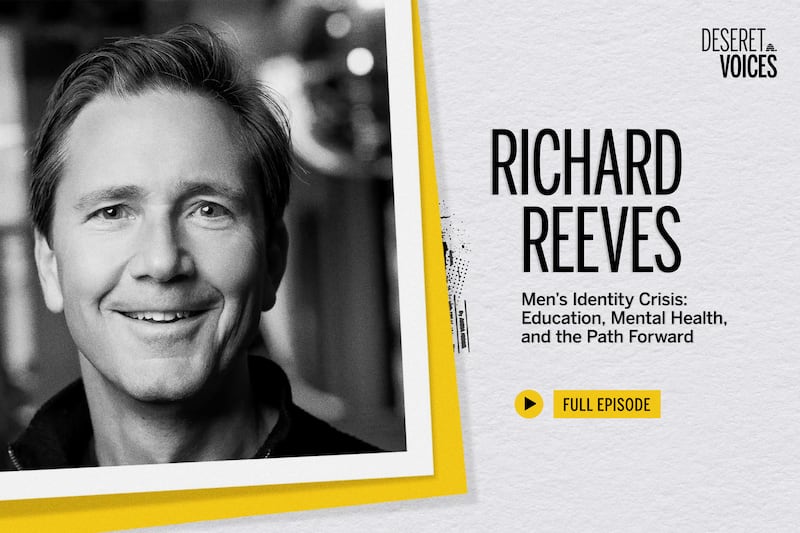


Women have made great strides due to the push for equality, overtaking men in educational and professional pursuits.
Richard Reeves, president of the American Institute for Boys and Men, applauds those efforts, but recognizes that men are not quite sure what their place in society is.
In this week’s conversation on “Deseret Voices,” Reeves tells Deseret News Editor Sarah Jane Weaver that “father figures” can step up to provide a lift for men and boys.
Subscribe to “Deseret Voices” on YouTube, Apple Podcasts or Spotify.
Note: Transcript edited by Steven Watkins
Sarah Jane Weaver: Researchers are seeing a significant decline in educational and mental health outcomes for boys and men, issues that extend beyond personal impact to societal consequences, according to Richard Reeves, social scientist and president of the American Institute for Boys and Men. I’m Sarah Jane Weaver, Deseret News editor. This week on “Deseret Voices,” we examine the challenges facing boys and men in the world right now.
Richard, thanks so much for being with us today. I want to start and talk about what got you into this work. Why have you dedicated your life to studying and advocating for boys and men?
Richard Reeves: I didn’t think I would end up working on issues of boys and men. I am a dad, I have three sons, but my work has been on inequality, education, and opportunity broadly — how do people move ahead in the world? But I just kept seeing these data points really showing troubling trends for a lot of boys and men.
So if you look at college now, it’s a 60/40 female-male. In fact, there’s a bigger gender gap on college campuses today than there was in the early 1970s, but it’s the other way around. And so what we’ve seen is just this huge kind of overtaking. And it’s great that women are rising; I think it’s really important to keep adding that caveat.
But when you see such worrying trends of a declining college enrollment for men, when you see the suicide rate among young men rising since 2010 by about 30%, and a four times greater loss of life to suicide among men than among women — so it’s about 40,000 men a year — these are just problems for everybody, but they seem to be skewing kind of particularly male right now.
I think just more broadly, there’s this sense of dislocation, maybe not quite sure of your place in the world for a lot of boys and men. And that’s for some really good reasons, like we’ve taken away, I think, some of those old traditional, even patriarchal roles for men. We can all celebrate that, but at the same time, we have to replace it with something. And so I think, what’s the story today of what does it look like to be a “good man” today that is compatible with gender equality and the aspirations of women and the work we still have to do there, but which just takes seriously the fact that a lot of boys and men aren’t doing very well.
SJW: What’s contributing to this? I have three daughters and I worry all the time about who they’re going to marry.
RR: Yeah, it’s very interesting that very often it is the moms of daughters as they get older who start to worry more about this because they start to look around; they look at the men a bit differently once their daughters get to that age where they might be thinking about marriage.
So I think that makes the point that it’s in everybody’s interests for both men and women to flourish and to rise together and to have kind of good, equal partnerships. So I do think that kind of men and women are bringing some slightly different things sometimes to like parenting, for example.
But if we haven’t learned by now that we need women to be able to kind of rise and reach their full potential to have a good community, then we have not been paying attention. But we can now add: by the way, that’s also true of men, and boys and men.
And so the big move here, I think, that we have to make now is to move past zero-sum thinking. And we have to be able to say there is still a lot more work to do for women and girls. And it was quite right to pay a lot of attention to the issues of women and girls in education, in work, etc. And we’ve also got to pay attention to the challenges now of many boys and men, and to do that “and” rather than the “or.”
If we continue to think that if you care about boys and men, that somehow means you don’t care about women and girls — and maybe you’re even somehow against the progress of women and girls — that’s a big problem. But also vice versa; I think that if you’re caring about women and girls, then that doesn’t mean that you don’t care about boys and men, right? You can be a woman in the workplace who’s quite rightly saying, “Look, we’ve still got more to do in terms of women in leadership,” for example — that’s true. “We still have a gender pay gap” — that’s true. And you can be worried about your son at school, your husband’s job and your brother’s mental health. And the idea that people can’t hold those thoughts in their head at once is honestly a little bit insulting, but it is unfortunately the way that the politics of this has sometimes developed.

SJW: My daughter just started medical school, and I was floored when I found out that there are more women than men in her medical school class. What is happening with boys and men in education?
RR: So overall, we’re seeing big gender gaps with women and girls ahead of boys and men on pretty much every metric at pretty much every stage. There are some exceptions, so, you know, some areas of math scoring, for example, you’re still seeing boys on average maybe doing a little bit better. But basically, the education system is now very strongly skewed in the sense that women and girls are doing much better in education.
And again, that’s obviously a wonderful thing. But it is clear at this point that the education system just isn’t working quite as well for many of our boys and men as it is for many of our women and girls. And that is not something that we’re used to thinking about because we’ve quite rightly spent so long — we’ve spent so much time and energy promoting women and girls — that suddenly to have to say, “Wait, I also have to worry about boys and men,” is a new thought.
But it’s clear: I mentioned the college gap, that there’s 60/40. If you look at high school and you look at the GPA of high schoolers, if you take the top 10% of those high schoolers, there are twice as many girls as there are boys in that top 10%. And if you look at the bottom 10%, there are twice as many boys as there are girls. And so there’s just no question that in almost every domain you look at, the boys are just not keeping pace with the girls. And that means that we can pay attention to and just be intentional about: “Is our education system serving everybody equally?” is a question we should always be asking, whether that’s about race or gender or class. And right now, I think it’s pretty clear that we have to do a bit better by our boys.
SJW: What role does the cellphone in this digital age play in all of this, in this decline?
RR: One of the interesting things is that the way in which digital technology is playing out is a bit different for boys and girls, young men and young women. And of course, some of it’s the same, but understanding that difference I think is really important.
Jonathan Haidt, who’s written a lot about this, is on our advisory council — co-chair of our advisory council — and he’s written about the fact that for boys, you could start to see some of these negative trends earlier, even before the rise of the smartphone. And it seems to be more about the way that boys and young men retreat away from relationships online and into sometimes what are more kind of addictive behaviors.
So right now there is a huge debate going on in Utah and other states around sports betting, for example. But there’s also a huge issue around pornography, etc. And it’s not to say that any of these things are just intrinsically bad, but it is very clear that they pose a different and sharper risk for boys and men. They can get sucked into those sorts of behaviors, partly because they’re a little bit more vulnerable to addiction, including online addiction.
Whereas for women and girls, it’s the very social nature of social media which has very often been so damaging around body image issues, relational bullying, other kinds of bullying online. And so it’s the very relational nature of social media that seems to make it particularly damaging for girls and young women, and we’ve seen a lot of evidence on that. But in some ways, it’s the fact that it kind of pulls men away from real relationships and into some of these more addictive corners of the internet that makes it so damaging for boys and men.
It’s actually quite different. So this technology shock that we’re seeing and its impact on mental health does have some quite strongly gendered elements. And that means we have to be thoughtful about that when it comes to policy and interventions because pornography and sports betting, just to choose two examples, are not affecting young men in the same way as they’re affecting young women. And I think probably most people hearing that will say, “Well, duh,” but then in that case, what are our interventions being designed in a way that are also gender-sensitive?
SJW: We just launched the American Family Survey, and you have been so helpful with that effort for so many years.
RR: Oh, I love the American Family Survey!
SJW: In this launch, there was a discussion that happened in the panel that was held at Brookings Institution, and somebody said, “Hey, there’s a lot of young women in this room. Let’s find out why they think marriage is in decline themselves.” And one young woman stood up and she said, “I’m 19 and I don’t even want to be in a study group with men because they don’t do the work. And marriage doesn’t interest me because I don’t want to do the dishes for the rest of my life.” And so how does this ripple into sort of other areas? I was shocked by that — that comment that actually somebody who is 19 would think, “Oh no, I don’t think that there are boys or men that are going to pull their weight.”
RR: Yeah. Well, note to young men: do the dishes. But I think it’s a really profound challenge to all of us because Gloria Steinem — who I’m thrilled to say I just had the privilege of interviewing and we’ll be publishing that soon — she was saying the point of the women’s movement is to make marriage a choice rather than a necessity. And for too long, women essentially didn’t have much choice about getting married if they wanted to be economically OK because of this huge division in the earnings of men and women, which has significantly closed.
As you said, the whole point is to make women economically independent. OK. So the question is: what does marriage look like in a world where women are choosing it rather than essentially being economically forced into it? And what it looks like is a much more equal partnership.
And so I think there is an adaptation we’ve got to go through here, which is that men — and I think men are up for this, by the way, all the evidence I see is that they recognize this has happened — but in a world where women are choosing marriage, it means that those marriages are going to have to be more equal, more sustaining, and that we are going to have to rethink what it means to be a husband and a father in those kinds of marriages.
And I think there’s a bit of a lag. I think there’s a cultural lag here where some of our models of marriage, some of our models of what it means to be a man in a marriage, are just lagging behind the current economic reality. And the very last message we we want to send to young women is: “We need you to get married so that these young men are OK.” Right? It is not the job of young women to rescue young men by marrying them, right? You’ll sometimes hear that kind of idea out there. It is the job of both young men and young women to show up as equal partners. And if that’s what both men and women are really looking for, but that’s a profound change.
I mean, in the space of just a few decades, we have completely rewritten the economic script of marriage. Like in 1979, only 13% of women earned more than the typical man. Thirteen percent. Now it’s above 40%. Now, that’s not quite 50% yet, that’s not equality, but the world has utterly transformed in terms of the economic relationship between men and women. And that women have — thank God in the U.S. and other Western advanced economies — gotten more economic power. And what we want is all women across the world to have more economic power so that they can choose their life course rather than being forced on them.
Well, that means we’ve got to rethink some of these institutions around marriage. If we want marriage to prosper and flourish, then it is not going to be in the old way; it’s going to have to be in a new way. And that’s a difficult adaptation for us to make, and it’s one we should be helping men through rather than blaming them for.
SJW: So we’ve laid out the problem. What do we do? How do we start to tackle this in a way that makes sense?
RR: Yeah, well, I do think that even conversations like this, and the conversations that are happening in Utah and states more generally, to just allow the conversation to take place in a non-judgmental way and in an open and positive some way — I think that’s valuable in and of itself.
I really do think that a lot of boys and young men don’t necessarily feel as if raising their issues, their concerns, is OK. And that somehow to raise the issues of boys and men, or even for them to raise their own issues, is somehow to diminish the issues of women and girls. They don’t feel permission to do that. So honestly, I do even think just having these conversations is important and saying to boys and young men, “Like, we’ve noticed. We got it, right? We’re on it.”
Then as to what we do about it, I think there’s a number of areas we should be looking at, and I’ll mention a couple. One is I think that male role models are hugely important, and fatherhood is obviously central there. I think fatherhood — somebody recently described fatherhood as the last male institution. And I kind of thought of that for a moment, I thought, “That may sort of be true,” in a way. And we kind of don’t want “male” or “female” institutions as a general rule, but motherhood and fatherhood, I think, are still strongly gendered.
So dads: and keeping dads in the lives of their children, even when they’re not necessarily in a relationship with the mother, is a real challenge for policy. I think family law, things like paid leave, really matter there.
But father figures matter too. It’s very striking if you think about: how often do you hear people talk about “mother figures”? Not that often, right? It’s an odd phrase. But “father figures”? Very common. And I think that’s because very often other men do step into that fathering role, and that could be coaches, it could be neighbors, it could be uncles, it could be teachers.
And so the role models in real life that I think boys and young men are exposed to and are around, have a huge role to play, especially when we’re combating online figures. And so if you’re a young man or boy in search of a story about what it means to be a boy or a man, and you don’t see it in your own life — you don’t see it in your family or your classroom or your community — then I think it’s much more likely you’re going to look for it online. And I’d much rather they found it in their schoolteacher or their father or their neighbor than in someone on YouTube.
So I’m really pleased to see states like California issue actually a call to service to get 10,000 more men into service. And one of the things that saddens me is that many of the organizations who do serve many boys and men — Boys and Girls Clubs, but Big Brothers Big Sisters, YMCA — really lack male volunteers.
And I think we need to send a message to men, which is: “You really matter in the lives of other men and boys.” Of course the ones in your own family, but much more generally. I guarantee you, if you’re watching this as a man, there is a man or a boy in your life who would appreciate you reaching out to them and supporting them and helping to kind of lift them up. So it is absolutely true that it takes a village to raise a child, but some of the villagers have to be men. And we need men. Like, it’s not just that, like, we’re worrying about men; we need women, of course, but we also need our men in our communities and our families. And that’s a message that I hope we can get across to people more because our civic institutions, our communities, are not going to flourish if we don’t have men there helping other men and boys to lift themselves up.
SJW: Richard Reeves from the American Institute for Boys and Men, thank you so much for your insights and for joining us on “Deseret Voices.”