

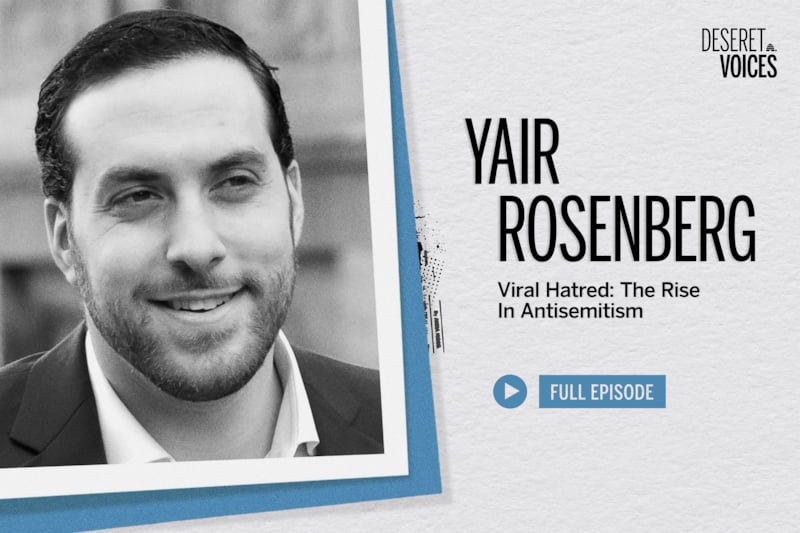


The Atlantic journalist Yair Rosenberg recently penned an article where he points out that Americans believe that with each passing generation we weed out prejudices and become more accepting of different cultures.
Rosenberg quotes a statistic from data scientist David Shor that a quarter of those younger than 25 with negligible differences among supporters of Donald Trump and Kamala Harris held an unfavorable opinion of Jewish people.
On this episode of “Deseret Voices,” Rosenberg joins colleague McKay Coppins to talk about the concerning rise of antisemitism.
Subscribe to “Deseret Voices” on YouTube, Apple Podcasts or Spotify.
Note: Transcript edited by Steven Watkins
McKay Coppins: Last month, in a quiet suburb of Detroit, Michigan, a man rammed his truck into the Temple Israel synagogue and opened fire. The attack was the latest data point and an alarming rise of antisemitism in America, one that seems to be embedding itself in politics, public life and online discourse. For Latter-day Saints, it was also an unnerving echo of a similar attack on an LDS chapel that had taken place just a few months earlier and a few miles away. The motives behind the attacks differed, of course, as do the histories of our two religious communities. But my guest today believes we might have more in common than we realize. I’m McKay Coppins, and today on “Deseret Voices” I’m joined by Yair Rosenberg, a staff writer at The Atlantic who has spent more than a decade covering religion, politics and the resurgence of antisemitic ideas in America. We discussed what’s driving that resurgence from the spread of social media conspiracy theories to a bipartisan generational shift in attitudes toward Jews. And in an era of rising suspicion, hatred and even violence, we talked about what religious minorities in the U.S. can learn from each other, as well as what we owe to each other.
Yair Rosenberg, thank you for coming on “Deseret Voices.”
Yair Rosenberg: It’s great to be here, McKay.
MC: So, I’m going to start this conversation with a confession. I have wanted to have you on for a little while now to talk about the rise of antisemitism in America, which I think is a phenomenon you have covered very well. You’ve been writing about it for a very long time. You’re one of the country’s leading observers of this phenomenon. And I have a little Google Doc where I write down ideas for episodes or guests for the podcast. And I wrote down — and this is really bleak, so forgive me, and maybe we’ll end up cutting it. It’s so bleak — but I wrote down, “Yair on antisemitism in America,” and then in parentheses, “Wait for news peg.” And the bleak thing is I knew there would be a news peg, like pretty quickly, right? Like the way your beat has evolved over the past decade or so kind of almost guaranteed that some prominent politician would do or say something antisemitic, that some new antisemitic conspiracy theory would come to the fore, or that in the absolute worst-case scenario, which is what happened a couple of weeks ago in Michigan, there would be an act of antisemitic violence — in this case targeting a synagogue. And I guess I want to start by just asking you about what it’s like to be a chronicler and observer of antisemitism in America at this moment.
YR: It can be very dark and dispiriting. I wouldn’t recommend most people sign up to marinate in the sort of things that it’s my job to swim in. I didn’t intend that either, right? I write about a lot of other things as well, as you know, but sometimes, you know, your beat evolves based on events. And it turns out a lot of people have a lot of questions about something like this because it keeps happening again and again and in many different ways, and so it’s in demand. So that’s unfortunate and deeply dispiriting. I would like this part of my job to go out of business. The goal of my beat is to become unemployed.
MC: You wrote a piece a few months ago that has really stuck with me that was called “Antisemitism Is a Youth Movement.” And I just want to quote from it — I always love when people read what I wrote back to me in the form of a question — but I think this is a useful way to kind of frame the conversation. You wrote:
“In late 2024, the Democratic data scientist David Shor surveyed nearly 130,000 voters at the behest of Kamala Harris’s presidential campaign. He found that a quarter of those younger than 25, with negligible differences among Trump and Harris supporters, held an unfavorable opinion of Jewish people.”
And you underscore that: "Jewish people, not Israelis or Zionists." A quarter of people younger than 25 have an unfavorable opinion of Jewish people. I remember reading that stat. It’s just kind of such an alarming thing for so many reasons, and one of them that you point out, which is that we in America have kind of adopted this consensus view that with each passing generation we as a country get less bigoted, less racist, less prejudiced, right? That each generation kind of cycles out these ancient prejudices and we become more enlightened and tolerant as a society. At least when it comes to attitudes toward Jewish people, that is not the case. Young people in America are more likely than any other generation in America to have antisemitic views. Could you talk about that kind of remarkable finding and what you think it means about what it is to be a Jewish person in America today?
YR: Yeah, there is that folk wisdom that prejudices are somehow the province of the old and thus they will die off as generations replace generations. But the thing is that antisemitism certainly doesn’t follow that rule. There are other prejudices that don’t, and actually in a bunch of other countries you see similar phenomena. And when you actually think about it, I think that, you know, it makes sense because sometimes the reason why people become suspicious or reject a prejudice is because they had an experience with that prejudice and they realize this is a dark and dangerous place to go.
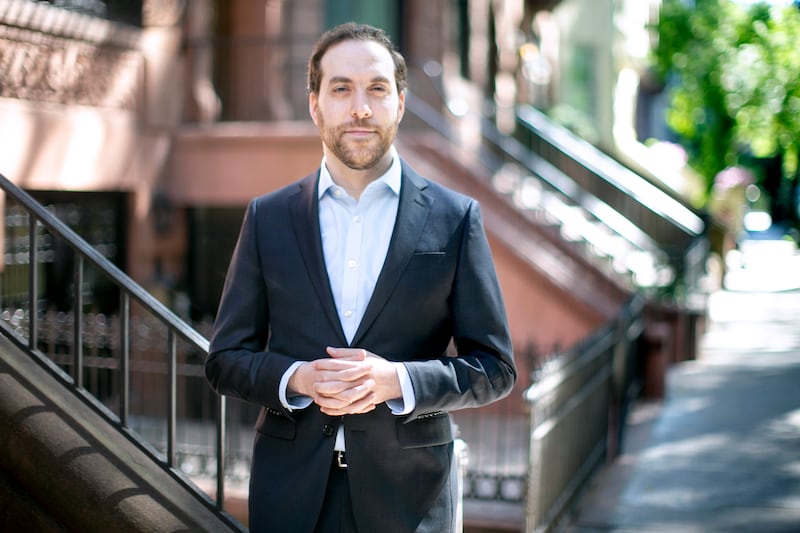
And in the case of the United States and many others, that was the experience of the Holocaust and understanding that sort of conspiratorial rhetoric about Jews and alleged Jewish domination of all institutions and control of all institutions and being behind all of the world’s problems and wars, that that kind of rhetoric both leads to tremendous harm against Jews but also enables tremendous harm to others by the people who wield it and eventually undermines and destroys the societies that embrace it. And that’s a lesson that a lot of people learned, you know, firsthand or witnessed firsthand in World War II and in fighting World War II, because of course America went and defeated the Nazis in Europe and then liberated a whole bunch of concentration camps along the way, not realizing what exactly was going on there.
A lot of Americans didn’t quite know or were suspicious that there was a lot of propaganda and didn’t believe that it could possibly be true that this stuff was happening. And then they all saw it. They wrote letters home. I quote some of those in one of my articles on this subject. They’re like, you have these letters from GIs saying, “I wanted to see this concentration camp for myself so I could prove to myself that all the stories they told about them were not nearly as bad, that it was just propaganda, war propaganda.” And it’s like, and then he tells his family it was actually much, much worse, right? And so these sorts of things shaped a whole generation of young men who then come back to North America. We have a conscript army, so people were from everywhere in the country. It’s not, you know, you know, and they go back to Canada and to the United States and they tell their communities, “This is what I saw,” and it changes the United States’ outlook toward Jews, toward antisemitism. The American myth becomes, you know, we defeated the Nazis, to be American was to have defeated antisemitism, to be antisemitic is somehow anti-American.
But when that generation passes on, that has that experience, naturally a new generation arises that doesn’t have that experience. And I think we’re seeing that with some other things too. If you look at the data — it’s not in my article — but support for political violence. The real dividing line is age. It’s not your politics. It’s not whether you’re left-wing or right-wing. It’s how old you are. And people who went through the ’60s and the ’70s and witnessed a lot of political violence and assassination attempts and assassinations and things like that, they learned firsthand that these things don’t solve our problems, right? In fact, they create more of them. But I think that sometimes when we don’t have those experiences, that sort of wisdom can fade. And it’s kind of a, it’s a really big question I think we face, which is: “How do you reclaim those insights without having the experience again?” Right? The dark view of human history is that we consistently forget the things that we’ve experienced and have to make the same mistakes again and remind ourselves why we shouldn’t. But what we’d like to think is that we could come up with new ways to engineer those sorts of experiences without the insights, without the experience. And the question is what that is. And maybe that’s writing, maybe that’s journalism, maybe that’s literature, maybe that’s culture, right? But there is a big question there.
MC: I mean, you raised the kind of obvious, you know, example of this generational radicalization that seems to be happening. And one of the obvious culprits here is social media, right? That in eras past, even just 20 years ago, the vast majority of news media came from, you know, legacy outlets, which had their problems but also had basic editorial standards in place that prevented overtly antisemitic conspiracy theories, for example, from being broadcast as though they were true. Now that people, especially young people, get most of their news from TikTok and Instagram and podcasts, that whole ecosystem has different incentives, right? It surfaces the most provocative ideas, the most outrageous and divisive ways of understanding the world because that maximizes engagement, which helps boost your visibility in the algorithm. There’s a whole economic element of this. But basically, what it boils down to is young people are consuming news, if you even want to call it that, in an entirely different way than their parents and grandparents. And that has kind of brought back these sort of ancient conspiracy theories and hatreds and given them a place in the discourse that 10, 20 years ago they didn’t have, right?
YR: Yeah, I mean, one of the things I point to in my article is of course there is also a data divide among Americans and among generations across many countries where the older you are, the more likely you’re going to be getting your news and information about the world from traditional media sources, legacy media sources, The Atlantic, you know, The New York Times, television. Whereas the younger you are, the more likely you are to both get more information from say TikTok and other places on social media and trust those sources. Because there’s, you know, who do you trust more? That being said, I don’t like to, you know, it’s of course very self-interested for people in traditional media to say, “And, you know, you can’t trust anything on social media.” The truth is that what people really need is sort of a balanced media diet, right? And recognizing that there are strengths and weaknesses to all these things.
The issue sometimes is that we have people who are, you know, ensconced only in one kind of media, like where you say, and the kind of media where the incentives are wrong. The article that I just closed before we talked, the article was about this very widespread internet delusion that Benjamin Netanyahu has been dead for some time and replaced with AI. And this sounds like some ridiculous thing where you find some weirdo people, you can always find somebody on the internet who believes something crazy. It’s like, no, this is many, many, many thousands of people as far as we can tell, maybe many more than that. It’s been voiced by Joe Rogan on his podcast. It’s been voiced by sitting politicians in governments. It’s a remarkable thing. And one of the reasons why something like this is able to spread — and no matter how many videos and public appearances that Netanyahu makes, it’s not debunked — is that people are getting their news from social media ecosystems where the incentives are not accuracy, but virality. And there are a lot of people who benefit from circulating this stuff, whether it’s because they’re war propagandists or they’re just profiting off the engagement that they get from people questioning whether Netanyahu is alive or feeding the wishes of people who really hate Netanyahu and wish he was dead. And so this is a sort of narrative they’re very inclined to accept.
And so when you have all of that stuff going on, you’ve created sort of an environment where people are not necessarily going to get the best information. And that of course is going to hurt Jews, but it also hurts many other minority groups. It hurts people’s ability to be effective democratic citizens. This is the thing I think about a lot. Because you have to be an effective actor in a democracy, you have to understand, you know, how the world works, right? What are the different political movements? Which political leaders are actually alive, right? Who’s doing what and why? And the more people absorb conspiracy theories about all those things, the less they understand how things actually work, the less they can effectively advocate for the changes they want to see. And so, you know, why did the stock market crash is a good question. Who did 9/11 is a good question.
But if you answer those questions by saying it was the Jews and chasing after fantastical Jewish culprits, you will never prevent the next similar calamity because you’ve never understood how the original ones happened. And so the role, I think, in some sense of good journalism is not to necessarily point at something and say that’s antisemitic and label and lecture, but rather to explain the correct answers to questions and recognize that sometimes these conspiracy theories are bad answers to real good questions and give people that information that empowers them, unlike conspiracy theories which actually disempower them.
MC: So, going back to this piece that you wrote a few months ago, the reaction to it was really fascinating because it was almost a microcosm of the phenomenon you were describing in the original piece, which was that, you know, these antisemitic attitudes are not primarily a partisan phenomenon, they’re a generational phenomenon, right? If you look at people under 25, antisemitic attitudes are split roughly evenly between liberals and conservatives. Now, you know, depending on the data you’re looking at, it might tilt one way or the other, but this is not by and large a conservative problem or a liberal problem; it is a generational problem. Here’s what’s interesting. So your piece comes out and it gets a lot of attention. You go on cable news to talk about it, where you are lectured by a liberal panelist for not accurately describing this as a right-wing problem, right? Meanwhile, Vice President JD Vance responds to your piece on Twitter and writes:
“Mainstream journalism is just profoundly uninteresting and lame, consumed by its own pieties. To write an article about the generational divide in antisemitism without discussing the demographics of the various generations is mind boggling.”
And he goes on to essentially argue that America imported antisemitism as a phenomenon by allowing a bunch of immigrants from the Middle East who already have antisemitic attitudes to come here and make America their home, and that that’s the chief problem. So talk a little about that argument. Is this primarily a liberal problem, a conservative problem? Is it primarily driven by immigrants from Middle Eastern countries? What does the data say about that?
YR: Yeah. So, fundamentally, antisemitism is a phenomenon — anti-Jewish prejudice is a phenomenon — that is older than Republicans and Democrats, capitalism, communism, Islam, Christianity. You can go back into the ancient Roman world and you see anti-Jewish ideology and activities. And so the way I approach this subject is to explain that it’s not a left-wing — fundamentally, it’s not a left-wing problem or right-wing problem or a Christian problem or a Muslim problem, it’s a human problem. It has to come from something deeper and more fundamental because otherwise you can’t explain how it predates all these other things.
Now, those fundamental human failings find expression in left-wing versions and right-wing versions and in various religious manifestations and various generational manifestations, as we’ve discussed. But they stem from, I think, more straightforward human characteristics, things like I discussed, which is — we’ve talked about antisemitism as a conspiracy theory. That’s what distinguishes antisemitism from other prejudices, in that like other prejudices, antisemitism is a personal prejudice. “I don’t like you because you’re different. You’re too Jewish, you’re too Muslim, you’re too Black.” That’s the personal prejudice. “I don’t want you in my country club, I don’t want you in my school,” etc. And that’s a deeply harmful and, you know, painful sort of prejudice. Antisemitism, though, has this other expression, which is as a conspiracy theory, which is this idea that Jews are these string-pulling puppet masters behind every world problem — social, economic, political. And that no matter what it is, you can trace it back.
MC: Can we pause on that one? Because it is really kind of striking how persistent that idea is throughout like all of human history, basically. I mean, I don’t know if you saw this, there’s a clip going around recently of Joe Rogan’s podcast where he had a guest on who asked him to guess how many Jews there were in the world. Did you see this?
YR: Yes, and like many people, he thinks there are way more than there are.
MC: He guessed 1 billion. He guessed there were a billion Jewish people in the world, which, you know, what is it? Like, it’s actually like 15 million, something like that?
YR: It’s 0.2% of the American population — of the world population — and 2% of the American population.
MC: Right. And so there is this idea that Jewish people have so much power in the world, and the prevalence of these conspiracy theories and the constant expressions of antisemitism and debates around antisemitism have kind of fed this belief by some people like apparently Joe Rogan that there are way more Jews in the world than there actually are. So where does this come from? Like, do you have a grand unified theory of what it is that causes people for literally like millennia now to specifically target Jewish people with their hatred, violence, and conspiracy theories?
YR: Yes. So grand unified is very presumptuous, but I do have like a couple of things that I feel are good guiding lights. Right? So one of this is, you know, the conspiracy theory at root is somewhat the search for a scapegoat. Right? It’s trying to say that there are problems in our society, which are always going to be true, there are always tremendous problems in any society, and then try to find someone to blame for them because there are two ways you can react to problems in your society. You can say, “Why did this happen?” or “Who did this to us?” Right? “Why did this happen?” leads to self-criticism and internal critique and attempts to fix the problem. “Who did this to us?” leads to externalizing the problem and then trying to offload it onto others.
And the fact is we see this with many groups, not just with Jews. It just depends on the time and place. Jews are just really old, and we’ve always been a minority everywhere we lived, except for very small, very, very exceptional periods of history in the land of Israel, right? Almost throughout human history, Jews are a minority community wherever they are. They are an extremely convenient scapegoat that doesn’t conform to everyone else’s, you know, ideology or religion or culture or whatever it is at the time. And so Jews are hit with this very, you know, universally human tendency to externalize problems and to scapegoat on unliked disfavored minorities for those problems. But Jews have just been around a really long time. We’re not particularly special other than that we’ve been around to be hit with this particular thing over and over again, right? So I think that’s a big one.
If you like, say open up the Book of Esther in the Bible, this is right there on the page, which is actually kind of shocking when you read it, because, you know, scholars date it back thousands of years and you’re looking at it and you’re seeing it, and it’s like Haman the villain says to the king, “There is this people dispersed among the peoples, their laws are different than the king’s laws, it is not in the king’s best interest to tolerate them,” and then advocates that he kill all the Jews. And like that could have been written or said on a podcast yesterday. And like, but that’s because the people have been saying this for centuries, and it is this general sort of way of looking at a minority group that is different, right? This inability to tolerate minority difference is sadly a universal human failing, and thus if you are almost the universal human minority, right? You’re going to get hit with it more than many other places, but of course Jews are not exclusively the ones hit with this. But that’s one thing that I see.
And that’s exactly why I talk about this in more than political or religious terms because I think it’s much deeper than that. And if we — and when Vice President Vance and others critiqued my piece on a generational gap on antisemitism, part of what I wrote in my response in The Atlantic to that critique was to say, if you only focus on the kind of antisemitism that you can pin on your political opponents, right, you’re going to miss so many elements and aspects of this phenomenon, including the ones that are much deeper than politics and much deeper than your political hobbies of the moment. And if that way of talking about antisemitism worked, we’d have solved it already, right? And so we should probably talk about it differently.
MC: Well, right. I mean, this is part of the phenomenon, which is that it becomes a kind of counter-polarized issue, right? So like there’s a rabbi in Salt Lake City who’s talked about this recently. He said, “I think people on the right are really good at calling out left-wing antisemitism, people on the left are really good at calling out right-wing antisemitism, but what I keep encouraging folks to call it out when it’s on your own side because that’s actually the hardest thing to do.” And I mean, you have experienced this in writing about it for The Atlantic, right? When you are criticizing people who are left-of-center who are indulging in antisemitism, you get a wave of angry responses from people on the left. And then when you write about, you know, conservative antisemitism, you get a bunch of right-wing people who are mad at you. It’s almost kind of funny how predictable it is. But the results are really tragic because what it means is that everybody can kind of dismiss this as a problem for somebody else to solve.
YR: Exactly. I like to say antisemitism is the perpetual problem of other people. And so you have all these people who are constantly pointing at each other and saying, “They’re the bigger bigot.” And meanwhile the actual antisemite is like, looks both ways and just crosses the street while the people who are supposed to be fighting them are actually fighting with each other. And so, you know, that kind of debate exactly in some sense only benefits the antisemite because all the people who claim to be opposing the antisemites are too busy assailing each other and saying, “You’re the real problem.” And I always say that even if you could conclusively solve that question and you could settle it and say we’ve come up with, we asked ChatGPT and the algorithm says that all antisemitism is 63.4% right-wing and I don’t know, let me try to do the math, 30, you know, I’m going to embarrass myself, 36.4, you know, 6% ...
MC: We get it, you’re close enough.
YR: You know, if they did that, what use would that information be? Because if you are a left-wing person, you cannot then go into right-wing spaces and dictate how they conduct themselves. They will not only laugh you out of the room, they will probably circle the wagons and become more defensive than if someone inside their community raised the critique. And the same would go if a right-wing person tried to show up to a left-wing space, a left-wing political or cultural space, and tried to police their attitudes toward Jews. It would result in defensiveness and it would actually protect the behavior it’s meant to be critiquing. I call this trying to bounce people from a party you weren’t invited to. It’s not going to work. And so, yeah, so we have a lot of that. Our partisan politics incentivizes that kind of thing, because of course politicians are incentivized to see prejudices and problems among their opponents but to sort of downplay them on their own side. This is why I’m in journalism and not in politics because it enables me to cover the things as I actually see them. And I think that is crucially important.
MC: In your view, what is the relationship between the war in Gaza since Oct. 7 and antisemitic attitudes in America? I mean, there’s certainly a narrative among some that Israel’s actions and the way that the Netanyahu government has prosecuted this war is fueling antisemitism in the U.S. Do you think there’s any merit to that, or what do you make of that?
YR: So it’s a two-pronged phenomenon, right? We have social science studies going well beyond this war that when Israel’s involved in any kind of military conflict, antisemitic acts rise around the world. So in a sort of very simplistic way, right, therefore Israel has caused antisemitism. But of course the real thing that’s causing antisemitism is the worldview of the bigot who says, “Israel just did something that infuriates me and that makes me really mad, so I’m going to go torch this synagogue here in Europe or in the United States. I’m going to beat up this kid in school in my high school in America or New York,” right? The bigot’s attitude that anyone who shares particular identity characteristics anywhere in the world is responsible for anyone who has those characteristics and who does something that makes me angry, that’s the real cause, right? Not what somebody did somewhere in one part of the world. And, like, that is sort of the fundamental thing.
The way I put it is like if a piano falls out the window and, you know, kills me on the street, right? The piano did in fact was the proximate cause, right? That’s like Israel going to war. But the real cause is the person who pushed the piano out of the window, right? And that is the bigoted worldview that a lot of people have of how they relate to minorities. You know, after 9/11 they go after Muslims in the United States, and you have hate crimes against people who are Muslims or Sikhs because they think they’re Muslims. That is somebody basically again collapsing an entire minority community into a mendacious monolith that is then collectively culpable for anything that they’re mad about from that community.
MC: Yeah, and the thing that is so absurd about those arguments is that you hear this over and over again, like as though it’s the responsibility of American Jews to be constantly condemning everything Israel does and the Netanyahu government does to kind of prove their worthiness as Americans or something like that, right? You definitely see that undercurrent. It’s very similar to the arguments after 9/11 that good Muslims, moderate Muslims need to call out what happened on 9/11, as though they are responsible for what happened. And you, I mean, obviously as a journalist, you have written critically about Netanyahu and his government. There are plenty of Jewish people who have spoken out very forcefully, but the assumption that an American Jewish person should have to prove their loyalty to America, their outrage on behalf of people in Gaza, it just feels a little gross to me.
YR: Yeah, it feels gross to a lot of Jews. But this gets back to that tendency that societies have when they’re looking at minority communities. So one we talked about is scapegoating, another is collapsing them into a unified whole. And anyone who’s ever been inside one of these minorities — I could speak from inside the Jewish community — knows that it’s incredibly fractured and fractious and all the Jews can’t agree on what to set the thermostat on, let alone on their opinions on Israel and many other things. But from the outside there is a very strong tendency by people who don’t know the community very well to turn them all into one thing. And usually that thing is a negative thing. Sometimes it can be a positive thing. You actually get sort of philosemitic stereotypes that Jews are all incredibly clever, smart, right? And all of these kinds of things. Like, you know, some of us are dumb. But it’s like the other side of the coin.
MC: The Mormon parallel to this is that all Mormons are nice. And I’m like, maybe overall on average nice, but I’ve known some not-so-nice Latter-day Saints. I’m just going to throw it out there.
YR: Exactly right. Exactly right. So inside the communities we all know all of the diversity and the complexity and all that, but outside those communities there’s a tendency to collapse them by others. And in times of strife and in times of negative sentiment that can be very harmful to those communities. And something I keep in mind because as I mentioned I cover, you know, one of my beats is minority religious communities. And you see this all the time.
I also see it in American politics because I cover the American right and the American left and their fractures within their coalitions. And it’s so funny because when I talk to, you know, my sources on the right, they’re like, “The liberals, the left, they want to do X and they’re all so organized and this is what they want to do.” And then you go and talk to my liberal sources and they’re like, “The conservatives, this incredibly organized, well-menacing effort that is going to do Y and they’re always on side.” And then in fact you actually report on them, they’re all fighting with each other, right? And the right is contesting who is actually running this thing and who’s going to be in charge when Donald Trump is gone, right? And there’s so many incredibly high-profile fractures and fights, which people are starting to notice, but this has been going on for a long time. And on the left, there are so many disputes over what should this party be doing in response to Donald Trump? What does America actually need? What kind of politics should we be embodying? None of these monoliths actually exist, but everyone who’s outside a community has a tendency to collapse that community. And part of what I do in journalism, whether about religious groups or about political groups, is try to complicate that and give people a more accurate picture of what’s really going on.
MC: I think the way that we first got to know each other was because you were writing really thoughtfully about my own religious community, The Church of Jesus Christ of Latter-day Saints. And there is, you know, there are some interesting parallels between our two faith traditions’ experiences in America.
And I remember it was like five years ago, maybe longer now, that I wrote a long piece for The Atlantic about The Church of Jesus Christ of Latter-day Saints, the history of Mormonism in America, my own experience growing up in a minority religion, and kind of the desire I had to perform to convince all my non-Mormon friends that Mormons were cool. And what’s funny is Jeffrey Goldberg, our editor-in-chief at The Atlantic, read the piece and he said, “You know who’s going to love this? The Jews.” And I was like, “Really?” And he was like, “Trust me on this.”
And sure enough, when that piece was published, I obviously heard from a lot of Latter-day Saints. I heard from a lot of Jewish people who said, “I relate to so much of this.” Jonathan Greenblatt, the head of the ADL, wrote a letter to The Atlantic that we published about how much Latter-day Saints and Jewish people in America can learn from each other. I’m curious, is it your experience as somebody who covers religion in America that these experiences of minority religions have more in common than you might guess, even though they have very different histories and different beliefs and different worldviews?
YR: I do. I’ve also seen it, I’ve seen it with Jews and Latter-day Saints. I’ve seen it with Jews and Muslims, and that’s a bit of a tragic story because of course Gaza and the Middle East basically ends up being this sort of filter through which those communities relate to each other and has been for quite some time. There are people who’ve been trying to break down that filter, but it’s extraordinarily difficult given events. But in practice, if you actually hang out with these communities and you talk to the different groups and you understand the different fights and fractures and all this, you’re like, “This is all the same,” right?
You have a lot of the similar controversies in the more conservative and the more liberal ones and the tensions over various roles and the generational turnovers and divides, and there’s a lot to be learned from each other and there’s a lot that people could share. And that, you know, it’s — that doesn’t get enough attention in part because the media is not great at covering religion. And the media knows this, right? Like, they’ve actually polled journalists at — I forget which journalism school did a study — and they actually asked journalists, “Are you confident covering religion?” and, like, less than 20% said they were. And they said, “And if I am, it’s my own tradition and not any others.” In practice, though, many more Americans than that are religious, so you have a real mismatch between the media and fluency and then the actual people they’re covering. And so I think a lot of stories get missed or are, you know, aren’t well-told, which is one of the reasons why someone like me and perhaps someone like you gets interested in telling some of these stories. And to the credit, I feel, of every journalism outlet I’ve ever worked with, when they see you can tell a story that they haven’t been able to tell as well as they’d like, they’re like, “Go for it, please do,” right? McKay, write that story. And I’ve been really gratified to see that.
MC: I 100% — I always tell this to young aspiring journalists who are also people of faith. I’m always like, you don’t realize how much of an advantage you have in being able to cover a vast swath of American experience that a lot of secular newsrooms know they should be covering better but don’t know how to. And it’s always kind of my call for people of faith to come join us in the news media because these are really important stories. And I would argue, to bring our conversation full circle, that one of the big problems that is feeding antisemitism in America is that people in the mainstream media are just not really well-equipped to cover Judaism as a faith tradition instead of just as a, you know, like an ethnic group or a political signifier. Like, Judaism is often covered in political terms, not in broader terms, right? And I think that that’s just a failure of our industry.
YR: Yeah, I think there are a lot of stories about Jews that are not told because of that. And another way that sort of even comes from our own conversation is naturally when you write about Jews today, the conversation gravitates toward two stories. One of them is bad people saying or doing bad things to Jews, which is antisemitism, and the other is military conflict and devastation in the Middle East, in which Jews are one of the actors, namely Israelis. Those are two real stories. They’re also two extremely charged and sometimes very negative stories. In the middle, there’s this vast universe of Jewish experience that sometimes gets short shrift. And so when people aren’t learning and hearing about Jews as Jews, right, and as their regular lives and all the other things that are going on, they can come away with pretty distorted understandings of those communities, not necessarily by intention. It leaves a big void. And so what the great things that journalism can do when done well is to fill that void. And that’s sort of what I really love about reading your stories on the LDS Church and, you know, some of the great religion reporters that we have out there, there’s some really great people you and I know, right, at The Washington Post, at The New York Times. This is the sort of insight they can bring when you uncover these sorts of things. But the fact is as you said we need more. More people need to get in because there’s still so many more of these things to be told than any few people could do.
MC: Well, maybe in that spirit, my final question to you will be: What is a story about Judaism in America that is being undercovered that maybe the average person listening to this podcast, watching us, isn’t aware of? What should they be paying attention to?
YR: There are a few that I’m thinking about. You know, I am quite curious, for example — and this is true in other faith communities too and I bet the story could be told there too — how artificial intelligence is impacting Jewish life, community, and practice. Which is to say that you have these magic boxes that can answer questions. How do people are asking questions to their magic box that they used to ask to their rabbi or spiritual leader? How many rabbis, when they’re trying to come up with their sermon, are working with an AI to do it? How good are the AIs at using looking at traditional Jewish texts? Because right now I feel like that is still a bottleneck. I don’t think they can do the Talmud, not well. They can read what people have said about the Talmud if it’s in English or in Hebrew they translated, but to like read abstruse ancient Hebrew Aramaic, less so. But I’m curious how that’s progressing.
And it is the case that pastors and rabbis have long had organizational superstructures where people exchange ideas and even sermon starters and things like that, and I’m curious if AI is starting to play some of that role. You know, I’m always interested in the way sort of these sort of emerging technologies end up being used and whether people find them helpful or harmful, because I think that’s always both sides of it. You had Spencer Cox on here talking about social media. All these technologies, they have their — you wrote your story about gambling — there’s the dark sides of these things and then there’s also the wonderful things.
I can say that I have worked with Suno, the AI music generator, to help teach my daughter some of the traditional melodies for various Hanukkah and hopefully soon Passover Pesach songs. Because if you look online to find the, you know, some recordings of those, it’s either like fancy cantorial music, which is not at all my style and not hers, or it’s like really kid pop, you know? And I’m like, I can’t listen to this, this’ll drive me nuts, and also you’re my daughter, you could be more sophisticated than that, right? But the middle ground doesn’t exist. But you can go sing the song to the AI and then say, “Here’s the type of instrumentation and stuff,” and now you have suddenly something quite nice that they can listen to and enjoy and the family can enjoy and that people who don’t necessarily know the tunes can learn. So I’m curious what those things are and all the people who are doing them that I know nothing about yet.
MC: I feel like we should end this with just a little teaser for people who want to go look it up themselves. Many years ago — you’re probably familiar with this, Yair — the former senator from Utah Orrin Hatch got together with our mutual boss Jeffrey Goldberg and wrote a and recorded a Hanukkah song. Have you seen this?
YR: I’ve seen it. Yeah, I think the video is still available on YouTube. People can find it.
MC: I think it’s still available on YouTube and it is a kind of strange and fun watch, but I feel like the audience for this conversation will appreciate that video. So it’s a Hanukkah song, but it’s — I think it can be enjoyed at any time of the year.
YR: Yeah. If people want something else, if people want more footnotes and further reading and things that they might enjoy if they’ve enjoyed this sort of discussion and are curious about sort of the LDS-Jewish relationship. So I wrote a piece a while back, you may remember, which was about the controversy over the construction of the BYU campus in Jerusalem, which became an international affair. It caused a vote of no confidence in the Knesset. And I like to say it’s the only interreligious conflict in the Middle East that was ever resolved amicably. Certainly in Israel. And it’s a really fascinating story. Orrin Hatch is in that story too. So are a lot of people that we all know and that became and were important historical figures at different points in the United States and in the media and in politics. And it’s a really, really fascinating artifact that I think it’s largely been forgotten precisely because the BYU campus is no longer controversial whatsoever in Israel, so no one remembers any of this happening. But it’s a really interesting time capsule and says a lot I think about how these two communities have found ways to work with each other. And so yeah, so I recommend people — I think the title of that article is “The Mormons on Mount Scopus.” So if you look that up, how many other Google search results would you find anyway?
MC: Yair Rosenberg, thank you for coming on. This has been a great conversation and we hope you’ll come on again soon.
YR: I’d love to. Thank you so much, McKay.