


NAGANO, Japan — The ice beneath the dramatically shaped, native-wood roof that gave the M-Wave its name is kept carefully groomed 10 hours a day, seven days a week.
On a cold November day last year, one of the Olympic speed-skating oval's 30 employees maneuvered a Zamboni around the 400 meter track, making sure the surface was perfectly smooth for skaters.
Except that there wasn't anybody waiting to use it.
That's true most of the six months a year that the $300 million facility built for the 1998 Winter Games is open for skating. Even so, the oval is maintained with financial help from the government of this small city in rural Japan.
"This is a symbol of the Olympic Games," according to Hiroshi Higuchi, the man in charge.
It's a symbol in more ways than one.
As the most recognizable of the venues built for the last Winter Games, the M-Wave does attract visits from Japanese tour groups who pay about $7 each to wander through a museum exhibit and watch a 3-D film of Olympic highlights.
But the ice often goes unused, except for the classes of schoolchildren that come to skate once or twice a year on the track and the two interior rinks. Weekends can be busy, but with recreational skaters rather than athletes in training.
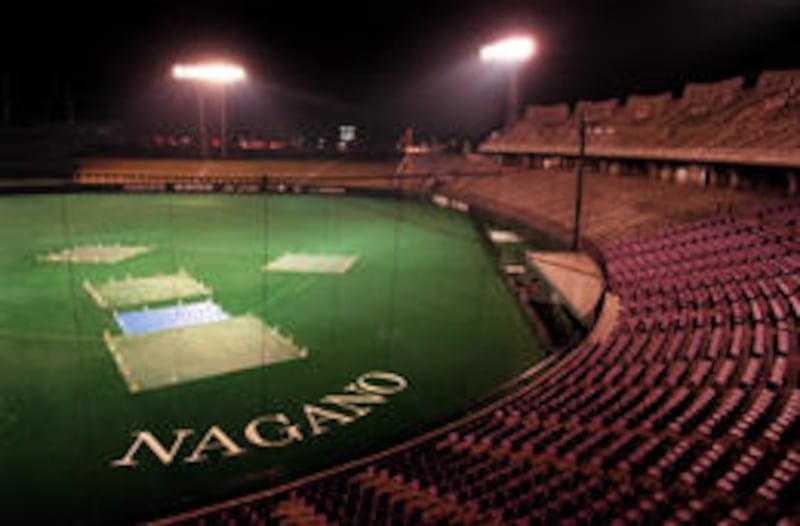
There have been international competitions held here since 1998, but usually the thousands of seats that ring the oval remain empty. With more people looking at the ice instead of using it, the M-Wave is an expensive reminder of the Olympics.
Taxpayers are contributing some $1.2 million annually toward the approximately $4 million price tag of maintaining the facility, which is used for conventions and exhibitions from April through September.
It's the same story at other Olympic venues.
Across town, it's after 5 p.m., but the dozen men dressed in identical jumpsuits stay seated at their desks in the control room of the massive concrete stadium where Nagano once welcomed the world.
Even though their workday is over, they won't leave while their boss is being interviewed about the arena's transformation from hosting the opening and closing ceremonies of the 1998 Winter Games.
The men stare at their desktops or glance at the wall of security monitors that show various views of the empty stadium. They may be staying put on this evening to show respect for their superior, but no doubt they're used to waiting around.
Few people use the facility, which was converted earlier this year into a baseball field for the area's recreational-league teams. The multimillion dollar project eliminated some of the seating, but the stadium still holds 22,000 spectators.
Most days, there are none.
Stadium director Motoyuki Takaike laughs when a translator tells him a reporter wants to know whether the baseball field is too extravagant for local league play. "It's not cost-effective at all," Takaike acknowledges.
But, he said, area residents like the thrill of playing in a stadium built to accommodate a major league team post-Games even though there apparently was never any chance of attracting a ball club to what is still a relatively remote area of Japan.
"Citizens don't think it is too expensive. Some say it's really great," Takaike said. "Children have dreamed to play baseball in the Olympic stadium." It's also a fantasy for adults in a country that has embraced the all-American pastime.
It's too soon to tell whether enough children and other baseball players will be willing to pay fees ranging from about $70 to $150 to cover the $70,000 in revenue expected annually. The facility, closed for remodeling since the Games, didn't reopen until April 2000.
Eight months later, only three professional exhibition baseball games had been played there. Takaike said there are no plans to book other events, such as concerts, that could bring additional revenue.
He estimated it will cost some $520,000 annually to maintain the baseball stadium, which shares an operating budget with an adjacent gymnasium and pool. The difference will come from local taxpayers.
The M-Wave's Higuchi was part of a city group that decided what to do with the facilities built for the Games. Only half of the indoor arenas still have ice, the M-Wave and Big Hat, an ice hockey arena.
The others have been transformed into community recreational facilities. White Ring, where ice skater Tara Lipinski won a gold medal, is a wood-floored gym. Aqua Wing, where ice hockey teams and short-track speed skaters competed, houses a swimming pool.
One, the Spiral bobsled and luge track, has no recreational use at all. A passenger ride program similar to the one already in place at the Utah Olympic Park was considered by the city group but rejected.
"It's too dangerous," Higuchi said. In fact, he has nicknamed a bobsled simulator ride inside the M-Wave's museum, "Mr. Trouble," even though it does little more than gently rock riders.
The track is located in the mountains above Nagano and is open just two months a year, December and January. Only Japanese athletes train there, although one world-class event is held annually.
There are few users and few visitors to the track, which cost nearly $1 billion. Higuchi said Nagano must get some value from that investment but suggests the track may be closed permanently someday soon.
Overall, Nagano is reportedly spending more than $12 million a year to maintain Olympic facilities. That expense, which is contributing to a huge annual debt, troubles even the few residents who enjoy the facilities.
It's a problem that Utah's Olympic organizers hope to avoid.
The state agreed more than a decade ago to spend $59 million building winter sports facilities to win the U.S. Olympic Committee's endorsement. The USOC wanted a new training site for the country's winter athletes even if Salt Lake didn't get the Games.
The Salt Lake Organizing Committee is obligated to repay the taxpayers' investment, as well as come up with $40 million to cover the post-2002 costs of running the most expensive facilities, the bobsled, luge and skeleton track, ski jumps and speed-skating oval.
The Utah Athletic Foundation, the private organization created by state lawmakers to run those facilities after the Games, is already going after major national and international competitions.
The foundation is working with SLOC to make sure money used to ready the facilities for the Games goes toward making permanent improvements whenever possible. The same is true at other venues.
Still, the foundation has already suggested that $40 million won't be enough to maintain the track and jumps near Park City and the oval in Kearns at the level needed to attract world-class athletes for very long.
There has been little interest among Utah legislators in providing additional funding for those facilities. It's a debate, however, that is likely to linger long after the Games are over.
E-MAIL: lisa@desnews.com