

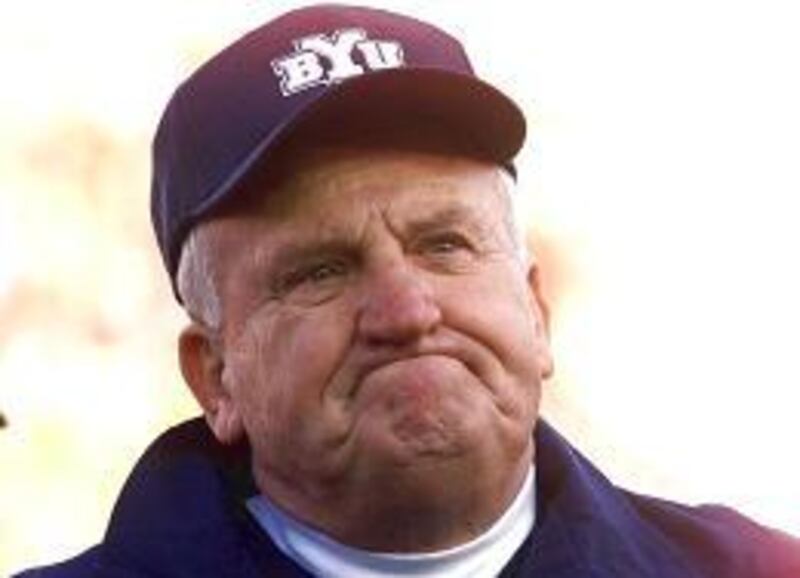
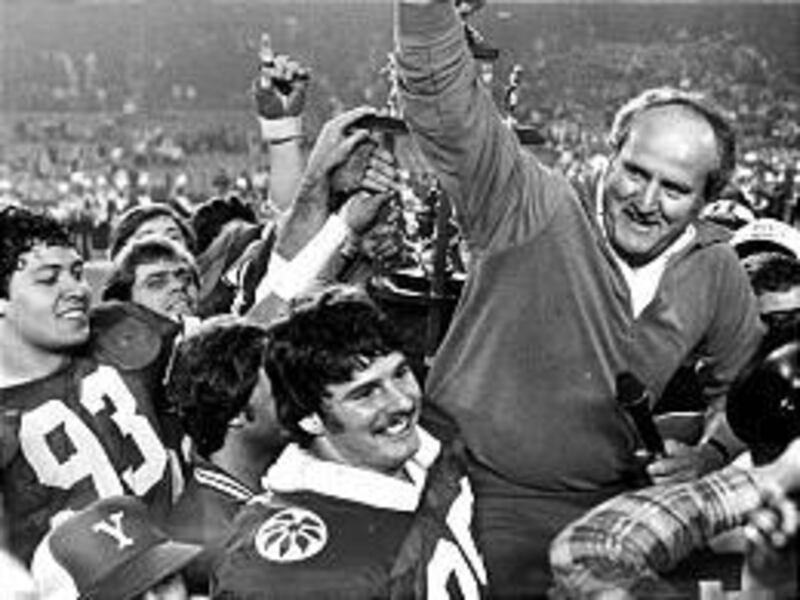
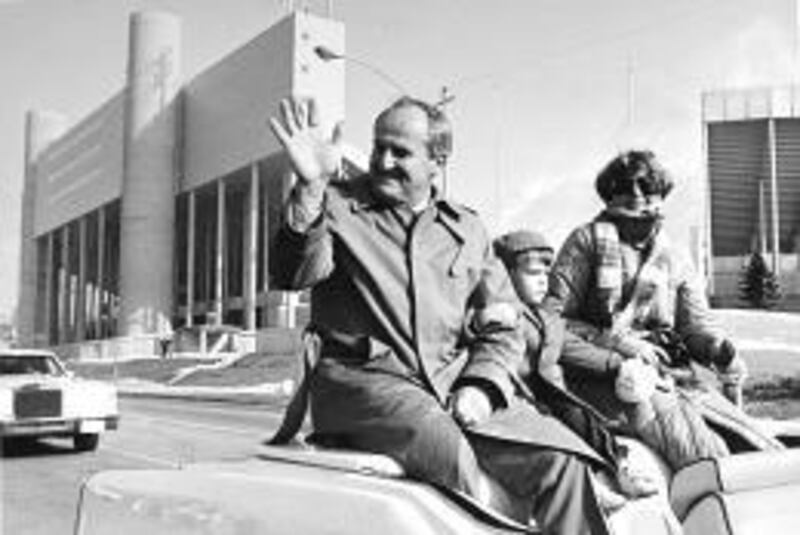
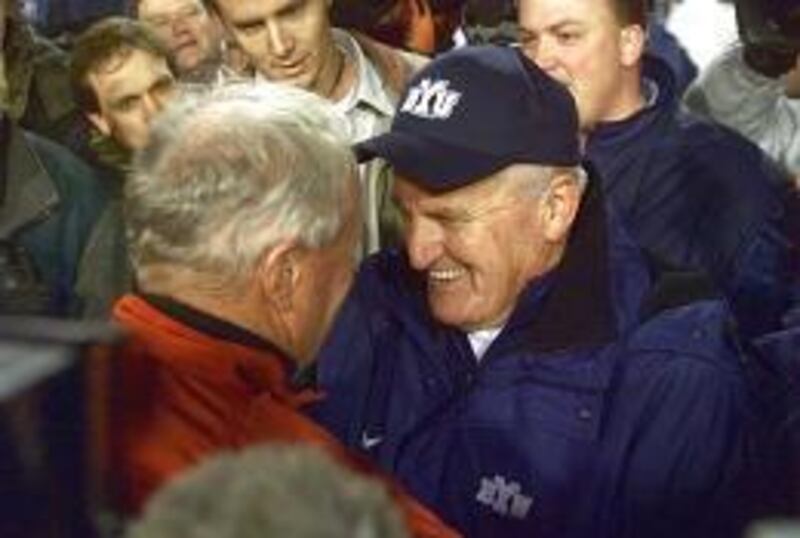
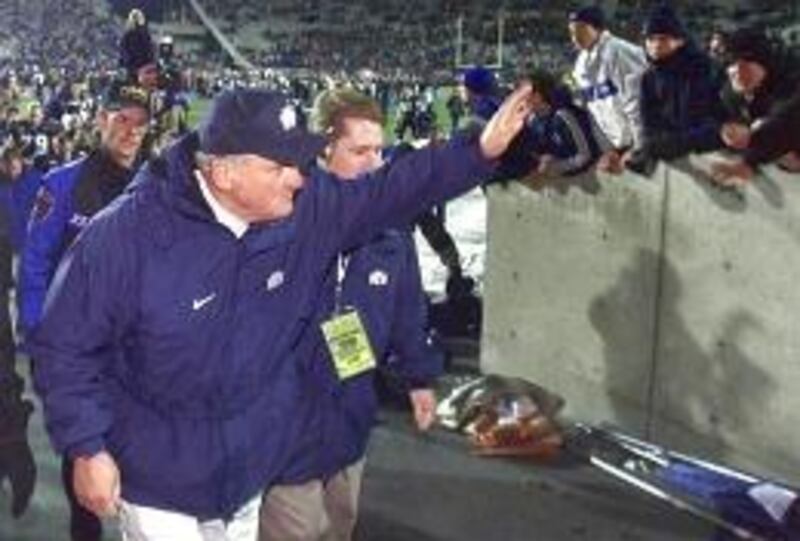
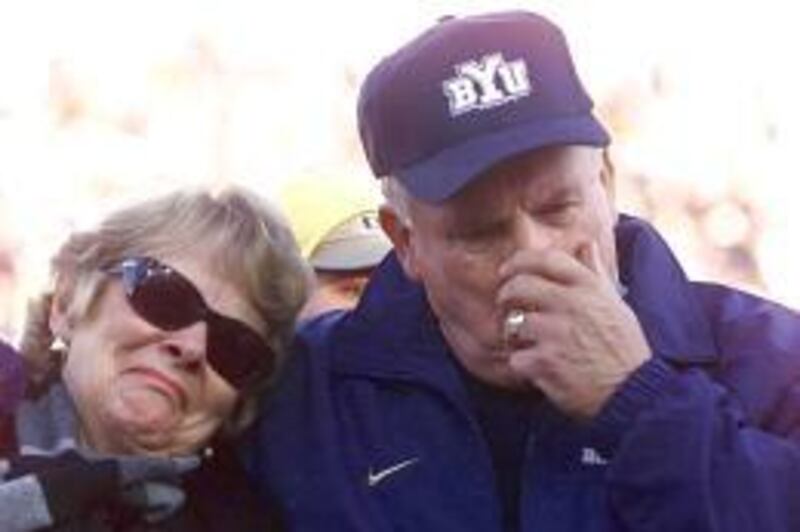
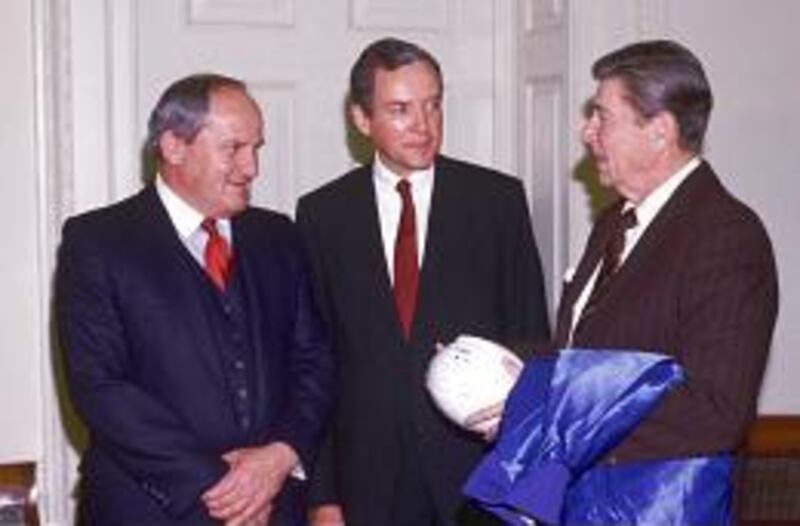
So my editor says to me one day, "Write a feature story on LaVell Edwards." Oh, is that all? Where do I begin? What would you like to know? That underneath that calm exterior lies the heart of a world-class worrier? That he treats co-workers so well they never want to leave his side? That he can't drive either a golf ball or a car in a straight line? That he does goofy things, such as attend the wrong funeral? That he expected to get fired during most of his career? That he's the finest man you'll ever meet, one who has moved through life without making an enemy, even in the intense world of football? That no one can ever remember anyone saying a bad thing about him, which works out well since no one can remember his saying a bad thing about anyone, either? That, despite success and fame and a healthy income, he has lived in the same modest rambler for 33 years? That one of his real passions is music, and that he has this thing for "Amazing Grace," which could describe the way he has moved through the world? That those who work with him believe he has some mystical power to control the weather? That, of all the things you could say about him, the best is that his wife and three children gush on and on about him? Write a story about LaVell Edwards? We'd better get started . . .
Here is what you don't know about LaVell Edwards:
He's a man's man . . . who loves growing and tending flowers in his yard — roses, begonias, impatiens, petunias, marigolds. "He likes ordinary, common flowers," says his daughter, Ann Cannon, "but in his yard they just look better than anywhere else." You can take the Orem farm kid off of the farm, but you can't take the farm out of the Orem farm kid. Each spring he returns to the yard in a pair of "flood" Levis, saddle shoes and an old golf shirt to plant, weed and till his gardens.
He likes to iron his own clothes because it's therapeutic and because he takes pride in his clothing. He's a dapper man who likes crisp slacks and tailored sports coats and thick sweaters, all immaculately cared for. He brushes his coats, polishes his shoes and presses his shirts and slacks. He shops at Mr. Mac and has an eye for fashion. His wife once brought home a new outfit for herself and showed it to him. He said it was nice, but the lapels were too narrow. She realized he was right. She took it back.
He is a gentle, kind man. When his father-in-law was still alive, Edwards drove to his house on Saturday mornings and helped him shave, bathe and dress to get ready to watch BYU's game. On weekdays he left the office to take him to lunch at Wendy's. On a road trip to Colorado State this year, he left the team to visit his old college coach, John Roning, in a retirement home. When his beloved high school coach, Sanky Dixon, was alive, Edwards wrote him notes regularly, usually something like this: "I do love you very much, and I'm so proud to have played for Sanky Dixon. Love you, LaVell." He always ended the notes with "I love you," or something like it. Sometimes Edwards included a quarter in the envelope — "give me a call."
"I see a lot of his dad, Philo, in him," says Dave Schulthess, a former sports information director at BYU. "He was my stake president, and he was just a kind man. The kind of guy you love. The kind of guy you go to if you need support. If you know his father, you see where some of (LaVell's) traits come from. He had a good laugh, too, and a good sense of humor."
Edwards is a pretty fair golfer who's known for hitting the long ball — destination unknown. As his frequent playing partner, Arnie Ferrin, says: "Straight is not in his game. He's been in places on a golf course I've never seen before. But he hits it a long ways."
Edwards has a 10 handicap these days, but years ago it was considerably lower. Ferrin sums up Edwards' game this way: "When I play with LaVell, I see him on the tee, and I see him on the green. You're just happy when you see him again."
Ferrin and Edwards usually have a steady flow of banter going during their rounds together. It often runs like this:
Ferrin: "I haven't seen you since the tee. What'd you have?"
Edwards: "A birdie."
Ferrin: "Gee, I would've enjoyed watching that. This is like playing by myself."
Says Ferrin, "We tease each other unmercifully on the golf course. He's fun to play with. He can laugh at himself — and he can laugh at me, too."
Willie and me
Edwards loves theater, musicals and especially music — all music. He has CDs that consist entirely of different versions of the same song, "Amazing Grace" (Judy Collins does his favorite version) and "A Closer Walk with Thee." He has another CD of Scottish bagpipe music (including "Amazing Grace," of course). He had a member of the football staff record a hodgepodge collection of his favorite tunes — Janis Joplin's "Me and Bobby McGee," Arlo Guthrie's "City of New Orleans," Credence Clearwater Revival's "Proud Mary," John Denver's "Sunshine on my Shoulders," Three Dog Night's "Joy to the World," the Eagles' "Take it Easy" and "Lyin' Eyes." He also favors early Willie Nelson, Hank Snow, Hank Williams, Montana Slim, Ella Fitzgerald and Tina Turner.
Edwards' idea of a great evening is to visit Preservation Hall in New Orleans and listen to old jazz. His jazz tastes run to Stan Kenton, Louis Armstrong, Kid Thomas and Emma and the Preservation Hall Jazz Band.
Every now and then, he'll play a tape in the tiny, outdated eight-track/cassette player that sits in the corner of his office and sing along as he writes letters and conducts his business under an autographed picture of Willie Nelson.
This is one hip old man who doesn't close his mind to anything or anyone, even though everything about his background and age might say otherwise. He once took his wife, Patti, and their children and grandchildren, to a Credence Clearwater Revival concert. The warm-up act was Iron Butterfly. So there he was, Grandpa Edwards, mingling easily with kids in black T-shirts who were asking for his autograph.
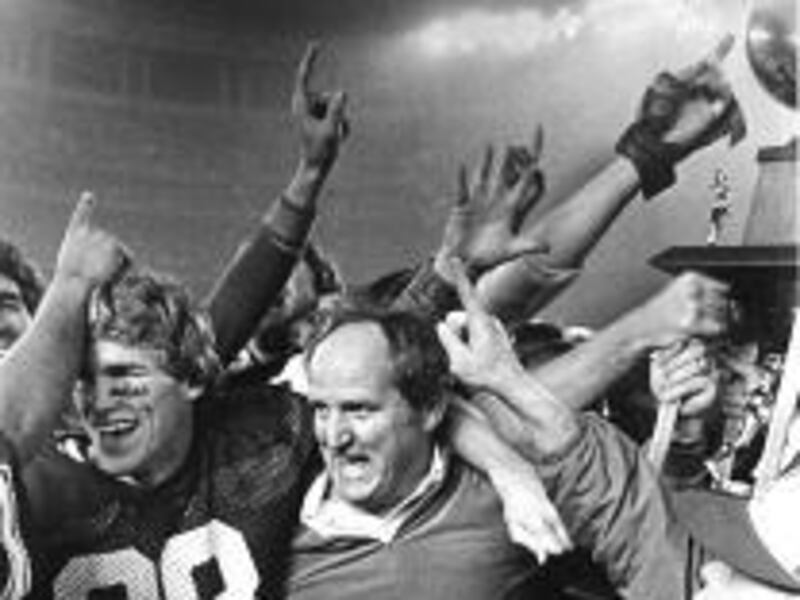
Edwards is a legendary coach, but he is an even better family man. We're talking about a father who jumped up and down on the bed to entertain Ann and a friend, with his shoes on. A guy who used to take his kids for a drive and make them close their eyes while he shifted into "flubber gear" and pretended they were flying. A guy who, when he announced his retirement at a news conference last August, referred to his wife as "my little Patti." And when he gathered his team for the last time following the final game of his coaching career, in the craziness of that breathtaking, last-second victory over Utah, what's the first thing he thought of, after God and saying the post-game prayer? "Three cheers for Patti!" he said, and the team complied.
The feelings are mutual. Not long ago she said she still gets goose bumps when she hears his car pull into the garage. His sons, Jim and John, are unabashed admirers — "You know what reminds me of my dad?" John says. "Rudyard Kipling's 'If.' That describes him perfectly." Ann says, "My dad was my idol when I was growing up. He still is." What does it say about Edwards that his children have become an orthopedic surgeon, an attorney and a children's author?
The miracle man
Did you know that he can control the weather? Well, anyway, that's what his players and assistants believe. "I swear, seriously, he controls the weather," says Chad Bunn, BYU's video coordinator. "A storm will be coming in, but we'll go outside (for practice) and it will clear up. Then the minute we walk off the field, it'll start storming. It happens all the time! All the time!"
"There are players who swear LaVell can control the weather," says defensive line coach Tom Ramage. "When it's time to practice, it could be raining everywhere but right here. LaVell would say, 'I just talked to the Man, and it's not going to rain.' The players did a rain dance once right on the field when it looked like it might storm. It didn't work. We had good weather."
"He's in charge of the weather," says offensive coordinator Lance Reynolds." Even when it rains all day and looks like it won't let up, we'll get nice weather. The baseball coaches complain because we are able to go out every day and get nice weather for practice. Then when football ends, it rains every day on baseball practice."
Edwards is a famously bad driver. It is considered a miracle — or divine intervention — that he has never had an accident. "I offered him $20 once if he'd pull over and let me drive," says Reynolds. "He's a horrible driver. He's driving and talking to you and looking at you like this (he looks at you while steering an imaginary steering wheel without ever looking ahead). Then Patti calls and tells him, 'Make sure you drive.' "
Assistant coach Brian Mitchell says, "He's the worst driver ever. We were driving to the airport once, and he was dialing his phone and looking in his briefcase and doing six things at once. We were swerving all over the place."
Ramage says, "He took one of our players to a function in Salt Lake, and the kid came back and said, 'I don't ever want to drive with him again.' He said he never drove with his hands on the wheel — he talks with his hands."
Here's something you need to know about now: Edwards, as you may have noticed, likes to do many things at once. Just try interviewing him on the phone sometime. In the background you can hear papers shuffling and Edwards saying something to his secretary off to the side and he's refilling the candy dish on his desk, and the whole time he's stuck on some word in the middle of a sentence " . . . uh, um, uhhhhhhh."
Edwards is distracted or preoccupied about half the time, which might account for his driving — or his absentmindedness. He once drove to Idaho Falls to speak at a church fireside. After much looking, he couldn't find the address where he was supposed to speak, so he found a local Mormon bishop and asked for directions. There was supposed to be a fireside, all right — in Twin Falls, 2 1/2 hours away. Well, he got the "Falls" part right, at least.
His faithful, longtime secretary, Shirley Johnson, once noticed that Edwards had written out a check to "Holy Ghost," which might explain his ability to control the weather. He had meant to write the check to Holy Cross Hospital. Edwards stood in line at a funeral viewing for an hour once, accepting the heartfelt thanks of the deceased's family for his attendance. Then he arrived at the casket and looked inside only to realize he had no clue who this man was.
BYU players have a tradition of huddling at the end of practice and, led by a coach or player, they shout the name of that week's opponent. Edwards did the honors one afternoon and shouted "UCLA!" Which would have been fine — except they weren't playing UCLA that week.
Here's something else you didn't know about Edwards: He's a worrywart. Don't let the calm, bored exterior fool you.
There's a whole pot of worries brewing inside the man. He once grew himself an ulcer, which he controls now with medication. It is laughable today, but during much of his coaching career he worried he was going to be fired. Every time he had a winning season, he would say to himself, "Well, that ought to be good for three more years."
Edwards is something of an insomniac. He might look sleepy over there on the sideline, but he's a lousy sleeper, especially after a game. After the recent win over Utah, he was awake until 3:30 a.m., wandering the house, reading, watching TV. That's the way it was for him after every game, win or lose. He's too wired to sleep.
'Controlled fire'
Here's something else that Edwards' stoicism hides: He is intensely competitive. As Ann tells it: "He hates to lose. When I was in high school one of the boys in my ward told me that he hated to play basketball against my dad because my dad wasn't particularly careful with his elbows. Also, he wasn't above stepping on priests' toes when priests went up for a shot. . . . If you don't know him, and you see him on the sidelines, the first thing you see is the steel in his face. . . . He is tough and full of controlled fire."
Edwards confesses that football losses "ate" at him. The wins never made up for the losses; he was always more pained by losing than he was happy about winning. The losses, as well as the self-imposed pressure and the sleepless nights — they all got harder as he got older, and then in the past few years he says he carried the added burden of wondering if it was a young man's game and striving to overcome that.
One other thing you wouldn't know about Edwards: Maybe the man is 70 years old, conservative and a lifelong resident of Utah — but he is remarkably at ease among people of all backgrounds, races, appearances, personalities, whatever. Last summer he stopped at a 7-Eleven in Salt Lake City, and there was a man sitting in the grass by the parking lot. He was shirtless, bald, tattooed — and, oh, yes, a snake was wrapped around his body. "What kind of year we going to have, coach?" the man called out. Edwards stopped and talked to the man for several minutes. "I think we're going to kick some rear end," he said finally.
He is similarly at home with the young men who played for him. He liked to mingle with his players while they were in the cafeteria. He walked around the room, eating french fries off one player's plate and chicken off another plate, the laughter and one-liners moving around the room with him.
"I love him to death," says safety Jared Lee.
And most people feel the same way. In a profession not known for longevity and loyalty, five of his assistant coaches have been with him a combined total of 102 years. They credit a large part of that to wanting to work with Edwards. Similarly, the three football office secretaries have been with the coach for a total of 51 years. Even his video coordinator, Bunn — a self-described "low man on the totem pole" — has been there 19 years.
Edwards himself is fiercely loyal — some would say to a fault. For instance, he never took a scholarship from a player when it became clear he wasn't going to be good enough to help the team. This is unheard of at any other university.
Says defensive coordinator Ken Schmidt, "We'll say, 'Coach, we got some dead weight here. These players are not going to help us. We got some guys who shouldn't be here.' We (Edwards' assistants) are pounding him about it all the time, but he'll say, 'We can't. I made a promise to his parents. We're not going to back out of it.' It hurts us. We don't have the depth we need. But he won't do it."
The irony, of course, is that Edwards also kept his assistant coaches year after year when others — fans and some administrators — urged him to bring in new blood every time they failed to win 10 games in a season. Edwards would have none of it. Assistant coach Chris Pella relates Edwards' philosophy this way: "If you had a family and one of them had a problem, wouldn't you do everything you could to help them and not get rid of them?"
It is Edwards' loyalty and integrity that caused him to coach this year — he actually decided late last January that he would retire right then and there, but then he remembered he had promised a recruit's mother that he would still be the coach. It is his loyalty and integrity that caused him to announce his retirement before the season began, instead of afterward, as he originally planned — a recruit asked him if he was going to be the coach next season.
Behind the frowny facade
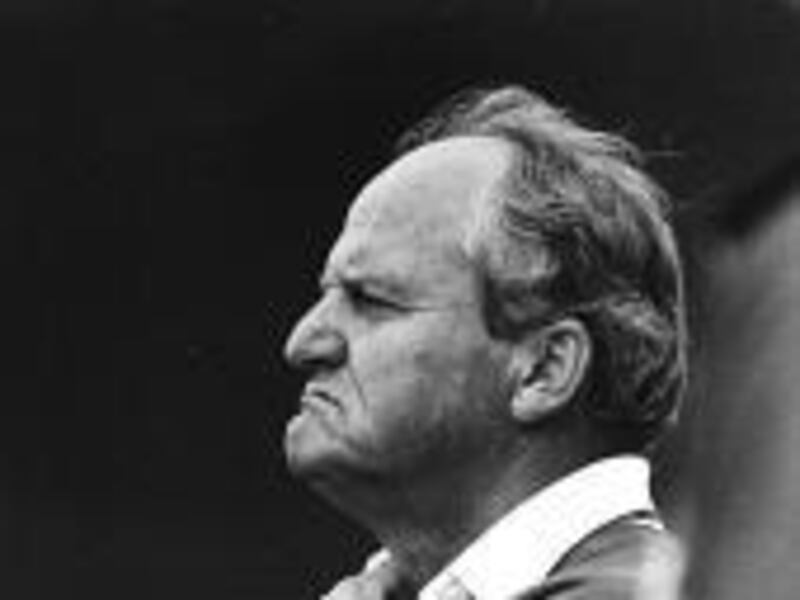
There is something important you should know about Edwards: He keeps his ego firmly in check and is very comfortable with himself. Big deal, you say? Wait, it matters. It accounts for why he could stand on the sideline with his arms folded, looking bored, week after week, knowing full well that it led many to believe he didn't have anything better to do. "If he cared what others thought, he'd act differently out there," author Lee Benson once wrote. It accounts for why he was able to delegate to his assistant coaches and allow them to take credit, even when it sometimes came at his expense. It accounts for why he's so thick-skinned when it comes to criticism. Earlier this season, a reporter wrote that Edwards had coached too long, that he should have quit years ago; the next day Edwards was seen doing an interview with the reporter, as if nothing ever happened. Edwards once said: "It's hard to keep track of all the guys you should be ticked off at — so why bother?"
It accounts partly for why the man possesses such a mild temperament. "In 25 years, I have only seen him lose his temper a couple of times," says Reynolds. It accounts for why longtime assistants such as Dick Felt say, "I never remember him being negative about anybody. We'd sit around talking about coaches or whatever, and he'd always find something good to say about someone."
All of the above has made Edwards universally well-liked. As Joe Paterno once noted, Edwards is without enemies in a business that is filled with feuds and grudges.
If ever there was an ego test, it came when Benson, the Deseret News columnist, wrote Edwards' book, "LaVell/Airing it Out." Usually when a celebrity agrees to do an "as-told-to" book, the subject makes frequent revisions, trying to make himself look better or to put a better spin on things.
Recalls Benson, "As hard as this may be to believe, after we had completed the interviewing process, not once did he tell me what to write, or who to interview, or what to leave in or take out of his own book. . . . The only thing he said was, 'Make it so I don't sound like a P.E. major from Utah State.' " When Benson turned the finished manuscript over to Edwards for a final review, he fully expected the coach to make changes, as any other subject would have.
"He made one change," says Benson. "He changed Eldon Fortie's height and weight."
At the root of all of the above, of course, is Edwards' personality. In some ways it isn't even fair; he is all those good things without even trying; he is who he is naturally. He is Philo's son. Reynolds said it best: "He never got tangled up with who he is. He isn't full of himself. That hasn't come with age; he's always been that way."
Edwards is as comfortable as an old shoe. Players seek him out for advice in matters of marriage, school and personal problems. Famous coaches have come to his hotel room to ask for advice about serious problems with their programs. Coaches such as Dick Tomey liked to play golf with him the day before their teams played, even though he said he would never do such a thing with any other coach.
"The effect he had on people and the respect they had for him was amazing," says Felt. "People around here have no idea the impact he had nationally. Coaches would seek him out at conventions. They liked to be around him."
Edwards' charisma, his easy, laid-back charm, has paid big dividends for all involved. For 29 years he carried the banner of the university, not to mention an entire church, and never once said or did the wrong thing. He redefined his job; he became a missionary tool for his church, one of the most visible Mormons in the entire country, along with LDS Church President Gordon B. Hinckley and Steve Young and Jon Huntsman. He became such an institution that during BYU's interviews with his potential successors, their No. 1 concern has been following the Edwards legend.
Here's one last thing about Edwards that is lost on most people because of his famous frowny facade: Edwards is a happy, humorous man with a sharp, dry wit. Rule No. 1: Never, ever engage him in a war of wit and one-liners. "You don't want to exchange barbs with him," says Schmidt. "He's the king." Says Mitchell, "He's just too quick." And from Pella: "Coaches call him the Rodney Dangerfield of coaching. He gets off the one-liners, I'll tell you that." As Johnson says, "Most people just don't know how funny he is. . . . If he was the one being roasted (at a formal roast), he would touch on every person who had spoken on what he or she said and zing it right back at them."
After a half-century in the public eye, Edwards is leaving coaching. He'll work for the university for a year, and then he'll probably serve a mission for his church. Never one to sit still, he vows to stay busy. There are still flowers to grow, and a short game to work on, and grandkids' ball games to attend, and music to listen to, and the love of his life to date, and something besides football to worry about.
E-MAIL: drob@desnews.com