

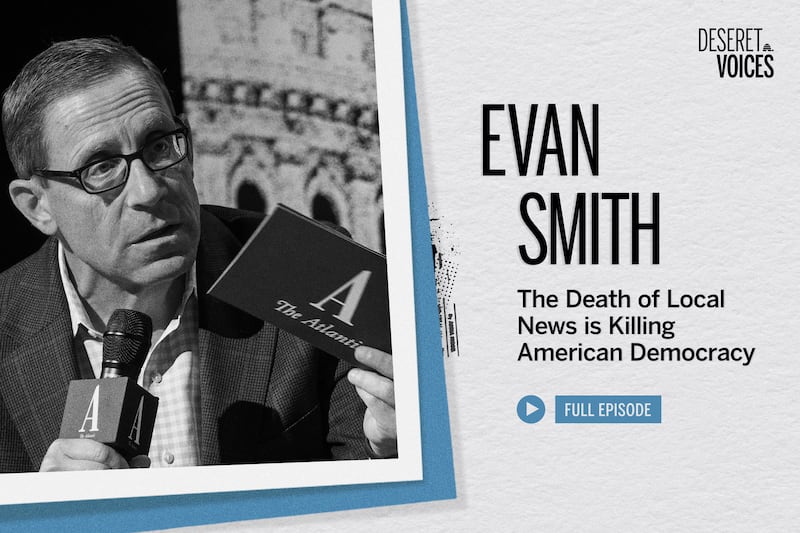


Evan Smith, managing director for events at The Atlantic, cites a statistic from the Gallup poll that only 8% of Republicans trust the media.
Smith believes journalists can restore confidence in the industry and better understand the issues plaguing the nation by having conversations with people across the country. That’s why he initiated “The Atlantic Across America” tour.
This episode of “Deseret Voices” covers the Salt Lake City stop of that three-year, 50-state circuit as Smith explains why “the call’s coming from inside the house” in regard to the problems facing journalism.
Subscribe to “Deseret Voices” on YouTube, Apple Podcasts or Spotify.
Note: Transcript edited by Steven Watkins.
McKay Coppins: Well, Evan, thank you for coming out here and thanks for putting this all together.
Evan Smith: Yeah.
MC: I want to start by asking you about “The Atlantic Across America” effort. Because you have been, you know, you’ve done a bunch of these events already, you’ve been all around the country. We are a publication that was founded in Boston, now headquartered in Washington and with a large presence in New York City. And, I feel like one of the inspired things about this kind of 50-state tour is that it’s given us a chance to get out of kind of the Acela Corridor. At a time when so many of the most important stories are happening outside of those places. We get so much attention on Washington, there’s so much attention on national politics. But I’m curious, as you’ve traveled the country, as you’ve met with people, as you’ve had these conversations, has anything surprised you? You know, what are the kind of big themes in these conversations?
ES: Well, I would say first of all, the thing we’re trying to solve for is the knock on the media business as a bunch of coastal elites turns out to be mostly true.
Right? The sources of news that most people even in the middle of the country consume come from one or the other of the coasts. And the reality is that the people who produce that news on the coasts have a coastal perspective. You do not understand the country unless you go out into the country. And so, for those of us who are in the business of producing journalism for a national audience, it would be nice if we could get out of our comfort zones every once in a while and travel the country. And so, we’re trying to solve for that.
Look, what I have found, what we’ve all found as we’ve traveled the country, is that the people in, again, in the case of the places we’ve been, Phoenix, Santa Fe, Durham, Omaha, New Orleans, they care about the same things as the people on the coasts do, in the end. At least at a high level. People are concerned about the economy. People are concerned about some of the social issues that you’ve touched on today, the fact that for a lot of people they feel isolated and lonely from their friends and neighbors, and even from some of their family members because politics has infected everything. People feel disconnected and dislocated. People are concerned about the state of the world.
People are actually concerned about the old ways of living our lives that have suddenly become delegitimized in this era of no more norms, no more guardrails, no more institutions. We’ve overthrown everything that we took for granted for decades for our entire lives. People are feeling the effects of that. That is no different in New York than it is in New Orleans. That is no different than it is, you know, in D.C. than it is in in Durham. And so, one of the nice things about this tour has been to be able to have conversations with people on the ground to discover that we are really defined as a country more by what unites us, by the things we have in common. And it is very easy to forget that if you hunker down on the coasts.
MC: You know, as journalists, I think there is sometimes a sense, especially as so much of the media has become concentrated on the coasts, and as the local journalism industry has just been decimated over the last couple of decades, there’s this sense among a lot of people that journalists are kind of in an ivory tower, and they’re in their own echo chamber, and they’re not aware of what the average person thinks of our industry. And, you know, we have a lot of faults, but I will say journalists know what people think of our industry.
ES: Oh, boy, do we ever. And it’s not good.
MC: It’s not good. We, like a lot of other institutions in American life, are suffering a crisis of trust and a crisis of authority. And I wonder, you know, from your perspective, and given your background in media and including in local journalism, where do you think that comes from? Why do fewer Americans now trust the press than ever before?
ES: Well, let’s first of all put some numbers to that because we talk all the time about the decline in trust, but the numbers are pretty stark. The last Gallup poll, which does measure the trust that Americans have in the media, found that only 28% of Americans had a great deal of trust in the media. That is historically a low. Thirty-one percent had the previous year. We thought, well, it can’t get any worse, and at this moment in our country, just when you think you’re in the basement, there’s another basement. So, we went from 31% down to 28%. Who knows what it’s going to be this year?
I’m more interested in by party because I live in a red state, Texas. We are in a red state, Utah. Republicans only have 8%. Only 8% of Republicans have a great deal of trust in the media. I mean, we are divided by so many things, and we’re divided by ideology along with everything else in our view of the media. How did we lose the trust of the American public? I think it’s two things. I think on the one hand, people in office have intentionally, actively undermined faith and confidence in the media. They’ve said it out loud while they’ve been doing it. And I think that this is the plan working as intended. I think it was clear to some people in office that if they attack the media, that would be a successful strategy for them politically. So that when the time came that the media wrote negative things about them, they could turn around and say, “Well, the media’s worthless. I’ve been telling you that for years.” And people believed it.
But I think the second thing we have to acknowledge, McKay, is that we did this to ourselves to some degree. Right? The call’s coming from inside the house. Right? We’re way too arrogant, we’re not humble enough, we don’t do a good job of walking in other people’s shoes. I mean, there are all these things that we expect of other people that we don’t expect of us as an industry or of us as journalists. And I think it’s time for us to acknowledge we have been imperfect, and we partly own the lack of trust.
MC: I totally agree with all of that. I also think that, you know, a big problem is that national publications like The Atlantic, like The New York Times, The Wall Street Journal, Washington Post, have been kind of put into a role that they were not totally supposed to play. We were not supposed to be the ones telling every American the story of their community, right? We were not supposed to be the ones who were providing the main source of news to, you know, every person in, you know, Albuquerque or Salt Lake or or Phoenix, right?
It used to be that people would get a local newspaper delivered to their, you know, their doorstep every day, and then they would supplement that with, you know, maybe a national magazine subscription, maybe they would watch the nightly news on CBS or ABC or NBC. But their interaction with the media, with the press, was through journalism being produced by people in their communities who maybe shared their values, who maybe went to the same middle school that their kids were at, right? That’s why the work that the Deseret News is doing is so important, it’s why, you know, as we’ve done this 50-state tour, we have looked for local news organizations to partner with everywhere we go. But talk a little about, especially as somebody who, you know, formerly ran The Texas Tribune, talk a little about the toll that it takes on a community when the local news is hollowed out.
ES: Well, I think the antidote to the poison is proximity. I think you’re exactly right. I think that when people know the people who are producing the news in their community, they know the reporters, they know the editors, they see them in the supermarket, they see them on the sidelines of kids’ sports, they have a sense of who those people are. It is much harder to hate somebody you know up close, who you’ve known in your community, and you inherently have more trust in somebody who has been in the community walking alongside you for years, even if you don’t like them, even if you don’t agree with them. You at least know that they have been in the community, and therefore, the stories they’re telling in the community are more likely to be ones you’d recognize.

The old Tip O’Neill adage, “All politics is local,” has been inverted. Now it’s all politics is national, and I would argue that because of the news deserts that we see all over the country, all media is largely national, too. When people hate the media, they’re often talking about the national media. They’re often talking about the cable television shows, they’re talking about the big national newspapers that to McKay’s point, parachute somebody in when there’s a crisis in your community, they extract everything they can over the course of a couple days, they go back home and they tell the story. They may have been here, but that’s not proximity. That’s not local news. That’s telling the story of something that happened in a local community, but it almost always has a national cast to it. So, I think the local news crisis has been — it’s played out on a number of levels, and it’s exacerbated this problem of us feeling in our communities like we don’t know one another, don’t know ourselves.
And I wish that we can undo what’s happened over the last 20 years. We’ve lost a third of American newspapers over the last 20 years. We’ve lost 70% of the employees of newsrooms across America in the last 20 years. Most of the newspapers in this country that remain are weeklies. There are more than 200 counties in this country that have no source of news, and another 200 that are about to join them in having no source of news. So, what does that mean? What is the net effect of that? We live in two Americas, one informed and one not. If you’re fortunate enough to live in a city like this one, where you have the Deseret News and you have The Salt Lake Tribune, you have a place to go to find out what’s going on and how it affects your life and the lives of your friends and neighbors.
But in too many places in this country, people have absolutely no place to turn. So where do they end up? They end up looking at whatever’s in their feed. There’s misinformation and disinformation, conspiracy theories that rush in to fill that void. And again, the lack of local news is the precipitating event that causes that to ultimately happen. And you’re right, the national media ends up filling that void to some degree as well, but it’s not helping. It’s not creating for local communities a sense of this is who we are, this is what’s going on, and this is how it affects us.
MC: Yeah, it’s funny. You know, then there’s this kind of self-destructive cycle where as local news outlets are hollowed out, and as national media, let’s be clear, that industry is under strain as well, they can’t be everywhere, we don’t have the same number of reporters we used to have. what ends up filling the void is, you know, news influencers or TikTokers, or in many cases, you know, conspiracy theorists, podcasters, whatever. I remember doing a story a couple of years ago where I went to Moscow, Idaho, where there had been this, you know, terrible murder, you know, multiple murders on a college campus in Idaho.
And I had gone to just kind of, you know, take a survey of what the community was doing, how they were feeling in response to this terrible thing. And what I found was that I was, you know, a reporter doing the normal thing where I was just trying to talk to neighbors and knock on doors and, you know, ask them, you know, polite questions, and nobody wanted to talk to me because they assumed that I was, like, a TikToker, that I was going to whip out my phone and, you know, ambush them with crazy questions and then post them. And they had started to blur the lines between the kind of true-crime industrial complex on social media and the normal press. And to the average person, it was just all the same, that was the media. And they are, you know, destructive and terrible and irresponsible and reckless, and I don’t want to have anything to do with them.
ES: Yeah. Well, to your point just now, that’s the most important thing that we’ve heard all day. To the average person, it’s all the same. The average person does not have the media literacy to be able to tell at first blush —or at any blush — the difference between The New York Times and your local paper, and a kid on TikTok and a conspiracy theorist on Facebook. It all runs together, as we say in the map business, right? One mile equals one mile. And I think that one of the problems we have is there’s so much information. I mean, the problem is not that there isn’t as much or more news and information as there’s ever been in our lifetimes, is that so much of it is not true. And the inability to distinguish between what’s real and what’s not real is a form of poison as well.
And so, I mean, I’m actually kind of sort of glad to hear that their only concern was that you were a TikToker. I was worried you were going to say that they thought you were from Huffington Post or something, you know? The reality is that most people in their busy lives, trying to get their kids out the door to go to school, trying to go to the supermarket to buy food and to get gas for their cars and all the things they worry about, most people don’t have the time or the inclination to spend thinking about, well, is this a real news source or not a real news source? We, in the business, talk about this stuff all the time. I don’t think the average person thinks about this nearly as much, and so it all collapses into the same same.
MC: There there’s a story that our our mutual boss, Jeffrey Goldberg, editor-in-chief of The Atlantic likes to tell where he had written a story where that was based in part on anonymous sources, right? These are government officials or people in the know who had told him something and asked, you know, not to be named. And the story was published, and he heard from a reader who said, “Well, I just don’t understand how you can publish something so incendiary based on people that you you don’t even know. You don’t know who they are.” And he was like, “Well, no, no, no, they’re not anonymous to me, they’re anonymous to you.”
But the point that he likes to make is that the average person just knows very little about how journalism works, and I don’t really blame them, it’s not their job to learn how the journalism industry works, everybody’s busy. But I wonder, you know, if you we want to kind of break out of this cycle, and instill more media literacy, flood the information ecosystem with better reporting, better news, better information, what should we as an industry be doing differently?

ES: Well, I think what you just described is exactly what we need to be doing first and foremost, and that is get people inside our process. People will trust us more if they don’t have reason not to trust us, like that sounds self-evident, right? But if we show them how we produce the work that we produce, that we’re not there for any other reason than to search for the truth and tell you what we found, and here are the steps that we went through to do that, I think that will go a long way to giving people at least a better understanding, which is a necessary condition on the way to people trusting us.
Like fourth graders in math class, we have to show our work. And I think that for too often, we’ve assumed people understood more about the way we do journalism than they actually do. So, I like you, don’t blame the people for not understanding that anonymous sources were people who we knew, but we didn’t tell you who they were, but that they were anonymous to us. Like, we haven’t explained nearly enough the work that we do.
I’m actually thinking about David Fahrenthold, who at the time was at The Washington Post but now is at The New York Times, who was reporting in the first Trump administration on the Trump Foundation and was tweeting out every couple of days pictures of this big chief tablet, this legal pad where he was writing the names of organizations he was attempting to see if the foundation had given money to. He was basically crowdsourcing, that’s what we would call it now, his reporting by showing people this is the list of organizations I’m chasing, I’m reporting on, I’d like your help, I’m going to let you know every time I get information. He showed his work in a way that I thought was almost transformational.
And I would say that I think all of us in journalism have not done a very good job over the years of making this a two-way conversation. We still act like it’s a one-way conversation. Readers have a different sense of what our obligations are to them, and I think we have to increasingly pivot toward being as transparent about our work, as transparent as we expect the people we cover to be, and show the process behind our journalism.
MC: You talked at the beginning about the deliberate effort by political leaders to discredit the press for self-interested political reasons. We’re also in an era where political leaders to a, you know, an unprecedented degree, at least in modern times, are using the instruments of the state to try to crack down on the press, to you know, silence the press, to intimidate journalists, to try to extract money from them, to essentially bully them into compliance. And I’m curious, what what you make of this moment and how the industry is responding.
ES: Well, I think it’s terrible. I mean, the people who are leading agencies of the government responsible for the communications industry sound like bad mobsters in bad mob movies. You know, “Nice little news organization you’ve got there, it’d be a shame if something happened to it,” is effectively the message from government when government doesn’t like what news organizations are reporting. The threats to journalism and to journalists are legal, they’re financial, they’re regulatory, and in some cases, and — I can’t believe I’m saying this with a straight face — they’re physical threats. Right?
Now we in journalism understood what we signed up for, not our first rodeo, and at the same time, this environment that we’re in, it’s kind of almost unprecedented. Like, I always hesitate to use unprecedented because every time you call something unprecedented, it almost certainly isn’t. But in this case, I think the threat environment for the media, beginning with the kinds of threats coming from government, is really pretty close to unprecedented. What do I make of it? I don’t make very much of it. I think that we’re going to be permanent, they’re going to be gone in a couple years, whoever these people are. Like, I think the media business is not going to be cowed by this. But it definitely creates, and new people will replace those people at some point, and we’ll have a different, hopefully, a different view of this, but it definitely creates yet another thing that the media business is grappling with and that it has to solve for as it attempts to do its job.
MC: All right, as we finish our conversation because I want to end on a hopeful note here, as you’ve traveled around the country, as you’ve seen the press operating, you know, in various different states and and towns and cities, what gives you hope? What gives you hope about the future of journalism and the future of American democracy?
ES: What gives me hope about journalism is that while much of the traditional media business is starting to to wither on the vine, all kinds of new organizations are stepping in to fill that void, right?
I mean, I’m a big believer in nonprofit journalism. I was a co-founder of a big nonprofit journalism outlet in Texas, as you mentioned, called The Texas Tribune, ran it for 13 years. All over the country over the last 15, 16, 17 years, we’ve seen like mushrooms after a rainstorm, as the legacy media in cities and states has started to draw down, news organizations, entrepreneurs, people who believe in the community, who want to provide that reliable source of news are emerging, creating organizations that are finding their way. I don’t think it’s either or. I think it’s both and. America needs both the Deseret News and The Salt Lake Tribune. I think that when people make it binary, that’s a mistake. We need more of this stuff. It’s both and.
But it gives me hope that in a lot of places around this country, in Nebraska, in Maine, in Montana, in Mississippi, in Texas, California, New York, Montana, we have seen really extraordinary news organizations start out of whole cloth, find sources of funding that have allowed them to do the kind of explanatory and accountability reporting that we need. So, I’m hopeful because I have no choice but to be hopeful, but the evidence is there. It’s a revival of sorts of the kind of journalism that we and everybody in this country needs, and I choose to be positive about it.
MC: Evan, thank you for doing this.
ES: All right, thanks, McKay.