

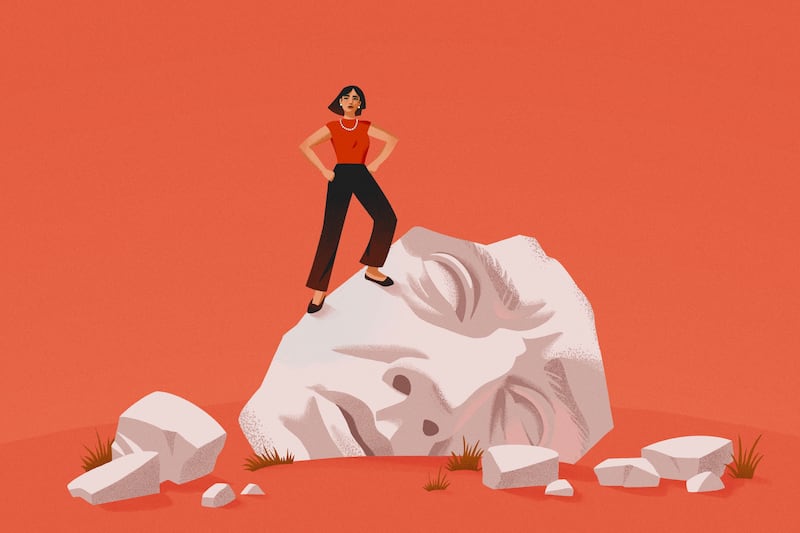


Legend has it that the Amazons, the warrior women of Greek mythology, built a civilization on a single premise: Women could build a world of their own without men.
The Amazons kept no husbands. They raised only daughters, sending their sons away, and they even cauterized their breasts so nothing would get in the way of their ability to fight. The legend reflects a fantasy that has appealed to different times, places and people: that a woman becomes strongest not by pairing with a man but by providing for and protecting herself — often with the support of some strong sisters.
Millennia later, many young American women are embracing this Amazonian strategy of detachment from men, minus the sword and the horse. They’re doing it by deleting dating apps, posting “boy sober” TikToks, enjoying Sunday brunches spent with just female friends, and hardening their conviction that men are more trouble than they’re worth.
Young women say they are put off by men who toy with their bodies and emotions, and those who seem stuck in “limbo between adolescence and adulthood,” dubbed child-men. They are discouraged by mainstream media depictions of men as emotionally and socially stunted, as well as those presented by influencers who get clicks by painting men and marriage in the worst possible light.
In short, growing numbers of young women are being tempted by heteropessimism.
This pessimism is reflected in young women’s declining faith in love and marriage. Only 24% of women 18–29 believe “married mothers are ultimately happier than other women,” far lower than any other group. High school girls’ hopes for marriage are also retreating: In 2010, more than 80% expected to marry; now it’s just 67%.
Dating tells the same story: We’re in a “dating recession.” Pew found 39% of single women under 40 aren’t even looking for a relationship at all, and our own research at the Institute for Family Studies and the Wheatley Institute shows more than 80% of eligible women in their 20s and 30s aren’t dating anyone seriously. A growing number of young women seem content — or resigned to — going through life without a man.
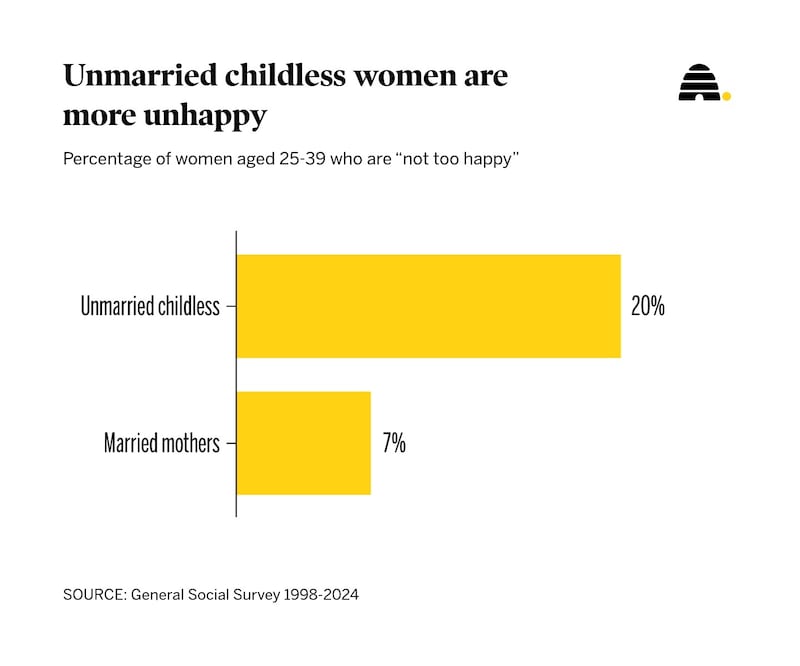
We understand the appeal of the Amazonian strategy. But the apostles of women going their own way — like the Hollywood actress feted in The New York Times for declaring herself “choicefully single, happily, gloriously single” — miss something crucial: For all too many, this path leads not to liberation, but to a more anxious, lonely and unhappy life. Unmarried, childless women in their 20s and 30s are nearly three times more likely to be unhappy with their lives compared to married mothers the same age (25-39), according to the General Social Survey. Heteropessimism really is a trap.
Perhaps that explains why so many hurting women in their 30s are showing up for help at the office of Suzanne Venker, an author and life coach who recently discussed the pattern with Chris Williamson on his “Modern Wisdom” podcast. These 30-something women are coming to Venker desperate to start or sustain a good family life but with no idea how to do so. Most spent their 20s building the scaffolding of independence — careers, savings, status — exactly as second-wave feminism had scripted, while dating and family sat on the back burner.
By the time they feel “ready” in their 30s, the switch doesn’t flip on command. Many found it hard to find a good man given that the pool in their immediate circles had shrunk; others found unanticipated difficulty in pivoting from a life focused on career and travel to marriage and young kids; still others found getting pregnant difficult or impossible, especially if they were in their late 30s. The Amazonian detachment they leaned into in their 20s, it turns out, does not reverse itself just because a woman decides she’s finally ready for a family.
Venker’s project now is to help younger women avoid the pitfalls she’s seen play out in the lives of her older clients. That’s a tall order. It’s nearly impossible, in her experience, to convince a 20-year-old woman who hasn’t begun to think much about a family that she should. But Venker said she hopes these young women can be convinced, at the very least, to build a life that maximizes their options to build a family.
To that end, Venker offers three guideposts. First, if you find a good guy, be open to marrying “youngish” (mid to late 20s, broadly defined). The husband hunt gets harder after 30, and today’s dating market isn’t doing anyone any favors. Women looking to make a smarter choice should be open to playing the odds early, starting with the biggest pool some of them will ever encounter: college. This also widens the window for building a family.
In Venker’s words, the “choice to marry young(ish) has so many benefits — a better dating pool, strong fertility, the opportunity to build wealth faster.” As she told Williamson, this is the math her clients keep learning too late: “The running joke is, well, I’m trying to get to you when you’re 22 before you come to me at 32. But at 22, you’re not interested, and at 32, you’re like, help me, help me.”
Second, she recommends dating with intention. “There’s just so much pretending going on” in modern dating, Venker says, and her fix is blunt: “Just get it out on the table in the first three dates” in terms of what you’re looking for in life and love — in terms of family, career and whether or not you and your partner are aiming for something more casual or committed.
If family matters to you, figure out if the man you’re sitting across from on a dinner date is marriage material. That includes sizing up a man’s character and his professional possibilities — not his wealth, but his reliability as a provider, since a wife generally needs “a man on whom you can depend financially (even) if only for a short period” while she steps back to raise young children.
She points to a telling gap in public opinion: 71% of Americans believe a man should be able to provide for his family while only 32% say the same of women. “That says to me that we know instinctively that women become vulnerable when they have a child,” she says, “and that they’re going to need support, both emotional and financial, for some period of time.”
Third, Venker says women who are particularly family-minded should choose a career that complements their future family dreams rather than competes with them. In college, for instance, this means picking a major “that works well with the kind of life you want to have down the line,” flexible enough to be “done part-time or from home,” rather than choosing an expensive degree that locks in a decade or more of debt just as her priorities start to shift.
“Rather than putting career at the center of your life and trying to fit men and marriage and motherhood in around that,” Venker says, “I want them to do the reverse.”
This strategy isn’t for every woman, but her point is that those who want to prioritize family would be wise to aim for careers with built-in flexibility — nursing and teaching are classic examples, financial advising and consulting are newer ones — that allow for part-time or freelance work and make it easier to combine work and motherhood.
In essence, Venker is asking young women to do what might seem unthinkable: plan for a future they’re not sure they’ll want, because they’re immersed in a culture that prizes Amazonian detachment. In this culture, to date with marriage in mind, and to choose a career with a future family in mind, is to swim upstream.
Journalist Matt Yglesias recently theorized that what family-first conservatives like Venker really want is to suppress women’s ambition. Maybe steering women toward flexible careers can be read that way. But doesn’t that badly shortchange the word “ambition,” relegating it to the realm of the marketplace alone? Why do we call a woman’s hunger for a high-status career “ambition,” but not her hunger for a rich and meaningful family life?
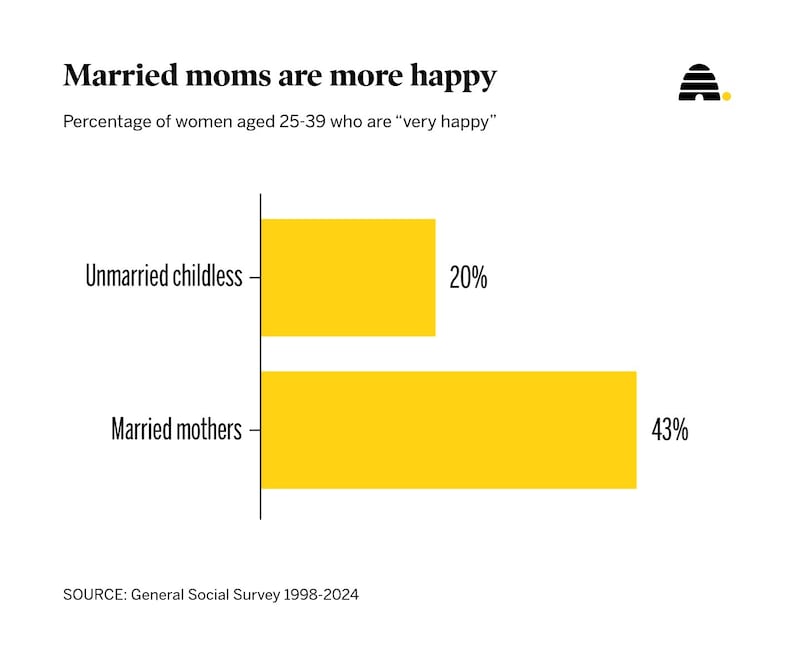
However regressive some commentators find it, most women end up being ambitious for family life, even as many are also ambitious for rich intellectual and professional ones too. And the women who build families with men in marriage are among the happiest in the country.
Venker’s argument, in part, is that women should own that ambition outright, rather than confess to it in hushed tones once they round the corner into their 30s. It is a natural ambition, and though its returns are often intangible, they run deeper than any paycheck or promotion.
Near the end of the podcast, Venker makes her clearest case for her advice. She describes a mother standing behind her toddler as the child climbs stairs alone for the first time: “Each time he climbs to the next step, he’ll turn around to see if you’re there. ... And by the time (he’s done climbing), you have just created a human in that little space there of trust that is going to carry them the rest of their life.”
Moments like that don’t show up on a balance sheet or translate easily to a curated feed. But millions of them, stacked across what can feel like short years of long days, build the kind of life most women actually want.
It’s a small tragedy that today’s cult of Amazonian independence talks too many young women out of leaving room for the risks and rewards of finding a good man, marrying and starting a family. But for those who want to maximize their odds of building a life that’s happy and meaningful — and, yes, sometimes messy and chaotic — the three pieces of advice Venker offers are worth taking seriously. Because for most young women today, the path to a meaningful, happy life runs not toward Amazonian detachment, but toward a man, a marriage and a family.
Maria Baer is a contributing writer at the Institute for Family Studies. Brad Wilcox, the author of "Get Married: Why Americans Must Defy the Elites, Forge Strong Families, and Save Civilization,“ is Distinguished University Professor of Sociology at the University of Virginia and the senior fellow at the Institute for Family Studies.