



When John Curtis was sworn into the Senate last year, he found himself at a bit of a crossroads.
He was filling the seat of former Sen. Mitt Romney, who had established a national reputation as an independent-minded Republican willing to buck his own party — including the man at the center, President Donald Trump.
As moderates in the Senate watched to see if the mild-mannered newcomer would take on that role, Curtis sought out a different path.
He wouldn’t be a rubber stamp for the president, he decided. But he wouldn’t be a constant naysayer, either. Instead, he found there was an opportunity to pursue cross-party collaboration without sacrificing his conservative brand.
“People have to kind of find their own place,” Curtis told the Deseret News in a lengthy interview. “I think it’s a mistake to go and say ‘I’m going to replace a Mitt Romney’ because it’s got to be authentically you.”
Settling into the new position, Curtis set out to master the art of bipartisan lawmaking.

So when he found himself on a short elevator ride alongside progressive Sen. Elizabeth Warren, D-Mass., traveling from the basement of the Senate to the second floor for votes, he didn’t waste a second.
Warren, a Democrat who couldn’t differ more from Curtis in terms of political ideology, had just passed her landmark housing reform bill with major bipartisan support. She was already thinking of a sequel to build on the success.
Seeing a window, Curtis decided to give a literal elevator pitch.
“I think the magic is: If you’re not thinking about it 24/7, you’re going to miss opportunities,” Curtis said. “Most often, I’m walking around with a couple of ideas in my head waiting for the right person.”
“She wanted to do a (housing) 2.0, and I had an idea,” he recalled. “So obviously, being ready and being caught in an elevator with her was pivotal to that moment working.”
The conversation likely lasted less than a minute. But it offers a glimpse into the strategy Curtis uses to forge relationships in the Senate. As a self-branded conservative, he’s searching for areas where Republicans and Democrats can coexist — and crafting his own playbook to help keep bipartisanship alive.
In conversations with half a dozen Senate Democrats as well as those in GOP leadership, senators told the Deseret News about Curtis’ unique role in building coalitions — and how it positions him as a key player in the Senate.
Find the issues that go beyond party lines

As Curtis will tell anyone, the first step to finding common ground is to identify an issue that transcends political parties.
All of that starts with an idea, he says.
“I think people overplay the R and D, and the reality is sometimes we have just as hard a time getting Republicans on our bills as Democrats,” Curtis said. “I think it more is just the difference in senators and constituencies and areas of emphasis, and all of those things have to come together to make it work.”
The easiest way to start might just be physical location. Heralding from the Mountain West, which has been ravaged by wildfires this summer, Curtis has used his proximity to blue-state senators to push for solutions.
“I think we have a great working relationship. I think it’s based on mutual respect and a real focus on getting things done rather than just running in circles,” Sen. John Hickenlooper, D-Colo., told the Deseret News. “These aren’t Republican or Democrat issues. These are issues that anybody in the West understands and respects.”
Curtis has teamed up with Hickenlooper on the Fix Our Forests Act, a framework aimed toward improving forest management by streamlining environmental reviews and strengthening cooperation between local and federal agencies, among other things. The proposal, which has garnered bipartisan support in both the House and Senate, is nearly finished.
The bill has the backing of Senate leadership, and Curtis has expressed confidence it will be approved in the coming weeks. The legislation has emerged as a rallying cry for lawmakers in the western United States, regardless of political affiliation.
Once those relationships are forged, it’s easier to find agreement on other issues, according to Hickenlooper, who has worked with Curtis in other areas such as cybersecurity and natural disasters.
Using that leverage has also established Curtis as a crucial team player in the eyes of Republican leadership.
”Sen. John Curtis is an excellent leader for Utah and a key member of our Senate Republican majority,” Senate Majority Whip John Barrasso, R-Wyo., told the Deseret News in a statement. “Utah is Wyoming’s neighbor, so Sen. Curtis understands like I do that Washington, D.C., needs to be more like the West. He is a leader who fights for American energy dominance and wants states like Utah and Wyoming to lead the way.”
Mark Kelly says he and Curtis can disagree without making it personal

From the outside looking in, Congress appears to be an institution with no cross-party collaboration. But the reality is much different, lawmakers say.
To be sure, there are disagreements. But forgoing personal feuds to find legislative solutions is still alive and well, according to Curtis and Democrats he works with on a weekly basis.
Curtis “is somebody who is willing to work across the aisle, and doesn’t care so much about the politics of things. It’s just more about what is the right thing to do to make people’s lives better, and I really appreciate that,” Sen. Mark Kelly, D-Ariz., a contender for the 2028 presidential race, told the Deseret News in an interview.
Aside from frequently working together on legislation, the pair have also formed a friendly bond inside the halls of Congress. While they have vastly different political profiles, they’ve forged a strong working relationship on issues ranging from social media accountability to immigration reform.
“I think it is true that (Congress) has become more partisan, but I also think it’s true that there is more bipartisanship than people realize,” Kelly said. “I think people get the sense that we don’t work together, that we don’t like each other, that we don’t talk to each other — and that’s just not true.”
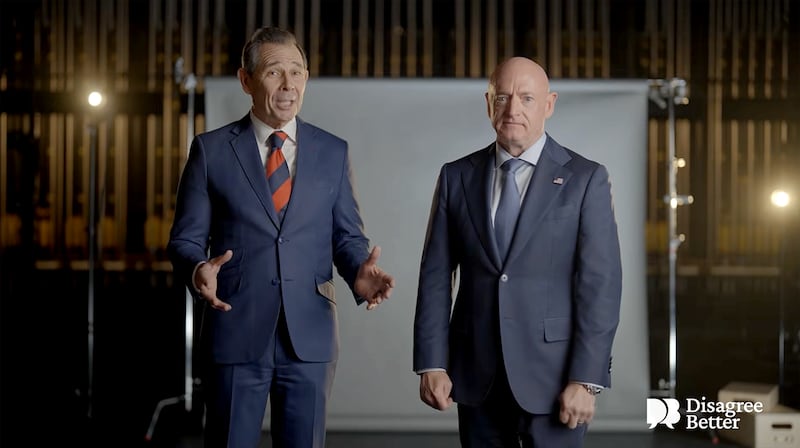
Curtis and Kelly have already teamed up for a number of projects in their budding working relationship.
They’ve collaborated on several Disagree Better campaigns, an independent nonprofit organization founded by Utah Gov. Spencer Cox that promotes healthy disagreement.
They also headlined an event at Utah Valley University last year to confront the nation’s epidemic of political violence after the assassination of conservative activist Charlie Kirk. The two then co-introduced a bill to hold social media companies liable for promoting content responsible for radicalizing users and prompting them to cause harm.
“You can disagree with people, but you can do it in a way that doesn’t burn the relationship,” Kelly said. “I think John Curtis is just genuinely a very nice person. We disagree on a number of things, but … the Senate is a better place because he’s in it.”
Find the unlikely partner — like California Sen. Adam Schiff
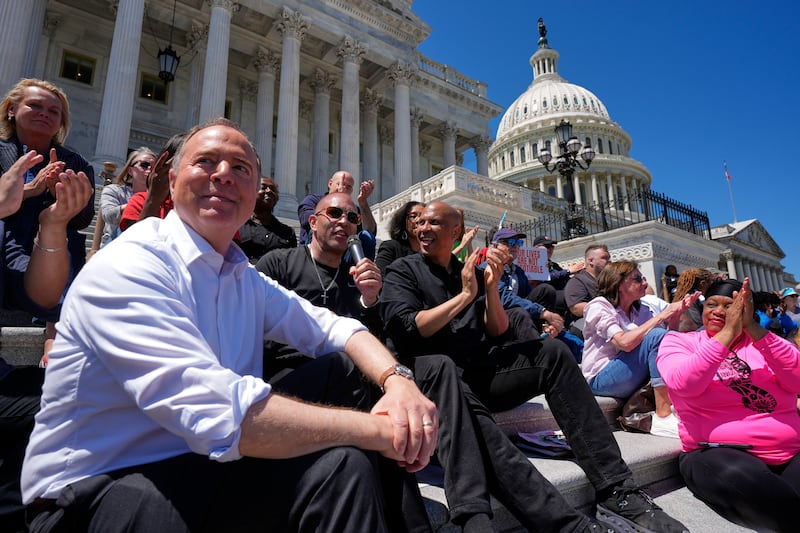
Curtis’ rise as a bipartisan negotiator has become crucial in the current landscape of Congress. With several high-profile negotiators preparing to retire in January, it leaves many gaps to be filled.
The Utah senator has already emerged as a pivotal voice within the Republican Party, securing agreements from the White House on green energy tax credits and asserting Congress’ role when it comes to the Iran war.
That’s prompted Democrats to view him as a natural choice to assume the role of bipartisan negotiator.
But becoming a popular confidante in the Senate doesn’t come from just teaming up with the regular suspects, Curtis said.
“Part of the secret sauce, the magic, is not having a predetermined go-to person but realizing that any senator on that roster at any time might be the key to moving something forward,” Curtis told the Deseret News. “I think some of the most productive work comes in maturing a relationship that wasn’t there or with somebody that’s not known for bipartisan work.”
For example, the Utah senator pointed to his work with California Sen. Adam Schiff, a progressive Democrat who rose to prominence while leading the first impeachment trial against Trump in 2019 — an effort Curtis opposed when he was in the House.
Despite having vast political differences on paper, the pair have found common ground when it comes to cracking down on prediction markets or mitigating wildfires.
They don’t agree on much. But where they do, they take advantage of it. Not by sacrificing their political ideologies, they both say, but by briefly pushing them to the side.
“You have to compartmentalize. You have to agree to disagree on a lot of things, and when you disagree, you’ve got to do your best not to make the disagreements personal,” Schiff told the Deseret News in an interview. “If you spend your time thinking about the commonalities instead of what divides you, you can find a lot of productive things to do.”
There will be different success rates for each senator you choose to work with, Curtis said, noting that while he and some progressive Democrats may only find common ground one time out of a thousand, there are other Democrats he could agree with one time out of a hundred — or even one out of 50.
“Just based upon their politics, the odds are either higher or lower,” he said. “But there’s probably no one that I would preclude from the possibility of doing a bill with.”
Because of those tendencies, many Democrats view Curtis as a trustworthy partner despite political differences — and believe he is an obvious successor of the Senate’s bipartisan leaders.
“I think that people on both sides of the aisle recognize John to be a good negotiating partner, as someone who is a person of integrity, and you can rely upon what they say,” Schiff said. “So I could see him having a pivotal role on any number of issues where there’s a bipartisan coalition coming together to try to solve a difficult problem.”
Curtis’ default: He wants to support President Trump, but he’s willing to say no
While those characteristics put Curtis in a prime position to take on the role of free agent within the GOP, the Utah senator wants to reshape that mold.
“I come out of the gates wanting to support the president, wanting him to be successful,” Curtis described as his thinking. “I think some of my Republican colleagues that fit that role come out of the gates looking for the differences or looking for the opposition.”
It’s an occasionally risky position to take. Just in the last year and a half, Curtis has seen a number of his colleagues feel the wrath of Trump when it comes to loyalty litmus tests.
Republican Sens. Bill Cassidy of Louisiana and John Cornyn of Texas both lost their primaries after Trump elevated their challengers, accusing the incumbents of being untrustworthy. Sen. Thom Tillis, R-N.C., announced he would retire amid public criticism from the president, noting at the time he felt bipartisan negotiators were “becoming an endangered species.”
Although those colleagues have now embraced their free agency to occasionally thwart the White House, it’s a tactic Curtis rarely chooses to employ. Despite voting in line with Trump a majority of the time, the Utah senator doesn’t want his vote to be taken for granted.
That mindset has made Curtis a Republican to watch in high-profile legislative fights. He was an early holdout on Attorney General Todd Blanche, although he eventually supported his nomination after securing agreements on Utah-centric issues such as public lands.
But Curtis still pushes back against the president on issues such as terminating the filibuster. He was also the deciding vote to sink a controversial nominee for a high-ranking position within the State Department.
“I don’t really know anybody else that’s quite like me, and trying to support but also being willing to oppose when it’s what I would say is out of alignment with Utah,” he added.
That tendency has made Curtis more trustworthy to his Democratic colleagues who say they can rely on him to find compromise.
“While I may not agree with John Curtis on everything, we’ve found common ground to advance legislation and policy initiatives on everything from countering foreign threats, protecting critical infrastructure, and health care reforms,” Sen. Jacky Rosen, D-Nev., told the Deseret News in a statement. “I’ve found him to be kind and an honest broker, and a Republican who is thoughtful and wants to do what is right for the American people. I’m grateful for his friendship and his willingness to work across party lines.”
Bipartisanship requires finding a ‘sliver of overlap,’ says Elizabeth Warren
Curtis’ playbook in forging bipartisanship comes at a critical time for Congress. A majority of the country (80%) views the institution unfavorably and more than half of U.S. voters (52%) say they have little confidence in Congress, according to polling from Gallup.
While bipartisanship may appear more rare than ever, lawmakers such as Curtis are working behind the scenes to protect the kind of collaboration they say is crucial to making Congress work.
“So often these days, Republicans and Democrats aren’t even talking to each other about the issues facing Americans,” Sen. Jeff Merkley, D-Ore., said in a statement to the Deseret News. “However, I know firsthand that finding common ground is still possible because Senator Curtis and I share a strong interest in tackling many of today’s challenges, including preventing and mitigating the worst impacts of wildfires, combating asbestos exposure, addressing prediction market corruption, and global affairs.”
In a closely divided Congress, it’s easy to back into a political corner and disagree with anything that doesn’t subscribe to a lawmaker’s specific party platform. The answer to that, Curtis says, is to find a “cross-section” of agreement.
Finding that cross-section can happen in unexpected ways — even on short elevator rides with someone who sits on the opposite end of the political spectrum.
“We of course don’t see eye to eye on every issue, but I’ve found Senator Curtis to be authentic and pragmatic,” Warren told the Deseret News in a statement. “Where there is a sliver of overlap, we engage, debate, and work to find common ground to deliver meaningful results for the American people.”
One Democrat will never agree with one Republican on every issue, Curtis argued. But by creating different alliances, you can tackle several problems at once.
“I think the greatness of the country is people getting together with different opinions,” Curtis said. “Which means you take even an Elizabeth Warren, look hard enough, and you’ll find even … one tiny little area where you both can agree.”