

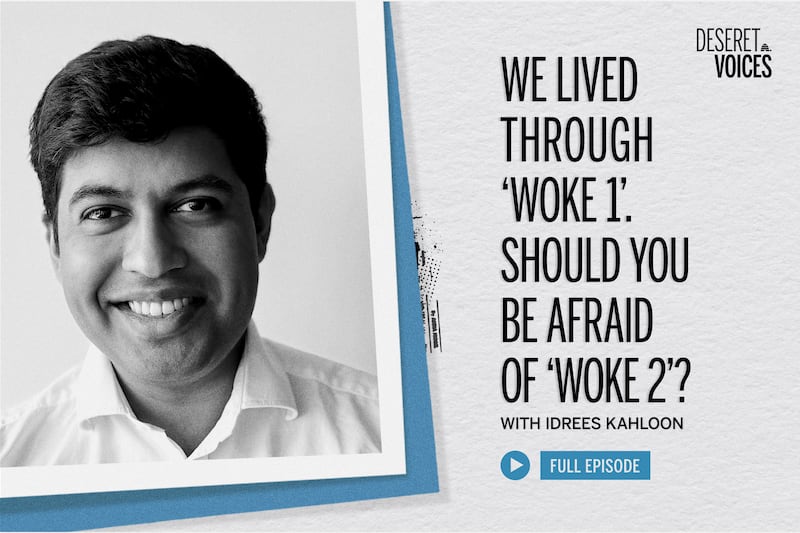


The Democrats’ pursuit of wokeness backfired when things got to the point where their beliefs seemed to line up more with those of white supremacists.
Idrees Kahloon, a staff writer for The Atlantic, mentions the belief held by some influential people on the left that mathematics is a “white art” above the capabilities of students of color.
On this episode of “Deseret Voices,” Kahloon and his colleague McKay Coppins discuss why the Democratic Party is going to have a hard time shaking off that political era — and if the Democrats are even really leaving it behind.
Subscribe to “Deseret Voices” on YouTube, Apple Podcasts or Spotify.
Note: Transcript edited by Steven Watkins.
McKay Coppins: Idrees Kahloon, thank you for coming on “Deseret Voices.”
Idrees Kahloon: Thanks for having me.
MC: So, you wrote a really fascinating piece recently for The Atlantic, where we both work. The headline is “The Democrats Can’t Just Laugh Off ‘Woke 1.’”
I think it’s a really good jumping-off point for a conversation about kind of the state of play in the Democratic Party and American politics right now. But I think it would be helpful to start by kind of defining some of the terms here, because “wokeness” is one of these kind of really loaded terms. It’s been thrown around and very broadly defined and used to describe a lot of different things.
So, when you think of Woke 1, kind of the first iteration of the woke era, what exactly do you mean? What are the kind of defining ideas and habits of that era?
IK: Yeah, it’s a great question because it tends to be used pejoratively, and eventually the pejorative just kind of swamped out any other terms for it. So now everyone just says “woke.” I think the most neutral way to think about it, just to describe what it is and why it’s different from other ideologies, is basically a set of views of the world that divides it into oppressor and oppressed. I think that that’s the right lens through which, you know, we could categorize ideas as woke versus just kind of left-liberal.
And so what I mean by that is, you know, there’s a lot of attention to racism, sexism, colonialism, etc. But in all of these cases, there is a kind of oppressed majority and an oppressed minority. And I think wokeness is a kind of application, a distillation of a few academic ideas and disciplines — critical theory, ideas like intersectionality, etc. It’s a kind of praxis version of that, which is basically, if we accept that the world is divided into, you know, a class of oppressors and the oppressed, what must be done about it?
And, you know, this kind of took off in 2020. It kind of emerged from the campus, which was its ordinary kind of feeding ground, and then it kind of leapt, I think, into American life in a lot of ways. And so there was a lot of attention to: How do we defeat racism? How do we defeat sexism? How do we enact systemic change in order to cure society of all of these ailments?
MC: So, that was, I think, a very good, neutral, and objective description of wokeness. My sense from reading you is that you don’t think of the Woke 1 era totally objectively — that there were kind of excesses, that there were political sins kind of baked into that era. From your perspective, what were those? What were the biggest problems with the woke era?
And I would say maybe this reached its apex in 2020, but you could probably say that this was like around 2014 to 2023-24, right? That decade was kind of defined on the left by these ideas being popularised. What do you think the biggest problems were there?
IK: Yeah. No, you’re right. I don’t find myself kind of agreeing with a lot of these ideas. And there are two reasons, probably: One is philosophical, and the other is policy-based.
So, the philosophical objection I have to it is that wokeness is not liberal. So I think of myself as a liberal, as someone who values the individual and, you know, their own autonomy, their own kind of willingness to define themselves how they wish. What I find disagreeable about wokeness is its collapsing of the individual into these identities. So you can therefore be a recipient of white privilege who is, you know, incriminated in white supremacy despite any kind of your own actions. And that’s kind of an immutable way of looking at the world.
So that’s, you know, my kind of main objection. I think that that gets you into — this goes to the second point — gets you into strange kind of policy positions. So, you know, obviously “defund the police” was kind of the big idea that categorizes this era. It kind of backfired both politically in terms of the backlash, but also just, you know, in terms of the experience of the cities that actually attempted to reduce funding in response to this, I think found it to be not a good experience.
But, you know, for example, the application of these ideas to education: You had, you know, people who were quite influential for a brief period who would argue things like mathematical disparities by race are due to the fact that, you know, mathematics and logic are a kind of white art, and that, you know, students of color can’t be expected to succeed mathematically, and that actually there needs to be kind of a different way of learning that identifies Indigenous methods of counting. I mean, and that to me actually ended up being pretty rather racist.
MC: Yeah, right. There was this horseshoe thing happening, right? Where it’s like you had some of the most far-left ideas being expressed about race in this woke era. A lot of those people would find kind of allies accidentally among, you know, white supremacists who would be like, “Yeah, those things are inherently white traits.” And I think that should have made everybody a little uncomfortable if you weren’t on the very far right or far left.
IK: Yeah. Yeah, no, I agree. And I think there was also an anti-intellectualism that was embedded in this. So like, you know, the core idea of Ibram Kendi is that any disparity by race is itself the result of racism. And that, you know, there are lots of complicated — the way I try to think about the world is that, you know, there are lots of complicated things that are happening, and, you know, disparities by race are important and worth addressing, but they can’t just be reduced to the fact that it’s race that’s causing it. And so, you know, I think that it kind of blinkered our ability to think about what actually causes problems in the world, and therefore also what can be done to fix them.
MC: There was also just something about that era, when you talk about the politics of it, that was inherently kind of off-putting to a lot of voters, as we saw in the 2024 election, right? There was a kind of censorship reflex, there was an illiberalism to your point. There were, in some pretty large and high-profile institutions, kind of an effort to weaponize, you know, HR departments or DEI initiatives, which often were formed with good intentions, but then were used to kind of conduct what a lot of people considered witch hunts, or efforts to, you know, ruin the livelihoods of people who didn’t conform to the program.
And there was also, I think, kind of a scolding quality to it that wore thin after a while. And a lot of people point to the 2024 campaign and Trump’s reelection that year as the beginning of a vibe shift, right? A kind of cultural backlash to the woke era.
And I guess my question is, you know, a couple years later, as Democrats are now trying to reclaim Congress in the midterms and they’re looking toward 2028, why can’t they just wash their hands of the whole thing? You know, why can’t they say, “Yeah, things got a little crazy. We made some mistakes. I’m going to distance myself from that era and I want to move on”? I mean, that’s essentially what AOC was trying to do in this interview that she gave, right?
IK: Yeah, there are a couple things there. One is, you know, Democrats are not really repudiating the stances. They’re trying to kind of get away with it by laughing. And why won’t that work? Two reasons:
One is that some Democrats don’t really seem to have left that era behind. So there are plenty of examples that Democrats are furnishing this campaign of people who are endorsing ideas like, you know, defunding the police. You know, very prominently, the woman nominated to Congress who beat an incumbent in New York, Darializa Avila Chevalier, you know, refused to say whether or not she would even prosecute someone for murder. She’s a hardcore prison abolitionist. That woman is going to be in Congress with all likelihood.
And this goes to the second point, which is that Republicans have no incentive to just let Democrats slink away from the issues that they became identified with. If the president — and he is very unpopular because of Iran, because of lots of other things — the Republican Party knows that it’s facing electoral headwinds, one of the best strategies they could adopt is to say, “Look, you know, the opponents are insane. You know, they’re associated with these ideas that don’t really resonate with ordinary Americans. They’re socialists, etc.” You know, that’s the play that Republicans have made, and they will continue to make. And so I don’t think it will be so easy for Democrats to run away.
And just to your point about the backlash, I think is also an important thing, and Trump being the kind of the end of the vibe shift: One odd thing about wokeness compared with other kind of left-wing movements is that, despite its genealogy in Marxism, there is very little class consciousness in Woke 1.
What do I mean by that? I mean that of all the oppressions that were kind of categorized and litigated, you know, income, I think, was strangely absent from that. And that’s how you ended up with this phenomenon in which, you know, the spaces that, the institutions that were most paralyzed, most affected by wokeness were elite institutions. It was an intra-elite, intra-left kind of competition about, you know, who’s exposed to the most oppression and therefore deserves X, Y, or Z, when in fact, you know, working-class people in America have, you know, actually drifted to the right.
And Democrats, I think — I think one distinction between Woke 1 and Woke 2 is that Democrats now seem to understand that, you know, ideas like saying “Latinx” was really off-putting. “Latinx” is just actually the perfect example of this, because it’s something that only people who are, you know, Ivy League graduates think is an acceptable thing to call someone who’s Hispanic, you know? And, you know, it ended up kind of pushing more people away from left-of-center politics than attracting them to it.
And so I think, you know, DSA and these kinds of things that are happening now, there’s much more actual consciousness of income and class as a disparity, which I think is a step, at least, in the right direction for the Democratic Party and the left.
MC: Well, that’s kind of an interesting point, because somebody who wanted to, you know, pick apart your argument might say, “Well, aren’t you conflating Democratic Socialism and wokeness, right?” Like, the Democratic Socialists have been most effective in this primary season by focusing on rent, healthcare, wages, affordability — the things that do have a real class component.
And the wokeness, you know, some of that stuff was indulged in by Democratic Socialists, but as I recall it, a lot of that decade we talked about, the wokeness was more kind of a component of the center-left, whereas the far-left and the Bernie Bros and the Dirtbag Left and all those people would kind of gleefully try to offend their woker peers in the Democratic Party while making these arguments about economic populism, right?
IK: No, it’s a good point. And what I’d say to that is, the DSA certainly emphasizes healthcare and childcare and these kinds of proposals. But if you look at their 2026 convention that just occurred and the policy proposals that they just drafted, I mean, nothing’s really changed. They’re still endorsing prison abolition, for example. That’s an official policy of the DSA that they endorse in the year of our Lord 2026.
You know, some of the climate stuff gets wrapped into wokeness, and I feel like it’s somewhat orthogonal, but, you know, if we’re kind of being loose with it, you know, all of that kind of Green New Deal sort of thinking is in there as well.
And so I think that there just hasn’t been on the DSA side — you’re right, they emphasize economic matters now, but I think that, you know, they’ve kind of just sublimated their kind of belief in all these ideas. And that’s also, I think, a problem with the laughing-off approach. If you were to say, “OK, AOC, be serious for a minute. Do you actually agree that defunding the police is bad?” She’d say, “Well, you know, maybe it’s just, you know, recategorizing funding.” You know, I think you might have something like that where Democrats actually, when they’re pushed, they get a bit woolly on these things. And I think that that is also what the laugh is trying to paper over.
MC: You know, it occurs to me that one of the problems with Democrats really engaging in the kind of reckoning that you’re calling for is that it would look to some people like political opportunism, right? Like, these ideas became unpopular, and now we’re taking them all back, disavowing them, apologizing and moving on.
Now, I wouldn’t say that because I’m a big proponent of politicians being able to genuinely change their minds and admit when they’re wrong. I think that there are too many incentives against doing that, and we should allow for more of that — make space for that in our politics — because a lot of politicians have a lot of bad ideas that I think it would be good for them to change their minds on.
That said, I wonder if there’s anybody in the Democratic Party who you think has done a good job of navigating this, who has kind of been able to disavow past positions they took at, you know, maybe the fever pitch of wokeness in 2020 and basically apologized and were able to move forward. Does anyone come to mind?
IK: Not immediately. I think that the people who kind of did best were the ones who just didn’t get swept up in the fervor at the time and sort of stayed out of it then and stayed out of it now.
MC: One interesting — sorry, one interesting case to me is Zohran Mamdani. Like, you know, he did call for defunding the NYPD, described the NYPD as racist and anti-queer, I think. And then when he ran for mayor, that was not a tenable position to have for a mayor of New York City. He recognized that, he disavowed it, apologized to police officers, pledged to maintain police staffing.
Like, you know, you can argue about how sincere all of that was, how calculated it was, but like, he did do it. He did pull it off, and he got elected, right? So, yeah, I wonder if there’s kind of a lesson there for other Democrats on Mamdani’s wing of the party.
IK: Well, I think, you know, what you’re saying about politicians, like, I think the art of politics is being able to change your mind without it looking insincere, even though that’s — even though you’re obviously doing things from a political vantage.
So the point that had come to mind as you were talking was, you know, Barack Obama campaigning in 2008 saying that he was opposed to gay marriage. In his heart, at the time, do we think he was really opposed to gay marriage? I don’t know. My guess is that maybe he was OK with it at the time. But, you know, the country evolved, and by, you know, 2012 and 2014, he had as well. And he is a talented enough politician that he was able to pull that off.
And Mamdani is definitely much to the left of Barack Obama, but is a very talented politician and is therefore able — was able to, I think, get out of, and identify quite correctly, that this was a liability and to wriggle out of his position.
In contrast, you know, Hillary Clinton in 2016, I think, was less good at, you know, this game. So, you know, for example, when you’re the Secretary of State negotiating the Trans-Pacific Partnership trade deal, and then suddenly you come out against it in the campaign, you know, you come off as insincere.
And then Kamala Harris’ reinvention in 2024 as a kind of, you know, tough-on-border politician was just totally, totally unbuyable. And she’s always, I think, struggled with appearing sincere. That was true in the 2020 campaign as well. But, you know, I think that that’s the art of politics.
And I think AOC is actually, in her own way, executing a tactical shift as well. You know, it might not be the kind of repudiation that I want, but it is an attempt and an identification that these politics are toxic to Democrats and that she has to wriggle out of them in some way. And in that way, what she’s demonstrating is quite a lot of political intelligence, I think.
MC: Before we leave this topic, I want to ask you if you think there is anything from what we’re just calling Woke 1, that era, that’s worth conserving, right?
Because I’ll just lay some cards on the table here: I was alarmed by the illiberalism of a lot of that era — you know, the censoriousness, the eagerness to cancel people, the demands for kind of ideological conformity and, you know, that everybody kind of sing along to the same orthodoxies whether they agree with them or not. I didn’t like that.
But I don’t really love the backlash that we’re living through either. I think that there is a performative, like, meanness and a casual dismissiveness about racism and xenophobia and sexism and disability that’s kind of seeped back into our culture. You know, I see this at my kids’ school, where I hear words and slurs that I thought had kind of died with my generation are now getting tossed around by kids these days, and they’re all kind of just OK with it.
And I wonder, like, is that simply the price of defeating wokeness, or is there a way to reject its excesses without throwing away, you know, what a lot of people would see as kind of real moral gains that preceded them?
IK: Yeah, the way I think about it is there’s kind of a law of excluded middle going on here, right? Where you have wokeness, which I think is totally contaminated with illiberalism, and there might be, I don’t know, some policy goals that are, you know — everyone wants to minimize the number of unarmed civilians who are killed by police, right? That’s a good policy goal.
There are other policy goals, you know, expanding — I don’t know if this is necessarily a woke idea, but, you know, it kind of got lumped into the era — universal healthcare. Great idea, right?
But I think that the means were were quite bad. And I think that the backlash that we’re seeing today uses a lot of the same illiberalism that wokeness kind of pioneered. So the idea that university professors have to kind of adhere to certain ideological frameworks, whether that’s the supremacy of oppression or whether it’s the kind of supremacy of, like, this idealized America in which nothing bad has happened — you know, they’re both kind of an attempt to enforce conformity from above.
And, you know, I think that what’s in the middle, what’s left out, is genuine liberalism: the idea that people should be able to have academic freedom, to have individuality, should be judged by their own ideas, not the color of their skin. You know, in the same way that I don’t want a world order in which, you know, African Americans are seen as superior to whites because they have, you know, suffered oppression, I definitely don’t want to live in a world in which whites are seen as superior to African Americans because they’re white.
But there is something in the middle there, right, that we could that we could go to, and I think is useful to go to. And I think it’s also a lesson about, you know, when Woke 1 was kind of in the ascendant, there was this kind of belief that it would be permanent, right? If you’re so confident in your ideology that you wish it to be imposed, you never believe that the shoe could be on the other foot.
And I think Republicans are making the same mistake now. And so I think that there is, you know, one of the best ideas of liberalism is forbearance, and the recognition that, you know, you won’t always be in charge. And so I think that there is, you know, a reason to return to that tradition that I think was, you know, dominant in America for a long time and did America a lot of good.
MC: OK, so I want to test all this against what Democratic voters are actually doing this year, because one of the most interesting things about this moment in Democratic politics is that there is kind of no narrative coherence, right?
Like, for people like you and me who write about politics and talk about politics, we tend to look for the trends and build a narrative out of it. And there just is no clear signal that Democratic primary voters are sending, right?
You had in Wisconsin, a moderate narrowly beat a DSA-aligned woman named Francesca Hong, who had been the front-runner, and who had, you know, talked about defunding the police and abolishing ICE and abolishing the Senate and canceling Thanksgiving. But then in Michigan, you had Abdul El-Sayed beat the Schumer-backed moderate, right, despite being massively outspent. And then this week in Florida, you had a Democratic Socialist get an upset.
And so, you know, you kind of can go race by race, state by state, and tell a totally different story depending on what case you want to make and what’s happening on the ground there. As you look at the kind of Democratic Party’s landscape in late August of 2026, what do you see happening?
IK: So I agree. I think Ken Martin is certainly not imposing order on the Democratic Party, and actually Schumer — Chuck Schumer and Hakeem Jeffries have also, you know, despite their role right now as being in charge of both chambers in Congress for their respective party, I don’t think have done a very good job in setting out what it is the party believes.
I think that, you know, if I had to impose a kind of narrative order on what’s happening, it’s that Democratic primary voters are incensed at Trump, and incensed also at their own leadership, and want candidates who they see as fighting harder.
And so I think you saw that in Colorado as well, where Michael Bennet, the sitting senator, lost his gubernatorial bid — kind of a shock — to the attorney general. And the Colorado attorney general’s argument was that he was going to resist Trump more.
And I think you see in the DSA victories that we’ve seen as well — you know, Hong, I think, was such a spectacularly poor politician that voters calculated that she risked losing the governorship. But, you know, El-Sayed is a more talented politician, Mamdani certainly is as well. You know, they have opted for candidates who they think of as resisting Trump the most.
And I think that, you know, the socialist commitments of these candidates may be secondary to that ultimate value that Democratic primary voters are yearning for, which is resistance. And so, you know, a lot of these victories are occurring in generally progressive places already, so they’re turning kind of blue districts even bluer.
Whether or not it scales to the national level, I think, is a much bigger question, and whether or not the backlash at the national level from electing people like that in very blue districts, you know, hurts the national brand even more, I think, is also something that we will see in the coming year.
MC: Well, and then looking forward to 2028, you know, we already have the kind of pre-primary taking place with various presidential aspirants kind of jockeying for position and cultivating donors. Most of this stuff happens behind the scenes before the midterms, but the second the midterms happen, everybody’s going to be running for president.
And I’m curious, when you look at the field of potential candidates, do you see anybody who could potentially achieve a synthesis that looks something like economically populist, culturally less doctrinaire, willing to kind of say plainly, to your point, that Democrats got some important things wrong during the woke era? Like, is there anybody making that case now?
IK: I mean, Gavin Newsom is trying to do that. I don’t know how sincere it is. I don’t feel like it’s fully sincere, but, you know, what I think matters less than what voters think, and if they think that he’s electable, then they’ll opt for him. But I think he’s probably the politician who has most attempted to exercise that move, who is in the kind of presidential aspirant class.
And maybe we could say that AOC’s recent comments are themselves a kind of move in that direction. She was obviously so well-identified with all of these ideas that her ability to extricate herself, I think, is a much trickier maneuver to pull off.
But I, you know, I think that that is going to be an argument that people make. But, in general, I don’t know. I feel like the Democratic Party really doesn’t know what it believes, and it’s just waiting for the presidential contest to settle itself before they actually have a standard-bearer behind whom they can rally.
MC: I will say, just as an aside, I’ve been trying to get Gavin Newsom on this podcast for a while. If somebody in his orbit hears this, I want to say that I am totally open to his sincerity, but I want to have him on the podcast to talk about it.
But, you know, I think that your point is well-taken. I think what’s going to be really fascinating about the 2028 race is that both the Republican Party and the Democratic Party are going to be in kind of open civil war, in a way, right? You have real factions on both sides that will see an opportunity to try to redefine the party, remake it in their image, and it’ll be fascinating to see what kind of emerges from the fray. So —
IK: I wonder if Trump is going to be like Lyndon Johnson in ’68 and basically not allow whoever succeeds him to diverge from him, and therefore hamstring the — so I wonder.
MC: It’s a good question. I mean, does he have — the question is, after the midterms, as he enters his lame-duck phase, is he able to retain the kind of stranglehold on the institutional Republican Party, on the Republican base, that he’s managed to hold for the last decade or so?
I think it’s an open question. I am not quick to say no, because I think way too many political obituaries have been written about him prematurely. But I tend to think that there are so many people in the Republican Party, including even, you know, Republican voters, who are kind of exhausted by the Trump era and ready to move on. And I think as soon as they have a chance to find somebody else as a standard-bearer, they’ll welcome it. But maybe I’m wrong.
IK: I would take the other side of that bet.
MC: All right. Well, why don’t we have you back on a year from now, and we’ll see where things stand.
IK: And one of us will eat crow.
MC: Yeah, exactly. Idrees, thank you for coming on. I appreciate it.
IK: Thanks for having me. Thanks.