

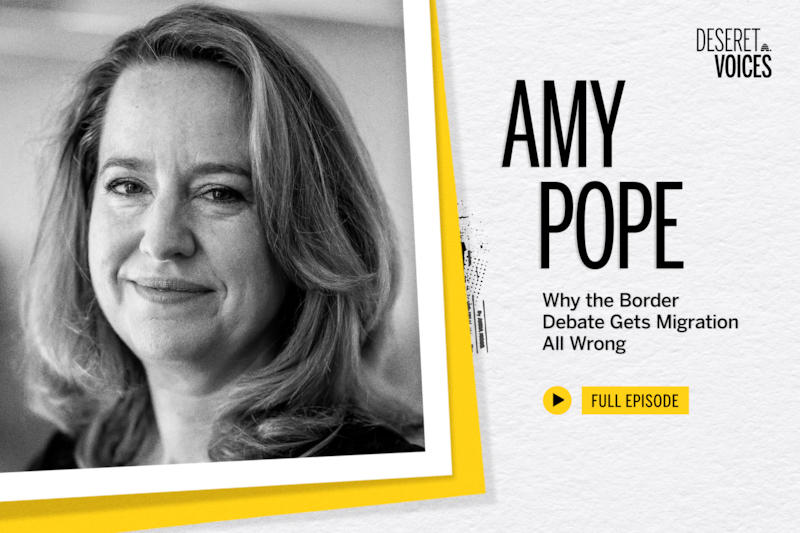


Migration can be a controversial subject. While some would welcome migrants with open arms as they seek a better life, others worry about the strain on resources.
While Amy Pope, the director general of the International Organization for Migration, acknowledges that citizens expect governments to manage their borders, she believes increased surveillance won’t get to the heart of the problem.
On this episode of “Deseret Voices,” Deseret News Executive Editor Doug Wilks asks Pope why her organization believes migration should “be part of the solution” in a changing world.
Subscribe to “Deseret Voices” on YouTube, Apple Podcasts or Spotify.
Note: Transcript edited by Steven Watkins.
Doug Wilks: Director General, thank you for being with us today. People don’t know much about the International Organization for Migration. You’re a U.N. organization, correct?
Amy Pope: Yeah.
DW: How do you even manage a world global population on the move?
AP: We operate in 180 countries around the world. So when someone is displaced, whether it’s the war in Sudan or Ukraine, or whether it’s a natural disaster that’s happening in their community, our first job is to be there to just provide support. So, especially shelter, distribution of things like hygiene items, helping setting up toilets and, you know, just the most basic human needs, that’s No. 1. So meeting those needs is our first goal. The second goal, though, is not to leave people in a state of displacement. And we see far too many examples of communities who are displaced once, they move into a temporary location, and then they just kind of get forgotten. And when that happens, people lose dignity, they become overly reliant on humanitarian assistance, they lose their own agency about their own future.
So our job is to help figure out how to transition people from that state of crisis into something that’s more durable, that gives them some more dignity and allows them to do what they do best. And then the third thing we work on is how we can facilitate safe and regular migration. That means migration that is not being done at the hands of a smuggler or trafficker. It’s migration that is not being done out of desperation. And some of the best examples we’ve seen is when we can connect work opportunities with people who are looking for work, or invest in skills training in communities, especially of young people, that don’t have the skills they need for the future that they’re going to face.
DW: So you’re trying to get beyond crisis management, correct?
AP: That’s exactly right, yeah.
DW: Can you define migration for us as it relates to the difference between immigration or emigration? But just when you talk about migration, what do you talk about?
AP: We’re talking about people who are on the move. People who are moving from the place where they were born and raised. Sometimes they’re just moving within their countries. So, you know, we have migrants who move from state to state here in the United States, and oftentimes, it’s people who are moving across borders.
DW: Why are they moving?
AP: Well, they move for a variety of reasons. Same reasons that you and I might move. Either job opportunity, lack of jobs at home. Conflict is driving people, especially in Africa at the moment. The impacts of a changing climate, so wildfires, earthquakes, floods, drought, that’s pushing people increasingly to move. In fact, that’s the No. 1 reason people are moving when they’re not choosing to move. But the No. 1 reason people go is to find opportunity.

DW: There’s an interesting statement on your website. Among your goals, you say, “Migration is and has been for centuries a cornerstone of development, prosperity, and progress for many. As the world faces major global transformations — from climate change, demographic transition, and urbanization to digitization — migration can and should be part of the solution.” So what’s the solution you’re seeking when you reference it in that way?
AP: So think about changing demographics. For one, in Japan, they have a rapidly aging population. They simply don’t have the young people to do the work that their economy relies on, much less even enough young people to take care of the aging population. Now, of course, countries are experimenting with technology to fill some of those gaps, but when we look at what are the range of needs across labor sectors, technology isn’t going to fill all those gaps. And ultimately, we know here, right, you don’t necessarily want a robot taking care of Grandma, right?
So having people move with job opportunities is a critical part of the work we do. And the more that that movement can be planned, the more that it can be part of a government’s development plan, the more that it can be done in concert with local populations so that services are sufficient for the people who might be coming in, the more success we see.
DW: So, so much of the conversation in America is about the southern border and people coming across the border, whether it’s legally or illegally. Your background with Homeland Security, working in the Biden administration, working in the Obama administration, are we not having the right conversation as it relates to migration in America?
AP: I love that question because I think we’re only having one tiny piece of that conversation. We, across the board, overly focus on the border. And you have to have border management, I will tell you, that is a basic expectation of citizens around the world that their governments can manage their borders. But, if you manage the border just by increasing surveillance technologies at the border or Border Patrol, you won’t actually get to the real issue: what’s driving people to move in the first place. And so it’s why I love the work that I’m doing now, because it allows us to open the aperture in a so much bigger way and look at what’s driving someone to move. How can we address that driver? How can we work with communities so that people are stabilized before they come all the way up to the U.S.-Mexico border?
And it became clear when we were looking at the movements across the Americas. I was just in Brazil at the border with Venezuela. There are still Venezuelans who are coming into Brazil every day, hundreds, and about half of them are kids, families are coming in. The way Brazil is managing, though, they have enlisted their private sector. When people come across, they get a right to work — whether they’re a refugee, whether they qualify as a migrant — they get a right to register and to work, and then they’ve established job training or job postings, private sector will interview them, and then they go around the country and they’re finding jobs. They have employed 165,000 Venezuelans.
I mean, it’s just a totally different way of looking at the issue. How can we support ways for communities to stabilize in a place where there’s an economic need? Brazil needs the workforce, Venezuelans are moving because they don’t have safety or security at home, combine those together and you actually get something that’s a winning formula.
DW: Is that happening elsewhere around the world? For example, I’m somewhat familiar with Scandinavia, and they had very much, were welcoming 40, 50 years ago, then they went through a period of time where that kind of changed, then they felt like some of the cultures were being overrun. Germany faced this, too. What’s sort of the state in Europe from your point of view in terms of what they need to do to either welcome or manage migrants, whatever, however you would describe it?
AP: So, I think Europe has faced a number of pressures in terms of migration, and that has triggered political backlash to migration. I think in the first instance — and we’ve encouraged our European partners to do this — is actually invest in the development of the economic communities closer to where migrants are coming from. So we see, for example, if you look in East Africa, there is a vibrant economic community where people can live and work where their skills are being recognized. Investing in that kind of community in West Africa so that people can go where the jobs are and don’t feel pushed to move is one way that you can manage migration better. We know people will go, the conflict in Sudan has led to the biggest displacement crisis currently in the world. About 3, 4 million went across borders. If they cannot find safety and stability, then they move on, right?
So, I saw in Libya firsthand, Sudanese coming across, they couldn’t get healthcare, they couldn’t get access to the job market, they were often, the treatment was often very poor. And so, then we start to slowly see an uptick of Libyans crossing the Mediterranean. So, thinking about it in the whole, looking at the routes that people are traveling, figuring out where there are points of engagement that can make a difference, has to be part of the solution. And then, looking very honestly at their own economic needs and figuring out how do you create a legal pathway for someone to come and work in the sector that needs it.
So, Italy is doing some really interesting work in this area. They have a very strong anti-smuggling platform, very strong border enforcement, but they’ve authorized 450,000 visas for people to come and work legally in their economy. So, that kind of bringing all the pieces together is what we think a much more comprehensive and, importantly, effective strategy.
DW: So where are the hotspots for you right now? Is it still Sudan? Is it elsewhere? When you go to bed at night, what are you thinking about?

AP: Sudan is a major one, including because much of the humanitarian support for Sudan has fallen away. But unfortunately, it’s not the only one, right? We work in Ukraine, where the conflict continues, and you see it on the news at night, the bombings continue. Infrastructure is being destroyed, and so the situation for so many Ukrainians remains precarious, and we still see people outside the country and would love to be able to go home, but just can’t go home.
We’re very active in Syria right now. As you know, the Syrian refugee crisis was actually quite destabilizing for many of the surrounding countries, for Jordan, for Lebanon, for Egypt, and then ultimately, for Europe. But right now, Syria is in a state of relative peace, so enabling the rebuilding of that country so that people can go home and finding ways for people to go home and help rebuild, people who have real skills that are needed, that’s a big part of our work today.
And then, unfortunately, I’m sorry to say, there are places like Haiti, places like the Democratic Republic of Congo, where the needs are so acute, but our ability to provide longer-term support rather than just humanitarian support are just really limited by the lack of stability there.
DW: Let’s talk about your work, the relationships with civil society.
AP: This I brought with me in coming in as director general 21/2 years ago, that if we’re really going to take on this issue in a comprehensive way, we can’t do it alone, right? We can’t. One organization, we’re 16,000 people in 180 countries, but that is a fraction of the need.
And you look especially at the faith community and the reach that the faith community has, the care that already happens at the congregant level, the way people will open up their homes or provide food or provide opportunities, it’s happening already as part of the regular way that faith communities engage across the world. And so, when I looked at how do we maximize our impact to support people in need, working with civil society, working with the faith community was a natural piece of that strategy.
DW: So have you been able to develop relationships with The Church of Jesus Christ of Latter-day Saints?
AP: Yes. So, actually, there is a fantastic representative in Geneva. I have a, actually, I meet with kind of a Bible study once a month of ambassadors and representatives, and he’s part of that. And so, we got to know each other a little bit, and then I had the opportunity to come out here and see the work that you all are doing.
DW: So what were your impressions as you toured some of the facilities, the humanitarian work the church is doing?
AP: My first impression is that this is a community that’s living its faith in ways that I’ve not seen really anywhere else in the world. It takes very, very seriously the teachings of Jesus, the responsibility to love thy neighbor as thyself, which is being played out in the most concrete of ways, and that was really deeply affecting.
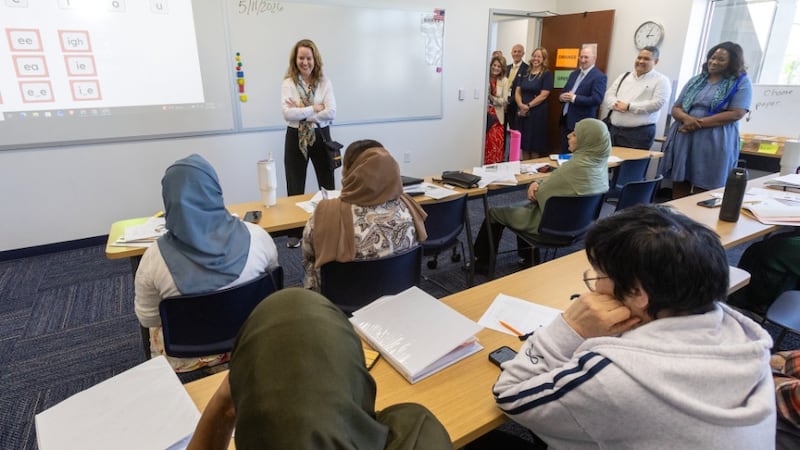
So one of my favorite parts of this visit was going to the Humanitarian Center and seeing migrants and refugees from all over the world working at the center, figuring out, you know, sorting clothes so that it could go on to people in need, learning English, learning ways of working together. That was powerful.
I spoke to a woman from Afghanistan, and we work in Afghanistan right now, and I’ll tell you, for our women staff in Afghanistan, it’s very dangerous often for them to come to work. The situation there for them to get any education is really difficult, if not impossible. And I saw Afghan women sitting in this classroom learning English, learning skills, and that was just so impressive, really taking to heart this obligation that every single person, regardless of their migration status, is a person worthy of dignity and of our respect.
We have a couple of projects that we’ve done in the past with the church, but this is, my hope is we can, we can build on it. And seeing the levels of alignment, especially around providing care for those in need, but actually giving them the tools to be self-reliant, I just see a tremendous parallel.
DW: What were some of the projects that you worked together on previously?
AP: So we’ve worked with the church in three different locations in the Americas. And two of them, Panama, Ecuador, is much more providing humanitarian support, particularly to support women with children. In Mexico, we’re working on integrating migrants into Mexican communities, including by making sure they have the job skills that they need to get opportunities in Mexico.
DW: So, would that be migrants coming from other South American countries into Mexico?
AP: Yeah. And in Mexico, they had a million jobs go unfilled last year. They have jobs especially in lower-skilled sectors where they just don’t have the workforce, and so the goal there is to make sure that if there are migrants who have traveled from elsewhere and can’t go home, that they can get a job, integrate into the community, be part of the community there.
DW: We interviewed Kevin Hyland, who’s the U.K., United Kingdom’s anti-slavery commissioner. Has done a lot with this, and he’s talked about sex trafficking. And a lot of the victims seek an economic opportunity, and then they’ll get a little bit of money, so it might not be sex-related, but it’s economically driven, and they’re still in bondage. So how does that interface with what you’re trying to do with migration?
AP: So trafficking is the most extreme state of what happens when desperate people cannot find safe and legal ways to move. I started my career as a prosecutor of human trafficking cases, and I saw firsthand what happened when people did not have opportunities at home. I worked with one family; they sent their 12-year-old daughter to go and work because they just didn’t have enough support for her at home, and they needed somebody to help take care of their kids. And when that 12-year-old ended up in the household of the family where she was abused, where she wasn’t actually sent to school, where she was physically mistreated if she didn’t perform her jobs to expectation, you know, it was sort of the cost of the situation that they were in.
My own commitment to this issue comes from seeing people like those survivors of trafficking who found themselves in a situation of huge vulnerability and exploitation, just absolutely exploited by people who are effectively criminals who are looking for the best and cheapest way, seeing people as commodities, not as people. And so the more we can create safe, legal ways for people to move, the more we can invest in systems that work, that pay people what they deserve to be paid, the more we can counter human smuggling and trafficking.
DW: This is foundational for you as director general.
AP: Yeah. Being able to now work in an organization where we’re taking on the issues as a whole is something that’s very meaningful to me. And I, to tell you the truth, there’s this young woman that I spoke to you about, her name is Evelyn Chumbow. Evelyn now runs an anti-trafficking organization. She reaches out to me regularly to let me know how she’s doing and the work she’s doing, and, you know, Evelyn’s case was one that personally inspires me.
DW: Can you say a little bit about how your faith motivates you?
AP: So I grew up in a very evangelical community. My mom and dad moved from Ohio to Pittsburgh when I was 9 years old to start the church in Pittsburgh. We moved into a Jewish community, and I lived in the church, which was a, you know, big old house with a Bible verse out front. On one side was, you know, the Yeshiva, the Jewish school, on the other side was the synagogue, and we stuck out like a sore thumb. But, you know, and as a teenager, that was mortifying, let me be clear. But as a person today, it actually helped me to really — we saw so many people come through our house. I’d wake up and some stranger would be sitting at the breakfast table. We never, my family never lived alone, we always had people coming in and living in our house as a young person.
And my mom and dad, they lived their faith, and it was always, “You don’t do the work to make money; you do this work to serve. And how do we serve?” And so that stayed with me. You know, I don’t live in a church anymore in the same way my mom and dad did, but my faith that I’m here to serve, that every single person is a child of God, every single person has something worthy of respect, no matter if I agree with them, disagree with them, no matter where they come from, no matter their faith, that stayed with me and that really motivates me to do the work I do now.
DW: One last question as we close. There’s so much more we could speak of. I’ll have to come to Washington, and we’ll do this again. Are you optimistic? Are you fearful for what’s ahead for the world? I mean, technology is changing, everything seems to be moving very, very, very quickly. What is it that gives you hope?
AP: So, a couple of things. I do worry that right now we’re in a period where people are overly focused on their own needs: “How do I get ahead? How do I protect my wealth? How do I make sure that nobody else tries to take from me what I have?” I see that playing out all over the world. What gives me hope? A couple of things. Frankly, seeing what you all are doing here and seeing, very quietly, these really impressive examples of people feeling a commitment to their fellow person is really hopeful for me. The other thing that gives me hope, frankly, are the hundreds of people I’ve had the opportunity to meet.
I met this one young man, he had come from a small village in West Africa. He left when he was 13 years old because his family didn’t have any money and he was very worried about his aging parents. He made his way all the way across West Africa over a period of two years, had really horrifying stories, ultimately made his way across the Mediterranean, was rescued by the Italian Coast Guard. He now works for IOM. He now speaks Italian, he now has legal status in Italy, and that guy works with us and he goes out on the boats every single day with the Coast Guard. He’s our cultural mediator with the Italian Coast Guard, and he speaks to the migrants that he meets and he continues to serve them and help them navigate the system, help them, help the Italians, the government, manage in a very often changing world, and he does it because he feels this deep commitment to give back. And seeing people like this guy, Sully, it’s really inspiring to me. Right? There are so many examples all over the world of people who have so much good to give and they just want the opportunity to do it.
DW: So, people over politics.
AP: People over politics, that’s the answer.
DW: Thank you so much. It’s really a pleasure ...
AP: Thank you for having me.
DW: … to hear and to see the work you’re doing.
AP: Yeah, thank you.