

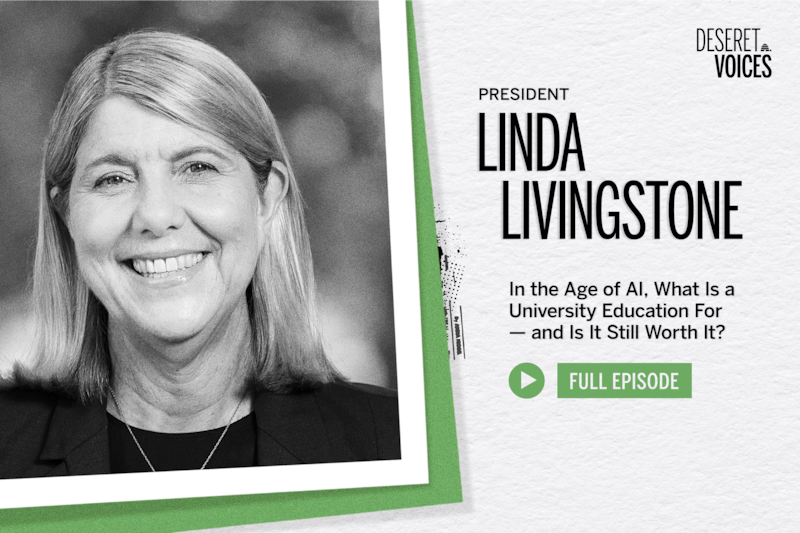


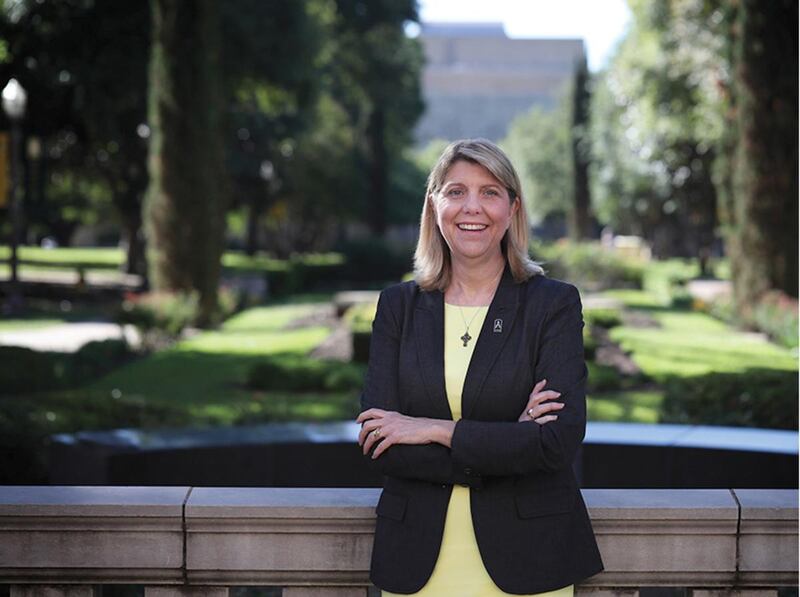
Baylor President Linda Livingstone’s administration began at a time of turmoil for the institution. Under her leadership, the Christian university has achieved Research 1 status, growth and record fundraising.
Livingstone says the school cares deeply about its religious mission and academic freedom.
On this episode of “Deseret Voices,” Livingstone tells Jane Clayson Johnson how Baylor is successfully navigating challenges brought on by artificial intelligence, government intervention and a lack of public trust in higher education.
Subscribe to “Deseret Voices” on YouTube, Apple Podcasts or Spotify.
Note: Transcript edited by Steven Watkins.
Jane Clayson Johnson: President Livingstone, thank you so much for being with us.
Linda Livingstone: Well, I’m looking forward to it, Jane. Thank you so much for inviting me to be a part of the conversation.
JCJ: You are the 15th president of Baylor and its first woman president. From your vantage point, what are the greatest challenges facing higher education today?
LL: It’s really the uncertainty that we face in higher education right now. The landscape for higher ed has changed dramatically in the last few years, and we anticipate that continuing. We know we’re on the front end of the demographic cliff of college-age-going students.
And then you layer across that changes in federal funding for both graduate and undergraduate financial aid, for research, the changes in visa availability for graduate and undergraduate students. And then we play Power Four athletics, and we know there’s a lot of chaos and change and uncertainty in college athletics. So it’s that combination that makes it really hard to predict and plan for the future because there’s just so much change and uncertainty.
JCJ: And so what would you say are the greatest opportunities?
LL: Well, anytime there’s a lot of change in a system or in an industry, it also gives you a lot of opportunity to think about what you’re doing, how you’re doing it, and how you can actually do things differently and better in the future. And it kind of forces us to put on a change and an adaptation and, frankly, a transformational mindset. So I think it’s a great time for higher ed to rethink how we do some things, make sure we’re putting our students at the center of what we’re doing and to really be creative about the work that we’re doing.
JCJ: Baylor has become a leading university and a major research center while firmly rooted in its Christian identity. How do you preserve genuine academic freedom and excellence while also remaining faithful to your religious mission?
LL: Yeah, we care deeply about academic freedom at Baylor, and we care deeply about our religious mission. And I really believe believe that in some ways that gives us a great deal of freedom, the integration of those two at a Christian university. We believe at Baylor, we talk a lot about this, that all truth is God’s truth, and that because of that, all truth should be open to inquiry. And so it opens the door for our faculty to ask really hard questions and to look at difficult issues, and also to kind of put a faith-based frame around those in ways that individuals at some secular institutions have difficulty doing.
So I believe it gives us a lot of freedom in the research that we’re doing and gives us opportunities to study issues and questions in ways that maybe other faculty have more challenges doing.
JCJ: Is rigorous scholarship ever in conflict with religious commitment?
LL: You know, I think there are certain topics, you know, in the world we’re in today, we have a lot of division over some really important and difficult issues, and there’s strong differences of opinions around some of these issues. And so I do think when we have faculty doing research in some of those areas, they have to be thoughtful about how they approach those. And I think sometimes the more difficult aspects of it come in the application of research.
And then what does that mean for policy? Or what does it mean for how an organization should respond or how people should respond? Because people have different perspectives about how you should solve some of these issues in the world.
JCJ: Can you give me an example of where that tension may exist?
LL: You know, I can think of several. I think the one that I will mention is there’s a lot of debate going on around the immigration environment and what we do with our borders, what we do with those that are here in our country. And this is a global issue. It’s not just an issue in the United States. And I think people from faith perspectives, of different faith perspectives, may approach this issue differently. And then certainly those in the secular community may have different perspectives on it.
And I think many of us have faculty that care deeply about these issues that are trying to study them and understand what’s going on, what’s the impact on our communities, and then, you know, what should policies be? How should we think about that? And because it’s such a divisive issue, both politically and theologically, I think it can be fraught with challenges for faculty doing research in those areas. And so again, I think making sure they’re doing really solid, good, objective research that they can put out there so that those that then are using that to make decisions can judge them and use them in the way that they think is best.
JCJ: Let me ask you about artificial intelligence, because AI is forcing universities to reconsider not only how students learn, but why they come to college in the first place. How is AI changing the conversations you are having as president of Baylor?
LL: Well, it’s certainly having a big impact across all organizations, but on college campuses, and there’s several places that we see that. I mean, we’re clearly looking at from an infrastructure back office perspective, how can we use AI to be more efficient and effective? And how can we provide better service to our students and our faculty and staff by just how we use it from an administrative support perspective? Then we see it in the classroom. And there’s a couple of ways it impacts the classroom.
One, there continues to be a lot of concern about the unethical use of AI by students in the classroom. So faculty and students are having to learn the appropriate ways to use the tools, to use them to learn and develop in whatever academic field it might be, but also then to protect the academic integrity of the evaluation process and the learning process. And we’re also seeing our faculty use AI a lot on the research side, particularly in the fields where they do a lot of analytical work. It is helping their research to be much more efficient and effective than in the ways we’ve done it historically. So I would say that across all aspects of what we do, we’re seeing the impact of AI, but we’re early in the process. So we’ve got a lot to learn, and we’re going to continue to see that grow and develop over time.
JCJ: Right, because for generations, education really was measured by how much information a student could master. And now with information instantly available and AI can analyze and problem solve and even do the thinking for students, what do you see as the value of a university education?
LL: I think in a way it raises the bar on what we have to do as part of the learning experience for our students. As you say, information is so readily available at the fingertips of students now. But I think that also poses one of the challenges. I think we have a great responsibility to help our students understand how to discern whether that information that they can get so easily through AI, through the internet, through other tools is actually accurate and truthful information. So they need to — we’re really having to develop in them better skills at discernment, at critical thinking.
And then now that there is so much information available, how do you decide what parts of that information are the most relevant for the work that you’re doing. So in many ways, a broad liberal arts education, an education that teaches you how to think, how to ask the right questions, how to be discerning, I think is even more important.
JCJ: Do you think it’s fundamentally shifting the university’s mission then toward cultivating judgment and wisdom and moral responsibility? I mean, is this making that aspect of education even more essential for you?
LL: You know, I hope it’s always been a core part of what we do in higher ed, but I absolutely believe that’s the case. I think there’s going to be less emphasis over time on sort of entry-level technical skills because much of that can be done by AI and more on these higher-level skills. And I love that you use the word “wisdom.” I think that’s a wonderful thing that we’ve got to work on. How do we help our students develop a wise way of thinking about the world and gathering information. So I do think it’s going to shift really to these higher-level ways of thinking and skills than maybe we’ve done in parts of our educational experience in the past.
JCJ: This is a complicated question, but I know educators are wrestling with it. How do you actually prepare students to use AI as a tool without allowing it to become a substitute for creativity or even their thinking?
LL: You know, that’s an important question. And I think it happens in different ways in different disciplines. So the more technical the disciplines are, I think it’s in some ways easier to think about how you use AI to do analysis and do those kinds of things. I think in some of the other disciplines, whether it’s, you know, some of the liberal arts disciplines and so on, because those are thinking disciplines and wisdom disciplines sometimes as we think about that.
So I do think those faculty sometimes have to think a little bit differently about how they’re helping students use tools. And so we’re seeing faculty in different types of classes, different kinds of disciplines use different approaches to the role of AI. And frankly, we have some who are much more early adopters and some that are a little more leery about it that will take them more time to understand that and see how they could use it in ways that really enhance and enrich the learning experience.
JCJ: Across the political spectrum, we’ve seen growing efforts by government officials to pressure universities over admissions, diversity policies, speech, campus protests. What principles should govern the relationship between government and universities?
LL: Yeah, it has been a tumultuous time in hiring for the reasons that you mentioned. And as I think about that, and as we think about this at Baylor, I think one of the most important things to do is to really focus on your mission as an institution of higher education. And if you really stay focused on your mission and the core elements underlying that mission, and you’re making the decisions you make in some of these difficult areas based on your mission and your core values, I think that helps you navigate that in ways. So I’ll talk about Baylor and then I’ll give a couple other quick examples.
As a Christian university, we ground decisions we make — particularly big strategic decisions — in our Christian mission. We use kind of biblical illustrations and examples and scriptures to help us understand why we’re doing things, what we’re doing and why that’s important. We did a monument to the enslaved. We were founded by slave owners in 1845 in Texas. And so we built a monument a few years ago to the enslaved on what we call Founders Mall. And we framed the building of that around the principles of repentance and reconciliation and in a context of our Christian faith. And I really think that helps people understand it in a way that allowed us to do it and move forward with it and help us think about, “What can we learn from that?” “How do we go forward?” — in ways that might have been more challenging if we had used a different framing.
I say this to others, if you’re a land-grant institution, you have a goal to serve rural communities, underserved communities in your state. And if you focus on that mission and you’re making your decisions on that, you’re, I think, going to be much better positioned than you would be if you’re just doing it for the sake of doing it or because of some outside pressure that is put on you to make a particular decision.
JCJ: But do you worry about government power being used to pressure or punish universities for ideological disagreements, understanding that those same powers could someday be used by an administration with very different priorities?
LL: You know, I think it is one of the challenges we face in higher ed that as administrations change, whose philosophies towards education change, you do get whiplashed in that at times. And I do think that as institutions of higher education, it is important that we continue to have the academic freedom we need to teach, to do research. I mean, we have the best educational system in the world. Much of that has been driven by the freedom that institutions have to do important research, to ask hard questions. And so you really want to try to protect that from outside pressure, whether that is from government, whether that’s from — even our church communities can sometimes do that. And so I think protecting the integrity of our academic missions is very important to continue to ensure that we have the best educational system in the world.
JCJ: And in some ways, do you feel like that’s under siege?
LL: I do think there are certainly some pressures that have made that more difficult. I also think we have to be really thoughtful as institutions of higher education that we are certain that we’re focusing on our mission and we’re not sort of getting out of our lane as institutions of higher education. So I think we have some responsibility in that to make sure we’re staying focused on the highest and best use of what we should be doing as institutions of higher education, while also wanting those institutions outside that may be trying to influence us to recognize the value of the academic freedom that’s important to higher education.
JCJ: Have you been concerned that other universities have been under pressure and that the government has overstepped in their oversight?
LL: There certainly have been instances where I feel like there has been pressure put on institutions, whether that’s at the state level or at the federal level, for, you know, political reasons that may or may not be in the best interest of those institutions from an academic perspective. And so you’ve certainly seen some of those institutions push back on that. You’ve seen some kind of agree to change some of what they’re doing. And I do think it’s causing all of us to be very thoughtful about the choices we make in making sure that we’re staying really committed to our core mission.
JCJ: Let me ask you about public trust in higher education, because public confidence in higher ed has fallen dramatically over the past decade. Why do you think that’s happened? And what do you think it will take for universities to rebuild trust?
LL: I think we’ve probably been a bit slow to sort of acknowledge that there may be some truth to that. I think there’s been a sense in higher ed that if we just tell our story better and we really emphasize the value of what we’re doing, we shouldn’t have to change anything and that will change the public’s view. And I think that has not been helpful to us in trying to kind of change the direction of people’s perceptions of higher education. So I do think it’s really important that we take seriously the criticisms we’re getting, taking seriously questions about affordability, taking seriously questions about, “Are we really preparing students in the right way to go out into the world that’s very different now than it was 10, 15, 20 years ago?” And making sure that while we’re continuing to still provide a really fabulous broad-based education, we do have to make sure that we’re preparing students for the careers they’re going to have, not just when they graduate, but five, 10, 20 years from now. And I don’t know that we’ve paid as much attention to that as we should. And I think if we start to do that and do what we say we’re going to do, that will certainly help us begin to shift that narrative and that perception of higher education.

JCJ: You recently served as chair of the American Council on Education, and you represented a coalition of roughly 1,600 colleges and universities across every sector of higher ed. What are the conversations and questions and concerns that university leaders are wrestling with today?
LL: You know, ACE is an interesting organization because it represents every type of higher education institution there is in this entire country, from community colleges to land grants, HBCUs, private faith-based organizations, some of the largest public research universities, the Ivy League schools. So it’s a really interesting coalition of individuals. And across those institutions, there is a lot of concern about the value of education question and how do we work together to address that because it affects all of us.
We have a lot of conversations around affordability and completion and how do we make sure that we are serving broad-based populations in ways that help people to actually graduate and get a college degree. We know the worst thing that can happen for someone is to start a degree and not finish, particularly if they’ve taken out student loans. And then we also are certainly very concerned about some of the government intervention in higher education and the way that’s affecting our ability to recruit students, whether that’s internationally or, as I said earlier, some of the changes in federal funding that might be limiting, frankly, some of the students who need higher education the most from having access to higher education.
So those are the kinds of things we talk about on a regular basis and say, “How do we work on changing the things we need to?” And then, “How do we work together with our state and our federal legislators on policy issues that could be helpful to higher education?”
JCJ: You talk to students today who are just coming out of high school, thinking about what their options are for the future, and they look at a possible college bill of hundreds of thousands of dollars and they just kind of wonder if it’s worth it. And so I guess I wonder, do you worry about education, higher education being for only people who can afford it?
LL: Well, I do think it is a deep concern both nationally and then certainly within the higher education community. I think, again, that’s one of the wonderful things about higher ed in this country is you have such a diversity of types of institutions that they can serve such diverse and broad populations in our country. But I think you’ve got to continue to find ways to support students in lower socioeconomic brackets to have the access that we want everyone to have to higher education. And it’s a big challenge as expenses go up and we have to continue to provide high-quality education while finding ways to support those that don’t have the means that some others do to pay for higher ed.
JCJ: During your presidency, Baylor has achieved R1 research status, record fundraising. You’ve experienced significant growth. I’m curious which decisions were most important in driving that progress.
LL: When I look back over my time at Baylor, I came in summer of 2017, and it was a very difficult time at the university. They’d gone through a really difficult transition with the president, the athletic director and our football coach. And so there was a lot of turmoil. There was a lot of unhappiness with the institution. And so when I came in 2017, it was really clear to me that one of the first things that I had to do was sort of rebuild a sense of confidence in the university, a sense of hope that the university’s future could be more positive.
And so when I look at our success at getting to Research 1, when I look at our success in fundraising, the foundation for doing that in many ways was the healing that took place in the culture on our campus with our faculty and staff and students, and then the healing with our alumni base. And we were then able to develop a vision going forward with our strategic plan, Illuminate, with our Give Light fundraising campaign that people got excited about and got behind because they knew we could be better and do better and have a greater impact in the world in a positive way than maybe the last few years had reflected for Baylor.
JCJ: You mentioned Baylor’s strategic vision called Illuminate, which you describe as a commitment to bring light to the world. Twenty years from now, when today’s graduates look back, what do you hope they say about how Baylor illuminated their lives?
LL: You know, I hope when they look back, they will talk about just the way in which the experience at Baylor really transformed their lives, helped them to grow, certainly academically, but really helped them to grow personally, to know who they were as a human being, to gain confidence, to go out into the world, and then also helped them to deepen their faith and their spirituality. And that they know it was a deeply formative experience that set them up for a very successful life — and not just a career, but a successful life.
JCJ: What keeps you up at night about the future of higher education and what gives you hope?
LL: I think what keeps me up goes back to that first question you asked me about the biggest challenges. What keeps me up, I think, is the ever-changing nature of higher ed right now and kind of the chaotic world we live in and figuring out how to navigate that in a successful way that continues to allow us to support our faculty, staff, and students in the way that we want to, to help them to be successful. And you have to be excited when you’re on a campus with students who are excited to be there. They want to learn, they want to grow, they want to develop. And you’ve got faculty that are pouring their lives into those students and then doing research that’s really making a difference in the world. And so that gives me great hope, not just for higher education, but hope for our country, that we’re producing really amazing young people, amazing research that’s going to make a difference in the world.
JCJ: President Linda Livingstone, president of Baylor University, thank you very much for your time today.
LL: It was a pleasure to be with you, Jane.