



President Dallin H. Oaks, president of The Church of Jesus Christ of Latter-day Saints, gave a 23-minute speech this week at the Washington National Cathedral on the U.S. Constitution as a catalyst for peacemaking, religious freedom and greater unity. In the panel discussion afterward, Rabbi David Saperstein acknowledged some of the ongoing challenges facing American faith while reiterating reasons for hope:
“Even with falling affiliation rates and people more individually spiritual,” he said of the United States, “still more people (are) going regularly to worship, more people (are) believing in God, more people (are) holding religious values central to their identity.”
Yet how can both be true, some wonder: a dwindling of faith among growing numbers of Americans alongside a deepening of religious conviction among so many others?
Both appear to be happening. While it’s clear some people are increasing and strengthening their faith, BYU professor Justin Dyer told the Deseret News that “those who are less inclined to religion now appear more likely to shed their religious identity today than in the past.”
While campus awakenings, celebrity conversions and a growing spiritual curiosity among younger Americans have prompted talk of national religious revival, major surveys from Pew Research and Gallup keep pouring water on this possibility. Generally speaking, traditional measures of religious life — such as weekly church attendance and formal denomination membership — remain flat or continue long-term declines, while numbers of religiously unaffiliated “nones” stay at record highs.

This is where recent Latter-day Saint data becomes especially interesting: varied analyses over the last decade demonstrate counterintuitive thriving in the faith despite a secularizing American landscape.
In what follows, the Deseret News aggregates 10 salient patterns from the last decade — beginning with a newly published analysis from our colleagues at Church News.
1. Growing numbers of Saints across states
The number of Latter-day Saints increased in 49 of 50 U.S. states over the past 25 years, as Dave Schneider reported in Church News in August. These percentage increases were the largest in North Dakota (131%), Tennessee (96%), Arkansas (85%), Texas (82%) and North Carolina (70%) — along with the District of Columbia increasing (187%).
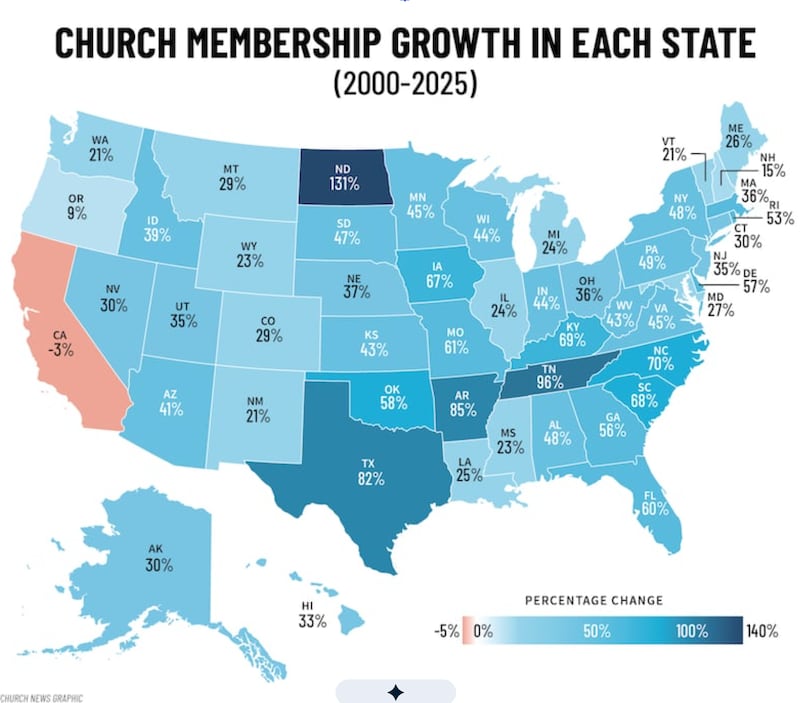
Although California was the one state with fewer members in 2025 than in 2000, the state still has the second highest number of Latter-day Saints among the 50 states (725,648) after Utah (2.21 million). They are followed in membership numbers by Idaho (482,905), Arizona (442,094), Texas (395,964) and Washington (278,576).
After Utah’s numerical increase of 576,368 more members in the last 25 years, the next highest states were Texas, 178,239; Idaho, 134,477; Arizona, 128,817; Florida, 66,612; and Washington, 48,939.
2. Increasing U.S. converts and members overall
As part of a record number of convert baptisms in 2025, Elder Quentin L. Cook of the Quorum of the Twelve Apostles pointed out that every region of the world had seen at least a 20% increase in convert baptisms in the first quarter of 2025.
Although the total number of Latter-day Saints in the U.S. did dip slightly from 2024 to 2025, Dyer noted that “the overall U.S. trajectory has been positive and congregation numbers grew during this same period.”
Overall, church membership in the United States grew from 5.21 million at the end of 2000 to 6.93 million in 2025, representing an increase of 33%.

3. Higher marriage and birth rates, lower divorce rates
Birthrates continue to decline virtually everywhere in the developed world, including in Utah. But Stephen Cranney’s analysis of data from 2008 to 2024 shows that Latter-day Saint women aged 18-45 have remained consistently 14 to 20 percentage points more likely than non-Latter-day Saint women to be a parent or guardian of a child under 18 — a gap that widened to its highest point in 2024.
Utah’s marriage rate also consistently outpaces national averages, reaching nearly double the U.S. rate in recent CDC and university analyses. Utah also falls in the lower-divorce tier in state comparisons, such as the latest WalletHub report where Utah ranks lowest in its combined “separation and divorce rate.”
The 2023 B.H. Roberts Foundation survey of Latter-day Saints found the divorce rate for marriages sealed in temples of the Church of Jesus Christ was “about three times lower than the national divorce rate.”
4. The highest active retention rate
Declining retention is a pressing concern of every faith in the U.S., including the Church of Jesus Christ.
Most discussions of retention focus on raw retention numbers, which count anyone identifying with a faith, including those who do so casually — in name only. On that measure, two different national surveys show that Latter-day Saints are higher than most other Christian denominations, except Catholics and Orthodox Christians.
When looking at those who identify with their faith and attend religious services at least once a month, Dyer and colleagues show that Latter-day Saints have the highest “active retention levels.”
“The Church of Jesus Christ of Latter-day Saints is retaining comparatively more than many other religions in the U.S.,” Dyer summarized in April, “particularly considering those who still identify as a Latter-day Saint and regularly attend worship services.”

5. Youth and young adults uniquely active in faith
Latter-day Saints are among the least likely to lose millennial and Gen Z members, Dyer pointed out — retaining active youth at a higher rate than almost all other Christian denominations except Seventh-day Adventists.
Younger Latter-day Saints are specifically more likely to attend monthly services (76%) than those of other faiths — also ranking highest in believing in God and considering religion important. For instance, Dyer and colleagues reported Pew data showing:
- A large majority of Latter-day Saint young adults (85%) say their faith is important (53% “very important”), compared to 54% of non-Latter-day Saints.
- Meanwhile, only 7% say religion is “not at all important,” versus 27% of their peers.
This high level of participation extends to home worship. In a 2024 Pew survey, 80% of Latter-day Saint parents reported praying or reading scriptures with their children — the highest of any religious group.
Additionally, Monitoring the Future data shows Latter-day Saint high school seniors attend church much more frequently than their peers, with millennial youth valuing religion more than previous generations did at the same age.
6. Record student enrollment in religious education and church universities
The church recently announced earlier this year that a record 1 million students are now enrolled in seminary for high school students and institute for college-age adults.
At a time of declining faith participation from teens and young adults generally, nearly 200,000 new students joined these educational programs in the past two years.
“Counter to the narrative sometimes heard that young people are leaving their faith, the numbers actually show that youth and young adults in the Church Educational System are flocking to their faith,” Elder Clark G. Gilbert of the Quorum of the Twelve said in late 2024, when he was the church commissioner of education.

That same year, there were record numbers of enrollments and applications to universities owned by The Church of Jesus Christ of Latter-day Saints. For the second straight year, BYU-Idaho’s incoming class shattered its mark for incoming students that fall, as Tad Walch reported.
7. Increasing numbers involved in sharing the gospel
After the age for missionary service was lowered for young men and women in 2012, a record of 88,000 missionaries for the Church of Jesus Christ was set in 2014.
This summer, after the age requirement for women was lowered from 19 to 18 in 2025, the church reported another record of 88,500 missionaries.
And this week, the church announced missionary numbers had risen to 90,000 total — the highest ever in the faith’s history. The milestone was reached as the number of young women serving as full-time missionaries — over 30,000 — became the largest cohort of sister missionaries ever in the church’s history.
8. Higher happiness, lower depression
Latter-day Saint college students have the lowest rates of depressive symptoms, according to the new BYU Studies report by Dyer and colleagues. Younger generations of Latter-day Saints are also the highest in rating their lives as “very happy.”
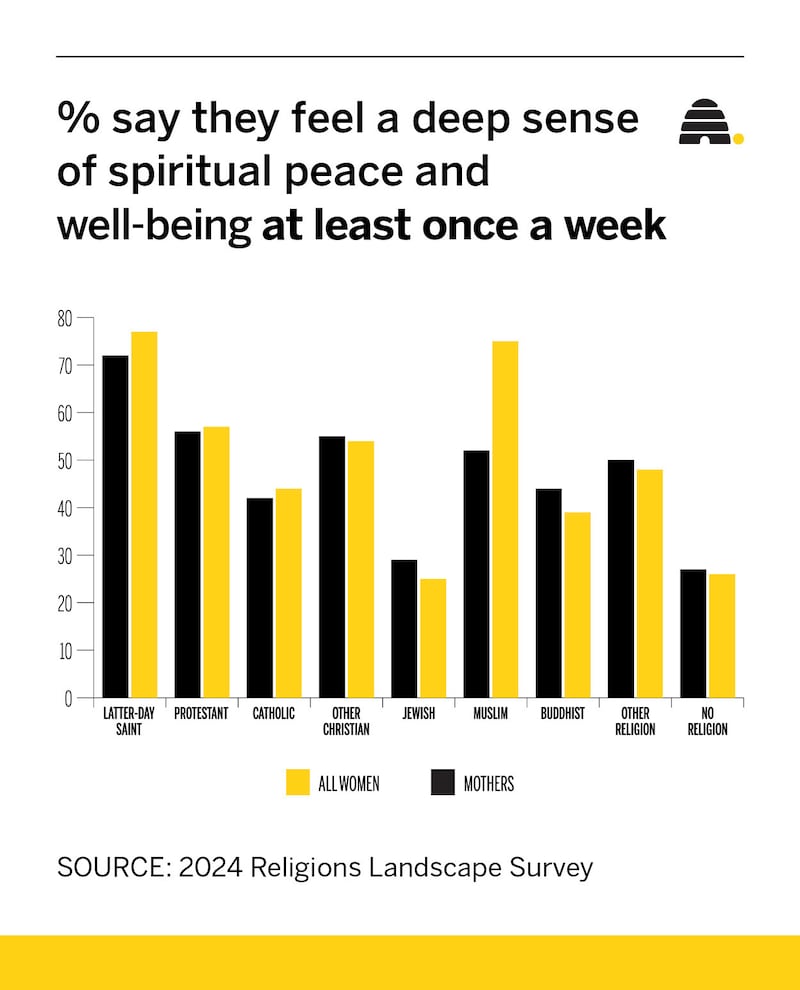
In previous Pew surveys, Latter-day Saints are also among the highest in their well-being, indicating high levels of feeling “a deep sense of spiritual peace and well-being” and being “very happy with life.” These trends also hold for Latter-day Saint millennials and Gen Zs who are highly involved in their religion.
Dyer noted that compared with other religions surveyed, Latter-day Saint millennials and Gen Zs were “the most likely to feel a sense of spiritual peace and well-being and to be very happy with their lives.”
9. Believing women thriving
According to the 2024 Cooperative Election Survey, a slight majority of active members of the church are women (54%). These Latter-day Saint women surveyed in the U.S. are “significantly more likely to report that they consistently feel a deep sense of spiritual peace and well-being,” according to Jenet Erickson and colleagues — a percentage that rises to 77% for Latter-day Saint mothers, significantly higher than all other religions except Muslim mothers at 75%.
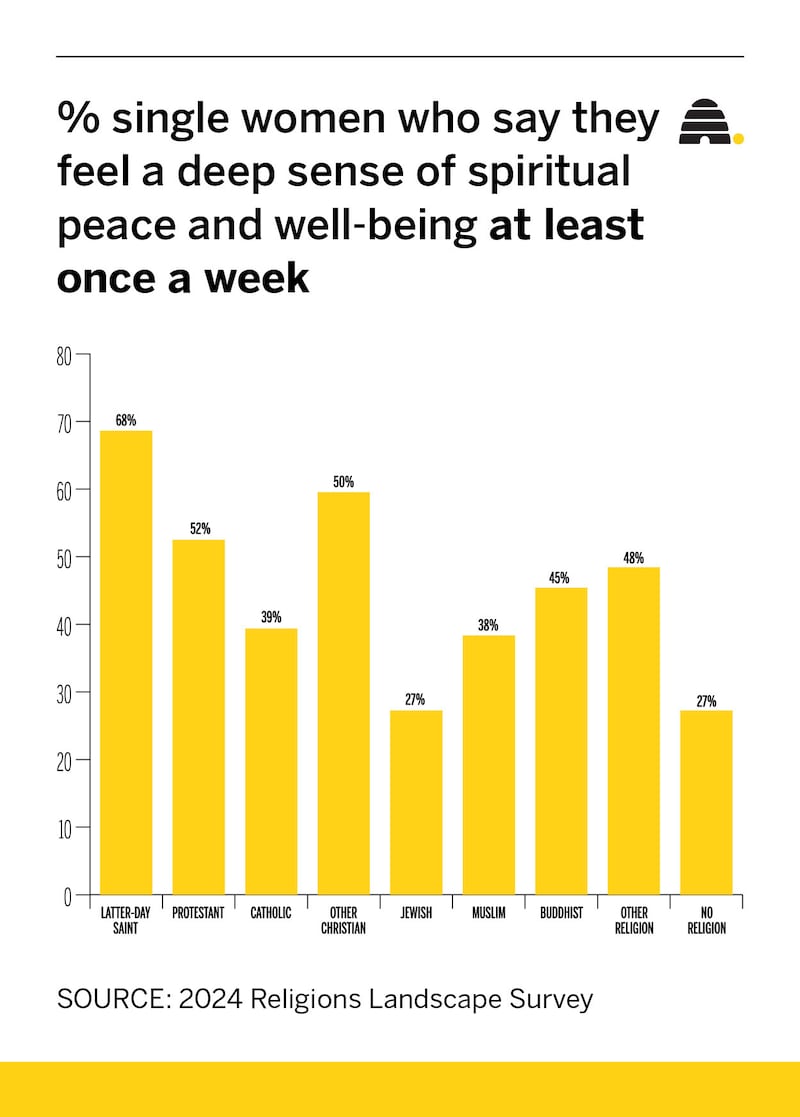
Among single Latter-day Saint women, 68% also say they experience a deep sense of spiritual peace and well-being on a weekly basis, significantly higher than single women of almost all other religions.
A 2019 Wheatley Institute study found that women who attended church weekly and worshipped at home were twice as likely as less-religious women and five times as likely as nonreligious women to feel their lives have meaning and purpose.
Latter-day Saint women were also significantly more likely to say they had a high level of life happiness compared to less religious women — with the highest rate of being very happy (35%) among other surveyed women. Only 5% of married Latter-day Saint women said they were “not too happy” — significantly lower than that of other religious groups.
Compared to other women, Latter-day Saint women were also the most likely to describe their family life as excellent and among the least likely to rate it as fair or poor.
10. Strong conviction and high activity
In 2023, B.H. Roberts Foundation randomly sampled survey of 2,625 members found between 65% and 71% of adults identifying as Latter-day Saints said they attend weekly, depending on where they live — rates similar to the 69% of Latter-day Saints who attend church weekly, according to the 2022 Cooperative Election Study.
This is in line with 2024 cellphone data by University of Chicago economist Devin Pope, which found Latter-day Saints among the highest weekly church attenders in America. Past Pew Religious Landscape Surveys confirm Latter-day Saints as having the highest rate of church attendance of any major religion and the highest rate of personal scripture reading and parents praying or reading scripture with their children.
In the same 2023 survey, 90% of self-identified members believed that “the Book of Mormon is a true record of ancient people who actually existed” — with over 85% agreeing that “Joseph Smith literally saw God the Father and Jesus Christ.”
A majority (about 80%) of Latter-day Saints surveyed also reported strong belief in God and in the institution of the church while also supporting the church’s teachings on marriage and the priesthood.
Vibrant activity across ages

The Church of Jesus Christ also noted this week that in the United States, “there is clear evidence of vibrant activity” among members. Church data shows that “over the last decade, there has been an increased level of church participation across children, youth and young adults.”
In his first interview as leader of the church almost one year ago, President Dallin H. Oaks emphasized that the source of the church’s growth is found in the message of Jesus Christ. “It’s a gospel of happiness and growth and information about the purpose of life,” he said.