


- Congressional Budget Office issues cost analysis of the ongoing Iran War.
- The federal agency estimates that the Iran conflict has cost the Defense Department $38 billion, as of Aug. 1.
- The analysis warns of depleted levels of U.S. missile interceptors.
Fifteenth-century Italian military leader Gian Giacomo Trivulzio is credited with saying, “To carry out war, three things are necessary: money, money, and yet more money.”
Centuries later, Trivulzio’s words still hold true.
The U.S. military’s ongoing conflict with Iran, which will soon reach its seventh month, is exacting a heavy cost in both cash and weaponry, according to an analysis released this week by the Congressional Budget Office.
In a letter to the House Committee on the Budget Ranking Member Rep. Brendan Boyle, D-Pa., CBO Director Phillip Swagel estimated that the war with Iran has cost the Defense Department $38 billion, as of Aug. 1.
“That amount reflects the costs of replacing expended munitions and equipment lost in battle, increased flying hours, other operations, and increased fuel costs,” noted Swagel.
The CBO is tasked with providing objective, nonpartisan information “to support the Congressional budget process to help Congress make effective budget and economic policy,” according to the CBO’s website.
Beyond the financial price tag of the war, the CBO also noted the war is exacting an “opportunity cost” because of its heavy expenditure of American missile defense interceptors. The agency asserted that the military will have a reduced inventory of interceptors for several years.
“The shortfall would become especially problematic if a conflict arose with an opponent whose arsenal included large numbers of ballistic and cruise missiles,” warned the CBO letter — adding that China has such an arsenal, “which would probably play a major role in a military conflict involving Taiwan.”
The CBO analysis included a key caveat: The agency relied on government databases and public reports to formulate the war costs because the Defense Department did not respond to its request for information.
“As a result, CBO’s estimates are subject to considerable uncertainty,” the letter noted.
Categorizing the Iran war’s financial cost
No surprise, Swagel expects the war’s economic costs will continue to increase as the conflict persists.
“CBO estimates that if the level of violence remained as low as it was in May and June, an additional month of conflict would cost $2 billion,” he wrote.
“If the intensity of the conflict increased to roughly the level experienced in July, the cost per month would increase to $3 billion. Monthly costs could be higher still if the violence escalated further.”
To estimate the costs to DoD of Operation Epic Fury, CBO grouped costs into the following categories:
- Replacing expended munitions, particularly cruise missiles and missile defense interceptors.
- Replacing equipment lost as a result of Iranian attacks, air defenses, or other causes.
- Increased flying hours for air operations, including the air transport of forces, equipment, and weapons to the Middle East.
- Other operations costs, mainly for Navy ships and Army ground forces.
- Increased fuel costs resulting from higher fuel prices.
- Repairing or rebuilding U.S. bases damaged by Iranian attacks.
The CBO analysis did not assign financial costs to the American service members killed or injured in the conflict, including the long-term costs of veterans health care and disability compensation.
What will it cost to replace expended munitions?
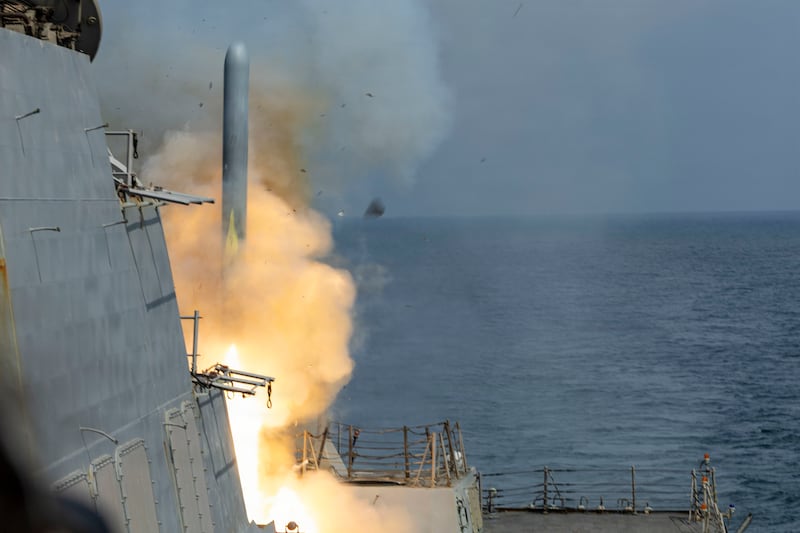
A large number of costly munitions have been used during the Iran War, particularly in the conflict’s initial weeks, the CBO reported.
Expenditures have included land-attack cruise missiles such as Tomahawks and missile defense interceptors such as the Patriot to defend against Iranian ballistic missile and drone attacks.
The cost of replacing those munitions makes up the single largest component of the war expenses.
CBO estimates that the cost to replace the munitions expended through Aug. 1, is $21.7 billion: $7.3 billion for the land-attack cruise missiles, $13.1 billion for the missile defense interceptors, and $1.2 billion for other munitions.
Reductions in the U.S. missile defense interceptors inventory would be relevant in a conflict with China, the analysis asserted.
“(China) has many more ballistic and cruise missiles than Iran had at the onset of Operation Epic Fury,” the CBO letter noted. “ (China) also has a significantly larger economic base than Iran and can produce such missiles more rapidly. An armed conflict with (China) could therefore place greater stress on U.S. missile defense capabilities.”
Rebuilding the DOD’s inventory of missile defense interceptors would “probably take at least five years,” the CBO added.
Defense Secretary Pete Hegseth has denied reports that missile interceptors stockpiles are running low.
And earlier this month, President Donald Trump said the U.S. has “virtually unlimited” amounts of mid- to high-grade munitions, pushing back on reports of the Pentagon depleting its stockpiles in the war, The Hill reported.
In a Truth Social post, Trump called journalists who report on U.S. munitions shortages “treasonous SCUM,” saying the country has “virtually unlimited amounts of Mid to High Grade Ammunition, far more than we could ever use” for the Iran conflict or “for any other War.”
Additional equipment lost in the conflict that the DOD would likely choose to replace is a THAAD radar destroyed by Iran, according to the CBO. The agency added it is uncertain how or if the DOD would choose to replace military aircraft lost in the war.
Meanwhile, the CBO was unable to estimate the cost of damage to U.S. bases and facilities in the Middle East. The DOD has not provided the CBO with information about the values of damaged or destroyed property — and it is also unclear how the DOD plans to repair or rebuild affected military bases.
Home front economic impacts
This week’s CBO analysis also examined the effects of the ongoing conflict with Iran on the American economy — primarily through its impact on prices.
The price of crude oil has increased because shipments of oil through the Strait of Hormuz have been reduced and not fully replaced by other shipments, the letter noted.
“Higher oil prices contribute to inflation directly, by increasing gasoline and other fuel prices, and indirectly, by increasing the cost of producing and transporting other goods and services in the economy.”
The CBO also estimated that the Iranian conflict will boost short-term and long-term interest rates.
“In CBO’s assessment, the increases in inflation and interest rates resulting from the conflict would boost both revenues and spending,” the letter noted, adding those effects would be modest relative to the size of the U.S. economy.