

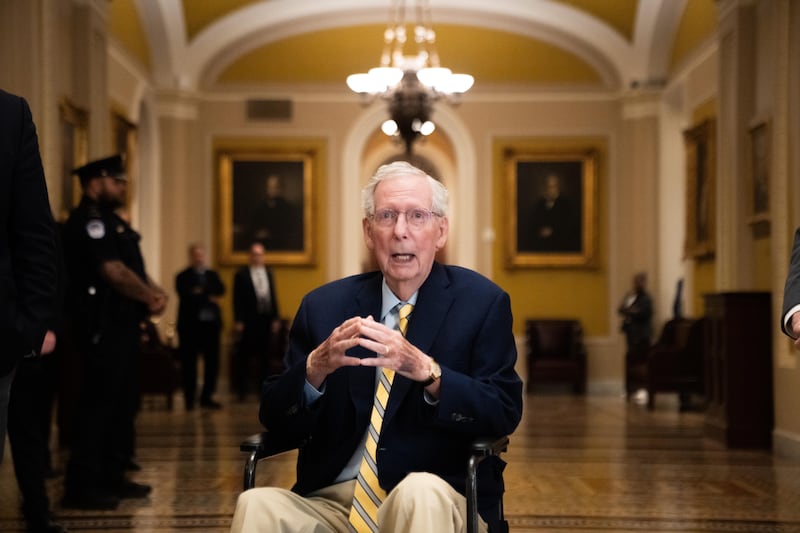

The recent image of Sen. Mitch McConnell returning to the Senate in a wheelchair, frail and mostly expressionless after a three-month absence, was a symbol, of sorts, of early 21st century politics in the United States.
First, we are a nation that loves conspiracy theories, and because of the 84-year-old McConnell, the past three months were full of these.
He was dead, some said, and his staff was keeping this information secret so they didn’t lose their jobs. If he wasn’t dead, he surely was incapacitated, went another narrative. When his office released a photo of the senator alongside his wife, Elaine Chao, it only fanned the flames. This was an old photo, some said, alleging it was from 2023. Others said it was generated by AI, the modern catch-all explanation for all things suspicious.
KCRA in Sacramento examined the photo with the help of experts and found no connection to a previous photo nor any evidence of AI generation.
This wasn’t a situation in need of a conspiracy. What we saw raised enough questions.
Our aging political leaders
Which brings me to the second thing McConnell now symbolizes — the aging public servant.
Is the senator incapacitated? Does he still know what he’s doing? Who judges this?
McConnell isn’t the first such symbol. Not long ago, Dianne Feinstein became the longest-serving female senator. She died at age 90, still in office. She had a remarkable record of service, but toward the end was visibly confused during committee meetings.
Should either of them have been forced to leave office because of age? Before you answer, consider Iowa Sen. Chuck Grassley, who is still going strong at 92, still feisty and in control.
Americans like to complain about how old our representatives are in Congress. A poll by the Deseret News and the Hinckley Institute of Politics, conducted in 2023, found 64% of Utahns agreeing there should be a maximum age limit for elected officials. That’s a decisive majority, at least at first blush. It fell apart quickly, however, when asked what that limit should be. The highest percentage, 48%, said 70, while 22% said 80 and 15% said 60. The smallest cohort, 2%, would allow up to 90.
Perhaps this is because many of us know people in their 90s, like Grassley, who are bright and capable of a high level of functioning, and many of us also know people much younger who are not.
The question, as I’ve said before, should be ability, not an arbitrary age limit.
What ought to be a separate issue is why we keep electing so many senior citizens.
Of the 100 senators elected to the 119th Congress, 27 are in their 70s, five are in their 80s and one is in his 90s. In the House, 71 are in their 70s and 13 are in their 80s, according to Ballotpedia. And, of course, the president just turned 80 in June.
We all age differently
It would be convenient to assign certain traits to certain ages, but life isn’t that predictable. This becomes obvious when we consider young people — you can’t get a driver license in many states until 16, and you can’t buy alcohol until 21. But only a fool would say those ages correlate with a magical maturation process equally in all cases. We all mature on different scales. Yes, I admit to feeling safer on the highways of Europe knowing the minimum driving age there is 18.
And while old age does increase the chances of cognitive decline, it’s hard in many cases to fairly judge this when the subject is a politician in a political arena. Cognitive tests? Could you imagine the arguments over details and results?
The 25th Amendment, ratified in 1967, was supposed to protect us from incapacitated presidents. However, it ultimately requires a two-thirds vote of both houses of Congress to remove a president who claims he really isn’t impaired. That’s tougher than impeachment.
Woodrow Wilson served long before 1967. He suffered a stroke in 1919, and his staff went to elaborate measures to make it seem everything was fine. I doubt the 25th Amendment would have helped much.
Joe Biden
More recently, President Joe Biden’s dismal debate performance against Donald Trump in 2024 made it clear he was having cognitive difficulties. Ultimately, pressures within his own party forced him to pull out of the race for reelection, but he served out his term despite the concerns.
No, we don’t need conspiracy theories about McConnell. We also don’t need arbitrary age limits. In politics, there will always be aides insisting we shouldn’t trust our lying eyes. Judging the fit from the infirm, regardless of age, always has been a job for voters, alone.