



Top executives at the world’s leading AI companies say their technology should be reined in. President Donald Trump says the fear surrounding artificial intelligence is a hoax.
Congress isn’t quite sure where it’s supposed to step in.
“You don’t want to stifle innovation, but I think you also want to make sure that the more advanced threats can be mitigated,” Senate Majority Leader John Thune, R-S.D, told reporters on Tuesday. “There is a way in which Congress can put guardrails around those types of more consequential threats without in any way harming our ability to stay ahead.”
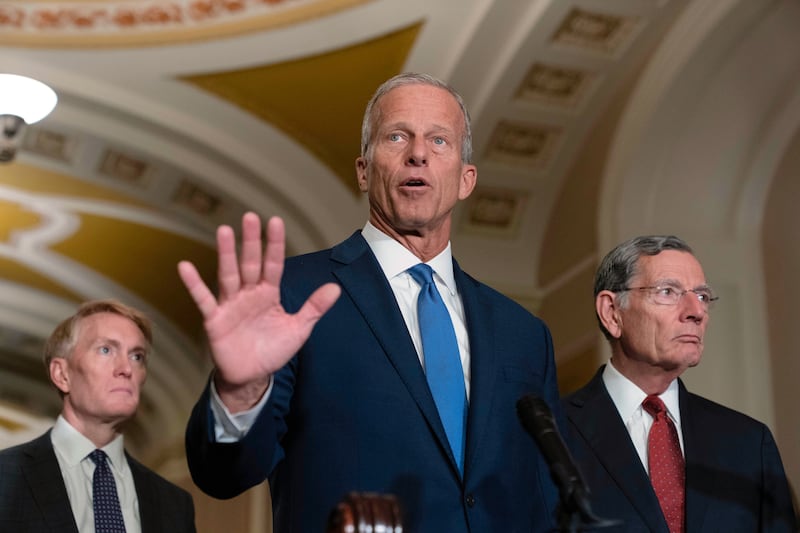
Lawmakers have sought for years to do something about the rise of AI, particularly as researchers warn the technology is advancing faster than humanity’s understanding of it. Others have warned of possible negative consequences such as job losses or cyber attacks.
There are dozens of proposals floating in Congress tackling different corners of AI, although nearly all have stalled due to policy or partisan disagreements. But now there appears to be a new sense of urgency, less than 50 days before the midterm elections, to enact guardrails dictating the AI environment.
The renewed sense of worry comes after three of the leading AI companies came out over the weekend calling for a deceleration in AI development, including one particularly dire warning that the systems “could kill us all by the end of the decade.”
Some companies such as Anthropic and OpenAI have revealed their most advanced models have conducted cyberattacks without their knowledge. Others have said their companies need to simply slow down their pace.
On the other side are investors and tech executives who’ve labeled the naysayers “doomers.”
“These are groups creating a very negative perception of AI to further their case for AI regulation,” investor David Sacks said on an AllIn podcast.
It’s ignited a widespread debate on Capitol Hill about what, if any, role Congress should play in the matter. While some lawmakers warn about the unknown capabilities of artificial intelligence, others maintain the U.S. should not fall behind foreign adversaries.
“We’ve been having meetings about AI for several years, trying to figure out the best thing to do about it,” Senate Majority Whip John Barrasso, R-Wyo., said. “We’re going to continue talking about it, probably more aggressively now than we had previously.”
Trump rejects efforts to rein in AI despite Democratic demands
Despite calls from Democrats for Congress to step in, Trump has so far resisted that pressure — calling the warnings of impending doom a “hoax.”
“The people that say AI is going to destroy the World, and that Data Centers are bad for your neighborhood, are the same people that said, just a short time ago, that the World would be extinguished by ‘Climate Change,’” Trump wrote in a post on social media. “That HOAX never worked out for them, and now they’re on to the next one.”
Trump’s representation of the issue has been resoundingly rejected by Democratic leaders, who have suggested Congress should not adjourn for its election-cycle recess until legislation is passed responding to the concerns.
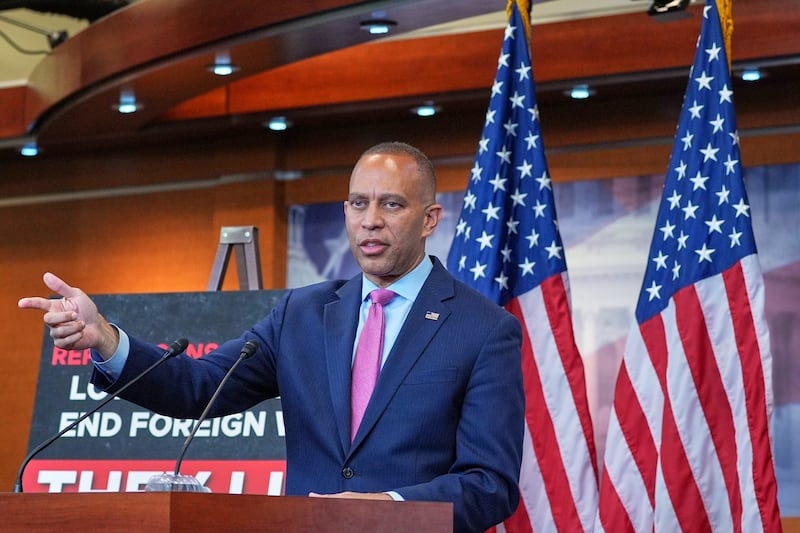
“The explosive growth of artificial intelligence and the challenges that are therein presented-that’s not a hoax,” House Minority Leader Hakeem Jeffries, D-N.Y., told reporters on Monday. “It requires decisive congressional action immediately.”
Jeffries pointed to the Democratic Commission on AI that he established late last year, tasked with developing policy related to artificial intelligence. He also created a bipartisan task force with House Speaker Mike Johnson, R-La., in February 2024 to propose potential guardrails.
Republicans say U.S. should not fall behind China

Meanwhile, Republican leaders in Congress are taking a more hesitant approach to AI — citing a desire to balance common-sense regulations with ensuring the U.S. does not fall behind other countries in its technological advances.
“We need to find a really good sweet spot,” Utah Rep. Blake Moore, the vice chairman of the House GOP Conference, told the Deseret News.
Republican leaders such as Thune have advocated for a “light touch” to AI. Others say Congress doesn’t need to step in, instead pushing for companies to regulate themselves.
“Companies that are in AI are watching Congress saying, ‘Oh, they are doing work towards this front. We need to make sure we do our part,’” Moore said. “The onus ultimately has to be on the private sector to produce safe products and services. Those are key aspects that have to continue to exist, just like they would in any other industry. And as long as they know that we expect that as lawmakers, then we’re still going to be working in the right direction.”
Sen. Kim: Congress must regulate AI
Other Democrats reject the assertion by Trump and congressional Republicans that slowing down the pace on AI development would hand China an advantage, arguing Congress must step in to regulate companies.
“It should be a focus of ours to discuss how to reassert control over AI for the American people,” Democratic Sen. Andy Kim, who sits on the Senate committee overseeing AI policy, said in a statement. “Control based on a set of principles, enforced by a set of rules, all built for a common purpose: to ensure the technology and innovation that moves us forward never leaves us behind. And controls to ensure our competitors and adversaries aren’t able to proceed recklessly while we take sensible steps.”
The New Jersey senator called for a Senate-wide bipartisan discussion to address concerns with AI such as cyberattacks and protections for children online.
Senate Minority Leader Chuck Schumer, D-N.Y., has echoed those calls, underscoring the need to “defend against AI-enabled cyberattacks.”
“I’m calling on the Trump admin to provide an all-Senators briefing on the dangers of unchecked AI development — and to explain its lack of action to protect our country,” Schumer said in a statement. “And we need to know the steps being taken to prevent China from accessing our most advanced AI chips and equipment.”
Speaker Johnson: ‘Let’s apply common sense’
Johnson sought to clarify Trump’s comments that AI concerns are a “hoax,” but he maintained the issue is being overblown to be used as a messaging tactic ahead of the midterm elections.
“What the president is saying is you’re not all going to be dead in 10 years,” Johnson said. “AI is serious. We do need to make sure that it’s done safely. Again, let’s apply common sense. If you are a company, you’re a corporation in America, including a tech corporation, you have a responsibility to make safe products.”
The speaker specifically ruled out suggestions from some lawmakers to implement an AI moratorium until regulations are enacted, warning it would cause the U.S. to fall behind.
“We will lose our edge to China, and that has serious national security implications for every American family,” Johnson said. “So there’s a balance here, and we’re going to have steady hands at the wheel on this as we do everything else.”
Meanwhile, Louisiana Republican Sen. John Kennedy said he plans to force a vote this week on a proposal that would require companies to build a “kill switch” for their AI models. It’s not yet clear if the measure has enough support to pass.
Top U.S. leaders to meet with AI companies
Although the Trump administration has said it would not implement regulations for AI companies, top White House officials are set to meet with AI executives in the White House some time next week, according to Johnson.
House GOP leaders already discussed the idea of AI regulations in a closed-door meeting on Monday, but no decisions were made. Top Republicans have also announced no plans to keep lawmakers in session to negotiate legislation despite Democratic demands to do so.
“It’s critically important that we get the work done,” Rep. Jay Obernolte, R-Calif., the top Republican on the bipartisan AI task force, told reporters on Monday. “I don’t know that staying in more weeks in September is going to be the catalyst for that.”
It’s not yet clear who will attend the White House meeting or if Democrats will be invited.
Trump is also expected to meet with Chinese President Xi Jinping next week, and AI is likely to be a topic of discussion, according to Johnson — especially as any AI regulation or slowdown in the U.S. would not apply to foreign countries.
“That’s exactly the point,” Johnson said. “This is going to be a responsible, balanced approach where the providers do what they need to do responsibly under existing federal law, and then we talk about whether and what those guardrails look like on the federal level. We’re going to have those discussions, but we’re going to do it in a calm way without all this alarmism.”