

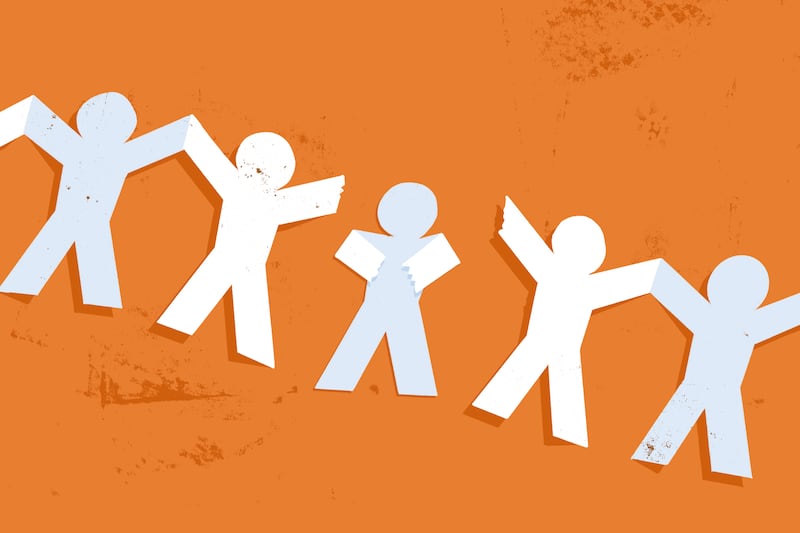

Until recently, the “no contact” movement appeared to be full steam ahead, with little slowing in sight. If you missed stories like “7 signs it could be time to cut off contact with a family member,” or “17 People Share The Exact Moment They Knew Their Family Was Truly Toxic,” you might have caught viral TikTok videos like “How to know it’s time to cut off your parents.”
Or maybe you spotted the “Toxic Family Quiz” promoted by the author of “Cutting Ties with Your Parents.” This year, a new collection of “No Contact” testimonials came out, marketed as countering “the prevalent trope of reconciliation as a happy ending.”
All this estrangement encouragement had an impact. Freya Sanders writes of receiving many messages like this at the Free Press:
- “We have two adult children, a son aged 30 and a daughter aged 27. We are estranged from them both,” wrote a 60-year-old mom.
- “Our oldest son, 27, has gone no contact with our entire family,” wrote a 57-year-old mother.
But it’s not just parents with regrets. In August, a New York Times op-ed carried the headline “Cutting Your Parents Off Isn’t the Answer.” The same week, The Free Press published a cautionary tale entitled, “I Went No Contact with My Parents. I Regret It.”
Maybe that wasn’t such a good idea
Some professionals are also cautioning about the long-term mental health consequences of the “no contact” movement.
Therapist Geoff Steurer told the Deseret News the trend is ultimately damaging “not only to the families who are cut off, but (also to) the person who cuts off.”
Joshua Coleman, author of “Rules of Estrangement: Why Adult Children Cut Ties and How to Heal the Conflict,” told the Deseret News, “Typically, if a parent gets cut out by their adult child, they’re also cutting out access to their grandchildren.”
That ”becomes a cataclysmic event in the family system that just fractures outward,” he said. “Siblings line up against the parent or with the parent. Young cousins and siblings get estranged and cut off from each other.”
Coleman believes a “slow” counter-reaction is taking place, reflected in a “groundswell of parents who are beginning to push back.”
This week, a new book by Noelle Mering, fellow at the Ethics and Public Policy Center, is also being released: “No Contact: How a Seductive Ideology Broke Families and Friendships and How We Can Repair Them.”
“We get used to a seamless virtual existence where we can mute, block, unfollow and silo ourselves away from anyone who challenges us or our narratives,” Mering told the Deseret News. “When we apply those online norms to real life, this is the result.”
‘Finally seeing the truth about my parents’
Although Christina Buttons endured some tumultuous teenage years, she admits her parents did everything they could to help her. But her view shifted at age 21 after a professional encouraged her to see some parental behaviors as emotionally abusive.
Until then, Buttons “had associated the word ‘abuse’ with the physical or sexual kind,” she said. But at that point, she began to see the expectations expressed by her parents as a form of “coercive control.”
Looking back from her current vantage point, Buttons said she recognizes how she began to “downplay the severity of (her) own out-of-control behavior” while discounting how much her parents really had done for her.
Yet she also remembers the relief that came with a simple explanation for her complex challenges. “My depression, low self-worth … could all be traced back to the same source: my parents.”
She wrote in her journal at the time, “I’ve finally found the missing piece to the puzzle. It all makes sense now.”
After being told by a professional it would be “unhealthy to remain in contact with them,” she came to see separation as “not merely justified, but healthy.”
Buttons moved into her best friend’s home, got her own phone and changed her number — all without any explanation to her parents, who didn’t hear from her for five years.
That changed when Buttons found out about her mother’s cancer diagnosis. “All of a sudden, the reasons I used to justify staying away seemed horribly trivial,” she said.
Short-term relief, long-term pain
Although “parents who are estranged are absolutely miserable,” Coleman pointed out that adult children can come away believing “there’s all kinds of upsides to being estranged.” That could include limiting any potential conflict and “pushing back against figures that you think were hurtful,” while joining an affirming online community of “people who have a similar kind of ideology.”
Yet dozens of studies show that keeping families intact is linked to better mental health over time, therapist Jeff Ford said.
“Anyone who encourages and validates the desire to cut people off is flying in the face of research,” Ford said.
“It’s like overusing antibiotics,” Mering explained, “which can be life-saving when necessary, but harmful if overprescribed and overtaken.”
Frozen relationships
Therapist Mark Chamberlain told the Deseret News that “when you stay away from parents, they become stone figures … who are larger than life. Whereas when you just interact with them and you stay interacting and you’re around them often, they just shrink down to just regular people.”
“That’s the risk when we distance — they’re cardboard cutouts now.” Yet, he added, “Most people aren’t so toxic you need to be away from them. They’re a mix of good and bad, just as we are.”
Mering stated, “Without that live, embodied relationship to humanize someone, they get reduced in your memory — calcified around a wound that you feel was inflicted upon you.”
“In real life, you might see that someone’s mom is selfish, but sometimes she’s generous,” she said. “Without those daily reminders, both people tend to stay frozen in ‘no contact.’”
“Just imagine the future when the child you raise discovers your qualities that aren’t endearing,” Chamberlain said. He cautioned against a world where parents who gave “blood, sweat and tears” over years of involvement through the good and the bad get cut out from a child’s life because of an unfortunate moment.
‘I’m so grateful we didn’t do that’
Steurer described personal experiences talking with his own family about patterns that were raising concerns. While some of those conversations lasted months and even years, ultimately, he said, “We finally found a way to come back together and feel connected and feel understood.
“I’m so grateful we did that work,” Steurer added. “I’m so grateful we all stayed with it. And nobody cut each other off.”
There were times that family members saw each other less or had shorter conversations as they took space to think, he acknowledged. “But there was never a severance, and I’m grateful we didn’t do that.”
Instead of merely aligning with someone in pain and validating them, Steurer encourages other professionals to consider ways to teach clients “how to sit with discomfort, to ask hard questions — to reflect, to show grace, to show gratitude.”
All of this can help “turn people back to their family,” he said.
“This doesn’t mean that we just let harmful patterns continue,” he clarified. “It just means that we learn how to deepen our own ability to regulate and be brave and trust in the inherent goodness that everybody’s doing the best they can and they may just need an opportunity to grow and develop.”
Swimming upstream in a pro-estrangement culture
Although more stories like this are beginning to circulate, Coleman cautioned that America’s dominant narrative is still “geared toward” cutting parents off. Popular culture is more sympathetic to separation than reconciliation.
This is being influenced by more than TikTok or therapists — half a century of revolutions in philosophy and cultural messaging has shaped us all, Coleman said. For instance, there’s been a shift away from “honor thy mother and father, respect thine elders, family forever” toward a “greater emphasis on protecting my mental health, family is what you make of it, respect is earned, not granted.”