


Adapted from a longer article recently published by the Institute for Family Studies, “Ready to Parent: Helping Couples Overcome the Fear of Parenthood.”
Several years ago, some good friends invited me over to their home one warm Sunday evening. We sat on the back porch with a lovely view of the nearby Wasatch Mountains. Their married eldest daughter joined us, and she mentioned she was struggling with the idea of bringing children into the world, even though she loved children and valued motherhood.
I tried to hide my surprise. She was the go-to babysitter in her neighborhood during her teen years. She had a solid marriage to a good man who also liked children. She was working but did not have a strong career focus.
Yet she said she just wasn’t sure about parenthood. “Is it really a good idea to bring children into such a crazy world that seems to be falling apart, not to mention a looming environmental catastrophe?”
She was also worried by simple economics — could she and her husband provide for their children on a teacher’s salary and in an expensive housing market where they hoped to live? Under these conditions, having children seemed risky, maybe even selfish.
We had a sensitive conversation that evening as I asked questions and shared research-based perspectives and general wisdom. But that night I became much more aware of — and sympathetic to — the real mental load young adults today carry as they wrestle with the choice to bring children into the world.
Personal fertility as a public concern
The concerns I heard that evening are making the news now. The New York Times has run four stories on fertility decisions over the last month, including an article about the decreasing fertility rate in the United States that explored how contemporary young adults are wrestling with the child-free vs. child-full lifestyle.
What is driving decisions to reduce the number of children or forgo parenthood altogether?
For one, parenthood is no longer seen and accepted as a societal norm — at least not to the same degree as in the past. Pew found in 2024 that the No. 1 reason younger adults were hesitating to have children was that they “just don’t want to” (57%), which was followed by “just want to focus on other things” (44%) and “don’t really like children” (20%).
A second contributor to child hesitance is that a quarter of young adults (24%) say they “haven’t found the right partner.” This response suggests a desire to be parents but a sensible decision to not do it alone. (Thus, my interest in trying to fix the current dating recession.)
But the other reasons documented in this poll are even more intriguing to me, including “concerns about the state of the world” (38%), “can’t afford to raise a child” (36%) and “concerns about the environment” (26%).
Empathy for those grappling with this decision
Yes, many couples today simply don’t want children, preferring to prioritize work, independence, time for leisure and the couple relationship over the admittedly heavy demands and lofty expectations of 21st-century parenting. I get it.
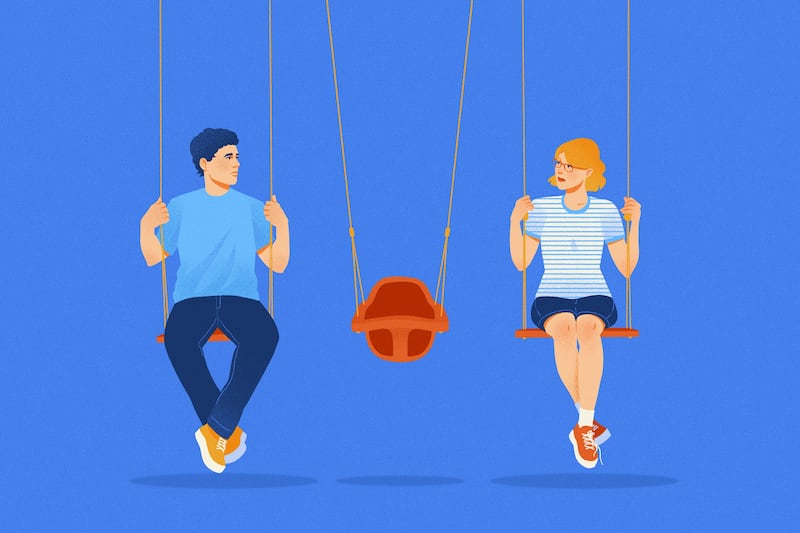
But my thoughts are drawn to the other group of child-hesitant couples, who generally would welcome children and parenthood but struggle to get over the mental hump of whether it is even a good idea these days.
I’m deeply sympathetic to this generation of young couples, who are open to parenthood but who experience less cultural support for that choice than in the past and have greater fears about how it will impact their lives.
I’m pretty pronatalist. I think rearing children may be the most soul-stretching, meaningful and transformative choice we have in the range of human experience, as well as one of the most significant concrete contributions we may ultimately make to humanity.
Human life — in the image of God — is itself an inherent good and is something that doesn’t straightforwardly lend itself to rational, economic analysis.
All this is true, and yet I’m deeply sympathetic to this generation of young couples, who are open to parenthood but who experience less cultural support for that choice than in the past and have greater fears about how it will impact their lives.
Gentle encouragement and wise education
So, what more can we do? These thoughts bounced around my head for several years and eventually became a prime motivation for tasking the Utah Marriage Commission (of which I am a member) to develop an online course designed to help young couples today name their hesitations and concerns about becoming parents, hold them up against the research, talk together about them, and come to a more settled decision point.
This balanced, sympathetic, research-based online course, called ParenthoodREADY, is self-paced, with regular pauses for self-reflection and deep couple discussion. The course is free for Utahns and costs $100 for individuals or couples outside the state. The class takes on the important questions many couples today have about parenthood, including:
- Why does this decision of bringing a child into the world feel so complicated?
- What can we do financially to be ready to afford this?
- Will parenthood change our relationship? And if so, how can we best navigate these changes?
- What are the common physical health challenges of pregnancy and parenthood?
- How can I become emotionally and mentally ready to become a parent?
- How can we be good parents in a crazy world like this and with concerns about climate change?
There are other resources available for couples thinking about making the leap to parenthood. What may be most helpful, however, is hearing real stories of young couples who have faced their initial worries and still decided to become parents.
Real-life narratives are especially powerful in canceling out the seductive voices on social media celebrating and advocating for the child-free lifestyle and questioning the wisdom of producing and nurturing the next generation.
Not all childless couples want children. But many do. And many of those that do struggle to cross the parenthood threshold.
They deserve more than a societal shrug and a sheepish “good luck with your decision.” They deserve a respectful understanding of the reasons for their hesitations amid the unique 21st-century headwinds they are facing.
They also deserve a fair presentation of the thrills and chills of modern parenthood. (Not to mention some more family-friendly public policies that could better support their voluntary parental sacrifices.)
Finally, these prospective parents could use some heartfelt thanks, old-fashioned cheerleading and even some material support if and when they make the hard personal choice to boost the national fertility rate.
Which reminds me: I need to send an encouraging text to the young woman I mentioned earlier, the one who wanted to process with me her fears about bringing children into the world.
She is raising young twins now. Courage and hope come in many different forms!