

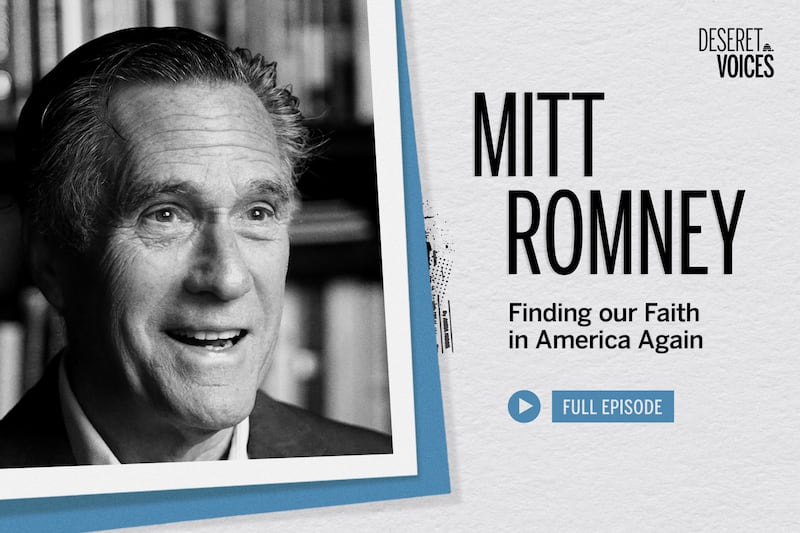


As America celebrates 250 years of independence, former U.S. Sen. Mitt Romney reflects on the individuals who have inspired us to our better angels and made democracy work.
Romney says the United States has been fortunate to have leaders who have “risen to the mantle of the presidency.”
On this episode of “Deseret Voices,” host McKay Coppins asks Romney about his level of faith in our nation’s future.
Subscribe to “Deseret Voices” on YouTube, Apple Podcasts or Spotify.
Note: Transcript edited by Steven Watkins.
McKay Coppins: Sen. Romney, thank you for coming on “Deseret Voices.”
Mitt Romney: Thanks, McKay. Good to see you.
MC: I told you beforehand when I asked you to do this that I probably already maxed out my lifetime allowance of Mitt Romney interviews. So, you’re especially gracious to make time for this.
I want to start with one of the first conversations I remember us having years ago when I started writing a book about you. You had me at your Senate office and you had on the wall the Rand McNally Histomap, which basically charts 4,000 years of human history according to the most powerful civilizations in the world at the time. And it’s a fascinating document and, you know, you see the Egyptians kind of dominating the world for 900 years and then they’re replaced by the Assyrians and then the Persians and the Romans and the Mongolians and the Turks. And the thing that you pointed out to me when you showed that map to me was that if you look at the span of human history, you basically have almost the entire time a world dominated by autocratic rulers of one kind or another, right? Kaisers and kings and emperors and the American experiment with self-rule, self-governance.
Democracy is both exceptional and, as you put it to me at the time, extremely fragile. It’s a fragile thing, American democracy. And I’ve been thinking about that a lot this year, that conversation, because we now are celebrating the 250th anniversary of the United States of America. And I wonder if you think that we as a country, as a people, are losing sight of both the exceptional nature of American democracy and its fragility.
MR: Yeah, I think so. I think it’s pretty clear as you look at history that what we have is an experiment. It hasn’t been tried very often. It has never endured anytime it’s been tried, which a tried, which is a government of, by, and for the people. And Lincoln questioned in Gettysburg, you know, “Will a nation of, by, and for the people long endure?”
The founders said, “The Constitution is not sufficient to secure a nation unless it’s led by virtuous people.” I mean the founders — and I think historians as well — recognize that this is something that hasn’t been tried at great length. Going 250 years I think is a record. And we have some real challenges right now. We’ve had a wonderful and glorious 250 years, but there are new developments on the scene that will test us and help us determine whether we fall in the same bucket as the other nations in history which is to become authoritarian.
I mean, the history of the world is some strongman, and basically always a man, a couple exceptions, Cleopatra, but mostly a man who gets some military might around him and then oppresses and conquers other people and dominates for some period of time. And we could fall into that. I don’t see that happening imminently, by any means, but I know that we face some challenges that call into question whether a nation of, by, and for the people will long endure.
MC: One of the ways that I’ve been thinking about this moment in American history is actually in religious terms. Sometimes we talk about people who have a faith crisis, right? They suddenly lose confidence or belief in the thing that they have long believed in, that it shaped their worldview. And I feel like we as a country are kind of in the midst of a faith crisis. We’re losing confidence in ourselves, in the kind of mission that we have for the world. We’re losing sense of, you know, whether we can really persevere or whether we’re even that special at all. And I wonder, you know, the thing about a faith crisis like that is that it’s self-fulfilling, right? In a democracy, if we all lose faith in democracy itself, in the American project and the American experiment, it almost ensures that the experiment will fail. And I wonder if you’ve been thinking at all about how to rediscover our faith, how to strengthen our faith in America.
MR: You know, there’s — an individual said something which I thought was quite profound. I wish I could remember the name of the person who said it. But with regards to a faith crisis, he said, “People who become atheist don’t realize they still believe in a god. They’ve just changed gods.” They don’t believe in a Divine Creator, but they find something else to worship and something else takes the place of the religion which they once had. I thought that was an interesting and profound thought.
And I look at what’s happening to many people in our country and other nations around the world that have a history of liberal democracy. And I think people are, in some respects, replacing the sense of community and devotion to the principles upon which our nation was founded. They’re losing the same level of devotion that they might have had in the past, and instead turning to something else. And it may be selfishness, it may be resentment, it may be revenge, it may be just money. But people are, in some cases, pulling in a different direction.
And in times like this throughout history, what has helped a nation or a civilization recover is an extraordinary leader who is able to unite the people again and bring them to their senses, if you will, and to once again call them to revere those things which are enduring and most critical for the happiness of humanity. I think that’s what our country needs. I think we will see that. I don’t know who it will be that rises to the occasion. I would have never guessed that it would have been Abraham Lincoln had I lived at that time and looked at his history. I would not have guessed it would have been Ronald Reagan, an actor for Pete’s sakes. And I think he did that.
So I don’t know where it will come from, but I think it will be an individual, a leader at the top, but also leaders throughout the nation. Whether it’s teachers, parents, folks that we work with in the office, leaders will step forward and call on, if you will, the better angels of our nature. And that’s happened before. I think it’ll happen again.

MC: Actually made me wonder about something that I somehow have never asked you in all of our conversations over the years. You know, there’s long been this debate among historians about what’s called the Great Man Theory of history, right? Is history shaped by unique individuals kind of using their agency for either good or evil, or is it more the fact that we elevate certain people who are really kind of swimming in the currents of history and that, you know, the people we decide were transformative were actually just kind of going along with, you know, a phenomenon that would have shaped history anyway. I’m curious where you land in that debate.
MR: No, I’m more on the former, which is, my view is that there have been some individuals who have surprised the world, surprised their nation or their civilization, and spoken in a way that has connected with the people. It’s not like they’ve changed the hearts of all the people of their nation, but instead they have connected, if you will, almost with a type of harmony with the soul. I mean, when Lincoln talked about calling upon the better angels of our nature, he recognized that we can call on the better angels or the lesser angels. And he called on the better angels.
I mean, Winston Churchill, I mean, the, you know, Great Britain was on its knees and despondent and fearing that they were going to be conquered. And he awoke a sense of courage and capacity and faith that was there, but had been overwhelmed with fears and trembling. And, you know, so I look at the people in our nation’s history and think in many respects what we are as a nation is the result of the extraordinary people we’ve had as leaders — leaders in faith communities, leaders in political positions, leaders in educational institutions, but particularly presidents.
We’ve had, with very few exceptions, some really extraordinary people who have, if you will, risen to the mantle of the presidency, and have been people of courage and character who we have sought to emulate, and have made us a better people. It’s not that we are not ourselves good people, we are, but all of these leaders together — religious leaders, education leaders, and so forth, including a president — have helped us become, I think, an extraordinarily good nation.
MC: Are there any leaders in American history — I know that you are somebody who reads a lot of biographies, you read a lot of history — are there any leaders in American history that you think are especially relevant right now, whose lives give us lessons that we as a country kind of really need to be learning?
MR: Well, there are very few presidents I wouldn’t put on that list, all right? I mean, one of my favorites is John Adams, and I know there’s not a lot of attention given to him, and I know he’s a bit of a curmudgeon from reading history about him. But he was very much in love with his wife, Abigail, and sought her counsel and advice, and she moderated some of his more extreme characteristics.
And he stood up and did what he believed was right in the most difficult circumstances. He defended the British soldiers that fired upon patriotic Americans. He defied, he, you know, fought for them and cared for them in the court of law and was successful, and the American people recognized, “This is a person of character.” And I think that’s been an element of our national psyche for a long, long period of time.
But I, you know, I look at someone like Harry Truman. I mean, this is an ordinary American, a haberdasher as people are fond of saying, who was thrust into a position of leadership, and made decisions which have influenced the world and helped keep America safe.
Dwight Eisenhower, of course, was an extraordinary general, but becoming president, he was able to make enormous changes in our country and by virtue of his character, I think also helped us shape the kind of people that we hope to be. So, you know, I look at those presidents, but then I, I mean, I have to tell you that I look at leaders of various religions.
I think Billy Graham was an individual who spoke about character and goodness and following the example of Jesus Christ. Look, if we’re following the stories and the teachings of Jesus Christ as they’re taught in the New Testament, and throughout scripture, then we’re going to be a better people, and he did that. I think we’ve had popes of that nature. I believe that the leaders of my own church likewise have had enormous influence on the character of people in my faith, and perhaps others in the community as well.
So, you know, we’ve been blessed by people of character that are fundamentally good people. And I think that is one of the reasons why we are seen as a nation that seeks to do good things. I met with the former president of Israel, and asked him about America. And he said, “America is unique in the history of the world. It’s the only nation in the history of the world which has won and fought wars and taken no land for itself. The only land America has taken is enough land to bury its dead.” That’s the image that is I think recognized and revered around the world. And we have times when that waxes and wanes, but that’s our heritage.
MC: You were invited recently to speak to a future generation of leaders at Harvard Business School, and your speech was really interesting because it kind of, you know, went viral. Like, it got a lot of attention, it was widely covered. I’ve seen clips from it, you know, circulating on social media for weeks now. And I’m curious, when you are asked to give that speech, you of course are a Harvard alum yourself, and you were thinking about what advice those future leaders needed to hear, what was going through your mind? What led you to give the speech that you did?
MR: You know, I recognize that the 900-plus people coming out of Harvard Business School this year will go off largely to corporations and will have a big economic impact on the nation. And I wanted to talk to them and give them the confidence that if they’re building strong economic entities, why, that’s a kind of public service. Don’t feel bad about doing that. You don’t just have to teach, or be a religious leader to help the country.
But I wanted to provide also some sense of what they need to think about for their own happiness and sense of achievement in life. And that’s a recognition that if someone wants to write your biography, they should not have to use an adding machine to figure out what’s important to you. But they should instead be able to look at the things that you’ve done with your family, with your friends, in your community, in your faith, that these are the things that are going to have the biggest impact on your life, but also on the place where you live and in our country.
I mean, I, you know, I go back to this sense that America is a great nation not just because we’re economically vital, but also because we’re a good nation. And people who are graduating from elite institutions, we expect them to be capable and accomplished, but also good people — people who contribute to their churches and to their communities, and to their families and friends. And that is at the heart of what makes America a unique nation, I believe, in world history.
MC: It’s interesting, in that speech you quoted David O. McKay, the former president of the LDS Church, “No success can compensate for failure in the home.” And then later you kind of expanded on that idea. You said, “To be a great nation it must also be a good nation. There is no success that can compensate for a failure to be a good and noble people.” Why was that an important message for those students in particular to hear right now, and why do you think it resonated so much? I told you actually, I texted you after I saw it, I thought it was obviously a good message. I’m surprised by how much of an impression it made, because it feels like in some ways, you know, kind of conventional wisdom, or at least it would have been at least not that long ago. But it feels like it really struck a nerve, and I’m wondering if you have any idea why.
MR: Well, it’s interesting. The quote of President David O. McKay, which is “No success can compensate for failure in the home,” was a quote which was first offered at Harvard Business School at this same type of convocation about a decade ago by then-Dean Kim Clark, who became Elder Kim Clark in the Seventy some years later. And he offered that quote, and that likewise really impacted people. So, I recognize that that rings true with people and decided I was going to lift that again and say it again in part because I think it is something which people tend to remember and as these young people are going out into the world of the economy or politics or wherever, that they recognize the significance of their family.
But I also feel that it’s important to connect that to the nation, that it’s true for individuals that no success can compensate for failure in the home, but it’s also true for us as a nation that no national success, no conquest, if you will, would ever compensate for failure for us to be a good and noble people. We’ve made mistakes, terrible geopolitical mistakes in our history, and I consider Vietnam one of those, and I think clearly how we exercised our power in Afghanistan and in Iraq, it didn’t work out the way we wanted to, but I think nations recognize and people around the world recognized we did what we thought was right. We happened to be making some mistakes and misunderstood what was going on in some respects, but we did, we always acted out of a sense of what we believed was the right thing to do. And I think it’s important for us to continue to have that as the test of our military or other actions around the world. We will do what we believe is the right thing. And I think that is one of the things that has led us to have friends around the world.
Someone has pointed out that what has allowed us, if you will, to be so successful as a economic and military entity is that whereas Russia and China have perhaps military might, they don’t have the friends that we have. We have, you know, we have over a hundred nations that are our friends. And that gives us economic might, geopolitical might, and in some cases in our history, military might. So, being a good people, I believe, is essential to America’s capacity to enjoy the great economic and geopolitical riches that we enjoy.

MC: You have been in a quasi-retirement for the last couple of years, and I’ve been wondering what it’s like for you to watch what’s happening in the world, in Washington, you know, we have global conflicts all over the world, there are really interesting things happening in the economy, we’re on the brink of some potentially historic IPOs of large companies. I wonder, is it strange for you to be kind of watching it all and not be in the middle of it? Because you are a person who has spent most of your life in the middle of the action, and you’ve been remarkably restrained about not kind of wading into daily politics, you’re not kind of commenting on every news cycle. What has that been like for you?
MR: There’s no question, McKay, it’s a change. But I think it goes with the reality that in our nation, in our system of government, for instance, when you’re off the stage, you’re off the stage. I mean, the microphone is taken away. You may have a few people that still listen, but by and large, they don’t. You know, I know in nations that have a parliamentary system, the person who loses, for instance, in Great Britain, a race or leadership in to become prime minister, he or she still, you know, goes into Congress and or goes into the Parliament and speaks and is the voice of the opposition, but not here. So, whether it’s Hillary Clinton or Barack Obama or Mitt Romney or Al Gore, it’s expected in our nation to get the heck off the stage and let new voices take over.
And I just, I recognize that. And so my role now is a different role. It’s not to be pointing a finger at the opposition and arguing that the Democrats are wrong, or the Republicans are getting it wrong, but instead to shore up the next generation, to teach what I can to them, to talk to leaders of various kinds and encourage them to take action which I think will be helpful, but it’s calling on, if you will, the next generation of leadership as opposed to arguing with the current generation of leadership. Because, frankly, I think people don’t tend to listen, and if they do, they think, “Oh, you’re just, you’re a has-been.” And it’s like, “OK, yeah, you’re exactly right. I am a has-been, but it’s better than a never-was, and so I’m happy to live with that.”
And frankly, McKay, you know, I watched my dad as an example in many, many ways. And I saw him after he left the president’s Cabinet — he’d been a governor for three terms, he’d run for president unsuccessfully, but after he left the president’s Cabinet, he was a little frustrated and I watched that and I thought, “Well, I don’t need to have that frustration.” He found a new passion, which was volunteerism, but my passion is trying to help young people recognize that they can have a great impact on the future.
MC: So, what is keeping you busiest these days? Are you spending a lot of time talking to students, to younger people? Are you writing? I mean, I’ve always been waiting for your slate of books that you and I have talked about over the years. I’m just curious, what’s filling your days most these days?
MR: Yeah, I can’t compete with your writing, so I’m not going to try. I’m not going to try and write a different story than you wrote.
MC: I think you could do pretty well. I think a book by Mitt Romney would do pretty well.
MR: Well, I’ve actually kept all the letters that Ann and I wrote to each other in high school. We met in high school, so I have all those letters. We were from schools that were across a pond from one another, girls school on one side, boys on the other, and they took our letters back and forth every day, little mail service between the schools. And so I would write Ann, and she would write me back. So I have all those letters, and the letters we wrote during my mission and so I could write a story about our love story, which I would find fascinating, but I don’t think the world would.
No, what I spend my time doing, one, I’m again engaged in the investment world, and, you know, making sure that I keep body and soul together, and I work to try and help in businesses that I care about. But No. 2, I do have speaking assignments, some I get paid for, which is really a shock. But others I just do because I think they’ll potentially have an impact. I do whatever my church asks of me. I made a commitment many, many years ago to consecrate time to the building up of my faith, and I do that when I’m asked. I’m not asked very often like I once was, but that’s fine. And you know, McKay, I think, you know, at some point you recognize it’s time for the old folks to lay down in green pastures, and the pasture is still green, I’m not exactly laying down, I’m keeping busy, but more time with Ann than I’ve had in the past. You know, I try and make meals now and then. I’m not very good at that.
MC: Wow!
MR: Well, I mean, very, very now and then. I mean —
MC: What what are we talking? Like what are some dishes you’re doing recently?
MR: Well, I, you know, one of my specialties is so-called the Senate bean soup, which has been served in the United States Senate for, I think, over a hundred years, which is, you know, you soak navy beans in water and you put in chunks of of smoked ham and you cook that overnight, or simmer it for long, long period of time. It’s absolutely delicious. I mean, I’m — and put in some onions. These are the kinds of things I’m adding to the Romney menu.
MC: Wow, see, look, this is amazing. Even in retirement, you’re expanding your life skills, you’re learning new things. How does Ann like the Senate bean soup? Is she a fan?
MR: Yeah, she loves it. The problem is I make a lot of it, so we have to have it over several days. But we have some others, you know, Italian wedding soup. Basically, Ann has me making the meatballs. I’m a good meatball maker with some Italian sausage and some turkey, ground turkey, bread crumbs and some onion, mold that into meatballs. And I’ve, you know, we have dinner with our grandkids. We’re here in Utah, so we have grandkids at various universities here. And so we bring them all together on Sunday. A couple Sundays ago, I made over a hundred meatballs, so, you know, I’m breaking new records in the Romney home.
MC: That’s really inspiring. Look how far you’ve come from a freezer full of frozen salmon fillets, right, when you were in the Senate.
MR: Yeah, well, we’re staying away from salmon, ketchup and hamburger buns, yeah.
MC: I’m happy for you. Well, returning to America’s 250th anniversary, we talked a little about this idea of kind of faith in America and how a lot of us might be struggling with our faith in America’s future. And as we look forward, I’m curious what your level of faith is in America. You know, you urged those students at Harvard to be relentlessly positive and optimistic. You also acknowledged that you are not always following that example. I think Ann was the one who told me that you’re a pessimist by nature. So, I’m curious, I want to get as as candid an answer as possible from you. As you look forward to the next century of the American experiment, how confident are you?
MR: I’m confident, but let me tell you what I think the great challenges are, the risks, if you will, and then I think I will also tell you what I think the source of optimism might be. The risks you know well. One is just the arrival of AI. It’s not fully arrived yet, but they’re moving towards AGI, and not just agent AI, but also, if you will, a level of intelligence which equates to the smartest people in the world. And will we have robots with that as well? I mean, Elon Musk says we will. You know, Dario Amodei says we will. But if we do, that’s going to represent a real challenge.

Another challenge is just the amount of debt and the spending that we have. We’re not really addressing that. Another challenge is China. It’s got a different model of governance, and it’s doing really, really well. It has some challenges, demographic would be one of those, but it’s doing, I mean, it’s, in technology and in various industries, it’s really pretty advanced and in some respects ahead of us. So, that’s a challenge. And the decay of many of our institutions, that’s a challenge.
I’m concerned about the amount of money a few people are getting. I mean, the idea that Elon Musk is going to be a trillionaire, what does that mean? We’re talking about a thousand billions. And that means, you know, he could drop a couple of billion in a political campaign to support someone who would give him even more power, and he’s not just the only one, I shouldn’t just pick on him, but there are others that are going to become hundred hundreds of billions of dollars in wealth, and they will influence our political system. So, these are some of the challenges that we face.
The decline of religious belief, I think, is a real concern. And so those are the kinds of challenges we faced. But the reality is we faced challenges in the past. The Civil War, the division that existed in our country — I mean, people were, Americans were killing each other. We were being torn apart. And so, you know, I look and say, “OK, there’s an example of a time when we faced great challenges as well.” And we were retrieved from that by a great leader that called on America’s heart and goodness and drove us to be better people. We were also retrieved, if you will, by the power of freedom.
I happen to think that freedom is a extraordinarily powerful elixir, if you will, that it blesses our industries, it blesses our people, it gives us the ability to pursue our dreams. And people pursuing their own dreams, if you will, hundreds of millions of people pursuing their own dreams is a lot more powerful than someone like Xi Jinping pursuing his dream. And so we’re able to succeed in part because of this great freedom which the founders blessed us with. So, yeah, that’s the source of my optimism, is that freedom and great people will step forward and that together we will be able to overcome the challenges we have.
And other nations that are pursuing more malevolent courses, at least in our point of view, will fall upon stumbling blocks, and America will reemerge as the economic, military and geopolitical leader of the world, as we have long been.
MC: Well, before I let you go, I want to ask one more question. Are you running for president in 2028? No, I’m just kidding.
MR: Well, I’m glad you’ve raised that. I wanted to announce that I am running one more time. The truth is, the truth is I, you know, I remember talking to my dad about this and, you know, in his 80s he said, “Oh, I would love to do it again.” And the reality is sure, I would love to do it again. And this time I might get it right, you know, third time’s a charm. But no, I’m not.
MC: You know, 80 isn’t what it used to be. I’m not the first one to tell you that.
MR: You know, Bill Bryson, in his book “The Body,” he points out that the human brain shrinks by 20% by the time you’re 80 years of age. Twenty percent smaller, just the size of the brain itself. So, I basically think people who are 80 and above really should not be running the world or running the country.
MC: OK, that’s probably some good wisdom. No, my real last question, and this is something I’ve been asking guests on this show in recent months as the world just feels incredibly tumultuous. What is something in your life right now that is keeping you sane, that’s keeping you grounded?
MR: Well, you know what that is, which is, No. 1, is my wife. Ann and I have a partnership that spans almost 60 years, and she is my best counselor, adviser, and the kids call her the “Mitt Stabilizer.” Which is when I become too extreme or become too concerned one way or the other, she’s able to bring me back to the center.
No. 2 is my church, my faith. My faith in the gospel itself, as taught in scripture, but also the leaders of my church. I happen to be blessed by having church leaders who have not failed me. They are individuals of great character and capacity, and I look to them for guidance.
And No. 3 is a sense of purpose. My purpose in the past was pretty expansive. It included working for a state, the state of Massachusetts, then working to try and improve the nation and to represent the people of Utah in the nation. But now my purpose is much more narrow. It’s my family and my faith and my wife and our relationships, because I’m not in those roles that I used to be in. And so I have purpose, I have people I admire, and I have a person I love deeply.
MC: Sen. Romney, thank you for coming on “Deseret Voices.”
MR: Thanks, McKay. Good to see you again.