

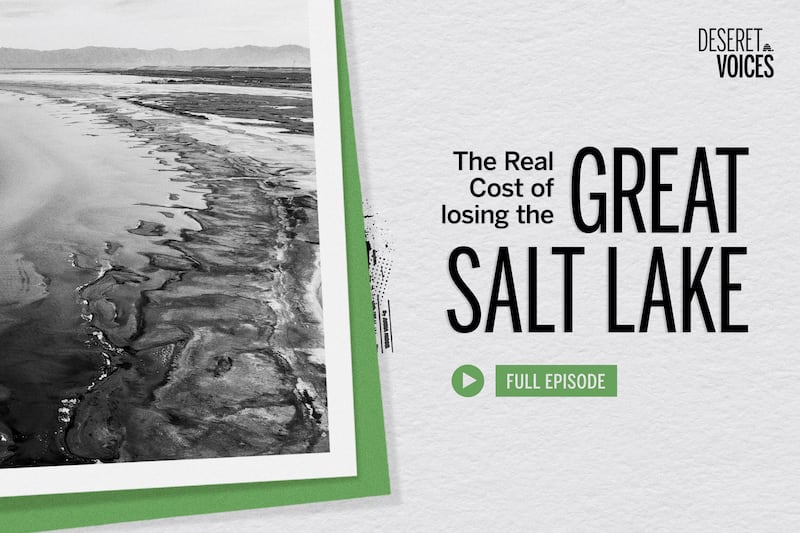


“Deseret Voices” host Jane Clayson Johnson noted as she flew over Salt Lake recently that the Great Salt Lake is “gone.”
On this episode, Johnson asks Ben Abbott, a global ecologist at Brigham Young University, and Josh Romney, CEO of Great Salt Lake Rising, what can be done to save the lake.
Their conversation touches on the debate between agricultural and residential use, and what would happen for the 2.5 million people living on the shores of the Great Salt Lake if the issue isn’t reversed.
Subscribe to “Deseret Voices” on YouTube, Apple Podcasts or Spotify.
Note: Transcript edited by Steven Watkins.
Jane Clayson Johnson: So let me start by having you introduce yourselves and tell us what your involvement is with the Great Salt Lake. Ben Abbott?
Ben Abbott: I teach ecology at Brigham Young University. I study global water security all around the world. And for the past few years, have been working in the community on Great Salt Lake, first with a group called Grow the Flow, and now with Josh at Great Salt Lake Rising.
Josh Romney: So I am an adopted Utahn. I did not grow up here, grew up back East, but I’ve raised my eight children here. I love the state and want my kids to have the same opportunity that I had here in Utah. And a big part of that is rescuing the Great Salt Lake. So I’ve thrown myself into doing everything I can to make sure that we can bring that lake back to a healthy level.
JCJ: So let’s start talking about the lake in its current condition. I was reading the first line of an article in the journal Science that said the Great Salt Lake is a ticking environmental nuclear bomb. What is the condition of the Great Salt Lake today?
BA: The lake is mostly gone. Two-thirds of its water, over half of its area have been desiccated. The lake is 15 feet lower than it would be naturally. You know, and this is a lake when full, that’s the size of Delaware.
JCJ: I flew in over Salt Lake a couple of days ago. I mean, it is gone.
JR: Yeah.
JCJ: It’s just not there. I mean, you could physically see it, but if you’re on the ground, it’s really hard to really get a sense of it.
BA: If half of the mountain was gone, everybody would notice right away. But because the lake is low-lying, you can kind of only see it from the air or when you’re right there. This has happened slowly, but also largely out of view. But as the lake shrinks, it’s shifted weather patterns. Sometimes people think the lake is declining because of drought, but the relationship’s actually the opposite. Part of the reason why we had such a severe snow drought this winter is since the lake is mostly gone, we’ve lost a source of water vapor, right?
JCJ: So the lake creates rain.
BA: That’s right.
JCJ: It creates water and snow.
BA: We don’t have as much local precipitation because the water coming from the lake through the evaporation can’t be a source of snow and rain downwind. During the 1980s, there was an uncommonly wet period, so a series of huge water years. If you reconstruct climate over the past 1,000 years, that was the wettest period there. So we think this is about a one —
JCJ: Wettest period in 1,000 years?
BA: In 1,000 years, right? So might the lake come back naturally? Maybe, but we probably are gonna have to wait 1,000 years for that to happen, right?
JCJ: And it’ll be too late for all the consequences.

BA: It’ll be too late because we are within just a few years of seeing the lake’s food web collapse, of the lake sediment becoming a source of this toxic dust pollution that’s already impacting our health, our economy, our snow, and our fields. It’s gonna be too late for the millions of birds that depend on this lake. The stakes are too high for us to bet the farm on another wet year.
JR: And the reality is this is not theoretical, this is math. It’s if we don’t get 130% snowpack every year, the lake is going to continue to decline. So the hope right now is that we get 130% snowpack in perpetuity, which is not realistic. That’s not going to happen. So unless we change our behaviors and the way we use our water, the math is telling us the lake is going to continue to decline.
JCJ: Is there a tipping point wherein if we don’t do something here, if Utahns don’t do something, that there’s not a way back?
BA: Well, I think it’s important to put this into context. There are 120 of these large saline lakes all around the world. Nearly every one is in decline. They’re very sensitive. You know, if you divert the rivers that flow to them, it’s like a bathtub without a drain that starts to evaporate out and the lake levels drop. There isn’t a single success story yet of one of these lakes being restored. And so what we are —
JCJ: Anywhere in the world.
BA: Anywhere in the world. So you can go to Iran. There was a lake upwind of Tehran called Lake Urmia. Just 12 years after they diverted the rivers, the lake completely collapsed. It was as large as Great Salt Lake. The biggest of these that’s been destroyed is the Aral Sea in the former Soviet Union. It killed over 100 species, extincted 100 species of fish and birds, mammals, other wildlife there. Half a million people were permanently relocated, right? They didn’t, as Josh said, they didn’t focus on what was causing the decline of the lake, the overuse of water. Instead they said, “OK, we can maybe wait for the weather or we can cut the lake, make it smaller so it doesn’t need as much water.” We’ve learned a lot of lessons of what doesn’t work. We’ve got to be pioneers and figure out a way to care for these lakes and actually bring it back.
JCJ: OK, so why is this happening? Why is the lake declining? Why is the water evaporating?
JR: So there’s a small piece of it that is due to our temperatures are a little bit warmer in Salt Lake, that has a small piece. Eighty percent of it is because we just use too much outdoor water use. Indoor water use is just fine. We actually say flush twice for the Great Salt Lake. Like, you can use indoor water all you want. It’s the outdoor water use that’s really, really destroying the lake.
JCJ: So people watering their lawns.
BA: We didn’t have lawns when our ancestors, the pioneers, arrived. They weren’t growing grass, they were growing crops to eat, right? But we started using water for things that didn’t really make sense here.
JR: You know, Kentucky bluegrass is not an ideal desert plant. It uses a huge amount of water. And not only that, we tend to overwater it by about 50%. So not only have we put like a crazy crop of, you know, Kentucky bluegrass in all over the state, we water it, like, to crazy ends. So, you know, people get a little brown spot in the middle of lawn that the typical solution is, “We’ll just turn everything up 10, 20%,” instead of adjusting sprinkler heads. So if simply we just watered how much our lawns need, we could save upwards of 200,000 acre-feet of water.
Without doing anything else, without tearing out lawns or doing anything else, hundreds of thousands of acre-feet could be saved just by watering what it needs.
JCJ: But isn’t a lot of this agriculture? Isn’t a lot of this about water rights and farmers?
JR: It is.
JCJ: You know, watering alfalfa, which takes a ton of water.
JR: I’ll say that the second least ideal plant you’d put on there is alfalfa. But I think it’s important to understand —
BA: It does use less water than rice.
JR: It’s better than rice. Yeah, it’s better than rice. But I think it’s important to say the farming agricultural community couldn’t save it alone. And residential can’t save it alone. We have to go on both sides. And I think there’s kind of a chicken and egg problem because agriculture is saying, “Well, we don’t want to do anything if residential is not going to do anything.” And residential is saying the same thing. “Well, it’s mostly agriculture’s problem.” The reality is both sides need to make huge changes and both need to be part of the solution. Otherwise, we essentially, you know, you just can’t do it one without the other.
JCJ: Do you think most people understand the severity of the problem and the urgency of the crisis?
JR: I think people are a long way off from understanding how severe this is. And two years ago, before we had those double rainstorms, like, we had 200% snowpack. So I think a lot of people thought, “Hallelujah, we’re saved, we did OK.” The reality is most of that 200% snowpack was used to refill the reservoirs. Not a lot of it made it to the Great Salt Lake.
I think this year is actually a blessing in disguise. I think the fact that we had a rough winter and people know we had a rough winter, it’s made them start paying attention to the Great Salt Lake again. We’re seeing a lot of news articles, a lot of awareness, but we have a long way to go to convince people that the lake is really important to their health and to the economy. I mean, you think about like some of the stuff Ben talked about with health impacts, what happens when people realize that it’s unhealthy to live on the shores of the Great Salt Lake? Economically, it can be a disaster. I mean, catastrophic.
JCJ: Let’s talk about some of the impacts of a drying and a disappearing Great Salt Lake. What happens when all the dust from that lake blows into a metropolitan area like Salt Lake City?
BA: So Kevin Perry from the University of Utah has collected thousands of samples from the exposed lakebed. Every single sample that he’s collected had arsenic concentrations that were 10-fold higher than the industrial exposure limit by the Environmental Protection Agency. So the dust itself, it’s a surprise to people, but the dust itself is already unhealthy, right? We call that particulate matter or PM. It’s mainly PM10, but also some PM2.5. That can make us sick. Then you add on top of it arsenic, mercury, selenium, uranium, organic contaminants, pesticides, all of these things that have accumulated in the lake, sometimes over thousands of years. We do not want that in our backyards.
JCJ: Are people already breathing that?
BA: People are already breathing that pollution.
JCJ: And you’re saying it will get worse.
BA: That’s right. We, when the lake initially drops, there’s kind of a grace period because a salty crust is often left on top of the sediment. But through time, that breaks down. So after — when the lake has been exposed one, five, 10 years, when the lakebed is exposed, it becomes a hot spot of dust emissions. And that’s what we’re starting to see now. We had the first dust storm in January, right? I mean, this is supposed to be the time of year where the lake is refilling, everything’s wet, but because of how much the lake has shrunk, this is affecting our air quality year-round.
JCJ: And you’re saying that when the lake disappears, I mean, what does that do to the health concerns in a metropolitan area?
JR: So I think what we’ve seen, we don’t have to guess, we’ve seen it happen. So Ben talks about the Aral Sea and others where these lakes have dried up. You’ve seen cancer rates spike 50, 60%, preterm death and birth defects spike. I mean, there’s 41 health impacts that they’ve kind of listed that spiked when these lakes dried up. And so this is why you’ve seen where other lakes have dried up, outmigration, mass outmigration. It’s not what we want to have in Salt Lake. It’s not going to happen here. The good news is we can fix it. There’s a lot of things we can do to fix it. We want to get ahead of it before those health effects really kick in. But we are already seeing an increase in asthma and other things already in Utah. We can do a lot of stuff really quickly to solve this problem. That’s the good news.
BA: One of the issues is people will look up and see that the sky is cloudy or hazy, and they don’t always connect it to the lake. You know, this happened to me at a barbecue last summer. All of a sudden the sky got dark and I had to get on the weather and see where the wind was coming from. Sure enough, it was a dust storm blowing off of Great Salt Lake. We don’t yet have monitoring around the lake to provide an early warning when this happens. But ultimately, Josh is right. We can’t think about mitigation, making it less bad. The only solution is to refill the lake. Otherwise, we could spend billions of dollars just trying to keep the dust down versus really addressing the heart of the problem.
JCJ: That dust starts here, but it keeps going.
BA: Yeah. We don’t want to have on our license plate, don’t come to Utah, Utah will come to you, right? Let’s keep that here. And just a few weeks ago, new research from Molly Blakowski showed when that dust falls on crops, it gets absorbed into the food. And so you actually can have radioactive cabbage or corn.
JR: I think part of the challenge is we don’t even have the dust monitors out there to know what’s really happening.
JCJ: How bad it is.
JR: Yeah, so we’re not, we’re just kind of, our head is in the sand a little bit. And part of it is we know we’d be out of EPA compliance and we don’t have a way to fix it. And if you’re out of EPA compliance, there’s some real big federal penalties that come your way. So rather than kind of get ourselves out of EPA compliance and have those federal penalties, we decided we’re just not gonna pay attention to it.
JCJ: Put the blinders on.
JR: Put the blinders on. And so that has some long-term health impact and that’s changing. So those monitors are going up. We’ll start to know what’s happening. And, you know, we are going to be looking at real data on the lake so we know what the real impact is of this dust. And I think in a lot of ways, it’s going to force our hand as a state to make sure we keep moving in this direction.
BA: You know, I’ve heard Brian Steed, the Great Salt Lake commissioner, say, “This isn’t actually a question of whether we save the lake or not. It’s a question of whether we’re going to do it on our terms or the terms of the federal government.” And this gets back to the question of farmers, right? If the Clean Air Act is invoked, if the Endangered Species Act is invoked, we lose a lot of sovereignty. At that point, it isn’t farmers and cities being compensated for their conservation. It’s just cuts, right?
JCJ: The federal government comes in and you lose control.
BA: That’s right. That’s right. And so —
JR: That doesn’t work real well for most Utahns. We don’t like the federal government telling us what to do. And so we want to do this on our terms. We want to do it in a way that’s economically fair for all Utahns, that really lifts the state, makes us proud of who we are, makes us accomplish something incredible rather than having someone else come in and tell us what to do and how to do it.
JCJ: So this is not just a Utah problem. I mean, people across the country should be aware that they’re at risk too.

BA: Yeah. You know, the minerals from Great Salt Lake, it’s the only source of magnesium and one of the major sources of titanium. It’s used in aerospace and industry all throughout the country. The brine shrimp from the lakes, from the lake produces 10 million tons of seafood annually. So it’s fed to table shrimp and tilapia. About half of the world’s supply of table shrimp comes from Great Salt Lake through these brine shrimp. And similarly, the fertilizers taken from the lake are used in agriculture all over the country. So it’s not Utah’s lake, it’s America’s lake. And so we need to coordinate at a national scale. I want every American to know what’s going on here and how they can play a role.
JCJ: What’s the timetable here?
JR: Well, the sooner we get on it, the easier it is to fix. The governor just recently announced that he wants to have this lake healthy by the Salt Lake Olympics. That’s an eight-year plan. So —
JCJ: Is that possible?
JR: It’s a stretch. We can do it. I think for me, my goal would be to see that the lake is increasing. So every year we see the lake going up and up and up, and that’s a big victory. And I think we can see it increasing certainly by the Salt Lake Olympics. Now, if it’s not all the way full, I think we’ll be OK as long as we’re headed in the right path. And I think, I know we will be. I mean, that’s — if we’re not, I mean, we just — this is like, it’s not optional. It’s not something we can afford to, to not rescue. So it’s going to happen.
JCJ: Yes, And having said that, there are people who say that this is just a natural cycle, that this really isn’t a problem that should be, that should have such concern, that it’s the weather and that this has happened before. And so what is your response to that?
BA: You know, we’re able to look at the data. And so I completely understand when people look at the lake level and they realize since the year 2000, we have gotten less snow and rain than we did before. We call it the millennial drought. But when you account for that and where the lake level is, what’s happened in the past, you can isolate out the impact of our water consumption. And as Josh said, the best news is because this is a locally created problem, we can implement a local solution and actually turn the lake around. Even this year with record-low snow, we could see the lake start to increase and rebound if we just let the rivers flow. We don’t need all these new technologies and new infrastructure. We just need to let the watershed act as it has for thousands of years.
JCJ: And what are the barriers to letting the water flow?
JR: A lot of barriers. So, you know, I think one of the important things is, I talk about agricultural and residential and like those two fixes. On the residential side, it doesn’t, there’s no money out of your pocket to turn your sprinkler down. It doesn’t cost you anything.
JCJ: Josh, people don’t want golden lawns.
JR: We don’t have to go golden. I’m just saying turn it down to what you need. It could still be green. Adjust your sprinklers, get it off the cement, It can still be green. Maybe it’s not fluorescent green in August. It starts to maybe brown a titch in August, and that’s OK. But I would say on the agricultural side, when we say, “Hey, turn your water down,” that starts to impact their pocketbook. That’s a very different conversation.
JCJ: Let’s talk about the farmers.
JR: Yeah.
JCJ: Let’s talk about that.
JR: And I think it’s important that we say, if we’re gonna ask the farmers to make a sacrifice in the water, they absolutely need to be compensated financially. And it also has to be voluntary. It has to be something we’re not gonna go out and tell everyone: You can’t use your water; that’s your right. We’d say, “We would love to partner with you to help us come up with a solution that’s going to benefit you financially and benefit the lake.” And that’s a very different conversation that we have on the residential side where it’s like, well, you’re just not gonna be able to overwater your lawn. I mean, you can, I guess, but you’re going to have to pay for that.
JCJ: How are farmers feeling about this? Are they on board?
BA: It’s really interesting. The state has an amazing program called Agricultural Optimization. So it provides financial support for farmers who want to use more efficient irrigation techniques. That program is oversubscribed, meaning there are more farmers who want to sign up and improve their water use than there are funds available. There still are plenty of farmers and there’s a lack of trust. You know, if you follow the news, every few weeks there’s a story from Salt Lake City saying, “Hey, it’s the farmers’ fault.” And then you sometimes see a response where the farmers say, “Until there’s not a blade of Kentucky bluegrass in the watershed, we’re not going to do a thing because at least we’re growing food,” right? Versus your lawn where you’re not producing any crops.
JCJ: Is that the question? Do you want food or do you want a lake?
JR: Ultimately, I mean, ultimately, if we don’t have a lake, we don’t get food. Because if this lake dries up, farmers are going to be the most and the first ones to suffer. So, you know, if we look at losing half of our valley precipitation, that’s going to impact the farming community.
BA: Because the agricultural sector requires the most water, when you lose these lakes, that’s the first industry that’s hit. And so in the case of the Aral Sea —
JCJ: So why aren’t they running to you to say, “Yes, we’ll help, we’re on board”?
BA: Again, it’s actually really encouraging. We have farmers actually leading the charge here. And I think this is one of the differences. It hasn’t fallen into a tug of war between the lake or farming. It’s a situation where we need the fertilizer from the lake. So Great Salt Lake is the largest source of sulfate of potash that’s used for farmers around the country, right? It’s supporting the food production directly. We need the lake, its chemicals, its moisture, and ultimately the lack of dust, right? When you get this dust deposited on fields, that decreases soil fertility. So we’ve got to work together on this.

JCJ: And are you going to talk farmers into changing their crops? Are you going to ask them to stop planting alfalfa and plant something else?
JR: I think it’s difficult to tell farmers what to grow and what not to grow. So, you know, ultimately, we hope that a lot of people do elect to choose a different crop, but that would be at their election. We’re not going to — I don’t think — this is not a state where we tell people what they can and can’t grow, from Kentucky bluegrass to alfalfa, like, “You are going to be able to grow what you want to grow.” We just hope that there’s going to be some economic incentives to grow other things that will drive people in different directions.
JCJ: There are also farmers who say, “If God wants it to rain and fill the lake, he’ll do that.”
JR: There’s almost not a prayer you hear over a church pulpit in this valley where people don’t pray for rain or pray for moisture. I usually push back when I hear it and say, “Hey, have you turned your sprinklers down yet?” Because it’s really hard to ask God to bless you when you haven’t done anything at all to merit that blessing. And so until you say, “Hey, I’ve turned my sprinkler down 25%,” I think it’s hard to say you should go out and pray for more rain because we’ve been given abundance already. We don’t need more rain. We need to live within the rain we’ve already been blessed with.
JCJ: Let’s talk about the politics. You have the attention of President Trump on this issue. He tweeted his concern about the Great Salt Lake, and his 2027 fiscal budget includes a $1 billion funding request for your efforts. What are the politics of all this? Let’s start with what you’re trying to move forward in Utah.
JR: Yeah, so I think first we need to thank Mark Burnett and Gov. Cox on really working —
JCJ: Mark Burnett, the producer? “Survivor”?
JCJ: “Survivor”?
JR: That’s it. He’s on our board. And he has been talking to President Trump about it. And Gov. Cox went in and had 15 minutes with President Trump and decided that the lake was the most important thing for him to talk about.
So you can thank those two men in particular for getting President Trump to come out. And the benefit there, I think the biggest benefit is this sometimes is seen as a left versus right issue. Saving birds, the environment tends to be a more liberal Democratic issue. President Trump hopefully kind of smashed that and said, “This is not a left or right issue. This is an economic issue. This is a health issue. This is a moral issue. This is an imperative for the state of Utah.” This is, like, so take politics out. And ultimately, that’s what we wanna do is completely eliminate politics from this because your politics should not matter. The health of your children, I’m pretty sure is universal. Like left and right care about the health of their children. Left and right care about a thriving economy. They care about the ecology. They care about wildlife and birds. So in fact, Ducks Unlimited is one of our partners. Big hunters, big outdoorsmen tend to be a little more conservative, but the Great Salt Lake is very, very important to them. So politics shouldn’t play a role in this. It does. Politics plays a role in everything.
JCJ: In everything.
JR: So it is playing a role, but we’re trying to take that out.
JCJ: But last year, Gov. Cox requested $16 million for the state to buy water leases for the lake. Lawmakers approved $1 million. The governor also wanted $650,000 to monitor and mitigate dust from the lakebed. He got less than a quarter of that. So I hear your urgency here. And I just wonder, is there the political will to move forward?
BA: You know, political will changes with the winds of public opinion. And I really think this is the role that every Utahn, every person in Idaho and Wyoming has to play right now. Do we turn down our sprinklers? Heck yeah, we need that. We also need to be more involved, right? Because that opens up space for our political leaders to make the kinds of changes that we need. And until they’re hearing from Utah voters that this is a priority issue, it’s going to be an uphill battle. But as soon as the people of Utah indicate, you know, this is what we want you to do, we’re going to see action. And we’ve really started to see that break loose in this session.
JR: Yeah, I would just say I’ve talked to our political leaders. They care about the lake. They want to see it healed. And I think there’s been some frustration in that they have given in previous years a lot of money and not seen it deployed. And it’s like, well, we gave you all this money. And this is part of what happened this go around. It’s like, we gave you all this money last year. You’re sitting out, you’re still sitting on money. Why are we going to give you more? The challenge is there were some laws that needed to take place so that to allocate a water, an acre-foot of water from a farm to the Great Salt Lake took about 1,000 legal hours.
And so, you know, the group that was out there trying to buy water rights is like, “Well, let’s hold off until we get that streamlined before we get really aggressive.” And so there’s just been — and to their credit, the Legislature did that. They’ve made those changes. They’re streamlining these things. They’re making all these improvements that needed to be there. Because we could have just spent all that, a whole amount of money just on legal fees. And it’s like, that wouldn’t have done, doesn’t benefit anybody but the lawyers. So they’re streamlining that. So they’re seeing things start to impact and work. And we’re seeing that the lake isn’t gonna hit all-time lows this year, like other lakes in the West will. So we’re making baby steps, we’re making progress. The Legislature has done a phenomenal job in doing that. Our governor’s leading on it. And I think in 2027, we’ll see some other major legislation.
JCJ: How much will it cost to restore the lake?
JR: So good question. I mean, my back of the envelope is between $3 and $4 billion. That’s how much it’s going to cost.
JCJ: Do you agree with that, Ben?
BA: Yeah, the independent estimates are between $2 and $10 billion. So it’s totally, totally plausible.
JR: So, and if you look, I mean, the state’s going to have to come in, the federal government’s going to come in.
JCJ: You’ve also been raising a lot of money.
JR: Yeah.
BA: Yeah.
JCJ: Hundreds of millions of dollars is what you’re trying to do, right?
JR: We’re trying to do that.
JCJ: So what will that money be used for?
JR: All that money is gonna be dedicated to getting water to the lake. So we actually —
JCJ: Is that water rights?
JR: It is a commodity. So there’s a lot of stuff. The exciting thing is there is water right now that is just ready to be taken into the lake and it just needs some work. So you have a Newfoundland Basin. There’s this basin — when Gov. Bangerter built those pumps, to pump water out of the Great Salt Lake — they actually created a berm and dammed up a river that would’ve been flowing in the Great Salt Lake upwards on a wet year of 100,000 acre-feet out there, on a normal year, 50,000 acre-feet. That berm just needs to have a little cut in the berm to allow that water to come in. You could get, you know, 50,000 acre-feet on average of water coming in the lake. We have an invasive plant species called phragmites that it uses significantly more water than natural vegetation would. So we can remove — it’s very difficult to remove, it’s expensive. But overall, the cost of that is minimal compared to, you know, buying water rights or anything like that. So there’s all these things we can do.
JCJ: So is this sort of like a slush fund where you sort of designate what you need when? Or you’ve got all this money coming in.

JR: We are coordinating 100% with the Great Salt Lake Commissioner’s Office. Water rights are going to play a really, really big role. So we can lease them, we can buy them. I mean, we’re going to do everything we can to get them. But there’s a lot of other stuff that’s easier. So we’re going to start there. We’re obviously trying to buy water rights as we can get them if they’re available, but only if people want to sell them. We’re not going to, like, take them away and, you know, say you can’t water your lawns, you can’t water your fields. If they want to sell, there is definitely a buyer that’s willing to buy.
JCJ: So, so do you see this, I guess, as a public-private partnership? Is that the hope here?
BA: Yeah, that’s right.
JCJ: And what’s the vision?
BA: You know, this problem is too big for government to solve alone. It’s too big for the business community to solve alone or the environmental community. It’s such a big problem. It actually calls on us to work together. And so we’re trying to bring the best of the private sector, that agility, the ability to move fast, to have unrestricted use of funds, to partner with and focus and provide oversight to allow the state to accelerate and succeed where no one else has won, right? Just next door, Nevada, they’ve trashed a bunch of their lakes. California, they’ve trashed a bunch of their lakes. I was in Argentina late last year, right? The lakes are in decline there.
This is an unsolved problem. And one of the things that we’re starting to see shift is rather than pointing and blaming, “Gov. Cox, why haven’t you fixed this?” People are coming to the table and saying, “How can I help?” Right. I live here too. And I love this metaphor of lift where you stand, right? Our roles are going to be different. But we need that public engagement. We need the private sector investment. We need the government coordination, and including the federal support, right? That billion dollars is something that’s out of reach in an individual fiscal year. Now we need to work together to make sure that we turn that water or that money into water. That’s the real challenge.
JCJ: Because if you don’t, then what?
JR: Economic, health, ecological calamity. It really is like, we can’t overstate how big a deal this is if it dries up. This is not the same Utah we know now. So we’ve had, we’ve seen saline lakes around the world dry up. There’s never been a saline lake with 2.5 million people living on the shores. That is not something we’ve ever seen. We’ve seen it with a couple hundred thousand people, and it’s devastating. This is unprecedented in human history. We’ve never seen anything like this. So this is one of those moments we absolutely have to come together. We absolutely have to fix it, and we will.
JCJ: What does the scientist say?
BA: The stakes are so high, right? I mean, really, I think that we can speak as fathers of children, as members of the community. It’s really frightening. The stakes are so high, and that means that we’ve got to work together. We have to pull something off that’s new. It’s absolutely technically feasible. Two point five million people living right along the shores of the lake, that means resources that haven’t been available to any other lake in the world. And my — it’s not just a hope — it’s my conviction is that when the world comes to visit Utah in 2034 for the Olympic Games, they’re gonna be asking, “How did you do this?” And this is a model that — it’s not just us in this region that are facing issues like this. You know, globally, groundwater is dropping, rivers are drying up, lakes are collapsing. We’ve got to pioneer a path toward water security, and that means creating a new relationship with each other and with this glorious creation.
JR: And I think the fact that 80% of this is human-caused is the best news we have because that means it’s solvable. We can fix it. And it’s not impossible. It’s not, in fact, I mean, it’s expensive if one person were paying for it. When you think about the power of our federal government, our state government, and how much, how many resources they have, this is a very solvable problem. If we can’t fix it here, it can’t be fixed anywhere.
What I think we are about to do is create a model for the world on how to not only rescue saline lakes, but to increase fresh water and resources all around the world. So I think this sets a real stage, and I think the world is watching to see if we can fix it. And if we can’t, I think, you know, the whole world is in trouble on all our water resources.
BA: And if we can, we become the center. Everybody else is coming here to Utah, to the U.S. to solve these issues. It turns a threat into an opportunity.
JCJ: Thank you very much. Really appreciate it.
JR: Thank you, Jane. Appreciate it.