

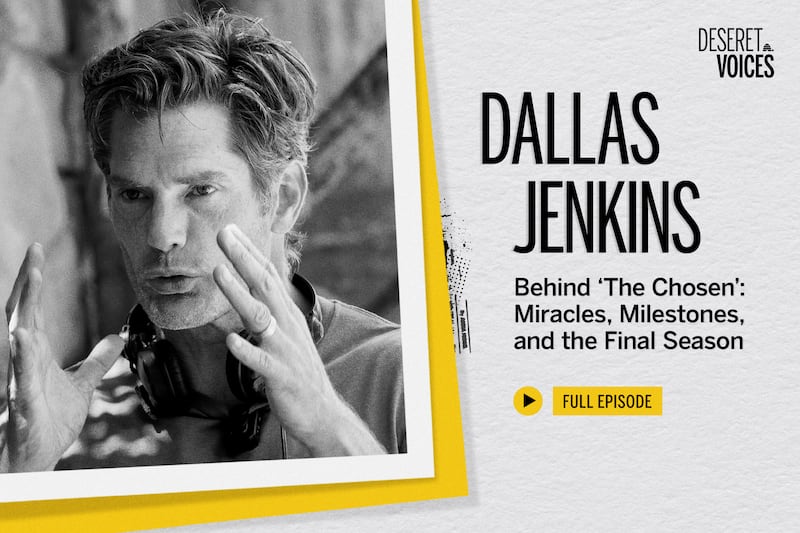


Dallas Jenkins, the creator of “The Chosen” television series, believes he could do a lot worse than telling Bible stories for the rest of his life.
While Jenkins says it is his job to “bring the five loaves and two fish,” he acknowledges God’s hand in the “parting of the Red Sea” to make the production a success.
On this episode of “Deseret Voices,” he sits down with guest host Sheri Dew, the executive vice president and chief content officer of Deseret Management Corporation, as they reflect on how his crew came to use The Church of Jesus Christ of Latter-day Saints’ movie set in Goshen, Utah, during the COVID-19 pandemic.
Subscribe to “Deseret Voices” on YouTube, Apple Podcasts or Spotify.
Note: Transcript edited by Steven Watkins.
Sheri Dew: It is a thrill to be with you again, Dallas. Creator, producer, writer, director, basically everything of “The Chosen.”
Dallas Jenkins: I don’t act in “The Chosen,” so —
SD: So we make that clarification.
DJ: Yeah, yeah, exactly. I’ve stayed behind the camera. But I’m always glad to be here. I’m always glad to be with you. You’ve been so kind over the years and helpful, and we have a fun little backstory for how this all came together with you and with the church, but it’s always good to connect. I love being around here.
SD: I kind of wanted to start with that, actually, because I was thinking as I got ready to say, “Well, gee, if you’ve got a few minutes with Dallas, what do you want to ask him at this stage in this amazing process?”
DJ: Sure.
SD: So we met, I think, just a little over six years ago. It was early 2020. And you were seeking permission from the church, The Church of Jesus Christ of Latter-day Saints, to use their Jerusalem set out in Goshen.
DJ: Yes.
SD: And just before that, I had been asked by the Presiding Bishopric of the church to be the one that would vet commercial entities who wanted to use it.
DJ: Right.
SD: So you come into my office. I had not — I knew about “The Chosen.” I hadn’t watched it to that point. Met you. Really liked you.
DJ: Well, good.
SD: I just have to say, off the bat, I thought — you walked out and I remember thinking, “Oh, I kind of like that guy.” I think I like what he’s doing. I feel pretty good about it. And then COVID hit. Within — I was barely getting everything submitted to get permission because you were like the first. So there was a kind of a startup process. So I was getting it all ready to get submitted and COVID hits. The church starts — we’re not meeting on Sunday. The temples in The Church of Jesus Christ of Latter-day Saints closed. We’re all wearing masks. We’re social distancing. We’re in that era.
And I keep getting these messages saying, “Don’t even ask. We’re not letting anybody use Goshen. We’re not letting anybody use any of our sound stages anywhere, anytime, even church departments. Don’t ask. We’re not going there.” And I kept telling you, “Dallas, there’s nothing I can do. There’s nothing I can do.” Big long story, which we don’t need to rehearse here, other than to say I was not just an observer but a participant over the next several months that led to what I consider to this day, you know, I don’t like to throw the miracle word around loosely, but it certainly was something that involved heavenly help because we actually ended up getting help and approval in July when the senior leaders of our church don’t hold meetings.
DJ: Right.
SD: And we got you approval. It took the help of several leaders. But It felt like a miracle.
DJ: Yeah. Well, the reason I would say in the eight years or so that “The Chosen” has been developing and in production and going, I would say there’s a handful. I mean, there’s dozens of amazing things that have happened, hundreds, thousands. But there’s a handful of moments that I would put on my Mount Rushmore of —
SD: Moments.
DJ: Moments that would not have happened without God’s direct hand. So you can call that a miracle or whatever term you want to use.
SD: It’s definitely heavenly help.
DJ: Certainly heavenly help. And that also had a significant long-term impact. The weather’s coming and we’re gonna shoot this or we’re not, and suddenly the weather changes and we think, “Oh, God might have helped the weather to get us this shot.” This was a seismic shift because we had filmed Season 1 and the show was just starting to spread the word, you know, people were just starting to find out about it, but it still hadn’t really hit much. And for Season 2, we were all geared up, ready to shoot, and there was nowhere to shoot because of — COVID had a big hand in it — but also in the United States, there’s, I can’t think of more than two or three places to film that could ever be first-century Jerusalem, right? First-century Israel. There’s places like Morocco and Malta and places in Italy that most movies have filmed for Jesus stories. Very little in the United States.
We’d filmed Season 1 at this tiny little place in the middle of nowhere in Texas, owned by this rancher who had gifted this thing to his daughter. And so we had outgrown that. And this beautiful set in Goshen that the Church of Latter-day Saints owned, I had kind of ruled it out because there’s a lot of good reasons to say no to letting outsiders film on a set owned by the church. You don’t know who they are. It might come across like a partnership. Especially with a Jesus project, do something that’s a little bit off, a little bit controversial. Now the church has to answer questions. So there’s plenty of reasons to say no. And I understood that. I think that might have been what connected us. It was — I wasn’t coming in like a salesman trying to convince you to give me a gift.

SD: Yeah, it’s true.
DJ: It was: I think I’m doing something. I think you guys are trying to do something similar. I’ve heard that this could be a match. I don’t want to get my hopes up. If it’s not meant to be, I don’t want to do it. So, but here’s what we’re trying to do. And the weird thing is, is that I didn’t want to visit the set because I didn’t want to get my hopes up. Because I knew once I saw it, I’d be impressed. And I did eventually. A mutual friend of ours got me this tour and I was like, “God, I want to see this place.” And when I was on the set, I really felt God’s presence. And I felt — and this has only happened to me a handful of times in my life as well — where I felt, not an audible voice, but a clear impression of, “People’s lives are gonna be changed by what you do on this set.” That’s what I really felt this, and I actually recorded it on my phone, just to say it, just to be like, I don’t know what’s going on, but I feel this. And then who knows, time will only tell if that’s God’s voice or if it’s just my own thoughts.
SD: Hopes and wishes.
DJ: Yeah. And then when I was told in July, it’s an official no. COVID, timing, can’t get a hold of the right people. It’s July, the whole nine yards.
SD: Don’t ask again.
DJ: And I thought, “Interesting, I guess I was wrong. I guess it wasn’t God’s presence I felt on this set.” I mean, I’m sure, you know, you feel God’s presence everywhere, but I’m saying, in that moment, I guess I just might have been confused. And I told my wife they said no, it’s over. And she said, and it’s still kind of a famous “Chosen” story to this day, she said, “Nah, I believe what happened on that set.” She said, “I think this is God just putting you at the edge of the Red Sea so that when the waters part, you know it’s him.” And I was like, “Don’t say that. Don’t get my hopes up. I don’t want to start. They said, ‘No, it’s over.’” And I think women have this divine intuition at times that, sometimes —
SD: Spiritual sensitivity.
DJ: Yeah.
SD: I think it’s fair to say.
DJ: That’s a good way to put it. Yeah, because I think men of course can have it too, but I think we tend to be a little more practical in certain cases, like, “Well, they’ve said no, let’s move on,” you know. And my wife and Brad (Pelo)’s wife were like, “I just don’t think this is it.” And it was like three days later you got me on a Zoom call with some of the leaders of the church who were on furlough, and we just —
SD: And that we got them was amazing.
DJ: Yeah, that’s amazing. And then they said, “Well, we have to ask the Presidency,” the First Presidency. And they’re like, “It’s July, I don’t even know how we can get a hold of them.” And that’s when I said, “Wait a minute, you guys know how to get a hold of everybody. I’ve had you knock on my door 20 times in my life. You’re the best door-knocking organization in the world. Surely you can track them down.” And they laughed. And then it was the next day that we got formal approval. It was like that. And it’s proven to be an irreplaceable — what’s the word for necessary? I mean, we couldn’t have done it without — we couldn’t have done the show without use of the set.
And the partnership has been so wonderful because we’re — I’m not a member of the LDS Church, but there’s been this mutual respect and I think a shared goal in making Jesus known around the world. And this show has been doing that in every country of the world. And so that relationship and the use of the set has been an immense blessing. And you guys have been so generous.
And you were instrumental in at least getting the ball moving to the edge of the Red Sea. Ultimately, all we did was strike a rock. The parting of the Red Sea was done by God, but the process involved a lot of people being woken up in the middle of the night and being led to pray for “The Chosen.” And then one of the elders of the church just being randomly handed a DVD as he’s leaving for his furlough, saying, “You need to watch this,” and then him calling up some leaders going, “Why aren’t we doing anything with ‘The Chosen’?” It’s all this randomness.
SD: And that’s what helped me. Because then somebody said, “Oh, they ought to call Sheri. I think Sheri’s trying to do something with this.” And that’s when we got a couple of those senior leaders, members of the Quorum of the Twelve, on the Zoom with you. And at the end of the thing, one of those leaders said, “Sheri, write a memo for the First Presidency. Write us a draft.” So I drafted a memo. I’m sure that leader improved it dramatically. But it went to them, the First Presidency. Again, not in a meeting, it went to them through email. The next day, it was July and COVID. And by the afternoon we had approval. It’s like, oh wow, I gotta get Dallas praying for stuff for me because if he’s this powerful, this is — so it was a great moment.
DJ: But yeah, for sure. And it was an indication, and this has happened many, many times with this show, that the show is bigger than me. It’s bigger than you. When God has something to do, God has something to say, we get fortunate to be asked to be part of it, to be called to be part of it. And sometimes it’s as significant as creating the show itself. Sometimes it’s as seemingly minor as passing on an email or writing a draft of something and having a huge —
SD: But that opens a door.
DJ: Yeah, it has a huge impact on it. And so I’ve stopped being shocked, but I’ve never stopped being grateful. For each of those moments. And so now we let — you know, I’m here again, just landed off the plane.
SD: Moments ago.
DJ: Moments ago, came straight here because when Sheri Dew says, “You want to talk about something?” I go, “Of course.”
SD: Like, I could only wish that.
DJ: So yeah, we start — we’re going to be filming. This is our final season of filming of “The Chosen.” It’ll be our final time here on this set. I hope and I believe that this isn’t the final time we’re actually ever here on this set. We’ve got other Bible stories to tell that I’m sure can benefit from the extraordinary landscape in Goshen and the Jerusalem set that so many wonderful volunteers and leaders built for the purpose of getting, I think, the Bible and these stories out to the world. And we’re going to continue to do that.
SD: It seems amazing to me to think about what has happened to “The Chosen” since that time that we first met six years ago and where you had one season under your belt, but certainly had not become a phenom.
DJ: Sure.
SD: But that started to happen, and now we look where it has gone. You know, influence is a hard thing to measure. Media influence is hard to measure. I mean, we can measure clicks, viewers, views, numbers of hours, minutes, or whatever. We can measure all of that. But measuring what actually happens in somebody’s heart and mind. And yet you’ve now been hearing stories for years about the impact that “The Chosen” has had. What kind of influence has touched you the most as it’s been related to you?
DJ: Well, there’s so many. I think the one that always stands out to me because it was early and it was again, that kind of early indication that this is bigger than you are, is we got — during COVID — we got an email from a mom in China. And the show hadn’t even been translated yet into Mandarin or any Chinese language. And she was with her family stuck in their homes during COVID. And she had a Chinese husband and four children, all between the ages of like 8 and 14. And none of them spoke English. And she was saying, “We decided to try watching this show because we get the app.” The app, The Chosen app was free and easy to access all over the world. And she started talking about how her husband and her kids, even though they didn’t speak the language, were just begging to watch the next episode right away. And she said, “They’re seeing Jesus as he really was, a Jesus who laughs and who relates to people, and they see a Jesus spending time with children, and my kids are so engaged.”
And the thing that struck me about this, and she just said it was moving her whole family, was that A, I didn’t expect kids to watch the show. It’s an adult-themed show. It’s not inappropriate. It’s just, it’s adult-themed. The storylines are at times complex. Of course, I didn’t expect it to necessarily get into other countries. I didn’t know. It wasn’t like it shocked me, but it hadn’t even been translated yet. And so these words that I was so proud of having written, they didn’t even understand them and they were getting moved and impacted. So the age gap, the cultural gap —
SD: The language gap.
DJ: The language gap being filled not by me, but by God working in the hearts of these people watching. I was like, “OK, I’m not this good.” So this is clearly growing bigger than I’m capable of instituting on my own. So then there’s been stories like that over the last eight years. But gosh, we’ll go into other countries and we’ll hear from people the same thing that we’re hearing in the States. Like our portrayal of Matthew as being on the spectrum, for example. Jesus winking at someone in a charming moment, dancing with his friends at a wedding. Those moments are opening people up to the deeper truths.
And so when people see me, whether it’s here or in other countries, they’ll almost invariably, two-thirds, three-fourths of them will start crying immediately. It’s not a celebrity thing. It’s a grateful — it’s a gratitude thing. And they’ll just say, “You have no idea how much the show has changed my life. It’s changed my heart, my relationship with my family. I’ve never been this close to God. I’m pursuing Jesus like I never have been before. I’m opening my Bible more.”
The American Bible Society just released their annual report about Bible sales and Bible reading. For the first time, it’s actually gone up in the last couple of years. Or at least grown stable. It’s been going down for 20 years. And in their first paragraph, they mentioned “The Chosen” as one of the key factors in that.
Those are the kinds of things that if I stopped hearing them today, it’s like the Jewish “Dayenu,” it would have been enough. I have heard enough stories to last a lifetime that are so life-changing for me because they’re such a confirmation of just keep striking the rock. And I’ll continue to part the waters of the Red Sea. Keep bringing five loaves and two fish and I’ll continue to multiply. So I go, “All right, that’s my job. It’s not to multiply. It’s not to part the Red Sea. It’s to bring five loaves and two fish. It’s to strike the rock when asked to.” And I get a front row seat to what God is doing.
SD: Tell us a little bit more. Just explain a little bit more about the international expansion, the international reach. What have you seen happen?
DJ: So just a couple months ago, we received at ChosenCon, which is our yearly gathering of kind of viewers and cast and crew, we received the Guinness Book of World Records for most translated TV show in history.
SD: Really?
DJ: We had previously broken the record for most dubbed show at over 50 languages, but Season 1 of “The Chosen” has been translated in over 125 languages. And we’re well on our way to being translated into 600 languages. The intention is to cover at least 98% of the world’s spoken languages. And we’ll, you know, if we can keep going, we will. But Come and See, which is the nonprofit that finances our productions and then also finances translations and marketing, it’s a real passion of theirs is to get this translated. And so 125 languages already. The show is in every country. We have been viewed in every country in the world, well over 180 countries, by well over 100 to 200 million people. It’s hard to track at this point, but the languages are ensuring that people get to hear this story and see the story in their heart language.
And so, I mean, we’re hearing from, you know, I’m not, like I said, a member of the church myself, but we hear from LDS missionaries all over the world at times who say they use this on their missions. It’s not just for their own comfort and, you know, while they’re watching things in their rooms at night, but they’re actually using it with people that they’re ministering to just as a visual representation of what they’re preaching. And it’s been extraordinary to see.

SD: Since you bring up missionaries and members of The Church of Jesus Christ of Latter-day Saints, not only have you used the church’s set, and I think, I know I’m yet to run into any member of the church who isn’t delighted that that has happened, that you’ve been using that set.
DJ: Oh, sure. Yeah, originally —
SD: They love it.
DJ: You were kind of the hinge point. Now people have been like, “Can you imagine if we hadn’t been?” It’s been so fun.
SD: Yeah. So anyway, it’s really great. But there have also been any number of Latter-day Saints that have worked with you, been a part of the marketing, been a part of the production or whatever. And at times you’ve kind of taken it on the chin for associating with the Latter-day Saints.
DJ: Yes.
SD: You know, there are those who are Christians who don’t think that we are. And you’ve taken it a few times. Tell us what you think about that. Are you sorry that you have associated with any of us?
DJ: Oh, goodness’ sakes.
SD: Do you wish that were different?
DJ: No. No. A couple weeks ago, I actually had two speaking gigs canceled because a prominent evangelical was criticizing me publicly for being on an LDS podcast recently. And I said, I just chuckled about it, because I don’t — let me be very clear — I don’t have any kind of litmus test for who’s willing to help get this show to the world. So I have seen many shows, books, movies, pieces of music that have been delivered to the world through all kinds of means, through all kinds of people. And to me, I find it — leaving aside my own relationships with members of the church and people like you who I love dearly — but let’s just say for the sake of argument that we had disagreements that we could never overcome.
SD: You mean theological?
DJ: Theological or anything. Yeah, anything. Anything. Do I pay attention or ask of the faith background of the UPS driver who’s delivering a stack of Bibles to some group of people? Do I — the printing press, the printing company that prints the words of the Bible onto — do I make sure that they line up with every single theological tenet that I have? I’ve had hundreds and hundreds, and I’ve spent thousands of hours with LDS friends, and we’ve had plenty of discussions about faith, and we’ve debated, we’ve had back and forth. There’s plenty of significant things we disagree on. I don’t hide from that. I don’t apologize for that. We have differences of opinion for sure. But I’m not only willing to work alongside members of the LDS faith, I’m willing to work alongside members of any faith background or any non-faith background to get this particular story to the world. And I’ve been not only willing to do that, I’ve been thrilled and excited by it.
My relationship with members of this church have been life-giving, have been huge for the success of and the spreading of the show. And so the things that we agree on, like the Jesus of Nazareth and the Gospels, that’s what we’re focused on. That’s what we’re getting out to the world. The other stuff, I’ll let you do your thing, I’ll do my thing. And for this show to be spread around the world and for people to be brought closer to Jesus and deeper into Scripture, I know is something that you’re passionate about, and I’m passionate about it.
SD: Truly.
DJ: So why can’t we work together and be friends and worship Christ together and see God’s name be glorified around the world? I think it’s not only been something that I’m not sorry about, I’m thrilled by it. And the criticism or the YouTube videos or the canceled speaking engagements, when we’re looking back on “The Chosen,” 25 years from now, or when we’re in heaven and I’m hopefully hearing from God, “Well done, good and faithful servant,” a speaking engagement or a YouTube video is going to be —
SD: A blip, if that.
DJ: Not even something that’s even in the realm of my thinking. So I couldn’t care less. I have a little superpower in that I care about what God thinks and what my wife thinks. And after that, it’s not all that important to me other than wanting to make sure that I’m serving God faithfully.
SD: That’s a pretty good duo. God and your wife. I think that’s a pretty good teaming up. After everything you’ve experienced and heard and observed yourself, do you have any advice for members of The Church of Jesus Christ of Latter-day Saints that would help them be less misunderstood? Because, as you say, we’re talking here about telling the story of somebody we all believe is divine and our Savior.
DJ: Yeah, yeah.
SD: OK, this is not hard. And yet you think about some of the angst that it has created. So yeah, this is your shot. Give us some advice.
DJ: I don’t have any advice for how to be less misunderstood because I actually don’t think that misunderstandings are really what we should be focused on. My advice to any member of the LDS Church and any person in general is to know Jesus more, to go deeper into Scripture, to go deeper into your Bible and know and love Jesus more. And that, I believe, is if you’re focused on my personal relationship with Christ, and deepening my faith, and deepening my relationship with him, and following righteousness, and following him, and accepting his grace.
I think one thing that I oftentimes hear from members of the church, and I think you would support this, is that sometimes the history of the church and the tenets of the church can result in almost a fear of, if I don’t measure up, if I don’t do enough, I have to do the right thing. I don’t want to mess up. I don’t want to fall short. I don’t want to screw up or do something wrong according to some of the covenants that we’ve agreed to. And I think there’s, I think grace, the grace of our Lord and Savior Jesus Christ, I’m a big believer in Ephesians 2:8-9, “For it is by grace you are saved through faith, and not of works, lest any man should boast.” That’s a summary of that verse.
And I do often say, get to know Jesus more, accept his grace more, and you might feel a little bit less pressure to just get there, to be there, to achieve something. And so focus on five loaves and two fish, focus on striking the rock. Christ does the rest, God does the miracle. God does the expansion. Know Jesus more, and some of our theological differences can be pushed aside for now if we focus primarily on the creator of the universe.
SD: Nice. You’ve had to, as you’ve written, directed, produced, really done it all, you’ve had to, you’ve tried to be, we’ve had plenty of our own conversations about the scripts that you’ve written alongside of others. You’ve tried to be really faithful to the Gospels, but there’s just not enough in the Gospels to make a TV show. I mean, right? So there has to be backstory. Some of the things you’ve already alluded to in our conversation today, and a little bit of creative license for sure.
DJ: Yeah.
SD: How are you going to handle that when we’re talking about the Resurrection?
DJ: Yeah. We have a series of people, a group of Bible scholars who review our scripts and review our footage to help ensure that those things that we are inventing, either through creative license or human experience, historical records that are beyond just the biblical record, that they never contradict the character or intentions of Jesus in the Gospels.
So the LDS Church did a series of short films that were filmed on the set that are word for word, verse for verse reenactments of the Gospel accounts. And that has its own value. You’ve, Sheri, and the church has been accepting of the fact that we’re filming on your set and adding things that aren’t directly from Scripture because you have seen over and over and over again that none of what we do is contradicting the character and intentions of the Gospels, even if it’s not lowercase factual, right? It’s capital T truthful, right? So that’s —

SD: Could have happened.
DJ: Yes, plausible is key. Now, when it comes to the Resurrection, is the pressure higher? Maybe a little bit, but I would consider every minute of this show to be pressure-filled, meaning I don’t want to get anything wrong. I don’t want to character — I don’t want to contradict the character and intentions of Jesus in the Gospels ever. But yes, the crucifixion and resurrection take on extra significance.
What we do sometimes have to do is when you look at the four Gospel accounts, and this is never more true than in the Resurrection, there’s multiple versions of the story. They don’t necessarily conflict, but there’s multiple women went to the tomb, they saw two angels. There’s another account where it’s one woman who went and just saw the gardener, thought she saw the gardener, then saw Jesus. So what we get to do is instead of trying to put all of them together, which can sometimes be plunky or messy and requires a sermon or a book to kind of navigate. We can choose one of the accounts and say, for the full account, for the extra account, you should go to the Bible. That’s what we do all the way anyway. The first thing you see before you watch “The Chosen” is: “Viewers are encouraged to read the gospels.” So we do that anyway.
But when it comes to the Resurrection, I’m not making anything up, but I’m certainly getting — all right, I’m going to — this part of the story is cinematic. This works well within the construct of our characters. And this part of the story, you can read in the Bible. We’re not pretending it didn’t happen, but we’re not going to show that part because it’ll take too much time or whatever. So there’s multiple reasons why we don’t do certain things. There’s multiple reasons why we do certain things. At the end of the day, though, what I’m really proud of with both the crucifixion and the Resurrection accounts. Hope I’m not spoiling anything for anybody, but Jesus does die and resurrect. I think you knew that.
But when we’re doing those accounts, what I’m really proud of is that we are in fact exploring the totality of Scripture, that this isn’t just a moment of crucifixion and resurrection in the first century. This is part of a story that God has been telling since the creation of time, that since the creation of human beings, that God has had a relationship with humanity that is coming to its climax here with the crucifixion and resurrection. And we portray that in a way that I don’t think has ever been portrayed before, that I’ve never seen. So I’m concerned less about some of the specific logistics of who showed up to the tomb at what time, when and where, than I am with what this actually means for those in the first century.
SD: Of course.
DJ: For those throughout history and for those of us today. And I think that when you see it, you’re gonna have a fresh experience with what Christ did for us that I think is going to illuminate what’s already there in the Gospels.
SD: So you’re most concerned about the feeling, the feeling it creates.
DJ: Well, yeah. I mean, I think it’s — I don’t want to say I’m most concerned with the feeling. I’m saying that that’s the, I think that’s the most important way to experience the crucifixion and resurrection on film is because I do think there’s an important — I think truth, “capital T truth,” is most important, obviously. I’m most concerned about capturing the truth of what happened. But I think how it impacts your heart and the meaning of what it was is more important than the who was at what part of the tomb at this time, right? So we can have our own discussion about the historical logistics of what happened on that Sunday morning, if it was a Sunday. And we care about those things. We want to be authentic. But the things that our Bible scholars are really going for and making sure that we’re capturing the heart of
SD: What goes on in here.
DJ: And what’s the life change that happens as a result of it.
SD: So in that regard, now, if you look back over all the seasons you’ve already filmed, is there anything you wish you’d done differently?
DJ: Yeah, a couple of things I can’t share, a couple of casting choices or, you know, personnel things that I regret. A couple of choices that I’ve made, just a handful of things where I look back on it and I go, “Uh, I could have written that a little bit better.” But I will say this, Sheri, more than anything else, when I look back on it, I see things that are better than I would have done had I could have done it on my own.
Moments where I was set on writing it a certain way or filming it a certain way, I was blocked for whatever reason — weather, timing, availability, the location — and I was stuck and I had nowhere — I didn’t know what was next. And then some solution came from either someone else or felt inspired by God, and it was so much better than I would have done had I not been stopped. I actually see that 100 to 1 over the regrets. And the regrets are very, very small, and they usually have to do with something that came and went.
But when it comes to the moments of significance, man, I have been — it is an Exhibit A in humility because I go, “I know I’m not that good.” I watch a scene sometimes, I’m like, “Man, that’s even better than I remembered. That’s even better than I wrote. This is so much better than I am.” And that’s been a really genuinely a sweet thing to go, all right, I’m not — I do have a lot of human, in-the-flesh, worldly responsibility for this project. I am the boss. The buck stops with me. I am the final say on all the content. But this story and what’s happening around the world with this project is so infinitely bigger than I am that I’m proud to say that my responsibility is small in comparison to what I’ve been gifted to see.
SD: Well, it makes perfect sense to me because anyone who believes as I do and as you do that Jesus Christ is our Savior, you would think there would be heavenly help. Right? You would expect heavenly help. And if there hadn’t been and if it weren’t ongoing, that would be the one thing that would raise questions for me.
DJ: And if you don’t think you need it, you just might not get it. Which is even scarier.
SD: That’s a beautiful point.
DJ: The worst thing that you can experience is what I call divine apathy, which, you know, is where God goes, “They’re not listening.”
SD: “So we’re going to stop talking.”
DJ: “So we’re going to stop talking.” Obviously, he’s spoken through his word, but if we’re, you know, when it talks about, well, God oftentimes releases us to our pagan desires because we’re not listening enough. And that’s the scariest thing. And so this posture of surrender that God pushed me into when I had a career failure before “The Chosen,” shame on me if I ever lose that posture of surrender, because God has only proven himself to be way more faithful than I would be to my own, to my own heart. And so, yeah, the need for it, the constant awareness of our need for a Savior. That there’s nothing we can do to earn it. There’s nothing we can do to be worthy of it other than accepting his grace. And out of his grace is when we start to pursue righteousness. It’s because we’re so grateful that righteousness is pursued. And so I’m like, I’m pursuing righteousness because I’m pursuing humility and I’m pursuing surrender because if I don’t, I don’t want to lose what I’ve gained from this surrender that God has shown me in these last eight years. It’s been such a sweet time. So if I — if you ever sense from me a sense of entitlement, I hope you’ll be the first one to smack me upside the head.
SD: I don’t know if everybody realizes that your father is a bestselling author of the “Left Behind” series. And rumor has it that he is writing the novelizations of “The Chosen.” How’s that going to go? Like, who has the final creative say, and how are you going to handle that father-son —
DJ: Well, he has forgotten more about writing than I’ve ever learned. I mean, he is an extraordinary writer, an extraordinary storyteller. My storytelling gift certainly came from him, but I also would — he would be the first to tell you that when it comes to this project, he’s serving the larger story. So I’ve let him go. I mean, when he does the books, I mean, I sometimes scan through them, but like, I trust him to when it comes to getting into some of the characters’ thoughts and kind of some of the expanding of the story that he does. Gosh, the guy’s done it over 200 times.
He’s written over 200 books, and he’s been a huge bestseller and has also given me — the biggest thing that my dad has given me besides my faith and an extraordinary upbringing — is that when he experienced a similar level of success with the “Left Behind” books where there was a period of time when millions of people were reading and he had four books in the top 20 in the New York Times bestseller list, something that he would have dreamed of years before. It did not result in arrogance, it resulted in the opposite. And I got to see firsthand what it was like to experience someone being at the center of a huge phenomenon and to see it make him even more humble and more surrendered was, I believe, looking back on it now, was a great example for me and a great training ground.
So when it comes to these novelizations, they’ve been great. People have read them and said, “Wow, I got even more out of those than I did out of the show,” because a book can go deeper into thoughts and what’s on the heart of people. And my dad is a lover of the Bible and a lover of Jesus and a lover of the show. And so he’s going to be faithful to the show while also faithful to the scriptures as he expands on these stories in the novelizations. And so the first five have been out and, you know, people can get them on Amazon, they can get them on the gift store, wherever they get their books. But it’s been really cool to see people go, “I’m getting more.” And it’s been fun.
My dad describes it, he’s been kind of knocking on the window saying, “Hey, can I play? Can I be allowed to see in on what’s going on with ‘The Chosen’?” And it’s been a beautiful relationship because to this day we text every day, we email every day. And then when he’s getting to do the books, he’s getting to read the scripts in advance. He’s watching the rough cuts in advance. And able to ask questions about it. And so it’s been really cool.

SD: Say a little bit more about what you said a minute ago, because, you know, the whole thing about rich men and camels and eye of a needle. What do you think is your father’s recipe or how was he able to do that? He sold tens of millions, it might be hundreds of millions of copies of his books. Very successful. How did that not go to his head? What do you think that’s about?
DJ: He describes it this way. He said he had a brief moment of it where the new book in the series debuted at No. 1 on the New York Times list, and then there were other books in the series that were also on the New York Times bestseller list. And he said he had this moment of like, “Wow, I mean, I’ve written over 100 books, I’ve worked really hard, not a lot of people get to do this.” And for whatever reason, he said in that moment, it just felt like a sledgehammer to his heart of just like, wait a minute. And it wasn’t again an audible voice or anything like that, but it was just a, “Excuse me?” Like, “Who do you think you’re this good? You think you’re good enough to write multiple bestsellers and to get this kind of attention on this book series?” And he said he just immediately went to his knees and repented, and it lasted like 10 seconds. And he told it to me at the time, and he’s told this story since.
And so I think that he was just — I think he was raised in a way that was humble, and he came out of poverty, I mean, growing up. I think that contributes to a little bit of gratitude that when you do get means, when opportunities and means, even if it’s earthly means like wealth come to you and success come to you, that hopefully you remember where you came from. I had a few more advantages growing up because my dad was successful. It wasn’t until I was in college when the “Left Behind” books came, but I was able to just — I think because of some of the initial failures I had in my career, God really broke me of desiring earthly success, which I used to. I think affirmation was my drug of choice. I think narcissism was my kind of the evidence of it.
And when I had my career failure, I just really broke and I really got to a posture of, “OK, God, whatever you want, I’ll do.” And that was my dad when he was in his 20s as well. It took me in my 40s to kind of figure it out. He’s just like, “Whatever you want, I’ll do.” And when you truly believe that, and it’s a discipline, it doesn’t come immediately and it doesn’t come naturally. I got broken quickly and I got surrendered quickly, but the practice of when you experience success or opportunity, thinking, “I’m going to replace these thoughts of entitlement with scripture and with worship music and with humility and with a prayer of surrender,” it really does over time change you.
And so I think my dad, my dad practiced that and brought it to me. And then I think when I got the level of success that I — beyond the level of success that I’d ever sought, I have so many people in my life who are just like, who were there when before it was cool and it’s very, very easy to be reminded of that this is bigger than I’m capable of.
SD: How has your wife played a role in all of this?
DJ: I mean, she’s the heart of the show for sure. She’s the heart of our marriage in terms of, I think, divine — what did you call it? — spiritual sensitivity comes to her quicker than it does me. I think all of us have a different, I think God speaks to us, each of us in different ways unique to our heart. She’s just always been very quick to be spiritually sensitive. Usually she kind of sees where the winds are blowing before they do.
I know that it’s interesting you talk about success. Before the show even launched, God had her in the book of Exodus. And she wasn’t sure why, but he kept putting her in the book of Exodus. And she was just really getting a Ph.D. on the book of Exodus. And it was, she came to me one day and she said, “It’s really interesting,” she goes, “God keeps putting me towards the stories of success.” Because there are so many stories of failure in the book of Exodus, there are also multiple stories of immense success. That always preceded failure. It was like success would come, they’d start to get cocky, and then there would be this dramatic failure. And she said, “I think God is warning us about success.” So there was this kind of double-edged message from the Lord that my wife was feeling, which was success is coming. “Ooh, that’s fun.” “Be careful.” “Oh, OK. That’s interesting.”
And that has proven to be such a true map for our show. With success has come also dramatic lessons, spiritual warfare. From the moment “The Chosen” launched, we faced more medical crises and relational crises. And I mean, from Day 1 to last week, than the previous 40 years of our lives combined. Not even — it’s not even close. My family has taken significant hits because of this project, and my wife has been at the center of it.
It’s public news now that she was diagnosed with breast cancer while I was on set in Utah, and she was visiting that day. We had 600 background actors there. They’re all cheering. She shows up for her first day there. I didn’t know it because I’m saying, “Oh, there’s my wife, everyone,” and they’re all cheering. And I didn’t know that an hour earlier she just heard the news that she had breast cancer. And so we had to walk through that journey while filming the crucifixion season. We’re on the other side of it now. She still has a couple of surgeries still to come, but —
SD: She’s doing OK?
DJ: She’s cancer-free and she’s recovering very well. And it’s like that kind of stuff. We’re not free from the lessons of each season. We’re not free from the lessons that Jesus had for his followers. This resurrection season that we’re filming right now has tremendous joy. I mean, I’m not giving anything away. It’s the resurrection season. In the midst of it is also warnings. It’s also, we know what happens next with the disciples for their faith and for their courage in telling these stories around the world. They met tragic ends. There’s — it’s the bitter is always mixed with the sweet when it comes to walking with Christ. And so my wife has been extraordinary at navigating through all of that.
SD: How are you different? What do you know today that you didn’t know five or six years ago?
DJ: Yeah, that’s such a good question. I think it’s the intimacy of Christ. When you watch the show — and I hear this all the time — that when we’re filming certain scenes, whether Jesus is doing a miracle like a healing, oftentimes hear from people, “I felt like he was talking to me. It felt so intimate. It felt so human. It felt so relational.”
Jesus was a God who, when he was here on earth, he wasn’t just the God of the masses. Yes, he spoke to 5,000 at times. Yes, there were moments of big groups, but the vast majority of encounters were individual. And when he was healing you, when he was calling you to follow him, or when he was even rebuking you, it was always speaking directly to your heart’s need. He knew exactly what was on your heart. He knew it was in your mind. He knew what you were going through. And it was never just about the physical healing. He was always more about the heart’s healing and the forgiveness of sins. But it was always personal. And he always knew exactly what you needed.
And I’m not sure I always — I might have known that. I’m not sure I always felt it or experienced it. And since studying the show, studying the Gospels for the purpose of the show, and portraying the scenes of healing and calling, we always make — we always kind of shrink them down to be very intimate. The music, the close-ups, the voice, the volume, it’s always just gets more intimate and personal. Like, I think that’s the Christian life, is I think that sometimes we think of ourselves as members of a church, members of a body, part of this big story that God is telling. And I think we sometimes forget that God has a personal relationship with you. He knows your heart. He knows your history. He’s knit you together in your mother’s womb. And I think that the intimacy of our relationship with Christ is something that I didn’t necessarily always value as much as I do now.
SD: I was thinking the other day as I was contemplating getting to talk to you for a few minutes and thinking, “OK, what do you do in your career next after you’ve told the most inspiring important story, the most inspiring story, the most intriguing story, most compelling story that there really is to tell.” So what do you — what does Dallas Jenkins do next?

DJ: Well, I do believe that the other stories in the Bible, and there’s some really great ones, are actually all pointing to the same story. So we just did a Joseph miniseries, an eight-episode “Joseph of Egypt” miniseries that I’m actually working on the finishing touches of right now. I didn’t direct it, but I oversee it, and so I’m giving notes on the score and all that stuff as we’re finishing up. And it’s not only — I’m very proud of the show, it’s turning out really great, I’m excited about it. But it’s also fun to go, oh, the connective tissue between Joseph and Jesus; the connective tissue in these stories; the connective tissue between Joseph and Moses. Who’s also got a connective tissue to the greater Moses, the greater than Moses in Jesus. All these stories, these great Bible stories are of extraordinary importance, and I feel led to keep telling them.
So the first thing people ask me when they meet me in an airport or at a restaurant is, they say something nice about the show and then they say, “So when are you doing the book of Acts? When are you doing, are you gonna, when’s season, the next season coming out?” So there’s always something next. I want to keep telling these stories if God allows me. I could do a lot worse than being called to tell Bible stories for the world for the rest of my life.
But I’ve also got other stories that I’ve been thrilled to tell as well. I think you were here in Utah last time, a year and a half ago when I was here debuting my Christmas movie, “The Best Christmas Pageant Ever,” which is based on a book that, yes, it’s a modern story. It’s about a Christmas pageant at a church, but it’s ultimately a Jesus story. It’s still, in my social media handle, you know, you got my name and then there’s usually like a little descriptor and I wrote, “I tell Jesus stories.” So even when I’m telling a Moses story, even when I’m telling a story about a Christmas pageant in a suburb in the Midwest in the ’80s, it’s ultimately a Jesus story. So I’ll be doing that the rest of my life.
SD: Let’s end where we began, if we could.
DJ: Can I use the set for the book of Acts? How’s that? That’s where we started, me asking you for permission.
SD: Well, I’ll do all I can to get it. Absolutely. There were any number of people early on who were skeptical about what you were trying to do. True?
DJ: Yeah, absolutely.
SD: And even when we first met six years ago, it was not a given that this thing was going to fly. You were, again, you were struggling for places to film. There were financial things. This amazing success as a crowd, you know, crowdsourcing and all that sort of thing. And yet still there are all these challenges. So when you look back now at the different things that have happened, large and small, has it affected the way you feel about heaven and how involved heaven is in each of our lives?
DJ: Absolutely. And I think in Season 6, the crucifixion season, which is, you know, coming out later this year, I describe it actually as the season where we see heaven meeting earth more than we ever have. There’s some supernatural things, there’s some timing things, there’s some past, present, and future all occurring at once, I think we get a glimpse of God’s economy of time. And I think we humans tend to — no matter how much we try to focus on eternity, we’re always bound a little bit by time. And I think that’s part of our human frailty. And I think that when we think about eternity, and we think about the fact that — and this is very hard to describe because we can’t understand the concept of eternity fully. When you think outside of time and you look — I think one example I saw once was Francis Chan, who’s a popular evangelical preacher, had this long, long rope that he was just showing someone on, he was on stage and he was showing it. And then he put this little red sticker around the rope in this one spot. And he goes, “This little red sticker is your life.”
In the context of eternity, think of just how massive it is and how small your life is. And then within your life, the little things that you do that feel so significant, right? So to answer your question about the concept of heaven, for sure I have a little bit more appreciation for the concept of eternity. But I also think about how, because my life is so small, surely heaven is already impacting earth. Heaven and earth in God’s economy of time are all impacting, and it’s become even more mysterious to me in some ways, but also more joyous in some ways, because I believe that when, like the story you and I told of where things that don’t normally happen and we didn’t think could happen, suddenly happened immediately. That’s a — you referred to it as divine. You have good phrases, I’m forgetting what —
SD: Probably divine help.
DJ: Or heavenly help or something.
SD: Heavenly help.
DJ: Yeah, that’s an example of that. I mean, it’s in the phrase, but —
SD: Because I didn’t have the ability to make that happen.
DJ: Yes, right.
SD: I couldn’t. I could do my best and I couldn’t pull it off.
DJ: So God oftentimes has us do everything we don’t need him for. Until the moment of —
SD: That it has to be him.
DJ: Where it has to be him. You think of the feeding of the 5,000 and the story, the name of my company, 5&2 Studios, five loaves, two fish. It’s always because Jesus said, all right, I could, if I wanted to, have loaves and fish created out of nothing in these people’s laps. But I want to involve humans in this process. And so I’m going to use them for what they don’t need me for. Five loaves, two fish. You can go find five loaves, two fish. That part you don’t need me for. The distributing of the loaves and fish to the people in the crowd, you don’t need me to do that. You can do that. The multiplication part, that’s where I come in, right?
SD: That’s my job.
DJ: Those moments of waters parting and of fish multiplying, of doors being opened, of people being introduced that otherwise would have never seen each other before. Those moments are God, are our heaven meeting earth. Those moments are — and is it a heaven that’s up here in the distance and earth is down here in our own little spot? That’s how we sometimes think of it. But I don’t think heaven is a place that you look up to and it’s way up there somewhere. I don’t claim to understand the mystery of — yeah, but it’s like — in God’s economy of time, and when Jesus was on the cross and taking on the weight of sin for the entire world, past, present, and future, that’s a heaven-meets-earth moment. And in the process of trying to portray that in some way through the limited and flawed medium of film and television, through the flawed instrument that I am, trying to capture something so huge and so perfect, I’m not capable of it. But it does help me appreciate it a little bit more and think maybe I’m not having to wait so long for heaven. Maybe I’m experiencing it even as we talk.
SD: Thank you. Thank you for talking to us today. But can I just be the voice of what must be millions to say thank you for pursuing your heart, pursuing something you deeply care about and love, telling the story of the Lord Jesus Christ. Thank you for bringing, for giving us another way to think about him and to make him feel personal in our lives. I think you’ve done that for millions. So thank you.
DJ: Yeah, I’m just trying to listen. That’s the best thing that I’m doing is listening. But I’m grateful to you and to others who are also listening, whether it’s a big or small way, it means a lot.
SD: Each trying to do our own little bit.
DJ: Absolutely.
SD: Thank you, Dallas.
DJ: Thank you.