

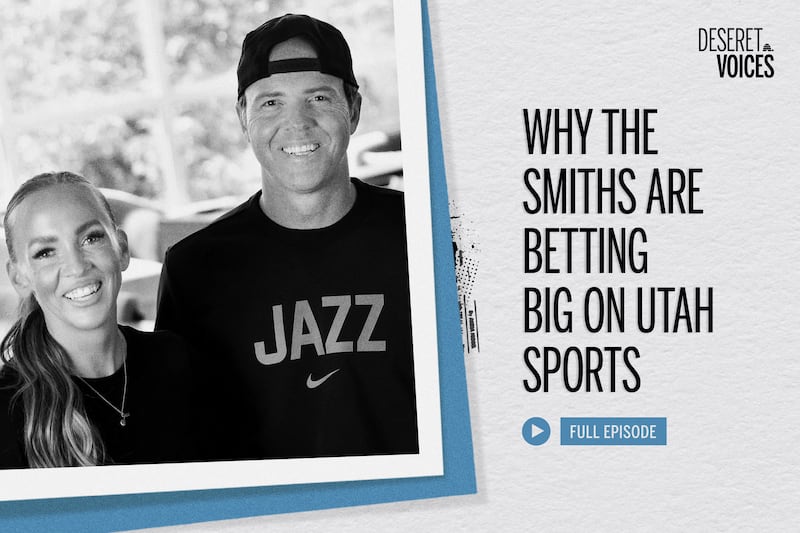


After years of tanking — for which the Utah Jazz were fined by the NBA — the club faces a franchise-changing moment as the Jazz have the No. 2 pick in the 2026 NBA draft on June 23.
Ryan and Ashley Smith’s other major sports venture, the Utah Mammoth, made the NHL playoffs in the organization’s second year in Utah.
On this episode of “Deseret Voices,” the Smiths share what their motivation is to invest in professional sports.
Subscribe to “Deseret Voices” on YouTube, Apple Podcasts or Spotify.
Note: Transcript edited by Steven Watkins.
McKay Coppins: Thank you to Ryan and Ashley Smith for joining us today. We are talking the day after the NBA lottery and I think a lot of people in this room are probably curious what your plans are for the No. 2 pick. But we’re going to save it, we’re going to save it for after. They told me backstage they’re going to break the news here who they’re going to pick. We just have to wait, all right?
I actually want to start with what motivates you right now. So you both, you bought the Utah Jazz a few years ago, you brought an NHL franchise to Utah. I’m curious why you are so committed to live sports. You know, this is an era that is largely defined by, you know, social media and smartphones and AI, and at a time when more and more people seem to be spending more and more of their time on their phones or on their laptops, you seem really committed to live events, live sports. Why is that, why does that matter?
Ashley Smith: Well, I don’t know if — whoever had a chance to go to a playoff game — but you can feel that it matters. You can feel — sitting in the Delta Center for a hockey playoff game was a new experience. And looking around, 18,000 people or however many fit for hockey, who don’t know each other, high-fiving and hugging and all holding their breath at the same moment and cheering at the same moment. I mean, it proves that sports matter.
And it’s just this unifier, it’s everything. And, like you said, you can go in my house and people are in different rooms at different times getting different feeds and different info coming to them and everyone’s living an alone life, a lonely life. We’ve kind of like programmed loneliness into our world and sports bypasses that and we’re all there and we’re all in it. I mean, yesterday the lottery, I mean my whole family of seven and everyone we know is on their phones, on a screen waiting for this moment to, like, feel connected about what pick are we going to get.
Ryan Smith: Yeah, I don’t think we set out to do sports. I mean, we went on a 20-year tech journey together and it was a little bit like, OK, we’d have these conversations like, “OK, we’re going to sacrifice, I’m going to be gone a lot.” And it was actually something that I was doing and Ash was kind of supporting from her world. And then we obviously had a chance to get into the NBA with the Jazz and, you know, a lot of debate came into that. Specifically, I see Gail (Miller) there, Gail sat us down multiple times and was like, “OK, hey,” a little bit like buyer beware. Like, are you guys sure you know what you’re getting into?
And there’s so many Gail moments where she was handing that off, it was very much like, “OK, I know you’re going to do it different than us, but you care about Utah and you’re going to keep it here.” But also, like, I’ll never forget the words, like, “I hope it’s as good for you and your family as it’s been for us.” And I’ve thought about that, like, a hundred times, like, what was she really meaning? Like, what’s behind the … ? And, like, there’s moments of time where I’m like, OK, this is what she was talking about. And not many people can explain that, but we’re always asking ourselves, like, what our new “why” is and what is our new “why” together. It’s really the first thing that Ash and I have been able to do together and that’s really cool.
Whether it’s Ash at the hockey lottery or last year at — as she claimed she got fired from the NBA lottery.
AS: They didn’t have me back.
RS: But it’s also so much more than that. It’s the community, it’s definitely a young person’s game right now in some of this stuff, like, whether it’s with the player management and this, like, it is involved because, you know, these players are brand and businesses and, you know, it’s interesting to see who’s coming into sports now as well as just the impact it has on a community like Utah.
Like, I just got done with “The Pat McAfee Show” like an hour ago and it was like a five minute, like, he wanted to talk about Utah. He wanted to talk about everything that’s going on in Utah and it’s not by accident as we’ve thought about what our “why” is — and Utah is a big piece of that — and probably the biggest piece in our community, that when you see the Mammoth on the screen it says “Utah” as opposed to “Mammoth” in there. And that’s really hard to manufacture in the NHL, where it’s like the Sharks versus Canucks. We want Utah. It’s not by accident that Utah’s on the jersey. This was all thought through to the “why” for us. And we hope it’s OK with everyone else but, you know, and we’re not perfect by any means, like, we’re going to make a lot of mistakes, but hopefully a little bit of luck, like we had yesterday (in the NBA lottery) and some other things, like, get us through it.
So, I think that’s why we’re into sports. It’s got to be a means to an end for everybody, because if it’s not, you’re not going to last long because the wins and losses are going to kill you. Like, there’s one happy team at the end of the NBA season. The rest are unhappy. And I would argue that as fans and everyone, we finish happy but we haven’t finished the happiest ever.
MC: Is that going to happen? I mean, make the promise to the people in this room right now, right, five years, three years?

RS: The problem with a championship is you’ve just got to bring more than the other person. And, you know, our best runs were ’97, ’98, I remember, like, I was on my mission, but the problem is you’ve got Michael Jordan on the other side. The other teams happened to squeeze in when he had retired or whatever it was and we still, like, even with Michael, like, you see him, those are — any picture he signs about games or anything, it’s in the Delta Center, it’s those moments. Those were arguably some of the moments that made the NBA.
MC: It’s interesting what’s happened since you brought an NHL team here because this is very recent and it seems like almost overnight you had a huge energetic fanbase. You know, I will say I grew up in Massachusetts, you know, those of us in the Boston area feel like Boston is the sports town, right? Like, all my friends skipped school the day after the Red Sox beat the curse and, you know, won the World Series. It was like a religion there, right? And then I lived in New York for a number of years, where they feel like they’re a great sports town. I feel like Salt Lake, Utah might be like a sneaky good sports town. Have you been surprised by the amount of energy around whether it’s the Jazz, the Mammoth? What do you attribute that to?
AS: I mean it doesn’t feel sneaky at all. Like, I mean, this state loves hockey. So it’s really cool to be a part of figuring that out. But also now I have pride — I didn’t grow up a hockey fan — but now I have Mammoth pride, I have NHL pride, I have East Coast pride because I feel like I can connect on a new level with people from the East Coast who grew up loving hockey. I mean, it’s just a whole new door of ways to connect with people and ways to unify and things to cheer for and things to be mad about together. And hockey — Utah was just ready. They were just ready. And it was very clear to us, this is not our team, this is Utah’s team. And Utah has completely taken it in with open arms and we’re just here trying to kind of steward the way. But it’s a lot of emotional connection for people.
RS: Yeah, I think if we go back to how this happened, I mean, I remember sitting on a Zoom with the governor with Gary Bettman and he was just like all right, I’m ready to give these people a hockey team. Are you guys on board? And right now, like, you fast forward two years, it would be very hard to get a hockey team and it is really hard. I mean, you’re seeing how long the process for expansion is in the NBA. We’ve been at the doorstep of Vegas and Seattle for 10 years. And what people understand is you’ve got to get 30 owners to go vote and say, “Yeah, I want to give up some of the pie to bring these new people. I want to compete against Vegas.” I mean because that’s real for us. Those are two good markets that make it even harder to get that ultimate goal regardless of television and money and everything, that’s the only way I look at it is like OK, is a free agent going to choose them or us?
And so we were super fortunate that, you know, we were in a spot where Gary Bettman and the owners were in a spot where they trusted us and it was a little bit of a crisis going on somewhere else that we benefited from. But it’s not just — hockey’s different. The reason — we didn’t have a lot of data that hockey would work, everyone could go run their models, you could get Qualtrics to do a hundred surveys: “All right, what do you think about hockey?” None of it matters. Because you’re seeing super small markets in Canada outpace all of the large markets from a revenue standpoint.
And hockey’s a story. It’s the antithesis of what some people who are turned off by sports love. There’s not one player bigger than the team. Everyone’s on the ice for about 45 seconds. They get hurt and they’re back on the ice right away. They never say I, it’s about we. And it’s little things. Like, our team just got done, they just got knocked out of the playoffs, this is a Friday and they’re saying, “Hey, Ryan, what do you think about us going on a trip together?” And they all go on a trip and go play golf at Pebble Beach for three days together to bond. This is after the season. And I’m not knocking other leagues, but when the season’s over on other leagues, that plane flying back home to Utah is empty.
And then you overlay that with who we are as Utahns and our values and what you want your kids to grow up and believe. It’s pretty crazy. And I’ll tell this one story, we had a game the first year and we’re on the glass with Will Hardy and Lauri Markkanen from basketball because Lauri goes to every game. And we’re up 5-1 in the third, which is kind of like the game’s in hand. Like, and Mikhail Sergachev, who’s on the defense, their team goes for a slapshot, it’s going about 80 miles an hour, he dives in front of it and gets hit in the head with the puck and kind of knocks him out.
And that was a moment where Will turned to Lauri and was like — we’re all new to this — we’re like, “Why would he do that?” And Lauri’s like, “Because if he doesn’t, everybody knows and he’s an associate captain, he’s got to put himself on the line for the team. You’ve got to dive in front of the puck. You’ve got to take that puck.” I was like, “But it’s going 90 miles an hour at his head.” Well, the next night we’ve got a basketball game and I’m in the locker room after the game and we end up winning. And we weren’t winning that many games.
MC: You sound so surprised.
RS: And I’ll never forget Drew Eubanks, who was on our team, brings it in and is like, “Way to get in front of the puck, guys!” And I go, “What’d you say?” He’s like, “Way to get in front of the puck” and whatever. So I go to Will. I said, “Will, what did you, what did you say? Why did he say that?” He’s like, “Well, instead of watching video to prepare for the team, I just showed Sergachev getting in front of the puck and then I just told our guys, ‘I’m not asking you to do that, just get back on defense.’”
So that’s a great crossover.

MC: The NBA players feel like a little kind of wusses compared to the hockey players, is that what you’re saying?
RS: No I didn’t say that at all, McKay. I would never say that, ever. But I would say that these hockey players are built a little different than everybody because it’s football 82 games. On skates. At least the football players play once a week, these guys are playing like — it’s crazy. But our basketball players are very tough.
MC: So it’s interesting because I think that live sports, you both alluded to this, is one of kind of the last bastions of American monoculture, right? Like, sociologists have been talking for decades about America atomizing and people are more isolated and alone and everyone’s paying attention to different things. But a live game, especially like a playoff game, can bring the whole country together, right, and everybody’s paying attention together. But that said, there are threats to live sports, to professional sports and I want to talk about them a little bit.
I mean, we’re just coming off this big round of kind of debate and discourse in the NBA about how to make the NBA regular season in particular a better entertainment product, right? Because any of us who watch the NBA on any given day, you turn on a game. You know, the star might not be playing that day, there’s load management; there’s tanking. You know, it’s a long season, no individual game during the regular season feels like it’s that high stakes. I’m curious how you’re thinking about that. Like, for example, Adam Silver recently decided that the Utah Jazz invented tanking and you guys were fined. But like I’m curious, like, do you feel like there should be a more aggressive approach toward tanking, should the season be shorter? Like what needs to happen to make the regular season more engaging for the typical fan?
RS: You want to talk about this one?
AS: You got this, babe.
RS: So it’s a fair question and there’s a lot of questions in there, but let’s just unpack season length, right? There’s no question that with scarcity comes a higher value. I think if you watch the San Antonio-Minnesota game, which I watch — I’m a junkie, I watch every game — like, it’s pretty incredible product. And if it was once a week, it would spike rating-wise just as much as anything. I think the NBA lottery, of course I say this, was about as compelling as any sporting event I see yesterday. I mean, the amount of videos I’ve seen where people jumping — jumping on the couch, jumping on each other, the dogpiling. If someone had a video in governor’s house last night, I would have paid for that, right, because I saw David Locke doing it, like, it’s just everyone from everywhere having this moment of a little bit of chance.
Now do I wish there wasn’t as much chance in that? Absolutely, and there’s conspiracies everywhere. I will give the NBA credit, we’re not afraid to change. And baseball was probably a little too late for it, but they’re going to have to change again here in a major way because they’re signing, you know, Shohei (Ohtani) on a 30-year deal that, like — they’re having those changes. And so the player contracts, the media all play part of this. I mean, Danny Ainge used to say that you know, when they would go for a preseason game in Boston, when he was playing, they had eight preseason games and Larry Bird was literally like, “I’m playing all 40 as hard as I can, all 40 minutes,” right? As a players’ union we’re only allowed three games. You know, so the world’s changed a little bit. Health matters. You could ask the question: Are athletes going faster? Are they — the science really getting there? Are they wearing out their bodies earlier? I mean, I don’t know. I mean, Anthony Edwards on a dislocated knee looked pretty amazing last night, right? And what Victor Wembanyama’s doing at 7’3” or Lauri Markkanen’s 7 foot, it’s pretty epic and the people are stronger, they’re all lifting weights, they’re all going through this whereas like Michael Jordan all of a sudden showed up and was a big thing because he lifted weights, right? So it’s hard to compare the eras.
We also just in the NBA have you know an 8 billion dollar a year TV deal. It’s pretty amazing. Like, there’s a product out there and a value and a market that, you know, a lot of other leagues would love to have that deal. You’re also seeing us go into Europe and you’re also seeing us look at other U.S. markets. So if I stand back from the NBA standpoint, the product’s really, really in demand. As we think about basketball globally, it should start with the logo of the NBA, and I think that’s where we’re going. When it comes to mobile — I’m on the media committee — we’re fortunate that Mr. Naismith decided a ball was going to be this big because we can actually see it. I can’t watch golf, it’s hard to watch hockey on the mobile device, which we need to work on. And so there’s a lot there. When it comes to tanking, the incentives are the incentives, right? And I think we’re looking as a group to change a lot of those incentives. And we didn’t create it even though it’s been, we’re the poster child of that. But I don’t look at everything as tanking, I look at it as you’re either rebuilding or rebuilding.
In golf, when you’re laying up, which means you’re not going for it, and the water’s 200 yards, hit something that only goes 150. You don’t need to hit something that goes 195 so you’re right there on the edge and you might go in. So I always have a saying that if you’re going to lay up, lay up. So if you’re not going to be good, like, lay up.
AS: Well, and we play board games and it’s the same. It’s just a simplified version of as soon as everybody’s at the same level of competence, we’re like, “What rule can we add? Let’s do … .” Or Rummikub: “Let’s have a few less tiles, let’s …” right? And then somebody’s finagling their way to win and then new rules, right? It’s the same thing. And the NBA’s not afraid of “OK, let’s figure out … we’ve got to reinvent a little bit.”
RS: Everything’s great till the humans get involved. Like, everything’s always perfect till the humans come.
MC: I kind of want to just hear about game night at the Smith house, what is it super competitive or what are we talking about?
AS: It’s just this, it’s strategy. It’s we’re going to create a new rule, everyone’s the same amount of competent, we’re going to find workarounds. It’s this exact same thing.

MC: All right, we have time for one last question. Are you trading up for AJ Dybantsa? Tell us right now, yes or no? We need the answer.
RS: So, contrary to popular belief, we don’t control that. It’s just the way the world is and I think that we’re trying to win a championship, so everything should be on the table. But one thing I’ve learned in the NBA is everyone’s like, “Oh, well, this year we got Jaren Jackson Jr. and it changed everything.” You don’t think Danny Ainge and Austin (Ainge) have been trying to grab someone like Jaren Jackson Jr.? I mean they only called for three years straight, right? So timing is really important in these things and the days of having someone on the opposite side of the front office who’s not smart are long gone. OK? That being said, Austin and Danny have also been known to do some pretty crazy stuff on draft night, like when they traded the No. 1 back to No. 3 and took Jayson Tatum. And I will tell you this, Danny has a chip missing and he doesn’t care what anybody else thinks, including myself. And that’s what we want.
We want someone who’s not afraid to make moves regardless if they’re unpopular or popular at this time. We know what the goal is, we know he’s not getting younger, we know that Austin is an absolute star in this league and we are so fortunate to have them instead of me running basketball decisions in the draft because that’s what they’re there for. So my job is to get — you know, I said this earlier on the show, Danny is made a living with owners who are over-involved. And so our job is to put the right people in place to be the sounding board. And what’s crazy is they always come to us because they want a different perspective, but at the same time they definitely are going to do everything in their power to improve our team to a championship.
And I wish I could turn over the cards — we haven’t got together yet, I’m headed right to Chicago after this — we’re going to go get together, we’re in interviews with all these guys for the next little while. I have no idea honestly what’s going to happen when we get out and then I think the next 40 days you’re going to see some madness in the NBA and, you know, it might or might not be with us. And it may be the best thing that Danny sees and Austin sees is just the path of just to go and let’s draft the best player available. I know that they don’t draft just based on fit. Always take the best, they are of the mindset, always take the best player available, we’ll figure out how to make them fit.
MC: Man, talk about ending the interview on a cliffhanger. Ryan and Ashley, thank you so much for doing this.