

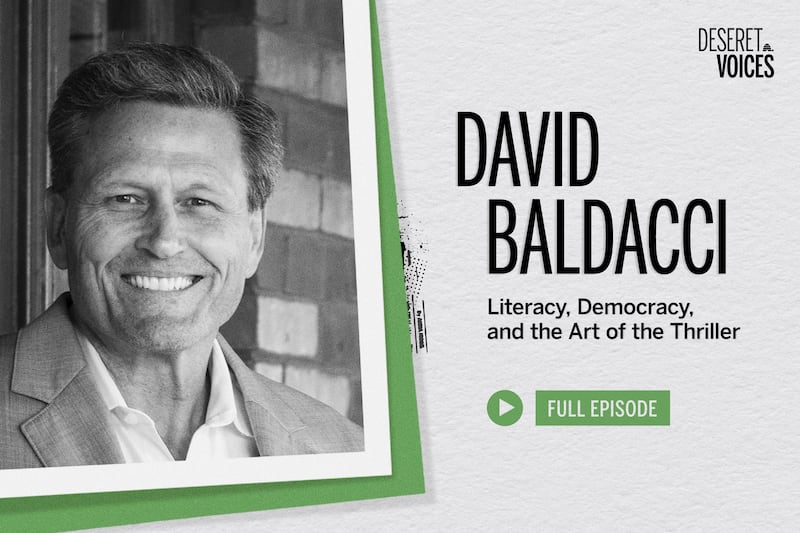


New York Times bestselling author David Baldacci believes “books are like body armor against bigotry.”
Baldacci says he wasn’t afraid of “boogeymen” because he had met them through books and learned to empathize with people from different backgrounds.
On this episode of “Deseret Voices,” Baldacci tells Jane Clayson Johnson what his response is to people who say they don’t read much.
Subscribe to “Deseret Voices” on YouTube, Apple Podcasts or Spotify.
Note: Transcript edited by Steven Watkins.
Jane Clayson Johnson: David Baldacci, welcome. Nice to have you.
David Baldacci: Great, thank you. Great to be here. Looking forward to it.
JCJ: Well, thank you. So, your latest novel is “Hope Rises,” fresh off the heels of “Nash Falls,” which was an instant international bestseller. So, congratulations. Very exciting.
DB: Thank you. It is, you know, I’ve written a lot of books, but it never gets old. You know, every time it comes out, it’s all the fresh new butterflies in your belly.
JCJ: I wanted to start a little bit with your early years. You grew up in Richmond, Virginia, at a time when segregation was still legal. How did that environment shape you as a little boy?
DB: First of all, it made me an observer of life. I grew up with a very ethnic last name in a place where if your last name wasn’t Lee, Jackson, Stuart, or Davis, nobody really gave a damn. So, I grew up as an outsider, even though I was a native-born Virginian. And so, I sort of watched the world and listened carefully to what everyone was saying about how the world should be structured.
But I also saw both sides of that world — both the black and the white world — just because of where I lived and what my parents did for a living. I was integrated into that world whether the law said I should be or not. And that made me more thoughtful than I otherwise would have been. I didn’t just skip through life saying, “Well, whatever people say I’m supposed to do, I’ll do.” I was never like that.
And the other thing that made a huge difference — the most remarkable difference in my life — was my parents. While neither of them had the opportunity to go to college, education was foremost in their minds for their kids. And so my brother and sister and I were taken to the library every week, and I checked out as many books as I possibly could. You know, Mark Twain always said that travel is fatal to prejudice; he was the most traveled person of his generation. I had no opportunity to leave Richmond when I was a child, but through books, I like to think I traveled the world without a plane ticket or a passport.
And, you know, back then, the boogeyman argument was the one you always hit with: “You should be afraid of those people; they don’t look like you. You know, they’re dangerous, so stay away from them.” But I’d met all the boogeymen in the books, so that argument didn’t work with me. So I would just look at the race and just say, “What else do you have? Because that one doesn’t really work with me.” And that’s why I’ve always felt like, you know, books are like body armor against bigotry and every bad thing that happens in the world.
JCJ: How did that really open your world and create empathy for you?
DB: Yeah, books naturally create empathy. They are the world’s best tool to create empathy because you’re diving into people’s lives who may not look like you, pray like you, eat like you, speak like you, but all of a sudden, when you’re inside their world and they’re having challenges and they’re losing people they love, they’re being knocked on their butts and have to get back up again, they have to reinvent themselves — guess what? Just like all the stuff we all have to do. There’s an instant bond that forms, and when you have a bond like that, empathy always follows.
Conversely, if you don’t read books and you only have your own narrow experience of life, the chance of you being empathetic for anyone who exists outside those narrow bands of your life are pretty much nil. We only have our own personal experience to rely upon; books fill out the rest of our humanity. And if you don’t fill out the rest of your humanity with books, I’m not sure how you get it. You’re not going to get it online, that’s for sure. You’re not going to get it from streaming stuff. Because books make you think.
I sit in front of — and when I watch — a movie, there’s no latitude for me to think about anything. It’s there in black and white; I see the people, I hear what they’re saying. In a book, you have to imagine all of that. So in a book, it forces you to think, and it forces you to get into the shells of the people that are in the novel, and it puts you inside their bodies, and you instantly form a bond and from that, you form empathy. And there’s no other way to get it. I mean, I’ve searched my whole life for it; there’s no way to get it.
And quite frankly, if you want to get really smart, guess what all the tech guys are doing these days? They’ve looked around the world. “How do they build super intelligence? How do we build super intelligence as fast and as efficiently as possible? Oh, I know, we’ll feed every book ever written into our software platforms, and that will make them super smart.” Now, if you think the tech guys are geniuses, then based on that, you should be reading a book a day.
JCJ: It was your mom who encouraged you to start writing early on. She gave you a little lined notebook as a boy. What did that awaken in you?
DB: It gave me the connection to what was up here, you know, and I take my pen and I go right there on the paper. It was like a tunnel of opportunity. I could take from what was up here and put it down on a piece of paper, and guess what? I could read it and other people could read it. And that was a connection and a revelation, this epiphany that hit me when I was 7 or 8 years old that I really never looked back from. That was my way to be able to explore my own creativity.
And her giving me that journal — I mean, she did it really just to shut me up because I was a little boy and never stopped talking. So she just wanted to have some quiet moments in her life, so she gave me a journal to write in. But that changed — really — my whole life. But for that, maybe I would have discovered it on my own somewhere else, but certainly, I discovered it early because of her, that I had this power that I could take from my mind and put it down on a piece of paper and other people would experience what I was thinking about and what I had created. I can’t tell you how massively important that was for me, particularly as a little boy.
JCJ: Well, you’ve written 60 novels, you’ve sold 200 million books worldwide. And as a novelist, you craft stories built on conflict and resolution. How does that shape the way you think about conflict in the world that we’re living in today?
DB: I would like to be at the point where, even though I know we’re always going to have conflict somewhere in the world, that we have — when we have conflict — we have robust resolution and we move on arm in arm as opposed to, you know, arming each other against someone else. After a while, if conflict is your normal state, then it’s not a world that many of us really would want to live in.
JCJ: You and your wife, Michelle, have poured a lot of time and resources into combating toxic political discourse. What drew you to this issue?
DB: Desperation, I think. I mean, I pay attention to what’s going on in the world. I’m politically active. I want the world, I want the country to be as good as it possibly can be for everyone. I see the trajectory we’re on now is totally unsustainable, and I also see where it’s going to end unless some people try to turn it around. I mean, I’m a student of history; I have seen this playbook before. It never ends well for anybody.
So, we looked around for a long time, talked to a lot of people, and decided that we needed to go right to the foundation. Because a house is only as sturdy as its foundation. My wife and I looked at each other and said, “Well, guess what? We’re the foundation.” You know, the people in this country are the foundation. What we want to try to do is give people platforms, venues, and opportunities to come together human-to-human, face-to-face — nothing on social media, nothing online — and talk to people. Talk to each other about issues that are important, trying to reach common ground so that the night before the election they don’t have to go on a podcast to find out who’s running and who they’re supposed to vote for.
You know, this is about people — I want people to think for themselves. I want them to learn. We live in a democracy, and that’s not a free ride. You know, if you live in Russia, it doesn’t matter whether you know who’s running, it doesn’t matter whether you vote or not; the same guy’s going to win. In a democracy, you shoulder responsibility. You’re supposed to be aware of the issues, supposed to learn the stuff, you’re supposed to understand who’s running, what the issues are, what it’s going to impact you and people you care about and the country as well. And if you don’t do that homework, you’re going to make terrible choices at the voting booth and the whole country’s going to suffer because of that. So what we’re trying to do is reinject this vigor of citizenship in a democracy.
JCJ: How will you measure success?
DB: I think we’ll measure success by how many people actually show up and how many people want to be engaged. I believe truly that people are interested in this stuff. All of a sudden, I think people are realizing this stuff really does matter to me. You know, my gas bill is through the roof, I can’t feed my family, you know, I don’t have healthcare anymore. These things matter to them. And I think that they should be vocal about it. I think they should question their leaders because that’s all part of, you know, being in a democracy. And people have to understand that they have a power here — every individual citizen has a power: they have the right to vote. And they can vote people out and they can vote people in.
JCJ: I think people want compromise, they want answers to their problems, they want to get engaged, but I think often they just don’t know how.
DB: That’s one thing that we’re going to try to address with this Institute [for Civil Discourse] is to sort of give people a refresher course, if you will, on the tools they need to engage better, to organize better, to collect their own thoughts better, and to get good information sources. I mean, look, I know we’re all aware that particularly with AI, you can create your own reality. I wrote a book 15 years ago called “The Whole Truth” where people were using the internet to create their own version of reality. These days, it’s a million times worse.
It’s really difficult to tell what’s real and what’s not real anymore, and that’s very dangerous, unfortunately. So what we’re going to try to do is give people the tools they need to build upon that skill of discerning what’s real, what’s not real, what’s a lie, what’s fake, what’s the truth, and then try to make good decisions based on that and to keep engaging with people. I don’t want people to go through life in these silos or in these bubbles; it’s not good for anyone. It just — what it does, it creates rage and hatred and divides people. And the last thing we need is more division.
JCJ: You talk about being a citizen of democracy, that citizenship is like a muscle — that if you don’t use it, it atrophies. What does it mean to exercise our citizenship today?
DB: I think that first of all, we need to put our phones away and get off of social media and don’t go down those rabbit holes anymore. If you really want to learn about issues, I would say, you know, go and read as many newspapers and magazine articles, go and listen to five or six different sources on as far as television goes, talk to your neighbors, talk to people who don’t agree with you on issues instead of never raising it with anyone because you know they don’t agree with the way you think politically. That’s just going to silo us even more. We’re going to get into tinier and tinier bubbles all the way.
You know, we have to confront our fears, and we have to realize that just talking to someone about issues that are important to everyone is not an attack on anyone. It’s just trying to understand people. I saw the latest statistics on screen time: the average person in this country spends anywhere from seven to nine hours looking at their phone a day. That’s longer than most people sleep. So that adds up over a course of an 80-year life to 31 years staring at your phone.
And let’s say that you took of those seven to nine hours a day, could you find 30 minutes a day to go and read some articles or some newspapers or some real news about what’s going on in the world and issues facing us as a country? Could you spend 10 minutes talking to a neighbor about an issue that’s important to both of you? Could you reach out to a friend and talk to them about something? Could you join a discussion group, you know, on local issues and — or go to a town meeting about it? You know, one of the platforms we’d like to use in this Institute for Civil Discourse is to have town halls with no politicians, just citizens who sit around talking about these issues. Guess what? Americans used to do that all the time. All the time.
JCJ: So with social media and the huge influx of information, are we losing the capacity then to just sit with ideas, to focus, to reflect?
DB: It’s totally destroying that ability. I mean, a lot of colleges now can’t even teach novels anymore; they teach excerpts of novels because students don’t have a long enough attention span. The average attention span for an American today is 42 seconds. Social media is destroying our attention span. That’s why TikTok 30-second videos are so popular, because that’s like the outer limit of someone’s attention span and then they move on and forget totally what they just saw.
That’s not the way the brain is designed to work. So if you’re shortening people’s attention spans, you’re cutting out 95% of the power of this thing up here. And they’re like, “Well, what’s the big deal?” Well, here’s the big deal: guess what’s happening over here? Where they’re creating super intelligence over on this other side over here, that is exercising 1000% of the ability to think. And then all of a sudden, you know, we live in a capitalist society, they’re like, “You know, these guys over here, the AI guys, much, much smarter than the guys over here. We don’t need these guys anymore.” Does this sound fantastical? It’s already happening. You know, I’m not predicting anything that’s coming. You know, I’m predicting things that have already happened in the past. And it’s only going to accelerate from here.
JCJ: You and your wife, Michelle, have another nonprofit; it’s called Wish You Well Foundation. You support literacy efforts across the country. You’ve said literacy is foundational to solving many societal problems.
DB: Reading will define who you are, and reading will define how high you can achieve. So if I told you that if we got the reading level for every American up to a 12th-grade reading level from where it is today at about a fifth- to sixth-grade reading level, the following social ills would go away: crime, poverty, hunger, homelessness. Those would all go away because they’re all tied to illiteracy.
Yet, we don’t spend a whole lot of time and money on reading. You know, we spend more in a month on defense than we do on education in this country over the course of a decade. So it’s all about, you know, fundamentally, what do you want the country to be and what do you want its citizens to be. When I say reading, all I really mean is thinking, because you can’t do one without the other. I mean, I see all the books behind you; you know, that has formed you. That has made you who you are today. The same with me. If you don’t have those books behind you as a person, those shelves are empty and there’s a big void in your mind.
JCJ: You’ve made an important connection between literacy and a healthy democracy. Why is being well-read essential to being a good citizen?
DB: Reading is the only skill I know where you’re able to use your mind to reflect upon what’s going on in the world and make healthy and informed decisions on that, and not knee-jerk decisions. Reading gives you perspective and context. Without perspective and context, it’s really hard to know what you should be doing at any particular time of your life when you’re faced with big challenges or the country’s faced with challenges.
If you can understand that when people went through rough times and this is what they did and this is how they came out of it, and then you go through your own rough times — that looking back, that gives you both perspective and context about: How did those people get through these challenges of which I’m facing right now? And I read about the choices they made and I see the outcomes they had; maybe I can learn from that.
If you don’t read, the only thing you have in front of you to help guide you is what’s staring in your face right now, and you often have competing interests: one side is telling you this, one side is telling you this, and how are you supposed to decide between the two?
JCJ: And what about when it comes to preserving a democracy?
DB: Well, let’s put it this way: we have all seen examples of where you had a democracy until you didn’t have a democracy. And what happened during those steps? You know, you can read lots of different books that will tell you all the dystopian novels that I’ve read everywhere from, you know, “1984” to “Animal Farm” to “Looking Backward,” the utopia novel by Edward Bellamy, to show you the stages of what can happen to turn a democracy into something that’s no longer a democracy. And it doesn’t happen very quickly, but it happens steadily. So if people can understand what happened before with societies and they could recognize the signals and the steps that are happening today to show, “Wait a minute, I know how this story ends. This is not where we want to go.”
JCJ: If citizens are not working toward maintaining a healthy democracy then, what’s on the other side of that?
DB: There aren’t a whole lot of other options out there. You know, Churchill always said that democracy was the worst form of government we’ve ever had, except for all the others. So it’s either we have a democracy where we have self-governance and self-rule, or we don’t. And the other side is you have one person or a very small group of people — whether it’s, you know, one president, one dictator, three tech lords, you know, three guys who run the largest AI companies in the world.
It seems to me like a small group of incredibly wealthy people — men — are deciding what the world is going to be and we don’t have a choice in that. For me, it’s deciding what sort of world do we want to have. And for the people who read widely, they understand the all-important context of perspective because everything that is happening in the world and will happen in the world has already happened before in varying degrees. Just the different names are associated with it. And we’re like, “Oh my God, we have immensely enormous people here, you know, seven guys have more wealth than the bottom 60% of Americans.” I know, that’s right. And the same thing happened in 1900 as well, with the robber barons, with the Carnegies and the Rockefellers and the Jay Goulds. They had as much wealth as the bottom 60%. You know, we went through all this stuff. This wheel keeps spinning and coming up the same sort of thing. But we have an opportunity and a choice to make about what sort of world we want to live in.
JCJ: You earned a law degree before becoming a novelist. How did legal training shape the way you think and the way you actually tell stories?
DB: The legal training was terrific as far as being a creator of fiction. I sort of tongue-in-cheek say some of the best fiction I ever wrote was when I was a lawyer. Because I had the same set of facts as the other side as a trial lawyer. We all have the same, you know, fact book to work from, and my argument and position and writing had to be diametrically opposed to theirs. So how do you do that? Well, you write creatively, that’s how you do it. You embellish facts that help your side and you de-emphasize facts that don’t help your side, and that’s why your stories are very different from one another.
And words were the only arrows I had in my quiver as a lawyer. I would either write them down on a piece of paper or I’d get up in court and say them. So that was my whole world. So this transition to writing novels was fairly easy because I was used to building stories, taking years at a time to do so and building them slowly and sort of letting the story grow organically. The more that I learned about a case, the more I learned about characters in a novel, I would let the story grow organically. I don’t really use outlines.
JCJ: So no pre-ordained path to the story? It sort of evolves? It’s a very organic process for you.
DB: It always has been. I have looked — trust me — I have tried outlines, and every time I do an outline, none of the outline ends up in the novel.
JCJ: Well, you’ve been so wildly successful — more than 200 million books sold in 45 languages in 80 countries. What is your secret sauce? Can you pinpoint it?
DB: My secret sauce is that I have never stopped being an 8-year-old little boy with his little journal and a pen. I have never — to this day — I have never looked at a story as a commodity to finish and then pass off to the publisher and then move on to the next one. It’s like I’m writing my first novel over and over again and realizing my good fortune to be able to make stuff up for a living — that I’m able to do what kids do all the time as an adult.
As a man in his 60s now, I still am able to exercise my mind like a little kid does all the time. You know, I just imagine stuff. And I hope we never lose that. I mean, I know with social media and things that that’s a challenge, but I grew up in an age where, you know, after school, after sports were done, I’d come home and I’d be out in the neighborhood, in the woods next door running and imagining and having adventures until it was dark and time to come home. And that’s really where my imagination was built from because I had many, many, many hours to exercise it without, you know, the distractions of a phone or whatever. And that’s where my imagination was built. And I have that with me today. So I’ve never looked at it as a job; I’ve never even looked at it as a passion. I’ve looked at it as like — that is my identity. So people say, “When are you going to stop writing?” and I say, “At the very, very end of my life.” It’s when I’m going to stop writing, because otherwise, why would I?
JCJ: Well, here’s your newest novel, “Hope Rises.” It is such a page-turner, really fast-moving, thrilling. And I’m curious, when you finished “Nash Falls,” was “Hope Rises” right on your fingertips?
DB: I knew the way that I ended “Nash Falls,” I had to write “Hope Rises” and have it come out fairly soon after because, literally, the story stops in the middle. And trust me, my staff tells me I’ve gotten like 10,000 angry emails from people about how “Nash Falls” ended, sort of in the middle. So I wanted it to come out no later than six months after, and so I was already writing “Hope Rises” before “Nash Falls” was even published because it was fresh in my mind, I knew what I wanted to do.
But I have to say that here’s what happened in “Nash Falls” and here’s sort of how, again, things grow organically and it can throw you some curves sometimes. I initially thought that “Nash Falls” was going to be a stand-alone book, one and done, and I was going to be able to tell the entire evolutionary arc of Walter Nash and everybody else in the story in one novel. Then I ran into this character Victoria Steers, and I realized that I could do so much more with her than just make her one-dimensional. So she was the reason I had to write “Hope Rises.”
JCJ: Well, you know, as you’re talking, I think that your books always include strong, grounded female characters, and I wonder if they mirror women in your own life.
DB: I grew up surrounded by strong female role models. My parents were both from huge families, so I had 17 aunts on both sides. And they were all intelligent, formidable women, but because of the era in which they lived, not a single one of them — including my own mother — not a single one of them realized their full potential because the ceiling back then wasn’t glass; it was like concrete.
So I write about women the way I have known women my whole life. I’ve never met a damsel in distress in my entire life; they don’t exist for me. The women that I know and the women I write about are strong, formidable, flawed, independent, fierce, and I try to present them as I know them.
JCJ: Well, I love the title of the book. And beyond the fact that Dillon Hope is the alias of your main character, Walter Nash, I’m curious what hope means in the context of this story.
DB: Throughout so many of my novels, one recurring theme comes back to me, probably because of the genre in which I write, but it’s the factor of redemption. And you can’t have redemption without hope and you can’t have hope without redemption. And I think we all struggle with that throughout our lives. No one’s perfect; we’re all flawed. I wouldn’t want to — I’d never want to meet a perfect character or a perfect person; I don’t even know what that would be. I certainly don’t want to write about them.
So if you’re imperfect and you’ve fallen down, you’ve made mistakes, which we’ve all done, there is a measure of redemption that we seek in our lives. It could be great or it could be small, depending on what we’re trying to redeem ourselves from. But associated with that always comes a factor that I think we can never overestimate the power that it will have over us as people, and that is the one of hope. Because without hope, I’m not sure why anyone would have a reason to get out of bed every day.
And so in my novels, I try to show people who have fallen, who have failed, who have made mistakes, who have destroyed certain parts of their lives, who have hurt other people — but I’m not going to write them off. Not quite yet. Again, that comes from empathy, though. Because people that don’t have empathy, they don’t care about people who are falling down; they don’t care whether they get up or not — doesn’t matter to them at all. We should all care about that, though. And that’s what really, you know, “Hope Rises” has reflected in me is that I put Walter Nash and Victoria Steers through a living hell in the two books, and they both got knocked down, and I wrote the books to see how they got back up. And that is a measure of who they are as people, and that works just as well in real life as it does in fiction.
JCJ: I’m curious what gives you hope right now.
DB: The one thing that’s always given me hope is just the people. At the end of the day, I refuse to believe that people don’t care. I believe that people care. I’m not saying that everyone does; I’m just saying that enough of us do that we will at the end of the day make good decisions that will benefit more people than not, that will benefit more than just a few. So that’s what gives me hope — it’s just the people that I see out there trying to do some of the things that I’m trying to do.
Just the fundamental goodness that I think most people have in their hearts. But I’ve got to tell you this: I used to, when people would come up to me at book signings — and usually it was a man and a woman — and the woman would come up, she had the book, and the husband would say, “Yeah, my wife’s really the reader. I don’t really read anymore. I don’t read much. Never got into it.” I used to say, “Yeah, yeah, everybody’s busy.” I don’t say that anymore.
You know, the last five years, somebody comes up to me and says that, I look up and they go, “You have no idea how sorry I feel for you. What you just said has devastated me, that you don’t read books. You have no idea what you’re missing in your life. You have the most enormous void in your life and you don’t even realize it. You better do something about that, starting today.” And when you say it that way, maybe some people will pay attention to it. Because what I’m telling them is the absolute gospel.
JCJ: David Baldacci, thank you so much.
DB: I enjoyed it. Thank you.