



As war rages in Iran, Father James Martin reminds us that “God is a God of peace.”
While Father Martin says that we can petition God to protect our troops, he doesn’t believe in the idea that God would only be blessing one side of the conflict.
On this episode of “Deseret Voices,” Jane Clayson Johnson asks Father Martin why the phrase “God is on our side” is a dangerous instinct.
Subscribe to “Deseret Voices” on YouTube, Apple Podcasts or Spotify.
Note: Transcript edited by Steven Watkins.
Jane Clayson Johnson: Father James Martin is our guest today, he’s a Jesuit priest, a prolific and bestselling author, editor at large of America magazine. He hosts the podcast “The Spiritual Life” and he was appointed by the pope as a consultant to the Vatican’s Dicastery for Communication, which in layman’s terms means part of his job is to help explain the Catholic Church to Americans. Father Martin, welcome to our podcast.
Father Martin: My pleasure, good to be with you.
JCJ: There’s a lot to talk about, including your new book. But I’m curious, how do you see the role of faith in public life today?
Father Martin: I think that faith always has a role in the public square, though I really do think that religious leaders should shy away from things like endorsing candidates and calling out candidates by name. I think it’s more important for people to, you know, preach the gospels. I think it’s really important to bring in faith-related topics, but I also think it’s important to kind of stay away from partisanship. So, it’s a, kind of a, it’s a little bit of a tightrope.
JCJ: Well, Pope Leo has become a more vocal in his criticism of the U.S. administration, specifically President Trump. And just last week, he criticized U.S. airstrikes in Iran, calling out the president by name.
Pope Leo: I’m told that President Trump recently stated that he would like to end the war. I hope that he’s looking for an off-ramp. Hopefully he’s looking for a way to to decrease the amount of violence, of bombing, which would be a significant contribution to removing the hatred that’s being created, that’s increasing constantly in the Middle East and elsewhere.
JCJ: Your response, Father Martin, to Pope Leo?
Father Martin: Well, I agree with him. Obviously, I mean, Pope Leo is talking about the gospel and I think it’s really important to remember that Jesus said, “Blessed are the peacemakers,” we’re called to be peacemakers. And also it’s important to remember Pope Leo rarely mentions politicians’ names. He only mentioned that because people asked him directly. Usually he’s just talking about working for peace and reconciliation. So I think he’s doing exactly what a Christian leader should do, which is to call for peace. Like Jesus said, “Blessed are the peacemakers.”
JCJ: What is the significance of an American pope criticizing an American president?
Father Martin: Well, I think, unlike under Pope Francis or Pope Benedict or Pope John Paul, people can’t say he doesn’t understand America. So it’s really important to say that this is someone who understands the American scene, who understands American politics but, again, who’s trying to be, you know, a faith leader, you know, not a political leader.
JCJ: After President Trump threatened to wipe out Iran’s “whole civilization,” Pope Leo issued another rebuke saying it was “truly unacceptable.” It’s not uncommon for a pope to speak broadly and talk about peace and call for peace, but these are very specific rebukes.
Father Martin: Well, and because these are really strange times. I mean, to call for, I can’t even say it, eradicating an entire civilization? I mean, it’s a kind of genocide, right? That calls for a response. So if you’re going to say, “I’m going to wipe out an entire civilization” or “an entire country” or “an entire nation,” you know, in terms of the threat, that’s, you know, hundreds of thousands or millions of people. It demands a response. I think also it reminds us that, you know, the Catholic Church is consistently on the side of life. These are pro-life issues. So if you’re going to say we’re going to kill people, the Catholic Church is going to be against that. So I think it’s perfectly appropriate.
JCJ: Do you think faith leaders generally should be more vocal on political issues relevant to their faith positions?
Father Martin: That’s a good question. I think that they should be vocal, but I don’t think they should be partisan. So I think it’s one thing to say we need to care for the poor, we need to care for people who are on the margins, we need to help the sick, we need to help the elderly, right, those kinds of things, we need to help people who are starving. That’s one thing. To say you should vote for this candidate or that candidate, you should vote for this party or that party, that’s another thing. So I think that they should be faith leaders, not political leaders. And that’s a difficult tightrope to walk.
JCJ: But do you wish we’d hear more from faith leaders as the pope is doing, speaking out?
Father Martin: I would wish we would hear more from faith leaders who are really talking about faith. And I sometimes think that, you know, Christian leaders are talking more about politics than they’re talking about Jesus. I mean, and I think Jesus is his own defense. I mean, all you have to do is say Jesus asks us to care for the poor and welcome the stranger or Jesus asks us to be loving and merciful and compassionate or Jesus asks us to be peacemakers, and that’s enough, right? I guess I wish that they focused more on Jesus and on the gospels, or on the, depending on the denomination, the Old and the New Testaments, than talking about specific political issues.
JCJ: Pope Leo has been critical of President Trump’s immigration policy, which is his signature issue. The pope called U.S. mass deportation efforts “extremely disrespectful.” I want to play a clip of U.S. House Speaker Republican Mike Johnson responding to the pope’s comments.
Mike Johnson: People cite passages out of the Old Testament and they say, “Well, you’re supposed to take care of the sojourner and the neighbor, treat them as yourself, welcome them in.” Yes, but that is an admonition to individuals, not to the civil authorities. The civil authorities are given authority under scripture to maintain order. Romans 12 — you want to do this? Romans 13 says that the civil authorities are God’s agents of wrath to bring punishment upon the wrongdoer. And it says, “If you do right, you have no fear of the civil authorities.” But those civil authorities are necessary. It’s a calling. It’s a calling to maintain order in society and we have not had that.
JCJ: Your response to that, Father Martin?
Father Martin: Yeah, well, that passage from Romans is not absolute. That passage from Romans is not the be-all and end-all. I mean, the be-all and end-all is what Jesus said and Jesus is pretty clear: welcome the stranger. Now that’s uncomfortable for a lot of people, and Jesus doesn’t say welcome the stranger only if they have the right papers or whatnot. Jesus says welcome the stranger.
So I think when you’re sort of pulling out scripture passages like that, you really need to look at the whole thrust of the Old and the New Testaments and it’s really hard to avoid it. And there are also some things as unjust laws. I mean, you know, the civic laws are not absolute. I mean, if that were the case — I’m not drawing parallels — but if that were the case, then Germans should have followed the civic authorities in Nazi Germany, right, because of that passage from Romans.
Those passages need to be seen in the light of the overall thrust of both the Old and the New Testament. And you cannot escape the fact that the overall thrust of the Old and the New Testament is: welcome the stranger. It’s very clear in Exodus, God says it over and over to the people of Israel: You shall not oppress the alien or refugee, for you were aliens yourselves once in the land of Egypt and in terms of the Exodus. Jesus says when you welcome the stranger, you welcome me; when you don’t welcome the stranger, you don’t welcome me.
Now, that’s uncomfortable for people and it stresses people out and it brings all sorts of excuses but that’s it. I mean, you might as well say that Jesus asks us not to take care of the poor. The other thing in terms of saying it’s only about individuals, that passage that Jesus, in which Jesus says we need to care for the stranger is called the judgment of nations. It says nations will be judged. I mean, you can’t get any clearer than that. It doesn’t say just individuals — which we will be judged — but it says nations will be judged. And so that’s, you know, that’s not me or Pope Leo, that’s Jesus.
JCJ: Do you think religious people, have a problem sort of connecting these two points?
Father Martin: Well, I do, that’s a great question. I think because they’ve been told by so many political leaders who are Christian that you don’t have to pay attention to that, they think, “Well, maybe I don’t, they’re smart people, maybe they know better than I do.” And then also it’s difficult, right? I mean, I’m not minimizing the migrant problem and for people along the border, it’s difficult, right, but that doesn’t mean that we just sort of ignore those scripture passages, we have to reflect on them and see really how to put them into practice. But sure, it’s very difficult, it’s like saying, you know, forgiving someone seventy times seven. That’s hard, I mean, the Christian life is hard.
JCJ: Pope Leo has not only spoken out in defense of immigrants in the U.S., he’s also urged U.S. Catholic bishops to do the same. And last fall, the U.S. Conference of Catholic Bishops issued a rare collective statement objecting to the harsh treatment of immigrants by the Trump administration, framing it essentially in moral terms. How unusual was that?
Father Martin: I think it was fairly unusual that the bishops would respond so quickly to something. But you know, the U.S. bishops have been on the side of migrants and refugees for decades and why is that? Well, there’s tons of Catholic churches along the border, first of all, a lot of these migrants and refugees coming from Latin America are Catholic so we minister to them, but we don’t minister to just Catholics. And again, it’s gospel teaching.
So this is an area where I think the bishops have been very good and they know these people, right? Not just the bishops, but priests and brothers and sisters and Catholic lay workers on the ground. I know some of my Jesuit brothers are working in Brownsville, you know, in Texas along the border. So this is a community that we know, and so I think the that enables the bishops to be more sort of authoritative when they speak out. It’s not like they’re speaking out in platitudes or about something they don’t know, they know what they’re talking about.
JCJ: But do you think that there are specific actions that the church as a whole should be taking on this issue?
Father Martin: Well, I think the first thing is speaking out, but the more important thing is pastoral care for these people. So for example, as I said, some of my Jesuit brothers are working in pastoral care in parishes and in you know, just one-on-one with migrants along the border, you know, helping them to get food and shelter and clothing and things like that. So it’s both the advocacy and it’s the on-the-ground work that the church really has always been doing.
JCJ: Some of the most visible Catholic figures in America today are serving in the Trump administration, from Vice President JD Vance to Secretary of State Marco Rubio, press secretary Karoline Leavitt. What is the responsibility of Catholics in positions of political power when their policies may be in tension with church teaching?
Father Martin: I’ve never worked in politics, but I would say it’s being a good and moral person. It’s trying to as far as possible live out those Christian values in the political sphere. Of course, there’s give-and-take in politics, right? Politics is the art of compromise, as they say. And I also think it’s remembering that, you know, God’s not just on one person’s side or one political party’s side or even one nation’s side. So to say, you know, God’s on our side and this is God’s will I think is really sort of misleading. So for example, you know, God is neither a Republican or a Democrat. And, you know, God is if God’s on anyone’s side, as the psalm says, God is on the side of the brokenhearted. But when we say that God’s on our side, I think we get into some sort of slippery slopes there.
JCJ: Well, Defense Secretary Pete Hegseth just a few weeks ago called on Americans to pray for victory in the battle in Iran and safety for American troops, “in the name of Jesus Christ.” The pope soon after warned against invoking the name of Jesus for battle saying that Jesus does not listen to the prayers of those who wage war but rejects them. So, the name of Jesus is being being invoked here, in the name of war.
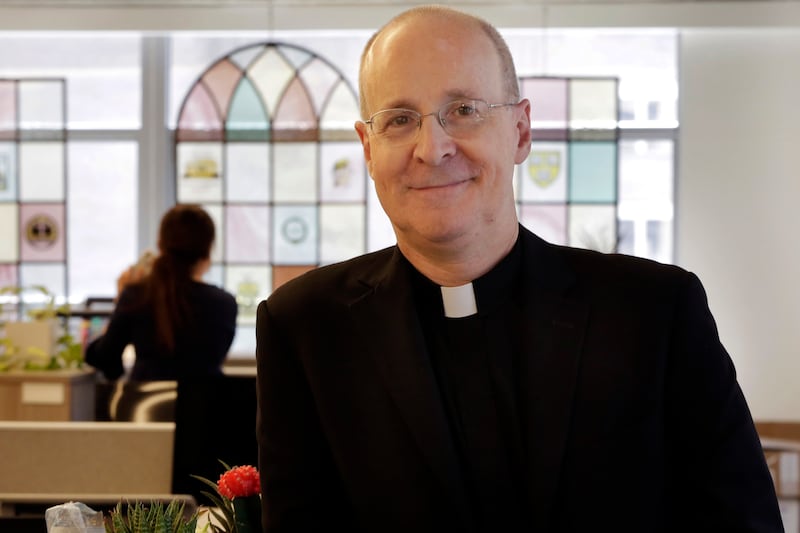
Father Martin: Well, Jesus says, “Blessed are the peacemakers.” So, I mean, you can’t be any clearer than that. Jesus also, you know, from the cross forgives his executioners and after the resurrection, you know, returns and forgives people. It’s not about revenge or who’s right or who’s wrong. But more broadly, you know, I do think, you know, God blesses American troops, but God also blesses people in Iran, right?
So the idea that God would be only blessing our side is really, I think, a misunderstanding of just theology, of just, sort of, Christian theology and Christian spirituality. Because, you know, if you say God is only blessing our side, does that mean God wants Iranians to die? That innocent men, women and children are dying? That makes no sense. But that’s the implication when you pray in that way. So I think it’s one thing to say, “May God protect our troops.” I think it’s another thing to say, “God is on our side,” and that God wills the death and destruction of the other side. I don’t, you know, God is a God of peace. Again, what, you know, Jesus’ words over and over again to the disciples are, “Peace be with you,” not “War be with you.”
JCJ: That phrase, “God is on our side.” Why is that a dangerous instinct?
Father Martin: Because it means God is against the other person and God wills the death and destruction of the other side. And I just, I just don’t think that’s the Christian God.
JCJ: During the first Trump administration, you were very vocal on social media about things that you disagreed with. Have your views shifted on what and how you speak out?
Father Martin: Yes. I’m much more careful about not using people’s names, not using politicians’ names, not talking about Republican and Democrat. I just think it’s better. I think it’s better to focus on the on the gospel and on Jesus. I mean, I sometimes I probably don’t do it as well as I should. I also, the few times that I’ll speak out on social media is when it wades into religious territory. So when people are talking about God wants this, God wants that or Jesus wants this or Jesus blesses that, I feel I’m on safer ground. But again, and I also try never to do ad hominem, you know, to say this person’s a bad Catholic or a bad Christian and I don’t think that’s helpful. So yeah, I have changed in that I focus much more on just what Jesus says.
JCJ: You have a really interesting life story. You come from a working-class background, you grew up in a family of what you call “lukewarm Catholics.” I’m curious how your upbringing shaped your faith.
Father Martin: What a great question. My parents were Catholic, but as I say, “lukewarm Catholics,” to quote Saint Paul, you know, not super religious. We went to church most Sundays. Not every Sunday. They were good and moral people. I think though that it really took me a while to get a sense of God’s call in my life and that really wasn’t until my late 20s. And what happened was, I was working in the business world and just thought, “This is not for me.” I mean, business is a real vocation for a lot of people, probably a lot of your listeners and viewers, but it just wasn’t for me and I really had to ask myself what was God calling me to and, you know, where were my desires leading me? And that eventually led to the Catholic priesthood.
JCJ: It wasn’t just that it wasn’t for you, in the book you say it was “soul-destroying,” that you hated your life. What was so bad about it?
Father Martin: For me, the overwork, the sort of 24/7 lifestyle, as well as some kind of mean managers that I ran into and a sort of a lack of compassion for people, really struck me as kind of inhuman. And it wasn’t the person that I wanted to be. I remember, I tell in the book a story about a guy who was going to be fired and I was working in human relations at the time and I went to his boss and I said, “You can’t fire this guy, we just gave him an incentive award, he has a family” and, you know, all these kinds of things, there was no sort of record of bad performance. And he said, “I don’t care.” And so as a last-ditch measure, I said, “Well have some compassion.” And I won’t use the word he used, but he said, “F--- compassion.” And I just thought — and he said that without irony — and I thought, “Boy, if I’m working in an organization that can say that about compassion, I think I’m in the wrong place.”
JCJ: And so did that inspire you to become a Jesuit priest?
Father Martin: Well, it took a while. I was looking for a way out basically, it was a kind of push out of GE and the corporate world. And one night I came home and turned on the TV and there was a documentary about a Catholic monk called Thomas Merton and his book, his autobiography really spoke to me and I thought, “You know, even if I can’t become a monk, this way of life, this religious way of life, this way of life that’s serving God is, seems a lot more congenial to me and a lot more appealing to me and a lot more of who I want to be than the corporate world was.” So it was a kind of a push out of GE and a pull into the priesthood.
JCJ: And what did you think of the priesthood after you joined it? I mean, I can imagine that was just these were extremes.
Father Martin: Yeah, they were extremes. I joined the Jesuits, a Catholic religious order first and I wasn’t ordained until another 11 years later, our training takes a long time. I was immediately happy. I know that sounds kind of silly, but I went from 100 miles an hour to like 10 miles an hour and it was about prayer and working with the poor and contemplation, reading the Bible and I thought, “This is great.” You know, it was almost like a vacation. So I really liked it. I think the first year in the Jesuit novitiate, which is the training ground, the house where we train, was really just wonderful. I mean, you spend all your time in prayer and reading the gospels and thinking about God and working with the poor. It was a lot more sort of appealing to me than working at my desk at GE was. So at, you know, at least at the beginning it was kind of like a paradise.
JCJ: And now?
Father Martin: It, you know, it’s like that was the honeymoon period, right? So, I think everyone needs a honeymoon period. Yeah, I’m very happy as a Jesuit priest. I work at America Magazine, which is a Catholic magazine. I write books and yeah, it’s not the perfect life, right? Of course, there are problems, but it’s the life for me.
JCJ: So your new book, is it your 20th book? Do I have that right? Somewhere in the range?
Father Martin: I think that’s right, somewhere around there.
JCJ: It’s a memoir, and it’s called “Work in Progress: Confessions of a Busboy, Dishwasher, Caddy, Usher, Factory Worker, Bank Teller, Corporate Tool, and Priest.” And it’s fascinating, it’s about the lessons you learned from the many jobs you’ve had and how you ended up as a Jesuit priest. So, I’m curious, which of those jobs taught you the most?
Father Martin: Well, first of all, thanks for a great summary of the book, that is exactly what the book’s about and that’s probably the best summary I’ve ever heard of the book. Yes, I learned a lot working in these sort of summer jobs, menial jobs, you might say, caddy, busboy, dishwasher, all the ones you talked about. I learned a lot of lessons. First of all, how to work hard, right? I think that’s an important lesson when you’re a young person, showing up on time. But also things like asking for help when you don’t know how to do something, being OK with not knowing everything, being kind to people who kind of are on the lower rungs of the job ladders. You know, I was mistreated, I talk about that in the book, some of them are funny, some of them are, you know, pretty serious. And I think when you’re mistreated in service jobs like that, it’s as effective as a, you know, course in morality, you know, because you say, “I’m never going to treat somebody like this.” So I learned a lot about working hard, but also about being kind.
JCJ: Yeah, everyone should work in the service industry at some point in their lives.
Father Martin: I think that’s right. I think that people learn a lot about how to treat people, you know, who might be, you know, seen as lower on the job ladder than you are. Everyone’s job is important, everyone has dignity in work, but I think that when you work in those kinds of service jobs, you get a real sense of what it means to be, you know, sort of less than, right? What it means sometimes to be humiliated. And so that teaches you, you know, not to treat people like that, it’s a kind of morality lesson. And you know, for people who are working in service jobs, it’s also a reminder that your jobs are important, right? That a busboy job is important, a dishwasher job is important. So it’s about the dignity of work as well. I learned a lot about that in these kind of crazy summer jobs.
JCJ: You recently met with Pope Leo. What should Americans know about him?
Father Martin: Another great question. I think the most important thing is that he’s a great guy. He really, he’s just a very good person. I got to know him at the synod, which was a meeting of Catholic representatives and Catholic leaders over the last couple years, October 2023 and October 2024. And I happened to be at his table for two weeks, you know, from nine-to-five. So you get to know somebody, a table of about 12 people. And I found him to be very, very intelligent, quite reserved, pretty quiet, not exactly shy, but reserved, very thoughtful. And a cardinal I know used a great word for him yesterday, which was (I really like this): he’s not just tolerant. He’s not just a good listener, right, for people from different viewpoints. He’s curious. Like he’s — isn’t that a great word? He’s curious about people and about where they come from and their points of view. So, I think we have a great guy. And to have an American is pretty special.
JCJ: You have said that the church in America is both healthy and divided to this point, and that the division mirrors our politics. What concerns you the most about that?
Father Martin: Well, just that, this great division in the Catholic Church, where people tend to think — in some places — more like Republicans and Democrats than Catholics. And this kind of demonization I would say. Now you see that, especially online. This person’s a bad Catholic, this person’s a good Catholic, you’re not doing this, you’re not doing that, right? Less so in parishes, but it really does seep into people’s discourse and I think, you know, the church is supposed to be one. Jesus prayed that they all may be one. Pope Leo is very much interested in unity. But I think the most difficult thing is to see people talked about as bad Catholics. Because, you know, we have no idea what’s going on inside their souls. Now we can, you know, look at their actions and say, “I don’t agree with that.” Or, “I don’t agree with what they’re saying.” But this kind of rush to demonization and this rush to condemnation. This rush to judgment, which is, again, what Jesus asks us not to do, he says, “Judge not.” And boy, that is a hard passage for a lot of people to to really sort of imbibe.
JCJ: Well, not just in the Catholic Church, but in many faith traditions.
Father Martin: Yeah, it’s such a human reaction. And I’ll tell you, sometimes I just tweet out, “Judge not,” and the comments are incredible. “Well, what about this? What about that?” And, you know, people say, “Well, what about the actions?” Yeah, we do judge the actions and say, “I don’t think that’s right. I don’t think that’s wrong.” But we don’t judge the person. That’s up to God. And there, boy, it is such a human desire to really want to judge, condemn, and also expel, you know, that this person’s not part of the community any longer. It’s really kind of shocking. And I think, I have to say, I think social media has exacerbated that. Because people aren’t meeting people face-to-face, they just sort of have a caricature of someone’s Twitter profile.
JCJ: What is the best way to understand the people you disagree with? How do you talk about issues like immigration and poverty in a way that does not immediately push people into political camps?
Father Martin: Yeah, great, great question and a really important question. The first thing is to always give them the benefit of the doubt, right? So to say that this person is probably coming from a good heart, right? And wants to understand and might be confused or fearful and, you know, we really need to take that person as a good person.
The second is to really listen, to really hard. I mean to really listen to what the person is saying and I have these experiences a lot. And the third thing is never to attack the person and to try to put forth your own view. I sometimes find, rather than getting into debates, it’s better to say, “Well, you know, let me tell you the story of someone I know who was a refugee or a migrant.” And I actually worked with refugees about 20 years ago in East Africa and sometimes I say, “Let me just tell you a story about a refugee. I don’t want to convince you, but I just I just want to share this story with you.”
And then to be OK with disagreements, right? I really think that’s important: to be OK with having disagreements with friends or even family and to be, you know, still love them. So it’s looking at things in charity. And also being open to critique, you know, that you’re not, you may not have all the facts or you may not know everything. You’re not God. So I think it’s giving people the benefit of the doubt, really listening, treating them with dignity, being OK with having some disagreements and, you know, being OK with being corrected. To say, “Oh, I didn’t know that.” Or, “That’s interesting.” I think that’s really rare these days.
JCJ: You’ve said that young people today seem to be rediscovering faith, rediscovering a spiritual hunger, and that we’re in a sort of post-secular moment. How is it that you’re seeing that?
Father Martin: Yeah, I see it in reports, for example in New York Times, The Washington Post, about upticks, particularly in the Catholic Church, of people who are joining the church over Easter, which is the traditional time for people to join the Catholic Church. But I’m also hearing it anecdotally. A lot of my Jesuit brothers work in campus ministry at colleges and universities are saying, “My gosh, you know, masses are packed and we’re getting all these baptisms.” So it’s happening. And I think it’s pretty exciting. And I really do think a couple things: one, there is that sort of post-secular, people are tired of, you know, secularity has found wanting. Second, they’re looking for community, certainly after COVID and, you know, lots of sort of societal upheavals, people looking for community. They’re looking for an identity. But, you know, really at the heart, they’re looking for God. They’re looking for a sense of God’s presence in their life. So it’s kind of taken the Catholic Church by surprise a little bit, but it’s a, you know, it’s a nice problem to have.
JCJ: At the same time, you speak about what you call “a coarsening of morality” in the United States. Why do you think that’s happening?
Father Martin: I think a lot of it is social media. Not all of it. I think in a sense it’s OK to hate people again. I think that, you know, political leaders, unfortunately, have been really virulent about their criticism of other people in a way that — I’m 65 years old — I just don’t remember that growing up. Now of course there are times and there are exceptions and you go back to colonial era times and, you know, John Adams was talking about Thomas Jefferson and Thomas Jefferson talking about John Adams, but it’s really stunning to me how mean-spirited people have become. And I think they look to their political leaders and sort of in society in general and see: I guess it’s OK to be public about hating people again. It’s kind of shocking. Stuff that really would have been beyond the pale and would have embarrassed people decades ago is now OK. So, but again, I think a lot of it social media.
JCJ: And so what’s the antidote to that? How do we move past all this?
Father Martin: Yeah, it’s to try to remember those virtues which is giving people the benefit of the doubt, remembering that everyone is a beloved child of God even if you disagree with them. Listening to people and having a little humility. That, you know, you may need some correction as well. It’s hard though. Humility is hard for people.
JCJ: Why do you think it is hard for people?
Father Martin: We’re human beings, it’s part of our sinful human nature to want to be proud, that’s one of the seven deadly sins. That’s the original sin, you know, that of Adam and Eve, they wanted to be like God, right? So it goes that far back. It’s just how we’re made and we really have to sort of work against it.
JCJ: So what is your final message for listeners about faith and politics and public discourse today?
Father Martin: Gosh, I would say, respect the other person, give them the benefit of the doubt, try to listen, put forth your position with love, and always continue to, as Jesus said, “Love your enemies.”
JCJ: Father James Martin, thank you very much.
Father Martin: My pleasure.