



Humans have drilled the Earth in search of water for thousands of years. Now, they’re excavating the sky.
Rainmaker, a drone-powered cloud seeding company, is attempting to solve the West’s deepening water crisis by inducing precipitation.
Water scarcity across the American desert has intensified slowly over the past century, compounded by explosive population growth and drought. In 1922 when the Colorado River’s water was first allocated, 9 million people lived in the continental states west of Texas. In 2026, the West’s population has ballooned to 78 million.
As a result, reservoirs built as back-up for dry years have steadily drained, with each arid state asking for more of the river than is sustainable to give.
Augustus Doricko, Rainmaker’s 26-year-old founder and CEO, learned about the issue while working with farmers across Texas. Water conservation and increased efficiency only took people so far for so long. The reservoirs are draining; aquifers are running out.
A realization settled on him: “We have to make more water.”

Three years after Doricko launched his cloud-seeding business, I sat across from him in Rainmaker’s two-story headquarters in El Segundo, California. Samurai swords hung from the wall near the front door; large TVs with real-time radar showed drones moving precisely through Utah’s mountains.
Those cloud-adapted drones were designed atop these rows of cluttered wooden desks. The operation, quietly buzzing with determination on a Wednesday afternoon, does a majority of its work in Utah. In 2023, state lawmakers put an annual $5 million bet on cloud seeding to increase snowpack, which accounts for 95% of the state’s drinking water.
Utah has developed the most robust operational cloud-seeding program in the U.S., Jonathan Jennings, a meteorologist with Utah’s Division of Water Resources, said. And Rainmaker is its heart.
What is cloud seeding? Does it work?

Cloud seeding technology has been around for more than 80 years. It does not create clouds; it encourages precipitation in already-existing clouds by adding tiny particles to help water droplets freeze and form snow or rain.
So far, silver iodide has proven to be the most effective cloud seeding substance, since its crystals closely match ice’s structure. The simple compound is both naturally occurring and can be produced in a lab.
Numerous studies have found that silver iodide concentrations in areas that were consistently cloud seeded, though slightly above natural background levels, are much lower than EPA safety limits.
One study conducted at the University of Wisconsin found that the same area would need to be seeded for 10,000 years before it would see an accumulated effect. However, Utah still funds an environmental study to monitor silver iodide levels.
Utah’s Division of Water Resources reports that cloud seeding adds at least 180,000 acre-feet of increased streamflow annually during spring runoff. Cloud seeding can likely boost precipitation by 15%.

Rainmaker began with Genesis 1
Augustus Doricko’s cloud-seeding empire began in the spring of 2023, as he read Genesis 1:26-28.
He’d been debating whether he should start another groundwater company when his eyes passed over those verses.
“It’s where Adam is given dominion over the Earth, the seas and the skies,” said Doricko, who belongs to the Eastern Orthodox Church. “And at that point, what struck me was that we essentially have no dominion over the seas and the skies.”
“God’s mandate for us to be good stewards, both for our own sake and creation’s, thereby glorifying him, has been totally abdicated. We have the technology to better manage the skies, to prevent droughts and disasters, to prevent famines, but we’re not using it,” he said. “So starting Rainmaker happened when I read that verse.”

But before that, Rainmaker began at a gym in Texas
Doricko was studying physics at UC Berkeley when Covid-19 shut the world down.
Social distancing, forced business closures and stay-at-home orders made life in pandemic-era California difficult. Since the doors to campus and his local gym were locked, Doricko moved to Fort Worth, Texas, and started working as a personal trainer.
At the gym, he met Jason Flynt, one of the biggest water-well drillers in Dallas. They began talking about water, and by Dec. 2021, they co-founded Terra Seco Solutions, which was “basically like TurboTax for farmers to report their water usage.”
Through developing Terra Seco Solutions, Doricko began to understand the difficult state of water in the West.
“All of the aquifers are running out for the most part. We’re getting less snow every year. The reservoirs are more and more empty. It’s not good,” he told me.
Farmers told Doricko about cloud seeding. Like Utah, Texas began cloud seeding in the 1950s. However, instead of focusing on snow, Texas tries to increase rainfall. For about thirty years, Texan rain enhancers have flown planes, with burning silver iodide dispensers mounted on the wings, through thunderstorms.
The one issue, which has prevented cloud seeding from gaining serious momentum, is its difficulty to validate. But an academic study conducted in 2017 offered a solution: use radar to differentiate between man-made and natural precipitation.
“If I fly the drone in a line and only see snow in that line, then you know it’s man-made,” he explained.
So Doricko set off to validate cloud seeding with his own drones.

The Pendleton boys and the fruits of Oregon
Pendleton, Oregon, has a 9 million-square-mile drone sanctuary, authorized by the FAA in collaboration with the University of Alaska Fairbanks.
It’s where Lockheed Martin, Anduril and AeroVironment test their next-generation tech. And it’s where Doricko sent a motley crew of software, electrical, mechanical and aerospace engineers to verify that his drones could literally make it rain.
Parker Cardwell, Rainmaker’s chief operating officer, was among the enlisted who were sent to Pendleton in Rainmaker’s early days.
“We very quickly realized that the type of drone that can withstand freezing clouds is not one you can find commercially off the shelf,” Cardwell said. “Drones do not — just like airplanes — naturally like to fly into icing conditions."
Once Pendleton’s clouds ate every store-bought drone, “we began designing, prototyping and building our first batch of like 60 of these things in about three weeks,” Cardwell said, pointing to one of Rainmaker’s first drones, hanging somewhat mangled from the ceiling of their El Segundo office.
Hundreds of thousands of Americans [have watched] immense struggle because of water scarcity. So the idea that I get to be part of the solution to it is the most special thing in the world
— John Tesmer, Rainmaker's deputy director of field operations
Before being told to move into real housing, the Pendleton boys all lived in a hangar, working around the clock to prove their tech worked.
John Tesmer, Rainmaker’s deputy director of field operations, told me during an interview in their Salt Lake City facility, Pendleton was “so miserable.” Laughing, he added, “It was so unbelievable. But I mean, it was fun. Like I look back on it with such joy.”

Some nights, farming families in the area would host the Pendleton boys for chili nights and bonfires, Cardwell said.
“They’d be like, ‘You look like you’ve worked really hard, have a beer.’ And we were like, ‘Hell yeah.’ Then they’re like, ‘That’ll just cost you an acre-foot of water,’ And we’re like, ‘We’ll do our best,’” Cardwell said, laughing.
But getting to know Pendleton’s local farmers made Cardwell realize the significance of increasing the country’s water supply. They stressed how much just one more inch of water would do for their crops.
Rainmaker is trying to pioneer ultra-precise cloud seeding
Rainmaker’s engineers and meteorologists are trying to take cloud seeding’s precision to the next level.

Kaitlyn Suski, Rainmaker’s head of research, told me that her team is gearing up to cloud seed specific locations this coming season (Nov. 2026-April 2027). Suski earned her PhD in physical chemistry from UC San Diego and has spent 18 years researching aerosol and cloud microphysics.
Her team will use statistics on timing, wind speed, direction and cloud conditions to try to make it snow or rain on a particular farm, mountain range or ski resort.
“I think we’ll be able to get more specific about timing once we have more examples and we can make it region-specific or cloud condition-specific,” she said. “But for now using wind speed and direction, we can pretty confidently say, ‘This is where the cloud is going to end up.’”
What sets Rainmaker apart from their competitors is their ability to validate through satellites and radar. As of April, the company had found 82 unambiguous seeding signatures, which show their operations directly caused precipitation.
One satellite image taken after an area was seeded showed a little black hole amid the white clouds. “It’s basically a hole in the cloud,” Suski said. ”Essentially, we made the clouds precipitate, so there’s a hole where it precipitated out," she explained.
Where does Utah cloud seed?

Utah has funded cloud seeding in northern Utah and the Western Uintas for 40 years.
Since 2023, cloud-seeded areas have expanded to include the Great Salt Lake, the Colorado River and Central Utah, Joel Ferry, the executive director of Utah’s Division of Natural Resources, said in an interview.
“We’ve enhanced programs up and down the state of Utah, from top to bottom,” Ferry said.
The program adds to Utah’s water conservation and efficiency efforts, he said. “We need to be doing everything we can. We still need to be doing conservation, we still need to be doing leasing and efficiency, and dedications of water, but cloud seeding can and does play an important part of the overall package,” he said.
Given Rainmaker’s recent validation announcement, Ferry described their partnership as “the smartest thing we can be doing with our money.”
The cost of cloud seeding is significantly lower than desalination. Utah pays about $55 to $60 per acre-foot of cloud-seeded water, Jennings said. Meanwhile, desalination costs $60,000 per acre-foot.
Other cloud-seeding tech ionizes the air

Another company in the weather business, Rain Enhancement Technologies, currently operates in Colorado and Utah and aims to increase precipitation by using ionization to encourage cloud formation and rainfall.
In an interview, the company’s CEO Randy Seidl described the tech as an “eco-friendly, year-round” alternative to silver iodide seeding.
Jeff Chagnon, Rain Enhancement Tech’s senior meteorologist, said in an interview that the company offers “the similar service of enhancing precipitation, without the same environmental concerns that sometimes are associated with silver iodide.”
However, Utah’s Division of Water Resources has not funded Rain Enhancement Tech yet, since their “science is more novel,” Jennings said.

Jennings said the company has yet to provide physical validation that the ionization is directly causing rain. “I’m waiting to see more results from them before the state gets too involved,” he said.
In response, Seidl said his company shares Utah’s “commitment to evidence-based decision-making” and is focused on building their own evidence base.
“The work underway in the La Sal Mountains is exactly the kind of validation Jonathan is describing,” he said in an interview. “Across December, January, and February, three of the driest winter months in recent western history, we documented consistent snowpack and snow-water equivalent enhancement at the treatment site versus the control. The underlying physics of ionization-based precipitation enhancement is well-established; what our Utah operations are demonstrating is its measurable effect under real-world conditions.”

Rainmaker’s mission is personal for many of its employees

During a walk through of Rainmaker’s Salt Lake City facility, John Tesmer explained how he ended up in Utah, helping Doricko modify the weather. Like many employees at Rainmaker, he joined the company with a personal commitment to its mission of mitigating water scarcity.
He grew up in Fresno, California. Between 2012 and 2016, the area suffered one of the most severe droughts in California’s recorded history. Some rural communities went without water, thousands of farming jobs withered and wildfires consumed much of the landscape.
“The drought was so severe,” Tesmer said. “I watched my backyard burn to the ground. I believe it was the Big Creek Fire in 2022.”
He continued, “Then I also watched my grandparents really struggle because of the water crisis. The thing is, my story is not unique at all. There are hundreds of thousands of Americans who have a very similar story of watching immense struggle because of water scarcity. So the idea that I get to be part of the solution to it is the most special thing in the world.”
Tesmer recalled his job interview with Augustus. The young founder quoted the American industrialist, Henry Ford.
“‘If I had asked people what they wanted, they would have said faster horses.’ And it’s the same idea here,” Tesmer said. “It’s so applicable because if you ask people what they want, they say more water storage, which I 100% agree with. But is it realistic?”
Cloud seeding with ‘Ferry’ dust
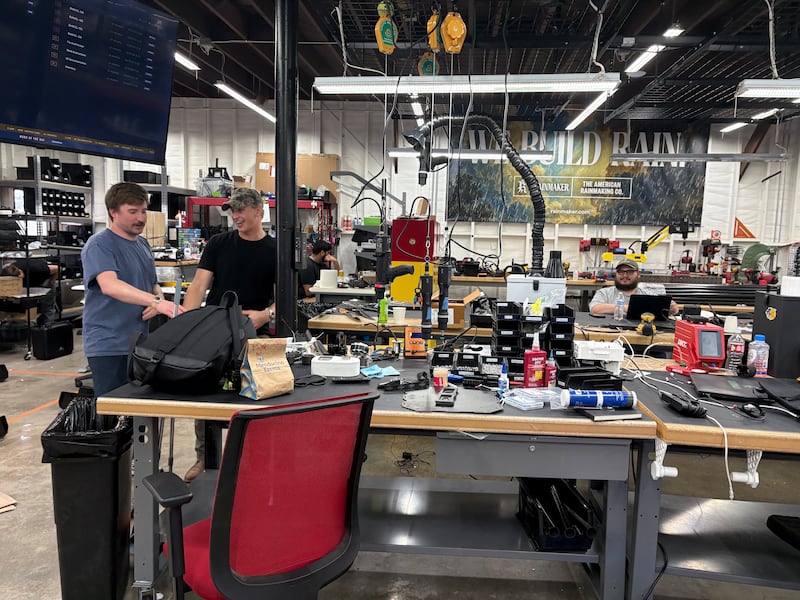
Standing in Rainmaker’s El Segundo headquarters, with his arms crossed over his chest, Cardwell referenced Utah’s DNR executive director.
“Joel Ferry is big,” Cardwell said. “I mean, he’s a brilliant man when it comes to environmental and hydrological science.”
Without Ferry and Jennings (Utah’s meteorologist overseeing the cloud-seeding program), “I think it’s fair to say that operational cloud seeding would still be in a lab,” he said. In Ferry’s honor, Cardwell and others referred to silver iodide as “Ferry dust.” But they’re not the only ones.
In a later conversation, Ferry laughed and acknowledged the tease.
It started when Ferry presented a review of Utah’s cloud-seeding program at a Great Salt Lake conference a while back. “Someone joked and said, ‘This is like magic dust. This is like fairy dust.’ Then they looked at me and were like, ‘Wait a minute you’re Joel Ferry!”
“And it just kind of stuck,” he said with a laugh.
When asked what it’s like working with a young and ambitious CEO like Doricko, Ferry said, “It’s nice, because I’m not one to get bound up by traditional norms.”
“My motto is, you’ve got to break a few eggs to make an omelet, and I would rather have someone that’s pushing the limits and is aggressive and challenging what’s done in the past rather than being bound by it. We can learn from the past, but we don’t have to be restricted by it,” he said.

Doricko’s faith fuels him
“Getting to do the work of trying to beautify creation is a mission that feels very much like an act of faith,” Doricko told me. “By no means is everybody at Rainmaker Christian, but everybody understands that it’s my animating principle.”
Though his faith in God guides his actions now, Doricko grew up an atheist.
“I was very much an angsty, philosophically inclined existential nihilist,” he said. “I was insufferable. I went around saying Christians were dumb.”
Eventually, Doricko reached a point where he didn’t care about the quality and betterment of his own life; he felt as though he needed something meaningful.
“I would say that God was reaching out in his grace to set me on the right track. I studied under multiple religious faiths: Muslims, Judaism, then a couple different Christian denominations,” he said.
Doricko started going to church, “then eventually, just through worship, developed a personal relationship with God.”
His conversion to Christianity appears through Rainmaker’s various religious allusions.
Their drone is named Elijah, “because of the story where he prays for rain and gets it.” The atmospheric sensing package deployed to the mountains is called Eden, because “we’re trying to restore the garden to some extent — or at least make the world resemble it a little bit more." Their probe is named Gideon, “because it’s one little sensor to give us so much information over all these other things.” And their software stack is named prophet.

That last one “maybe trends a little bit toward blasphemy, but it was like the God-mode view of all the data across all our stuff. So through that you can commune with all this information about creation,” Doricko said.
However, the team had to rename it because it violated blasphemy laws in the Middle East.
Are cloud seeding and ‘chemtrails’ related?
As Rainmaker has become more well known, some have tied its tech into a longstanding conspiracy theory about “chemtrails.”
This conspiracy theory claims that the white lines left behind airplanes are actually chemicals designed to poison people, manipulate their minds, control the weather or engineer the environment.
When asked to address these concerns, Doricko began by saying he feels “empathetic toward people who do believe that.”
“I think that our government absolutely has, as is evident as of the last six years for sure, explicitly and intentionally lied to us without the interest of the people in mind. So to be wary of some sort of clandestine or malevolent program of that sort from the government totally makes sense to me,” he said.
He continued, “What I have found, though, is that if you look at the samples — the chemical samples of materials in jet engine exhaust or from those streaks behind the planes, I call them contrails — there is no evidence to suggest that they are actually chemtrails and malevolent attempts to destroy the planet.“

“Even if chemtrails are real, and I’m pretty confident that they’re not, but even if they are, what I can guarantee you is that they are not cloud seeding. If you see a long streak in the sky, it is not cloud seeding. You need large natural puffy clouds full of liquid water in order to seed them and induce precipitation. On a clear day, we cannot make clouds. We can only harvest more of the water that’s not naturally precipitating and bring it down.”
Sitting in Rainmaker’s El Segundo headquarters, Doricko encouraged those skeptical about his company to reach out to him personally.
“I totally get why you’d want to inquire of the 26-year-old mulleted guy from Los Angeles who’s modifying the weather — like that should raise eyebrows," he said. “Totally reasonable. But if you do have those questions, if you ask them in good faith or at least with an open mind, I found that everybody I’ve spoken with comes on board.”