


Something is stirring in the American zeitgeist, and the year 2026 has become a pivot point. Americans have moved from a sense of almost resigned desperation in the face of corporate overreach turbocharged by technological advances to a very different emotional stance, enunciated most eloquently by Delsia Bare of Mason County, Kentucky, responding to a data center developer’s $26 million offer for her land: “Kick rocks and don’t come back!”
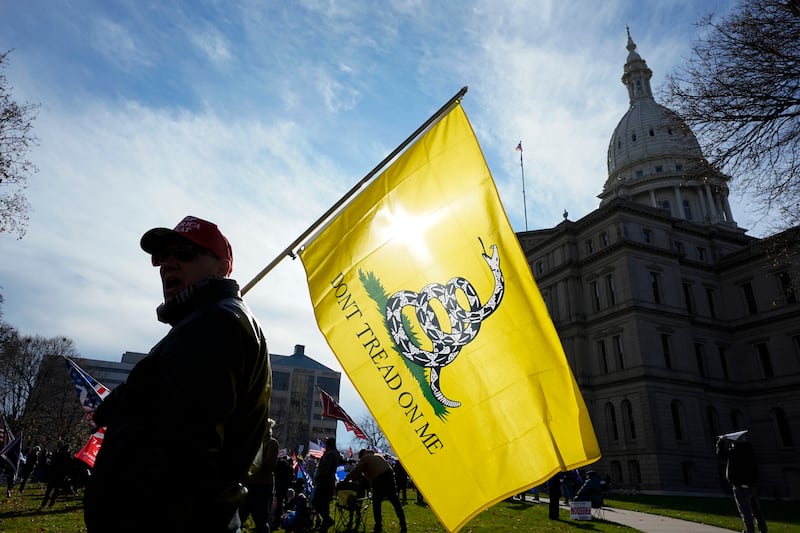
The “don’t tread on me” ethos has long been a part of American culture, but the onslaught of obscenely concentrated corporate money and power, especially with regard to artificial intelligence, left many Americans on the back foot. Skynet seemed too powerful. But it seems the scrappy Americans have now begun to regain their footing, and with a vengeance. Strikingly, in this age of political polarization, these are issues that unite the right and the left.
For example, for years Americans across the political spectrum have begged the federal government to regulate the social-media companies that came for their kids. Congress wouldn’t act. The White House wouldn’t act. But juries of Americans did, punching back in 2026 with guilty verdicts and billions of dollars in fines. In the latest case, the very threat of a jury advisory verdict was enough to cause Meta to settle within a few days of the start of the trial that cost them $17 billion. And now Meta is finally going to make changes American parents asked for a decade ago.
AI data centers are another such issue. At first, data-center developers ran roughshod over local concerns, even suing towns into coerced compliance, forcing them to accept data centers that they and their elected representatives opposed. The sheer arrogance of these companies has galvanized public opinion across the political spectrum firmly against data centers, so much so that three-quarters of Americans now oppose their construction.
In the great state of Texas, where I live, politicians that formerly welcomed data centers with open arms have made abrupt U-turns. Gov. Greg Abbott has accused data center developers of “digging their own grave” with their high-handed tactics. In this most business-friendly of all states, there’s now a pause and heavy new regulations on data center construction, and the same is happening in most U.S. states, red and blue alike.
Flock cameras are also the subject of Americans’ wrath. Creeping expansion of surveillance and loss of privacy was once seen to be inevitable, and not something the average citizen had any viable means of opposing. After all, even our very phones and cars were surveilling us, and so we had no right to complain about Flock cameras popping up everywhere.
But the powers-that-be hadn’t reckoned that maybe after you push an American over and over again, at some point it becomes too much. And Flock cameras were the proverbial straw that broke the camel’s back. Now there is a nationwide “Deflock” movement, with crowdsourced maps of the location of every Flock camera used for license-plate recognition, and car and facial recognition. Cities and municipalities are canceling Flock contracts, despite new guardrails put in place by the company in response to the brouhaha.
Gov. Ron DeSantis of Florida recently expressed what many Americans, from right to left, are thinking: “No one’s been stronger on law enforcement than me. But I don’t want to have this become a surveillance state. ... I think people are right to be concerned.”
The governor of Texas just banned state funding for the cameras, also. But it’s not just red states: Blue cities in California, Oregon and Massachusetts have banned them, as well. The strong backlash extends to other forms of facial recognition, too.
There are other examples. Until 2026, it seemed that people had reconciled themselves to Kafka-esque job-hiring software, where applications were screened via AI, and with AI even conducting interviews of applicants. People were resorting to having AI create their application to appeal to AI screeners. Now class-action lawsuits have been filed against these hiring software companies for illegal discrimination.
The glut of AI slop music has also resulted in a firm backlash, and music-streaming companies are demanding on behalf of their consumers that AI music be labeled as such and not promoted. And music award committees in this and other countries have banned AI music from any consideration for awards.
There are a wide variety of other victories, large and small, resulting from backlash from Americans across the political spectrum, including right-to-repair laws, banning phones in public schools, banning AI in elementary grades, age verification for social-media access, and also many ongoing struggles, such as prediction markets. What was thought to be an irresistible historical juggernaut has turned out to be quite resistible, after all.
Even more interesting are the figures showing that some companies have chosen not to fire their workers in favor of AI, in part because AI simply does not boost productivity — and if there’s no difference in productivity, these companies actually prefer to keep their human employees. Preferring humans! Now that’s an even more effective form of rebellion than chaining oneself to the front doors of OpenAI’s headquarters.
It seems that 2026 will go down in American history as the year in which Americans began to successfully fight back against seemingly overwhelming odds backed by money and power. In the year we celebrate the 250th anniversary of our country’s Declaration of Independence, it is bracing to see Americans — right and left — stand up and fight together for their freedoms once more.
“Kick rocks and don’t come back!” is an excellent motto for our time, more colorful than the social-science phrase “transformative repolarization.” Our forefathers and foremothers would be proud.