

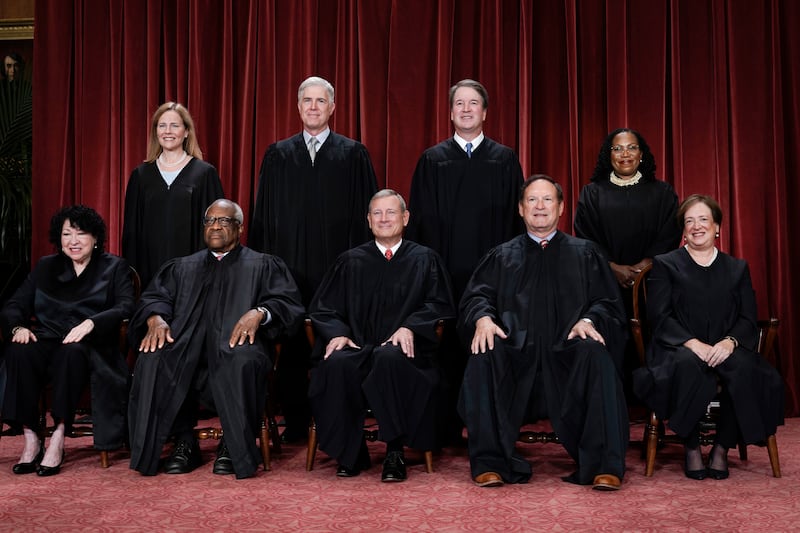

Democrats say the Supreme Court and its 6-3 conservative majority need reform in multiple ways. The latest idea floating around is increasing the total number of justices on the bench to 13 with the hope that it’d tip the so-called partisan imbalance in Democrats’ favor.
The idea, however, would likely cause intense partisan fighting both in Congress and among the American people.
Rep. James Clyburn, D-S.C., said on Sunday’s “Meet the Press” that expanding the number of justices from nine to 13 is a “pretty good number.”
The question comes after former Vice President Kamala Harris made several suggestions to help her party, including saying at a recent event that “we need to revisit the point of expanding the court to 13 justices like we have 13 District Courts.”
Clyburn told NBC News’ Kristen Welker that he agreed with Harris.
“I think we are in a position now that calls for some significant actions taken by the Congress and we ought to expand, and 13 is a pretty good number,” he said. “A baker’s dozen, it would be a good number to have on the court.”
Expanding the court has been a talking point among Democrats for several years. In 2021, Sen. Elizabeth Warren, D-Mass., wrote an op-ed published by the Boston Globe, calling on her colleagues in Congress to add justices to the court.
“I don’t come to this conclusion lightly or because I disagree with a particular decision; I come to this conclusion because I believe the current court threatens the democratic foundations of our nation,” she wrote.
Warren said the Supreme Court’s approval rating is low among Americans and pointed to the GOP nominating conservative justices to the court at the tail end of President Donald Trump’s first term, which she described as “court-packing.” Instead of trying to gain back trust from the people the court serves, it has instead issued rulings in partisan and extreme cases, she argued.
“Without reform, the court’s 6-3 conservative supermajority will continue to threaten basic liberties for decades to come,” she said.
Her fellow Massachusetts senator, Sen. Ed Markey, proposed legislation that was looking to expand the court, but has since been unsuccessful.
Clyburn told Welker on Sunday that he hopes if Democrats’ effort to pass legislation and expand the Supreme Court are successful, the new justices will “follow the constitutional underpinnings of this great nation of ours.”
“The 13th, 14th, and 15th Amendments have been interpreted different ways over the years,” he said later adding, “We have now a Supreme Court that has decided to reverse course and take this country back.”
The partisanship of it all
Welker asked Clyburn if he stood by a decision he made 35 years ago when he supported Justice Clarence Thomas’ confirmation to the high court in 1991. Clyburn at the time called Thomas a “good friend” but said Sunday he “absolutely” does not stand by his past remarks.
“I had no idea that Clarence Thomas would rebel the way he has against his own background and experiences,” he said, repeating an idea Thomas has strongly pushed back on.
Thomas, the second black justice to serve on the court, grew up in a time of segregation and discrimination and faced abject poverty in Georgia.
Thomas went on to attend Yale Law School and head the Equal Employment Opportunity Commission before joining the Supreme Court.
“I had hoped that Clarence Thomas would follow the modern underpinnings of that Constitution of ours, but he has not done so,” Clyburn said. “In fact, he decides to go all the way from an angry leftist to a very angry rightist.”
Thomas’ grandfather had him work a farm without gloves in the summer. He gained blisters before his hands became calloused because it represented “vulnerability before maturity.” At 78-years-old, his time at the Supreme Court is limited, but he will leave his lasting mark on the court and the country by being an originalist and the intellectual leader of the right, Sarah Isgur writes in her book, “The Last Branch Standing.”
Being an intellectual leader of the right at a time when the court is overturning precedent – like in Dobbs v. Jackson Women’s Health Organization – means figures like Thomas will stand out when Democrats make their case to add progressive justices to the court.
Should Democrats win in November and flip majority control of the House, trying to add justices to the court is on the table. House Minority Leader Hakeem Jeffries, D-N.Y., who would likely become House Speaker if Democrats flip the lower chamber, recently told the National Association of Black Journalists that “dramatic Supreme Court reform is necessary.”
He later said Rep. Jamie Raskin, D-Md., a ranking member on the House Judiciary Committee, would look at all options, including term limits for the justices with their terms capped at 18 years of service, instead of lifetime appointments.
The Brennan Center for Justice’s Michael Waldman said in an article that those who are possibly seeking to run for president in 2028 will likely speak on the matter – hence Harris’ recent comments, though she hasn’t confirmed another presidential run. Others who might weigh in could be former Transportation Secretary Pete Buttigieg or Pennsylvania Gov. Josh Shapiro.
Late in his term, former President Joe Biden endorsed term limits and a binding code of ethics for the court.
Republicans push back on ideological court expansion
Republicans have long been opposed to any sort of change at the court, accusing Democrats of trying to “pack the court” with justices who would vote in favor of their policies and agendas.
Others have argued that if Democrats add justices, Republicans may feel compelled to do the same, leading to increasing uncertainty for the court.
While that might be the case, should a law ever get passed by Congress and signed by the president, Isgur argues in her book, that partisan thinking of the court is backwards.
The 6-3 rulings on headline-making cases often gain the attention of the general public, leading to the idea that the court is very much at odds ideologically. However, SCOTUSblog compiled data about the court’s most recent term and found the number of unanimous cases rose to 44% this year, up 2% from the term before.
President Donald Trump did see some big wins at the court this year, but the conservative-majority court delivered him big blows as well, including by striking down his tariffs and dismissing his idea to end birthright citizenship.
Should a law pass to increase the number of justices to 13, there’d likely be an all-out brawl over the partisan make up of the court in the Senate confirmation process for those four new justices.
But it’s much more complicated than partisan fights, Isgur explains. She believes there’s a 3-3-3 split among the current justices and the way they rule in a decision is varied based off of where they land on an X and Y axis.
The X axis is a spread of how liberal to conservative a justice is and the overlooked Y axis is a spread of how institutionalist the justice is, she says.
Based off this theory, Justices Elena Kagan, Sonia Sotomayor and Ketanji Brown Jackson are grouped on the left. Justices Samuel Alito, Thomas and Neil Gorsuch are grouped on the right. That leaves Justices Amy Coney Barrett, Brett Kavanaugh and Chief Justice John Roberts somewhere in the middle. According to ruling data, those three were more likely to agree with the liberal group in non-unanimous cases than they were with the other group.
In a statement to the Deseret News, Isgur explained there’s a reason why the court system is set up both federally and at the state level, from lower courts, appellate courts and then up to the Supreme Court.
“If someone wants to argue that 13 is better than nine, I’m all ears,” she said. “But adding justices for the purpose of changing the ideological balance of the Court is the end of the Court as a counter to the popular mobs of the day when it comes to speech and criminal justice.”
Isgur noted that the Supreme Court’s approval rating is pretty low. National averages show it sank to a record low in July to just 33%. But when polling is done on specific cases and the justices’ actual rulings, nearly all are above 50%.
She said that finding shows the general public’s views of the high court are more based on partisanship and less about serious disagreement and legal outcomes.
Supreme Court experts agreed at the end of the most recent term that they hope the justices could take the political temperature down because things are so polarized right now.
Isgur’s podcast co-host David French highlighted the horseshoe theory at a term wrap-up event. It’s the idea where the extremes of either political party swing so far one way, they tend to meet up in the middle.
“The far left and the far right are hating this court. They hate this court and they’re hating this court for a very similar reason that they’re not getting everything they want from this court,” French said. “One of the problems with extremism in this country right now is extremists are not only extreme ... part of the extremism means that they can’t even acknowledge good faith disagreement.”