



A version of this article was first published in the Right to the Point newsletter. Sign up to receive the newsletter in your inbox every Wednesday morning and to vote in subscriber-only polls.
Imagine a politician who has always prided himself as being on the side of “the people” coming out on the other side of an issue that the people care deeply about.
That’s what we’re witnessing as President Donald Trump came out swinging in defense of data centers this week.
In a post on Truth Social, Trump said that the only reason Americans should not want data centers in their communities is if “they want to end up being backwards and poor.”
He went on to say that China is celebrating the resistance to data centers that power artificial intelligence, and that if we want “far lower taxes and jobs all over the place, let Data Reign.”
The post comes on the heels of revelations that the social media platform X had identified some 200,000 inauthentic accounts, suspected to originate in China, with about 200 of them promoting arguments against data centers. Kevin O’Leary and others say that China is behind Americans’ opposition to data centers, as Brigham Tomco reported for the Deseret News last week.
Still, “Let Data Reign” will surely wind up in the Annals of Regrettable Trump Tweets, right up there with the Rob Reiner death announcement and the AI-generated image of Trump looking suspiciously like Jesus.
It sounds too much like another ill-advised pronouncement, “Let them eat cake,” and is incongruous with the image of a man who worked a McDonald’s drive-thru window and drove a garbage truck during the 2024 campaign.
Americans’ initial delight with ChatGPT and its ability to fill our social media feeds with entertaining videos of cats driving cars and playing musical instruments has long since devolved into distrust and concern. From students booing speakers who mentioned AI at their commencement ceremonies to polls showing that upward of three-quarters of Americans don’t want data centers in their communities, the concept of data has never been more unpopular, even if you don’t buy into the we’re-months-away-from-annihilation chatter.
Trump’s post didn’t just not “read the room” — it read it, dismissed it and then thumbed its nose at Trump’s core constituency, many of whom actually are poor, or if not poor by Census Bureau standards, actively struggling to get by. And the debate over where data centers will be built is taking place largely in the South, the Heartland and the Midwest, not blue urban centers on the coasts.
Even some Trump supporters found it a “terrifying” thing to say.
In fact, the post was so jarringly out of character with the “man of the people” image that Trump likes to convey that it generated conversation on social media about whether he even wrote it. On X, Mike Cernovich argued that he didn’t, saying, “He doesn’t talk like this about the forgotten men and women of this country. Some snob inside the WH did.”
Regardless of who drafted the post, it’s out there, obscuring a serious conversation that could benefit from sober leadership.
Perhaps, as a lame-duck president, Trump isn’t concerned about his polling anymore. But he does seem worried about the midterms, given that he will find it difficult to pursue his policies without congressional support if Democrats prevail. “Pretend, please, that I’m on the ballot,” he’s been saying recently. That won’t work with the Kentucky women who turned down $26 million for their property and told a data-center developer “kick rocks and don’t come back.”
On CNN, Rahm Emanuel said of Trump’s post, “He’s on the wrong side politically, and he’s showing no leadership to actually resolve the issue.”
Emanuel is trying to rise to the top of a crowded field of Democratic presidential contenders, so he is opportunistic in jumping into this debate. But the former Chicago mayor is right when he says that America needs an “adult” steering the country responsibly on this issue.
Which seems a take that 100% of us could get behind.
A ‘Snake Oil’ salesman gets sick
Utah native Bryan Johnson shot into the zeitgeist in 2021 when he announced his plan to never die, a project that seemed to earn more scorn than respect, although it resulted in more publicity, including a Netflix documentary, than he ever got from his previous business ventures.
Using wealth from tech companies he founded and sold, Johnson decided to invest in experimenting on himself with the goal of cheating death. He built a large following of fans thrilled for the opportunity to follow his progress, go hiking with him, and to buy supplements and food that dangled the promise of longevity, if not immortality. He did so with a sly wit; he sold cold-pressed virgin olive oil with the name “Snake Oil” in a nod to critics who said that was all he was selling, even as he insisted his work was to benefit all of humanity, not just himself.
Even giving Johnson the benefit of the doubt, his social media posts are hard to stomach; “too much information” doesn’t even begin to describe what he writes. So when the person who once described himself as “the healthiest person on the planet” announced that he had been diagnosed with a chronic condition called autoimmune gastritis, there were pockets of Schadenfreude. Some people, it seems, wanted a new take on the famous Arthur Miller play. They wanted the death of a snake-oil salesman.
For his part, Johnson has said that his condition gives him a new purpose: focusing on research that could cure autoimmune gastritis, and moving humanity toward a place where diseases are rare — “to the point where it’s shocking if someone falls ill.”
That’s a noble goal and we can wish him success, while still believing that Johnson shares a problem with our president — ill-advised tweets that repel the normies.
Recommended Reading
Jay Evensen had the opportunity to thumb through an unexpected treasure: his father’s checkbook, circa 1962. He writes about what it revealed about the time, and the housing market of today.
“My dad was about average for 1962, a year in which the average household spent about 15% to 20% of its income on housing. Today, the figure is higher than 30% for both renters and homeowners, according to econofact.org. That may not sound like a huge jump, but it makes a difference when trying to scrape together money for Ice Treats.”
What an old checkbook can teach us about today’s housing market
Valerie Hudson applauds the settlement that brings an end to the multistate case against Meta, but notes that it’s about more than the money.
“As I have argued previously, social-media algorithms are turbocharging both addictive behavior and the stepwise procession into darker recesses of content. Human beings, whether teen or adult, should possess the absolute right to refuse algorithmic feeds for the sake of their mental health. This should be non-negotiable.”
The Big Tobacco moment has finally arrived for Big Tech
A few cases of mothers who killed their children stand out in memory, but these cases aren’t as rare as we would like to think, Naomi Schaefer Riley says.
She writes: “Why as a society do we seem to be more forgiving of parents who kill their children than strangers who commit the same crime? Perhaps we think they have been ‘punished enough’ by the loss of their children. But honestly this seems a little like the famous definition of chutzpah — kids who kill their parents and then ask for mercy from the court because they are orphans.”
Lindsay Clancy’s case isn’t as rare as we would like to think
End Notes
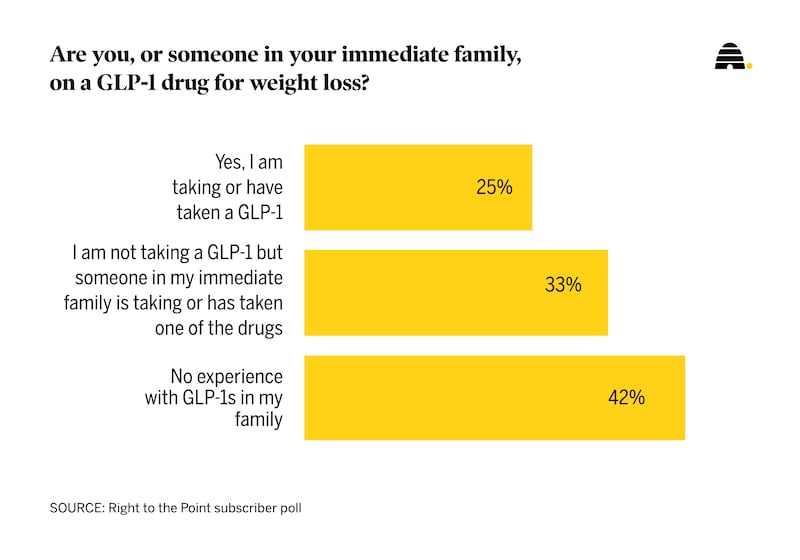
In last week’s Right to the Point poll, we considered the prevalence of GLP-1 drugs used for weight loss, in light of The Washington Post’s reporting on the president’s weight gain. There’s a lot of hype about these drugs, in part from people who have used them. Gallup reported last month that just 15% of Americans report using them. Our respondents came in a bit higher than that.
Finally, I just read two new books by Fox News hosts: Trey Gowdy’s crime novel, “The Sound of Regret,” and Trace Gallagher’s forthcoming “Turns Out They Were Right All Along.”
I loved this observation from Gallagher, the anchor of “Fox News @ Night” — “In the Deep South, it’s good manners to show people you have all the time in the world for them. In the Northeast, it’s good manners to show people you value their time and you’re not going to waste a second of theirs.”
Gallagher comes by this observation by personal experience — he’s lived in almost every region of the country, and part of his advice to people is to move somewhere new: “It’s deeply revealing to see how people in different parts of the country live and work and think, and chances are, the new people will be different from the ones you’re leaving behind.”
Having lived in both regions, I can confirm what Gallagher says about manners in the South and in the Northeast. If you have examples of what constitutes good manners in other parts of the country, please share.