

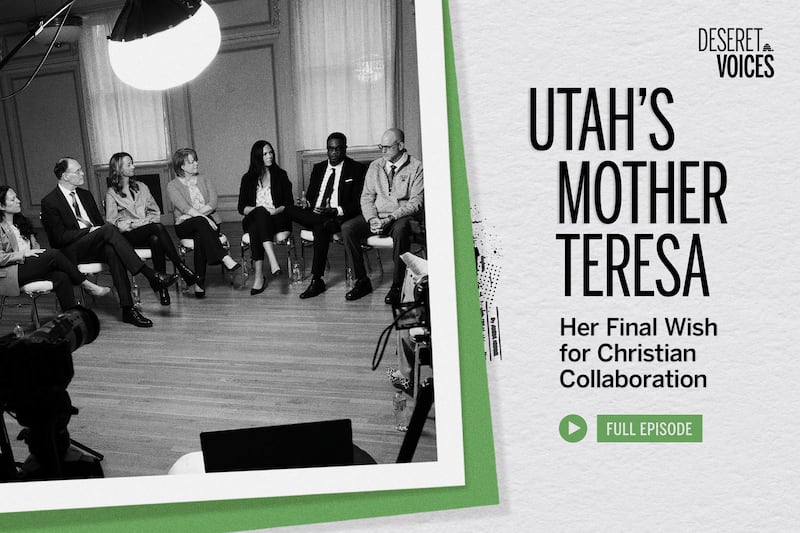


At 93 years old, Pamela Atkinson, Utah’s best-known advocate for the poor, knows it is time to pass on the torch.
Hoping to inspire a plan of action, Atkinson invited a group of community leaders to think about the question posed in the title of Charles Sheldon’s 1896 novel: “In His Steps: What would Jesus do?”
“Deseret Voices” host Jane Clayson Johnson facilitated the roundtable, which included Utah first lady Abby Cox; Sharon Eubank, director of Humanitarian Services for The Church of Jesus Christ of Latter-day Saints; Sophia DiCaro, executive director of the Utah Governor’s Office of Planning and Budget; Michael Edwards, director of youth and young adults for the Catholic Diocese of Salt Lake City; the Rev. Corey Hodges, lead pastor of The Point Church; Bishop W. Christopher Waddell, presiding bishop of The Church of Jesus Christ of Latter-day Saints; and the Rev. Jamie White, lead pastor of First Presbyterian Church in Salt Lake City.
Subscribe to “Deseret Voices” on YouTube, Apple Podcasts or Spotify.
Note: Transcript edited by Steven Watkins.
Jane Clayson Johnson: This is an extraordinary group of diverse faith leaders and policy makers here in Utah. And today, we are gathered at the invitation of one remarkable woman, Pamela Atkinson. Pamela is an iconic figure. For decades, she has devoted her life to advocating for the poor and the disenfranchised, those who are suffering, who are sick. She’s often been referred to in Utah as Utah’s Mother Teresa.
Pamela grew up in poverty in England. She became a nurse and later earned a master’s degree in both sociology and business from the University of Washington. She is known for hands-on, community-level advocacy and for her extensive work for the homeless populations, refugees, and low-income families. She has served as an adviser to three Utah governors, including current Gov. Spencer Cox, and on a variety of state boards, including the State Board of Regents and the State Refugee Advisory Board. She is a woman of deep faith and an elder in her Presbyterian congregation.
Unfortunately, Pamela last night was admitted to the hospital. And so while she was going to be with us today, she is not. She is on Zoom with us in spirit and in the room but not in person. She’s 93 years old and in declining health, but she is determined. At Pamela’s request, we are moving forward with our discussion today and our panel. So the title today of our conversation is “What Would Jesus Do?”
And Sharon Eubank, who’s been working with Pamela very closely on putting this discussion together today, I’ve asked her to just take a couple of minutes and help us understand what the vision is, what Pamela’s vision is for this conversation.
Sharon Eubank: I’m probably like a lot of people here. Pamela texted me and she invited me to come to her house. So I’m sitting in her living room, and she started to tell me a story about her Kindle and that a book that she did not order showed up in her Kindle, and it was this book by Charles Sheldon that was written in 1896, “What Would Jesus Do?” And she said, “If this is in my Kindle, this is something important for me to pay attention to.” So we talked, we had a little conversation about that book.
And then as her health declined, I was really amazed that she would use her last energy to try and gather a group like this. And she told me, you know, she’s been iconic in our community for so long. Every one of us knows her for different parts in our work. And she’s gingered policy makers and she’s gone out with her own hands, she’s spent her own money. And her final question, I think, to our community, to all of us as leaders, is “What would Jesus do?” That book was written more than a hundred years ago and, you know, not everything in it lands in 2026, but the question does: What would Jesus do?
And so when I went to see her this morning, she said, “Look, I don’t care what you all talk about. You have to act.” So she said, “You have a good discussion, but you come up with something to act on.” And so that’s really our purpose today.
JCJ: I’d like to start with each of you introducing yourself. Your name and your affiliation and why you accepted the invitation from Pamela to be here. Michael, I’ll start with you.
Michael Edwards: Sure, thank you. I’m Michael Edwards. I’m the director of youth and young adults for the Diocese of Salt Lake City. Pamela gave me a call also. I work with her on the UCAP board, Utah Coalition Against Pornography. And when Pamela asks, you just do. She called me over and again she told me about the Kindle and she calls them nudges, holy nudges, and I told her it’s a God-cidence, not a coincidence. So she asked and I’m here.
JCJ: Thank you. Pastor Corey.
The Rev. Corey Hodges: Yes, I’m Pastor Corey Hodges, the lead pastor of The Point Church for the last 29 years and just like he said, Pamela calls, you don’t say no. She’s been an advocate for humanitarianism here in Utah, just a wonderful lady of faith, and the subject matter is relevant today and I just wanted — I’m honored to be a part of this panel and this discussion and to help Pamela do one more thing good for our community.
JCJ: Pastor Jamie White.
The Rev. Jamie White: Yeah, my name is Jamie White. I’m the pastor at First Presbyterian Church here in Salt Lake City and very blessed to be Pamela’s pastor. I accepted this invitation because I know the heart behind it is to make the world a little softer, kinder place for people that are often not shown kindness. That’s what Pamela has done and so her sweet sauce is getting lots of people in the same room around the same table so change can happen. And so anytime I’m invited to a table that Pamela sets, I’ll be there.
JCJ: Sharon.
SE: My name is Sharon Eubank. I’m the humanitarian director for The Church of Jesus Christ of Latter-day Saints and I’ve had dealings with Pamela throughout my 28-year career. She’s been such a great advocate in Utah. But you cannot say no to Pamela and of course I’m here.
JCJ: Abby Cox.
Abby Cox: My name is Abby Cox. I am the first lady of Utah and have known Pamela for many, many years and of course, yes, I would say yes to Pamela. I would follow her anywhere. To me, this is an opportunity for us to take a step back and reflect on, first of all, what we’re being asked by Pamela but also what she’s been doing and leading out on for so many years. Again, I would follow her anywhere. I’ve read a lot about Mother Teresa and the comparison is apt.
JCJ: Thank you. Bishop Waddell.

Bishop Christopher Waddell: Thank you. I’m Bishop Christopher Waddell. I’m the presiding bishop of The Church of Jesus Christ of Latter-day Saints and I met Pamela for the first time when moving to Utah about 10, 11 years ago and I had heard about Pamela Atkinson and the description didn’t do justice to her. A remarkable woman of faith as we’ve heard. Again, as everyone has said, you don’t say no to Pamela. And so it was an honor to be invited to participate in this group. I love the concept of collaboration, of working with others of faith and different backgrounds to work together to solve some of the challenges that we face.
JCJ: Sophia.
Sophia DiCaro: I’m Sophia DiCaro. I’m currently serving as the executive director of the Governor’s Office of Planning and Budget, also a former lawmaker and had the privilege of working with Pamela on a lot of policy issues, funding issues, and she’s done incredible work and a lot of what you see in government, you can see her legacy carrying forward a lot of great things. And so when she reached out, totally unexpected, but again, you don’t say no to Pamela and, honestly, this is just such a privilege to share this time with all of you and to help carry Pamela’s wishes forward.
JCJ: Well, thank you all. Here’s the book that she has asked us all to read. I’ll start by asking you your thoughts, your impressions about the message of the book, the premise of the book. What did you think?
ME: It’s valid today. You know, “What would Jesus do?” I was talking with the bishop earlier, you know, it reminded me of about 15 years ago with the yellow wristbands, “What would Jesus do?” and that’s a hundred years after the book was made, but I think even more important, I think it goes to the core of what we’re about and that’s, you know, corporal works of mercy, taking care of the poor and the needy and being the person that Jesus would want us to be not only in our thoughts but also in our action.
The Rev. Hodges: And for me, the question to me is so relevant, right? A hundred-year-old book that was — became re-popularized by a youth director, basically, in Michigan. It was a young generation that wanted to put their faith into action and I think about the question, what impressed me about the book and the question, it’s a simple question but it’s not a safe one. It will cause you to have to go out of your comfort zone to maybe be misunderstood. So the question is relevant today and what impressed me about the book is how that relevancy still stands 100 years later.
JCJ: And people who are committed to not making any decision without asking that basic question: what would Jesus do?
The Rev. White: Which is why we needed bracelets 20 years ago. We needed to tattoo it on our foreheads because it’s a pressing question but I don’t know if very many people live with sort of a Christ-consciousness that compels them to ask that before they act. I think a lot of people spend maybe too much time worrying about a checklist of beliefs they can mentally assent to but this question pushes you right to the practical. If Christ were here in my shoes, what might he do?
ME: And the levels of society it weaves through, right? It’s not just affecting one person. It just ripples out to everywhere.
JCJ: Bishop Waddell.
Bishop Waddell: I thought it was interesting, it wasn’t just focused exclusively on those that were poor and needy. I mean, the focus was across the board and it’s what you can do whatever your — not just with money, but with your talents. And so it’s a question that has relevance at whatever circumstances we’re in and it applies today as much as it did in 1896.
JCJ: What are you seeing in your congregations, among your friends and colleagues, that are good examples of doing what Jesus would do? What’s the practical application of that that you’re seeing today?
SE: The book talked a lot about people taking a pledge, a pledge that they would act the way Jesus does and then it shows how that affected their lives and it was not always comfortable, what happened to them. But that idea goes back to the invitation that Jesus gave: “If you love me,” you know, “you’ll love each other” and “by this, by love, shall everybody know that you’re my disciples.” And so when I look around in Utah, in the community that I do, and I see, particularly, youth saying, “I’m going to express my love by the way that I take care of other people. I won’t judge their choices, I will — I will be a force for good in this community.” I think I gain a lot of energy from the examples of youth that I’m seeing in our community.
The Rev. Hodges: You know, lots of times our faith — we have lots of inspiration, right? We feel good about our faith, we feel good about the music that we sing that reinforces our faith. And so when I think about Kearns and our church being there, we can’t just be a big building in the middle of a neighborhood that’s needed and not do anything. One of the stories I remember when we first went to Kearns, one of the problems of Kearns was gang violence and graffiti and all the things. But we’ve been there almost 16 years now, we’ve never had graffiti on our church building, we’ve never had vandalism on our church building.
The elders wanted us to build a fence around it, wanted me to build a fence around it, I was like, “We just cannot do that. We can’t build a fortress.” And so we’ve created programs — a program called “For Kearns” to let the community know that we are for Kearns, we are for you, we’re for Kearns because Christ is for Kearns. So for me, it’s living that out and I call it — we call it at our church — living out loud.
JCJ: Living out loud. I like that.
SD: So something I thought was ironic was the year that the book came out is the year Utah statehood as well. And the theme of service came across very loudly and all the stories that were shared in the book had to do with service — how to give back, how to serve others. And I thought that stood out really nicely in the theme of, you know, Pamela’s work and the work that’s occurring with the state and those who are serving the public.
ME: It’s about stewardship, right? Like time, talent, and treasure. Each one of those people in the book have a different talent, a different time, a different treasure that they can contribute to what would Jesus do.
Bishop Waddell: You know, and Jane, I think one thought in reading the book, I was thinking of Pamela because she’s the one that asked us to read it. And there’s one phrase that I heard over and over again about suffering for Jesus’ sake and I thought, OK, but it might be nice if we even change that to sacrificing for. And so I see a lot of that — of people that will sacrifice, that will sacrifice their time, their energy, their resources to be able to help other people. And that’s something that is evident with Pamela and around this group and the people that we serve with.
AC: What I’ve seen too is that in the book it felt like, you know, they — we’re supposed to be not just hearers of the word but doers, and it’s got to hurt. Sometimes it’s got to hurt to — Christianity is a sacrifice, Christianity to follow Christ really does ask something of us. We can’t just be hearers only, we have to be doers. And like everyone here, in my community, I can look and see, you know, just really beautiful examples throughout our state. We see people that are doers and are using that Christianity to compel them to do something really hard. It’s easy to sit in the pews and just, like you say, feel good and listen to the music and feel the spirit, but it’s much harder to be the doer of the word and Christianity and Christ and the Savior is asking us to do what he would do and that’s what we see around us.
JCJ: I love that. And let me talk about the collaboration that is required and really necessary to do something great together. Because I think conventional wisdom often says that different faith groups compete more than they collaborate, right? So what is one thing that makes it more likely or even possible that our faith communities get to know each other and work together on some of these important issues?
ME: I think there’s a really good example with the partnership between the LDS Church and Catholic Community Services. I think that’s an amazing example of refugee help, helping for the poor, legal services, you know, all of that couldn’t be possible without the partnership that we have with the LDS Church. It’s an amazing partnership.
The Rev. Hodges: For me, this is one of Pamela’s sweet spots. I was 27 years old when I moved to Salt Lake City from Florida, met Pamela, and she just has this amazing ability to bring people together around the table. Why would she be interested in a small church in Taylorsville, now Kearns, a young guy from Florida? But I watched her through the years bring people together regardless of their faith tradition.
So this is — I get excited about this question because collaboration is so important. Because in this society, particularly in the climate we’re in now, we have so many things that divide us and sort us all in different spaces and different corners of a room. And we can be so competitive, right? And I think this book teaches us that we’ve got to put aside competition and move further toward collaboration. We don’t have to agree on every theological idea or every theological concept to do something good for common humanity. We all love our families, we all want to see our children prosper and do well, we all want to live in safe communities, and we all want to worship the way we want to worship. And I think there are things that we can rally around and collaborate, and I think it’s so important to human development, community, trust, and just quality of life in general.
JCJ: Yes. I remember interviewing Pamela 30 years ago when I worked at KSL. And I just always remember her reaching out. She was always putting her arm around somebody that she didn’t know that she wanted to bring into the circle. And as I listen to you all and I think, well, what about the people that don’t have a Pamela Atkinson in their community? What are the barriers for them and how do we overcome them? Pastor, what do you think?
The Rev. White: You know, your question immediately made me think of in the last few years with all that’s happened in the Middle East in the Holy Land, Israel-Palestine and Gaza. I’ve seen some of the breakdown in the religious partnerships that have been built over many years here between our Jewish friends and our Muslim friends and our Christian friends who kind of find themselves on one side of the political spectrum or the other.
But what’s been really beautiful about some of the pain and breakdown has been to see the faith leaders that have had longstanding friendships with these colleagues, these interfaith relationships — they’ve said, “That really hurt me and I need to understand why you framed your comments that way” or “I saw that you were posting or protesting for this, have you considered my community and how it’s been impacted by that?” And so it’s not easy. We’re back to like this is a complicated reality. When the rubber meets the road, when you start asking yourself what would Jesus do, what would God command me to do, you know, sometimes that plays out in our life and our faith community differently and we step on each other’s toes. We offend each other without meaning to. And being able to say “I’m sorry” or “Ouch, that hurt, but I’d like to stay in community with you and so can we have this conversation?” It’s been work.
JCJ: What you’ve seen — collaboration, I’m sure, Sharon, in different parts of the world even, where it works and where it doesn’t. What’s the trick? Why does it work?
SE: When the rubber hits the road and it is uncomfortable, the relationships that we built a long time ago are the key to that. I think that is the trick is the — so that you can have that vulnerable discussion. And then there’s nothing to me more powerful, in my own faith or anybody else’s, if one faith stands up for another faith. And to be able to say, “Look, when one of us hurts, all of us hurt.” And that cements those relationships for a long time. It shows that they’re sincere.
And this is a faraway example and then I think we can have another example: there was a lot of destruction in northern Iraq from the last war 10 years ago and they asked the Muslim community to help rebuild the Catholic church and the Christian community to help rebuild the mosque. And the construction and the ways that they worked on each other’s buildings was a really powerful symbol to me. What could I do like that that I could work with my friends in my own community of different faiths to show my respect for their places of worship, for my respect for their beliefs, and I think as you said, that is the real trick.
Bishop Waddell: Yeah, I love the things that are being said and it seems to me that the collaboration, the cooperation between different faiths, different backgrounds is better today than it was a number of years ago. It seemed like in the past, it was really — it’s the Mormons and the Catholics and the Mormons and the Baptists and the Mormons and — but today, I think we all recognize that we have more in common than we have that separates us.
JCJ: So what changed? What made that different?
Bishop Waddell: Well, what changed? I think part of it is people getting to know one another. I think communication, before you couldn’t talk to each other and now there is that talk that goes on. Pamela and what she’s done here has made a big difference in that, bringing people together and everyone recognizing that we have a lot in common. There are needs that affect all these groups and not just one group or another and by working together, we’re able to solve things that we couldn’t solve on our own.
ME: It goes back to the dignity of the human person, I think. We’re all human, we all have dignity in the eyes of God, and I think that if we can recognize that, and we do, and I think that’s one of the changes.

The Rev. Hodges: I think communication has helped, just a practical reason, like being able to learn more. A lot of our fears are ignorance. If I don’t know about Mormonism, if I don’t know about Southern Baptist or if I don’t know about Islam, then there’s a fear that develops and grows and we react out of protection, right? You know, if I’m right, then the other guy must be wrong. And I think with more information, being able to read, being able to research — I mean, that’s always been happening, I’m just saying it’s much quicker now with the technology that we have. And so I think more information faster is also helping that collaboration happen because we’re learning more about people of other faiths.
ME: Ignorance is not bliss, ignorance is ignorance.
The Rev. Hodges: Exactly.
JCJ: But how does that trickle down, you know, from the reverend, from the pastor, from the bishop, from the level in these congregations, you know, these neighborhood groups that are joining together, wondering how they can move forward?
The Rev. White: I think shared projects. I mean, I sort of wonder — the timeline for me having been in Salt Lake for almost 30 years and not from here, I can see the shift. And I sort of wonder if it was around the first time we hosted the Olympics. We had a shared project to focus on that required us to be around a table and then you just make friends, right? That’s just what happens when you share space and meals with folks and then work towards something that’s good for your state. And so we did that really well and it trickles down by the way we speak about our brothers and sisters in Christ, wherever they come from, whatever God they believe in. It’s my responsibility to speak well of people I disagree with but respect their dignity. And it’s my job to speak up in my congregation when people are not doing that. That’s part of the role and I have to do that.
I’ve had to do that quite a bit in the last couple years with all the political divide — holding the tension and staying right in the middle and knowing that if I’m taking flack from both sides, actually I’m probably right where I am supposed to be. That’s important. We are not allowed to speak ill of each other.
JCJ: That’s what a good leader does, right?
The Rev. White: That’s right.
The Rev. Hodges: Really quick, what Jamie’s saying — as two pastors here — the one word that keeps coming to mind in this conversation, this particular one, is intentionality, right? You can’t just sit back and expect because you have a position as pastor or because you’re a bishop that these things are going to be organic and natural. They should be, obviously, right? But every day I have to — we have to ask ourselves: what can I intentionally do to become friends with a Presbyterian and I’m Baptist or with a Mormon and I’m Baptist? And so these opportunities don’t fall in our laps, unfortunately, all the time. We have to be intentional.
SD: So what’s great about all of this too is Utah is a big small town and that makes all of this possible and I do think we’re uniquely positioned to do more of this and collaborate really well with one another and make magic happen because we are a big small town.
AC: To Jamie’s point about seeing these divides and these differences and these — you talk about these political things that are sort of creeping into each one of our congregations and our churches. We need to also be very intentional about making sure that those politics don’t affect the way we believe and the way we think about other people. And it’s really, again, a very intentional thing that we have to start to think about throughout the country and the world, probably. There is this sort of where — where the politics is becoming people’s religion. And that can be very dangerous as we’re talking about seeing one another as Christ would see each other. That is very dangerous when we’re allowing politics to sort of guide how we think about other people.
And so to me, it’s really important as faith leaders that we see here, you really do have to make sure that Christ or, you know, whatever affiliation you have, God, is at the center of what you’re doing. What would Jesus do in my congregation? How would I treat somebody that believes something completely differently politically than I do? That is, again, very difficult when you have very strong political beliefs. It’s really important for all of us to think about getting the politics out but also thinking about how we look at each other when we are thinking about political things.
ME: It takes intentionality, I think, in our own congregations too, like you just said and like Jamie said. You know, we all have youth programs, we all have young adult programs and what are we feeding them? How are we feeding them what Christ would do, you know, what would Jesus do, as we teach them and guide them and mentor them and bring them along in their faith traditions?
SE: I think one of my favorite phrases in the book — in the middle of the book, it talked about a tide of fellowship, that it would just, you know, flood the community with this fellowship. And, you know, one of our state mottos is to try and disagree better, that’s one of the governor’s things, and our president has talked about peacemaking, but what — what is the practical, what do you do with your hands? I think it’s shared projects. I think it’s that tide of fellowship that we work on something in common together and I think that’s what Pamela’s asking us to do is we’re going to chat and we’re going to have a great discussion here but then afterward what would we do to create that tide of fellowship?
JCJ: What do we need to be mindful of and what have you learned to successfully navigate the minefields when faith communities and governments try to work together?
AC: I’m in a really unique position because I’m not a policymaker. I’m very government-adjacent, for sure, and have connections and can network with all the policymakers. And through that, I’ve actually had this unique experience to craft some programs and policies with my faith community and with other faith communities — I’ve been working on child welfare where we’re using congregations to create care communities around our foster families. And it’s been beautiful to watch and see people rally around. Again, that’s just on the individual level.
I’m sort of quasi-government — I don’t think I’m government — but I’m also going to policymakers and saying, “This is a great thing to get behind.” Because now you’re seeing faith communities working together to support foster families, which is something the state needs. Government needs that — that’s their responsibility, foster families are their responsibility, foster children are their responsibility. So, if we can get behind that — so I go to policymakers, I can get buy-in from them, and then I can use the faith communities to volunteer and make it all happen. So, that to me is a great example of what I’ve seen of these communities working together with government and making something really powerful happen in our community.
The Rev. Hodges: I agree with what our first lady is saying because government gives us systems, right? And we need that, but faith gives us meaning or motivation, right? And we need those two things to come together. You know, when you think about organizations like the Red Cross, right, and how the Red Cross started, it was not government, right? It was communities that — that community came together to provide aid to soldiers on both sides of the battle. I don’t think it’s the government’s responsibility, right, to institute charity or things like that. But the government can provide a system through which our faith can be channeled.
JCJ: Yes. And Pamela was so effective at doing that, wasn’t she?
The Rev. Hodges: And nobody did that better than Pamela Atkinson. I mean, she did that so well.
The Rev. White: But what made her so successful — she was also highly sensitive to the reality that what would be an acceptable answer for her as a person of Christ might not be an acceptable answer for someone else. I was thinking about this as I was reading the book: someone from the Salt Lake Trib reached out and wanted just a soundbite, my thoughts on the legislation around making Good Friday a state holiday. You know, it was interesting. I was like, well, that’s ideal for me as a person who celebrates Good Friday and loves it, but are we also going to make Passover a state holiday and Ramadan a state holiday? Because the what would Jesus do in this moment question is, would Jesus want to run roughshod over people of different faiths? I’m not sure. I can’t answer that with confidence even though of course, as a person that has strong commitment to celebrating Holy Week, I would love Good Friday to be a state holiday.
But my faith in Christ demands that I ask the other question: what would Jesus do if he was me in Salt Lake City in 2026 when I am taking intentional steps to make room for people of other faiths? And I couldn’t say we should make this a state holiday, right? Like, so this gets complicated very quickly.
AC: Well, government has to have a specific role and it cannot — I mean, we — my husband talks a lot about the Alexis de Tocqueville when he came here and looked around and said it was so different from France, it was so different from Europe because what we have — these associations that were largely faith-based associations that were taking care of the poor, that were doing all these things in the community to build up a community.
If we wanted a community center built, the association built that, it wasn’t government. And when we lose those associations and those really powerful faith communities, then the — it does fall on government and they’re not good at it. Government’s not good at it. They’re sort of a, you know, they’re sort of a sledgehammer when we need a scalpel. But in connection with the faith communities, they can be a powerful and effective tool and partner, but it cannot be — we have to step up as a faith community and nonprofit community to be able to fill in those gaps.
JCJ: It’s a partnership. Bishop Waddell, do you have anything —
Bishop Waddell: It’s recognizing that government has a role and that their role does not necessarily include what faith communities are able to do. And faith communities play a role, and we shouldn’t expect the government to do what faith communities can do. We were talking with Michael just about athletics and sports and things like that. You have different players on a team; they have different responsibilities. But it’s when everyone comes together and uses their talents and abilities that you have success.
JCJ: Sharon?
SE: I’m trying to think as we have this conversation, what are the levers? What are the practical things that we can use in the community? I can think of volunteerism — you can use a platform like JustServe, we could post projects that we could all share. I think we have holidays that we could come together on, in a Christian tradition or another tradition. I think about music — a friend of ours from the Calvary Baptist Church came and taught us one of the Baptist hymns. It was such a joyful experience to share that music with someone else. I’m trying to think: are there other levers that we could pull to bring us together in some way?
JCJ: Are there other ideas?
The Rev. Hodges: As church leaders, I think part of our responsibility is to create systems where our faith walks can be repeatable. Because like she’s saying, it’s so overwhelming as an individual, as a pastor, I’m sure Jamie can relate. Like “Man, how do I help everybody? How can we help everyone?” And so, we have to create those systems where when someone is moved by the prompting of the Holy Spirit, right, that there’s something there for them. When I wake up in the morning, you don’t feel like this every day, let’s just be honest. You want to, but you don’t feel like you want to go conquer the world every single day.
But when I do, if I wake up tomorrow and I say, “You know, I want to help the homeless down in Salt Lake today,” hopefully, us faith leaders, we would have created systems where someone can easily plug into. So, if I’m a member of The Point Church and I want to help the homeless, I should be able to wake up that morning and call my pastor or call my church leader and say, “Hey, how can I help the homeless today?” And there should be some sort of system in place where I can go and live out my faith — live out loud.
The Rev. Jamie White: The scope of human need out there is pretty overwhelming for my congregants. And I think it’s felt paralyzing for people, like “What do I do? How do I live like Jesus in my reality?” They can’t scroll through Instagram for five minutes without seeing 14 different causes they can literally support or go travel to, or whatever it is. And I often have people just stuck. Like “Now what? Just tell me what to do.” And I’m like, “One, we believe the Holy Spirit speaks to us and will guide you — that’s part of asking this question individually for ourselves.” But two, I think the evaluation of what is ours to do in this moment becomes really, really important. Because as we all know very well, it’s little acts done consistently, it’s faithfulness, it’s building partnerships that can stand the test of time and the conflict, so that good can be done.
If I try and do everything, I’m going to be burnt out real quick, out of resources, and probably bitter and resentful — because that’s what happens when you face burnout in caregiving. But if I focus on the thing that God has called me to do and do well, then I just keep supporting that thing. It’s been this hammer, I feel like I’ve had to nail constantly for my congregation: What is God calling you to do? What is ours to do in our community here at First Presb, because we’re not going to be able to do everything. And then the practicalities of what do we do with that call now. Now that we’ve figured out this is our thing.
For us, we’re right downtown, so homelessness is high on the list of what matters to us. In the name of Pamela, we have two benevolence closets: one for children and one for adults. And it is imperative for my congregation to care for those facing housing insecurity and food insecurity. So, do our congregants care about all sorts of other issues? Absolutely. But we care about our downtown neighbors that need immediate, like, felt support. And so, we can get lost on other things, but we just keep coming back around Pamela’s closets — we keep coming back around food insecurity and it’s given us sort of a lane to stay in. But I think that’s freeing sort of in many ways, too.
JCJ: I love that. Bishop, systems where faith walks can be repeatable. What does that mean in your church?

Bishop Waddell: I think it goes back to actually what Pastor Jamie was saying: we can’t be all things to all people. And you have to understand what you can do and do it well, and then you collaborate together because someone else will do something better than you can do it. And so, if you can do what you do well and repeat that, you’re going to see results from it. And then as we collaborate, then we expand that and we’re doing more things well and working together.
AC: What I see too as I go out throughout the community — I am a lot with youth and kids are feeling — I mean, we’re not wired as humans to carry all this heaviness in the world. When, you know, when we were kids probably, we didn’t wake up and see the world’s troubles right in our face every second. It is really damaging and we as adults are feeling it, but we’re more — we have more capacity to handle that than our young people because they are seeing that and feeling the heaviness. I see this in my own children. They are seeing every heaviness.
What we need to teach our children, I think, as leaders, is that you are not capable — you — there’s only one person that I know of that’s capable of carrying all that and that’s Jesus. The rest of us are human, the rest of us cannot carry all that. So I love the idea of telling not only our adult congregants but especially our youth that you do not have to carry everybody’s burden. What you have to do is think: today, how can I lighten somebody else’s burdens today? Can I smile, can I help somebody? That’s where I feel like we can be powerful.
JCJ: And Michael, you see that working with youth all the time.
ME: Oh, for sure, yeah. And having good examples for them too, I think, is very, very important. And we need to be able to — as faith leaders, as adults — to be that example for our kids in our own homes and then also in our congregations too. If we’re not living it out, then it’s kind of a moot point.
JCJ: So I want to get to the specific action items because Pamela is all about doing as we’ve said and I’m hearing a lot of great ideas here. But in effort to produce concrete ideas and commitment to action today, how does your own faith in Jesus Christ inform what happens next? What are you going to do tomorrow or next week within your congregations to further this vision? What do you think?
Bishop Waddell: It begins with a discussion — to sit down with those that we serve with in our particular communities and congregations and have that discussion. I don’t think any of us — at least I know I don’t have all the right ideas — but you’re surrounded with people that have different ideas. So even within our own community, we can gather thoughts and ideas that we can then collaborate with. Sharon mentioned JustServe, that’s an opportunity for all of us to really look at a little bit more effectively and see what can we do, what can we collaborate with? But it begins with a discussion and then from discussion it goes to practice and action.
SE: We didn’t really know each other, all of us here today, and we’ve had a really great experience and I’m wondering can I replicate this in my own congregation? Could I invite, you know, other people of faith around where we live and could we have this same discussion and commit to some actions as well?
JCJ: And how do I do that?
SE: Well, I’m going to go back and just start it.
JCJ: I’m going to call, you know, the Pastor Corey and the Pastor Jamie in your local community.
The Rev. Hodges: And I agree with Sharon. Yeah, I think, you know, one step at a time, you know. Maybe Jamie and I can get together and we can do one in Salt Lake City proper and then one in Kearns, have a discussion. So I think those ideas can bring fruit for sure.
ME: Within our own faith communities, we have our own areas in which we have influence over. And I think we need to leverage our influence that we have within our own communities. If we have a directors’ meeting once a month, you know, are we really talking about these issues at our directors’ meeting that cover things from health and marriage and family and are we really doing a good job of us leading that way and making sure that these tough discussions are being held at that level also?
JCJ: And that’s really about creating trust, right? It’s those trust bonds too that I’m hearing need to be strengthened.
The Rev. White: I think we work also — I mean, we can create lots of new wheels, but a lot of them already exist. And so part of it is showing up to the places we’re already involved and called to. Love for God and love for God’s beloved children has to be my motivator because otherwise I’m going to get really exhausted doing this work.
I read a lot of Greg Boyle and he often talks about how easy it is to find yourself in burnout — and I see this in my people — if you start thinking you’ve got to go out and change the world versus your job is to just go out and love people like Jesus has loved you. And it actually’s not that hard. It sounds very fuzzy and mushy to talk that way, but actually just meeting people in their grief, showing up with sandwiches downtown. I often remind our teenagers, “OK, here’s $20, go buy a loaf of bread and some lunch meat and go make some sandwiches. If you go downtown, there will be people that are hungry.” They’re like, “I can just do that?” “You can just do that.” You can just do that.
JCJ: Right, sometimes it’s really simple. It’s not that complicated.
ME: And there are systems like we’ve already mentioned — Catholic Community Services and all those services that we already have. Are we really tapping into those? Are we really as a faith community, as different faith leaders, are we assisting in those systems that we already have in the LDS Church and in the Baptist church, the Presbyterian church and are we really tapping into those systems that we already have without having to make new systems?
SE: One of the saddest things I think that happens is we duplicate each other’s efforts and we don’t coordinate and so it wastes the energy that people are giving and as I listen to this discussion, I think, boy, I could map this a little bit better of who is helping with Kearns Elementary and if I wanted to do that, could I work with you instead? And the state programs and the AC’s initiative — all of those things. If I’m aware of those things, then I can put my energy to somebody who’s already got the ball.
SD: Government certainly can’t serve everybody and all of the needs. In the budget office, we have tons of demands that we cannot meet because we’re capped for resources. Government can’t do it all but this is where we all have to work together and to remind each other that we are government — we created it to fill the gaps that can’t be met otherwise. How do we make sure everyone’s providing the input that’s needed and how do we encourage everyone to get involved? It’s very, very easy to get involved.
ME: I think one other thing that might be pretty tangible is that how many of our own systems don’t include members of other faith groups on them, like boards of directors for other organizations? Do we have a member of the Baptist Church on a council within our own faith group that has different needs that maybe we don’t know but we don’t include them?

The Rev. White: Honestly, that’s probably our most important role and it’s what Pamela has done so well is she grabs someone that’s a new pastor in town by the hand and says, “Come with me, I’d like you to serve on this board.” She just says, “Can I have your phone number?” It’s forced friendship that has like meant a great deal of good in our world. And exactly, it actually literally has changed the state. It’s changed people’s lives. And I do think, like, that spirit of friendship, knowing that we don’t all have to agree and we can still love each other like Jesus has loved us and you just got to grab people by the hand.
AC: I think in the state of Utah we are so unique and so blessed because we have a population that wants to serve, that is — I mean, we’re No. 1 for volunteering, we’re No. 1 for charitable giving. So harnessing all that, making sure — I love to connect people that want to serve with nonprofits that need volunteers and so I love to be able to sort of matchmake in that way because we have this beautiful community that is ready and willing to serve.
JCJ: Pamela said that bringing this group together might be, in her words, her final God-given assignment. So maybe we could just go around here as we’re finishing — your vision, your hope for what is possible in Pamela’s memory and in her honor. Sophia.
SD: One thing that I’ve always respected with Pamela is and — I’m sorry, I don’t mean to get emotional, but the way she looks out for the vulnerable and the way she makes everybody feel mattered is just incredible. It’s an incredible legacy and I just think that, you know, if we can take some small thing away, it’s to lean into that vulnerability and I think that’s what makes us most effective when we can look out for the vulnerable and do what we can in our spheres to make sure that they’re not being forgotten, that everybody matters.
JCJ: Bishop Waddell.
Bishop Waddell: A thought comes to my mind just goes back to the book that she asked us to read. If we all really could ask ourselves the question, “What would Jesus do?” on a regular basis, that would honor her legacy as well as honoring the Savior. The other thing, I think gathering this kind of a group together, if there is some way we can actually — I don’t want to say institutionalize it — but if there’s some way — she was able to bring people together and it made a difference. You were saying it changed the state. Well, if it worked then, why wouldn’t it work going forward? And so I would love it if there was some way that we could all communicate, whether it’s us specifically or people from organizations, to make sure this kind of discussion occurred on a regular basis. It would be wonderful to continue with something like this going forward.
JCJ: Abby.
AC: I’ll go back to kind of where I started. One of my favorite books besides the one we just read — which is really wonderful — is “Come Be My Light.” It took Mother Teresa’s writings to her spiritual leaders and she had this experience on a train where she got her call and then really felt abandoned by God, by the spirit, for a long time. And I think about Pamela and her journey and our Mother Teresa here and her journey from England from poverty to bless the state of Utah with her spirit, with her gifts. So I think if the state of Utah could be more like Pamela, we will be more like Jesus and we will follow in his steps.
JCJ: Sharon.
SE: The first time I met Pamela, she had called into our offices and said, “Look, we don’t have enough steaks for Christmas dinner down at St. Vincent de Paul and can you help?” And so we got organized to help. And I’ve been down lots of times to see people eating at a table that Pamela set.
And when I was with her last night in the hospital, we were talking about the parable in the New Testament where the wedding feast is laid out and everybody’s been invited and then people have excuses, they don’t come. And then the master of the feast says, “Bring everybody to this table.” And there are people who will still have an excuse, but there are other people who will feel that it’s meant for them and that they’ll come. And I think my commitment, when we have a text group that we communicated the details of it and I called it “Pamela’s Table,” and I’m going to keep that, we’re going to stay bonded in this and we’re going to communicate in that way. But I think the invitation that I’m taking away from this and I hope everybody will is: let’s invite other people to this table. Let’s go out into the hedgerows and bring other people to this table because I think there’s a lot of power that is still untapped.
JCJ: Pastor.
The Rev. White: I think Pamela is uniquely gifted to — treats everybody the same. So I’ve seen her serving coffee under an overpass in the morning and in black tie at a fundraising event at night. Yeah, she says, “I don’t mean to be rude or disrespectful, but I forget people’s titles. I don’t care. I call Spencer Spencer and then I try and remember in public to call him Gov. Cox every single time because I respect him.” And she says, “But I have the same love and affection for him that I do for my dear homeless friends that I hold their hands while they die.”
And that is a particular kind of devotion to Jesus that I feel like not only compelled by personally but to duplicate in the life of our congregation. The other thing I would say that for me that I’ve been doing for 20 years because of Pamela Atkinson is keeping socks and water bottles and small bags of dog and cat food in my car because I can always pull off the side of the road and give it out. And that sounds so small compared to what she has done to be a mover and a shaker around some pretty important moves and legislation. But probably like cat food is a great place to start. Honestly, I mean, it’s the cat food that made her compelling around government tables and they cannot be separated from one another. So the legacy is holding those together for me in her name.
JCJ: Pastor.
The Rev. Hodges: I’m overwhelmed with joy and grief, right? To reread this book in her honor, to have this discussion and to answer that question, “What would Jesus do?” I think at the end of that process and that emotion trying to answer that question is that if you’re not moving toward people, then you’re not doing what Jesus would do. And Pamela always seemed to be moving toward people. And I’m going to do my best to carry on her legacy and her values. Like Paul said, “Follow me as I follow Christ.” I think you can easily say Pamela followed Christ. And so anyone that followed Pamela would be safe, would be on safe ground.
ME: One thing that I think Pamela did that I think we can all model is say yes. We have to say yes. We have to say yes to what God is asking us to do, to what Christ would do. But I think also the same time, Pamela reminds me so much of Sister Cabrini, Mother Cabrini — so many obstacles and she didn’t care. She didn’t care what the obstacle was, she was going to find her way around it, she was going to find somebody to help out, she was going to step into the — she was going to step into the fire, she was going to lead and not follow. And I think that’s what we need to do — we need to say yes, you need to say yes to Christ and we need to say yes to the things that Pamela had said yes to in order to make sure that her legacy lives on the way it’s supposed to live on.
JCJ: Thank you, all of you. This is a wonderful model that I hope is replicated in communities around our country as people listen in and hear what you have had to say. Thank you.