

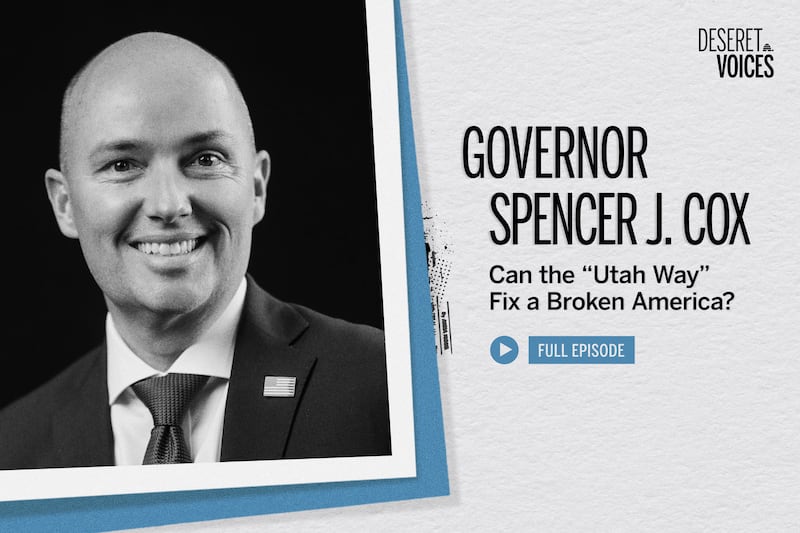


In the wake of the assassination of political commentator Charlie Kirk on Sept. 10, 2025, Utah Gov. Spencer Cox felt like he had to get the message out about the pattern of “contempt” he was seeing in a polarized nation.
His upcoming book, “Off Ramp: How to Be a Peacemaker in an Age of Contempt,” builds on his “Disagree Better” campaign to improve political dialogue.
On this episode of “Deseret Voices,” Cox talks with host McKay Coppins about the “grand idea” that Americans are still enjoying 250 years later and how “Utah’s values used to be America’s values.”
Subscribe to “Deseret Voices” on YouTube, Apple Podcasts or Spotify.
Note: Transcript edited by Steven Watkins.
Gov. Spencer Cox: Oh, we got them to clap twice for us.
McKay Coppins: Gov. Cox holds until the applause is to his satisfaction.
SC: We had mic issues, so he was doing like a wardrobe change. He’s kind of a diva back there.
MC: That is true. That’s what I’m known for. Gov. Cox, thank you for doing this. I appreciate it.
SC: Thanks for having me.
MC: We’ve been talking on and off for a long time. I think we first met when you were lieutenant governor, and I was pleased to learn recently that you were writing a book. Because that means that you’re planning to run for president. Because that’s the only reason politicians write books, as you know. So when do you plan to announce?
SC: So, well, first of all, let me just say this. It’s really cool to be here on stage with McKay Coppins, a professional. I say this to people all the time, that McKay truly is my favorite degenerate gambler in America. And I feel so lucky to be here with you. So no, I’m obviously not running for president.
And I probably shouldn’t give this away because they say that with a good book — and you’ve written some — that the beginning and the ending are the most important parts. But literally, the first line of the book is, “I’m not running for president.” That’s how we started things. So no, I’m not.
MC: I will take your word for it, but if I see a stop on the book tour in New Hampshire, I am going to be really upset with you.
SC: No, no, no, no. Sorry. We’re just going to Iowa.
MC: Strictly Iowa. Just Iowa and South Carolina. Low key. Yeah, OK. The book is called “Off Ramp: How to Be a Peacemaker in an Age of Contempt.” And we’re not going to talk about the book yet, because it hasn’t come out.
I did get an early copy, which you were very gracious to share with me. But we’re not going to spoil anything, except that you’re right. The first sentence was that you’re not running for president, which I 50% believe.
Can you talk about why you wrote this book? Specifically, the only word in that title and subtitle that I think might stand out to people and seem out of place is “contempt.”
What is it about this era, this moment that made you feel like you had to write a book about depolarization, deradicalization?
SC: So this is something I’ve cared about for a long time. When I became lieutenant governor in 2014, I wrote an article for the University of Utah. And it was about polarization and what was happening in our country and how dangerous I thought it was.
And I look back on 2014 with just tears in my eyes. It was the best of times. Who knew? I thought it couldn’t get much worse than 2014. Turns out I was wrong.
I’m wrong about things on occasion, and we’ll probably talk more about that today. But I cared about it then, and it did get progressively worse. And we saw political violence happening across the country. Certainly there were some pretty high-profile shootings and attempted assassinations.
And it concerned me so much, and not just that, but the decline of our institutions and what was happening with polarization in a way that this word “contempt” is the one that keeps going because it’s different than disagreement. It’s actually different than hate.
Honestly, and again, I know we’re kind of parsing words a little bit, but if you hate someone, there’s something visceral where you’re engaging. Contempt is where you think so little of a person that you don’t even feel like hating them because you just look down on them, you “other” them. I think that’s probably the most dangerous. I would rather have two people yelling at each other than two people pretending that the other doesn’t exist or doesn’t matter.

And so I launched this initiative with the National Governors Association. I felt so strongly about it. And I recorded an ad with my opponent when I was running in 2020. So I had already started to write and I had written quite a bit. And then there was this moment last year in September where there was an assassination of Charlie Kirk here in my state. And that’s when I just felt like I needed to get it out there. For nobody else, for me and my family, hopefully for the people of the state of Utah, and if anybody else is interested, I hope they’ll look at it.
MC: I was thinking as I was leaving the airport this morning that the school year that began with the assassination at UVU just came to an end. And I can’t imagine what those students are going through, how they processed it all. But I was thinking about the state and what it’s been through since then. Do you think things are better now than they were eight months ago? Have things improved? Have they gotten worse? What lessons have you learned?
SC: So I get asked this question, and it’s a little bit of both for sure. Obviously, I don’t know that you would say there’s been some grand awakening or unifying in our country. That’s certainly not happened. But as I have traveled the country, I will say in pockets throughout this country, it is changing.
And I’m more hopeful than I was nine months ago. We’re seeing — people are so tired. They really are exhausted. There’s always been a silent majority. We refer to them as the exhausted majority now. But more so now than ever, you’re seeing it in polling, I think. It’s really interesting that the Republicans are doing terribly in this country. But Democrats aren’t doing that much better and normally that’s been the case when one party’s struggling the other party becomes more popular.
There was some — I’m speaking of the Deseret News — an article just this past week, that talked about how a large percentage of Americans really don’t like both political parties right now. That number is even larger in Utah and I actually think that’s a sign of health. I think that’s a really good thing that people are starting to say, “We’re just tired of all of this.” Pendulums shift.
We’ve had, obviously, throughout our history, we’ve had polarization and bad moments. We literally had a civil war where 600,000 of our fellow Americans lost their lives. And we came back from that.
The Gilded Age and some of the things that happened during that time period. I think as we celebrate America 250, I feel it in my bones that we’re starting to come back and that over the next, you know, four, eight years, 10 years, you’re going to see some changes. I think you’re going to see some, hopefully some, a political party, it was my political party, that actually starts believing that there are some normal people out there and they want to make America normal again. And really just try to reach out to commonsense middle America. And I think the first party that does that is going to be wildly successful.
MC: Well, you brought it up, let’s talk about your party. You know, it’s interesting when you look at recent political history, how fast things can change, right? You went from 2012, Mitt Romney was the Republican presidential nominee. Just four years later, less than four years later, Donald Trump was the Republican nominee. And now whatever you think of those respective candidates, their respective ideologies, that was a massive change in the party and ushered in an entirely new era of Republican politics, Republican ideology. It became more nationalist, more isolationist in its foreign policy. Every time I talk to people who feel like we’re on this trajectory that just can’t reverse, I do point to that and I say, you might argue that things got worse between 2012 and 2016, or maybe you think they got better. They change really dramatically in the space of a few years. There’s nothing that says that can’t happen again, right? And so I’m curious, as you look forward, we’re in the midterms now. Republicans are not doing well. What do you think the party is lacking? Why are voters rejecting the Republican Party right now?
And what would you like the party to change going forward?
SC: Well, look, the voters are doing what voters normally do. There’s a famous quote by somebody. I should have it at the ready. This is terrible to give a quote, but it’s something like, you know, the American voter always gets what they want and they get it good and hard. And that’s the idea being that every party wins if they win a very narrow election and then think they were elected to make all of the wildest dreams of that party come true, and that’s never the case, right? There’s no mandate.
People want cheaper eggs and cheaper gas, and they want to be left alone, and they were tired of the craziness they saw from the left, and they don’t want craziness from the right either. Again, they want normal life, and I think that’s always been the case. I’ve always said that parties don’t change unless they lose badly. Neither of our national parties has lost badly in a long time. Midterm elections have been narrow. You may get a majority, but it’s going to be a very narrow majority, even presidential elections.
This one felt a little bigger, I think, because of the demographics of it. President Trump, he won, and he won the popular vote, which hasn’t happened in a while for a Republican, but he also won with some demographics that were not what we expected, right? Did very well with Hispanic men, did better with Black men than a Republican president has done in a long, long time. And so I think for the left, that felt like they got beaten maybe more badly than the final number showed. And you’ve seen some change with some potential presidential candidates who have moved away from some of the most, the wokest, I guess for lack of a better term, the most progressive policies. And have tried to moderate a little bit on that as maybe they’re looking to run for higher office.
And so I don’t expect to see much change from the Republican Party until that happens. But again, I think the focus should be on the things that helped Republicans be successful. And again, I have to give Donald Trump credit for this. You talked about the change from 2012 to 2016. And one of the things that we really weren’t good at was trying to connect with middle America and especially kind of the blue-collar workers and voters in different states like Michigan and Pennsylvania. And his ability to focus on those people really mattered. In fact, you have seen kind of a shift in the demographic makeup of the two major parties. And that’s been happening. And so those are the lessons we should have learned. And then I think worked on some things.
Immigration is a really important one where we took a 70-30 issue that the party was winning on, which was secure the border.
And every Democrat I know believed we should have secured the border and were really disappointed. I went to the White House multiple times under the Biden administration and pled with them, just let’s work together to fix this. We can do this, but we’re being overwhelmed.
We’re being overrun. Blue states, red states, we’re all being overrun, and this can’t be our policy, and it never happened, and then did that, but then again, went, you know, it’s like, “Well, if we can do this, let’s do all these other things that were wildly unpopular.” And we saw what happened in Minnesota, and those are kind of the self-inflicted wounds that are going to hurt us in November.
MC: It’s a cycle of overreach, right?
SC: Always a cycle of overreach.
MC: Republicans think that they have a mandate and then they overreach, and the Democrats think they have a mandate and they overreach. I was thinking back to the last time I interviewed you and we were talking about social media companies, because especially in the wake of the Charlie Kirk assassination, you really kind of focused a lot of your own outrage and a lot of the popular outrage against social media companies. You said that these companies are radicalizing our young people, they’re unaccountable, they’re doing all these bad things for society, and there’s a huge body of literature at this point to back it up.
I was surprised, though, to see, and a lot of the people in this room have been following this issue very closely, the data center in Box Elder County, right? This big AI data center has gotten a lot of pushback from local rural Utahns in Box Elder County, and it’s become this flashpoint, right?
And I was kind of surprised to see you kind of sticking your neck out in support of it because, you know, there’s one way to look at this issue as, well, this is just the infrastructure for kind of the Big Tech dystopia that you’re warning against, right? So can you explain your position on being opposed to AI and social media companies in large part while supporting the infrastructure in Utah?
SC: Yeah, so I think there’s — for me, it’s a very easy distinction — but I do think it’s a helpful and an important distinction. And first of all, let me just say on the data center issue in Box Elder, there’s been a tremendous amount of pushback and people are right to push back. And I feel that. I’ve never been a big defender of data centers.
In fact, I’ve been very opposed to the previous versions of data centers that did use a tremendous amount of water and were incredibly wasteful. The new versions do not do that. That’s part of some of the wrong information that’s out there. But also, the process wasn’t great.
And so we came out on (May 8) and said, “Hey, we’re backing this way back.” We’re focusing just on Phase 1, 1.5 gigawatts of power, only 1,000 acres of development. So really just right-sizing this for this time because of the feedback that we’ve gotten. Now, to further answer your question though.
Look, technology has the ability to solve, this technology in particular, to solve some of the world’s greatest problems that are affecting us. I mean, the very things that we might need to save the Great Salt Lake, to cure cancer, to prevent China from winning this tech race, which I’ll talk about in just a second, can come from these technologies.
You don’t stop the bad pieces of social media or artificial intelligence by saying you can’t build a data center in Tooele County. It doesn’t do it. It’s going to be built — or in Box Elder County — it’s going to be built somewhere else. If not, also, this stuff is already here. and already operational. If we’re going to talk about that piece, and I love to talk about this piece, let’s focus on the policy part of that. That’s what legislators are for. That’s what governors are for.
In theory, that’s what Congress is for, but they don’t do stuff anymore.
We have to have those debates and I’m proud of Utah because that’s one of the parts of this. I am leading that charge. Utah was the first in the nation to pass an artificial intelligence bill. We’re doing this differently than anywhere else on Earth, where we are working directly with AI companies to make sure that we are protecting people in our state.

We become a model. I’ve been sharing what we’re doing in AI in different countries around the world who are very, very interested in that. And let’s make sure that we’re building these data centers in the right places and in the right way so that we can do all the good things that can come from this. On the national security piece, which is, I just, I don’t know that we have our eyes as open as we should be on this.
The power of some of these AI tools right now, Mythos, for example, if China had gotten that piece of technology first — that could exploit the vulnerabilities of almost every major company and government entity in our country — it’s over. Like, we’re done, folks. If China beats us to that, they lock us down. And I don’t know where we go from there.
So there is a real national security piece of this that I think we have to understand and that we have to be a part of. And Utah is going to be a part of those conversations.
MC: Yeah, you know, I have followed the debate around national security implications of AI pretty closely, and I get it all intellectually.
I still find myself really kind of empathizing with the average American in a place like Box Elder County who feels like they have no say in this technology, that all of a sudden, all the people in charge decided had to be shoved down their throats, right?
We are going to radically reorganize our economy. We’re going to get into an arms race over this technology that nobody asked for, right? And do you hear that sentiment from your constituents?
SC: Not only do I hear it, but I share it. I’ve said this many times. If it were up to me and I could snap my fingers and get rid of social media completely, get rid of smartphones completely, I would do it in a heartbeat. I would jettison every social media company into the sun if I could do that. But I can’t, and I don’t get to make that decision.
And so I’m going to use the policy levers that I have to make sure that we have the right policies in place, that government is working for us to make sure that we’re mitigating the problems, the downside of these things, while taking advantage of the upside of these things.
We did not get this right with social media. It took us a decade, at least, to figure out that we had made terrible mistakes and that this should not have gone on unchecked. We don’t have to make that same mistake now. And I can tell you in Utah, we are not going to make that same mistake, which is why we are leading in this category.
Now, we did have the administration push back on some of the AI reform and regulation that we were trying to put in place. And I think even they’ve had their eyes opened now because you saw a major shift just in the past couple weeks where they went from saying, “Hey, we’re not going to touch any of this stuff,” to saying, “Maybe we should probably get involved and see what’s happening here at some level.” And that’s what we really want. Again, we want a functional Congress and an administration that is actually doing this work. That’s where it should be done.
But unless and until it’s being done there, it’s going to be done at the state level. That’s what we are doing and I’m proud of our legislators who are helping us to push back in a big way.
I will tell you that every major lobbyist in this country showed up to kill our bills on social media, and we rolled them every single time. And we’re the only state that did that. And they went home with their tail between their legs. And I couldn’t be more proud to stand up to the wealthiest companies in the history of the world to tell them, “No, you’re not going to do this to our kids.” And we did that here, and we’re going to keep doing that.
MC: We talked about the midterm elections. We’re in the middle of this kind of gerrymandering chess match that’s going on across the country where, you know, it started with —
SC: Are you sure it’s a chess match? It feels more like pickup sticks or something. I don’t know.
MC: Checkers, I don’t know, backgammon, I mean, I could use some gambling: blackjack, poker. No, but look, Texas redrew its maps. The state where I’m from, controlled by Democrats, just redrew its maps, although the Supreme Court of the state just overturned it. But I’m curious where you stand on this, because you have spoken critically about gerrymandering in the past. You have talked about the importance of competitive districts to the health of our democracy. And yet, here in Utah, critics would say that when push came to shove and you had to actually make a decision, you allowed partisan Republicans to redraw the maps in a more partisan way, sidelining the independent commission that Utah voters approved. What do you say to that criticism?
SC: So look, I’m open to it, and it’s fine. Criticize me. What I will say is the constitution of the state of Utah says that the Legislature gets to draw the maps, and I believe in following the constitution. I didn’t write the constitution. That’s what it said. It says the Legislature gets to do that, not the governor, not even the people of the state of Utah, although the Supreme Court had a little different interpretation of some other language in there. But that was — which has to do with initiatives and initiatives that alter and reform government — which has been hotly contested and I think was the wrong decision, but that decision came out afterwards. If it said that the governor got to draw the maps, I would have drawn maps that were different than that, but it does not say that.
And what you will find about me is I care deeply about defending, I have a legal background, defending the constitution and the laws as they are written. It gets me in trouble sometimes because it would be just so much easier to just say, “No, this is the way I think it should be and I’m just going to do this.” It’s why you don’t see me issuing executive orders that are outside of the power that the Legislature has given me to do that in some very, very limited ways. I would love to be able to do that. I think I make much better decisions. But that’s not the way it works. And if all of us just decide that it doesn’t matter what the law says or what the text of the constitution says, that I’m just going to do my own thing because I can and maybe I can get away with it.
And even if I don’t, at least I would have, you know, I’ll be on the right side of this political issue. I’m just not interested in that. That’s always been my defense, that the Legislature gets to do that. I’ll argue with them, but I won’t veto a map because it’s not even clear the governor has the ability to veto a map in the state of Utah. That’s a fight we would have if I tried to. It would go to the courts, I’m sure. But I’ve said from the beginning, it is very distinct. It is impossible to misread. The Legislature gets to draw the maps. And until we change the constitution otherwise, that’s what I will defend.
MC: OK. So even if we granted that the Legislature has control of this, do you feel like you have used your influence as the leader of the Republican Party in the state, the governor, to convince the Legislature to kind of back off a partisan redistricting effort?
SC: Look, I don’t know that the governor has been the leader of the Republican Party in the state of Utah for 30 years. I mean, just being honest, that’s not the way it’s worked. The governor wins the elections, but party politics is very different.
So look, that’s a fair criticism that I could use the bully pulpit more to do that, to push back on that. Look, I believe that in our state, we are a supermajority Republican state.
I hear the gerrymandering arguments all the time. If you go look at the state seats for the state House and the state Senate, it’s not even close. The number of registered Republicans to the number of registered Democrats, it’s a mile apart. And so I think the only way to get a Democratic district in this state is to gerrymander a Democratic district, which is what the courts did. And that’s it.
So you can rationalize that this is the problem I have with gerrymandering, which is why it’s just not that interesting to me. I don’t care that much about — I hate the midterm redistricting. I will say that. I hate it. I absolutely hate it. I don’t think gerrymandering is what broke our country. I don’t think it’s the biggest problem in our country. I don’t even think it’s in the top 20. And so it’s just not that interesting to me. The governor’s race isn’t gerrymandered. Our Senate districts aren’t gerrymandered. And we still have the same problems in the Senate that we have in the U.S. House of Representatives. So I think it’s a little overblown. I think it’s very easy.
You can draw districts in Utah that are fair, that have four Republican majority districts, and that’s probably the way it should be.
Now, I don’t know how you can even compare anything in Utah with what we’ve seen in places like Maryland and Texas and Massachusetts. I mean, if you want to see gerrymandering, I can show you some maps that’ll make your head explode. And they ain’t Utah. The Utah maps wouldn’t make the top 50 list of the worst gerrymandered districts in this country. So again, it’s not great, it’s not the best thing for our country, but it’s not the reason we’re having all of these problems.
MC: All right, so returning to your imminent presidential campaign.
You’ve been governor of Utah for a little while. You’ve developed a kind of national platform. You’ve talked about a lot of these issues we’ve been talking about today. If you really are not out for higher office here, what do you hope people in America learn about Utah, believe about Utah, through you as its kind of spokesman and leader?
SC: Well, I hope they learn that we have an incredible hockey team and a great NBA franchise.
It was fun to have Ryan and Ashley (Smith) up here on stage. Utah’s different. I know every governor thinks their state is special, but other people think our state is special. It is different. Honestly, when we go back to why I wrote the book and I said for my family and for Utahns, it’s because there is a narrative that has come to us through the ages.
And there are people in this room, as I look around, who have believed this, who have fought for it, who have helped make decisions and influence policy in a way that has been transformational for our state.
And I am the beneficiary of that. And all of us here are right now. But from those first settlers in 1847, the Natives who were before them, who worked to build a place, to live in a place that nobody else wanted to be. Everybody was passing over this place. Nobody wanted to stop here. In fact, the reason they ended up here was because nobody wanted it, and they hoped they could be left alone. And yet they built something, and in so doing, just to survive, they had to take care of each other.
And there are some profound problems in our country today, not caused by gerrymandering, but caused from what Ashley Smith said, where we’ve institutionalized loneliness.
And community has fallen apart in other places. It still exists here. And we still care about our neighbors. I love to brag about us leading the nation, not No. 1 in GDP growth or best state to live for the third year in a row.
All of those rankings are great and we love to talk about them, but the two that matter most are that we lead the country in volunteering and service and we lead the country in charitable giving.
And the third, which is a result of those two, is we lead the country in social capital, which is just another word for community. The networks, the way we take care of each other that have a high level of trust, allow us a high level of trust. Which is why we do lead the nation in GDP growth, why we do have the best economy, is because of this community piece.

You heard Gail (Miller) talking to Ryan and how she talked about how that mattered. Owning the Jazz for the Miller family wasn’t about making a whole bunch of money first. She felt it was a stewardship, that she was managing this for the people of Utah. And it was really important that the person she sold to felt that same way. Guys, that does not happen anywhere else in the world. That is not a thing. It’s all about maximizing the bottom line, making the most, getting the best deal for you or your shareholders. And so that, but that happens here. And here’s the thing, that’s what America was founded on.
Two hundred and fifty years later, this grand idea that we’re still enjoying, that was the stuff. It was about community. It was about caring for each other. It was about life, liberty, and the pursuit of happiness. The pursuit of happiness, the pursuit of self-excellence, being better, that there were virtues, that there was a higher standard. And those virtues still exist here, but we can’t take them for granted. They have to be passed on to the next generation.
I just truly believe that the answers to our country’s biggest problems can be found right here in Utah. I may be naive, and I know I’m a champion, and I know I’m the biggest cheerleader, but other people tell me that all the time, that Utah’s values used to be America’s values. And they can be again. And so what I was trying to capture is the things that I’ve learned, those Utah values, and put them in a place where other leaders can look back and say, “Oh yeah, those are our values and we should be more intentional about it.”
MC: I hope we see this same level of passionate case for Utah when you get to Iowa. Gov. Cox, thank you so much for doing this.
SC: Thanks, everyone.