

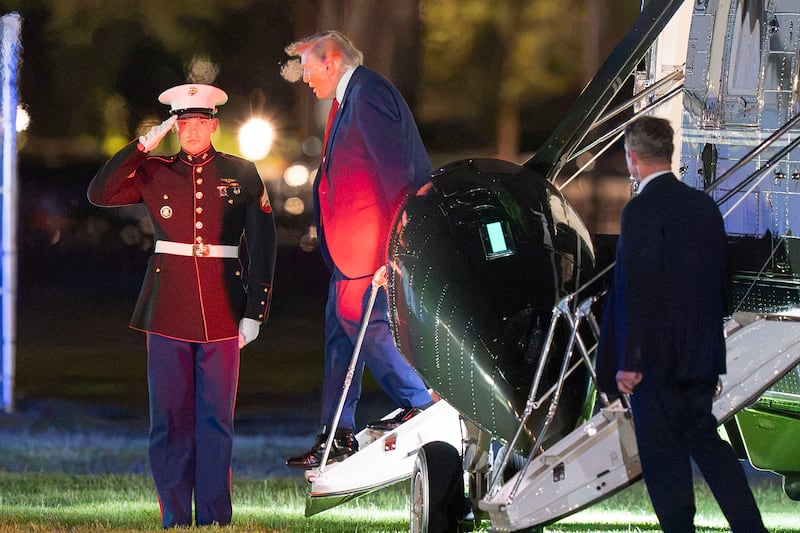

About a year and a half into his second term, President Donald Trump’s approval rating among Utah voters continues to be underwater.
A new Deseret News/Hinckley Institute of Politics poll, conducted by Morning Consult, found Utahns generally aren’t happy with the way Trump has handled his return to the White House. It’s a trend seen in nationwide polling, too, despite the president boasting about positive ratings.
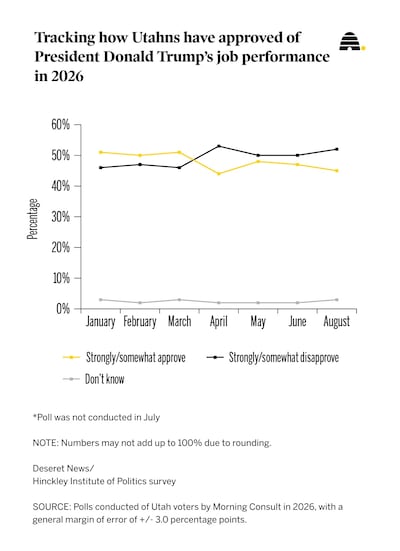
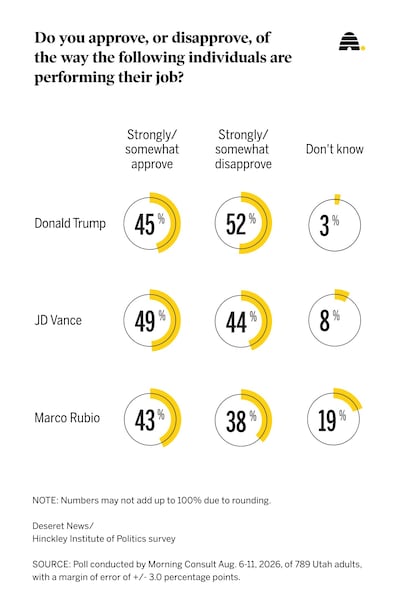
The survey found that just 45% of Utah voters approve of Trump’s job performance as president compared to 52% who disapprove. Among those who disapprove of his job performance, 11% say they somewhat disapprove and 41% strongly disapprove.
Like previous surveys, Trump performs better among male voters, people 45 years and older, Republicans and religious voters. Among Utah Republicans, 76% approve of Trump’s job performance, while 21% disapprove.
Jeremy Pope, a political science professor at Brigham Young University, said he thinks its true that in a lot of states Trump is underwater and his approval is “just quite bad.”
“It’s hard not to look ahead and wonder just how bad could it get for Republicans?” he said.
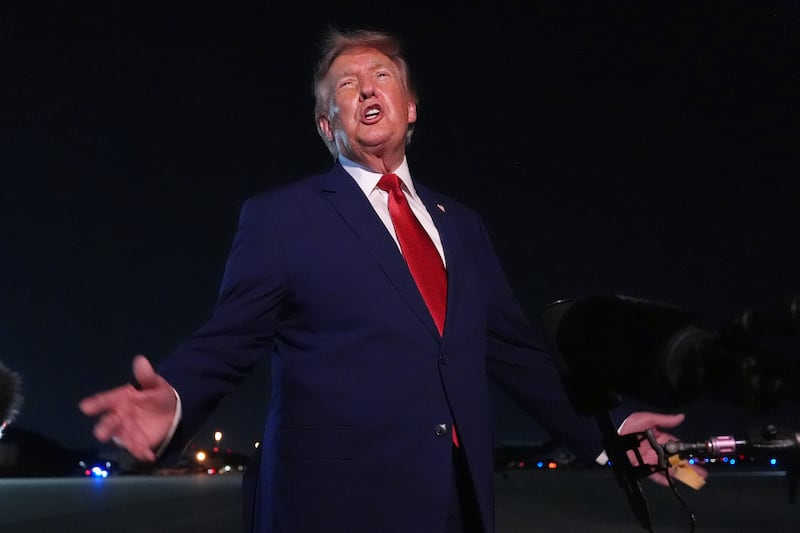
While Utahns are fairly evenly split about whether they approve or disapprove of Trump’s performance, survey data going back to January paints a different picture.
Tracking Trump’s performance since January shows that Utahns’ approval and disapproval has flip-flopped. Earlier in the year, Utahns were more likely to approve of the president’s performance. In recent months, that’s no longer true.
Approval is something that Trump clearly wants from the American people. He’s posted figures online saying he had a 59% approval rating but no source to back that number up.
National polls in recent months have shown that the president is losing support among younger voters and independents, particularly those opposed to the ongoing and uncertain war in Iran.
According to RealClearPolitics polling averages of national surveys, just 39% of voters nationally approve of Trump’s performance as president while 58% disapprove.
The war with Iran, which Utahns are more likely to oppose than support, could impact voters when they head to the polls for the 2026 midterm elections this November.
Trump and congressional Republicans are hoping they can keep their majorities in both the House and the Senate. It’s something important to the president, who kick-started a nationwide mid-decade redistricting battle last year with the hope that the House won’t flip to Democratic control. The House historically shifts away from the president’s party in the midterm elections.
In the 2018 midterm elections, during Trump’s first term as president, Democrats gained a net total of 41 seats in the House.
Pope highlighted how Republicans have seen some redistricting wins, and Democrats are also nominating candidates that are “going to be a problem in the general election.”
“But even with those caveats in mind, it’s very difficult for me to imagine the Democrats not taking the House of Representatives,” he said.
That’s something Trump is likely concerned about, Pope said, which is possibly why he is telling voters that his approval is higher than it actually is.
“He’s nervous about what would happen after a bad 2026 election,” Pope said, adding that Democrats would make it harder for Trump to spend money on his policies and the president would likely face the threat of impeachment.
It’s going to get harder for Trump to do much of anything during the second half of his term, should Democrats flip control of the House. It’d be even harder if they win the Senate, too, which Pope described as a “coin toss” at the moment.
“He’s doing something you’ve seen him do before, which is to kind of manifest good things that he hopes are coming, both about his approval rating and about how things are going in Iran,” Pope said. “And I’m just not that confident those things are going to actually come to pass.”
“I think his approval rating really is just genuinely low.”
Pope argued that if Trump were able to “wind down” the war with Iran, instead of being in a perpetually locked negotiation phase, he’d be able to head into the midterms with a bit of a boost instead of Americans feeling tired and deflated by high gas prices.
“It’s like an open sore on his presidency and he doesn’t know how to fix it,” he said.
No matter what the outcome is this November, after Election Day, all eyes will be on 2028.
The GOP heirs
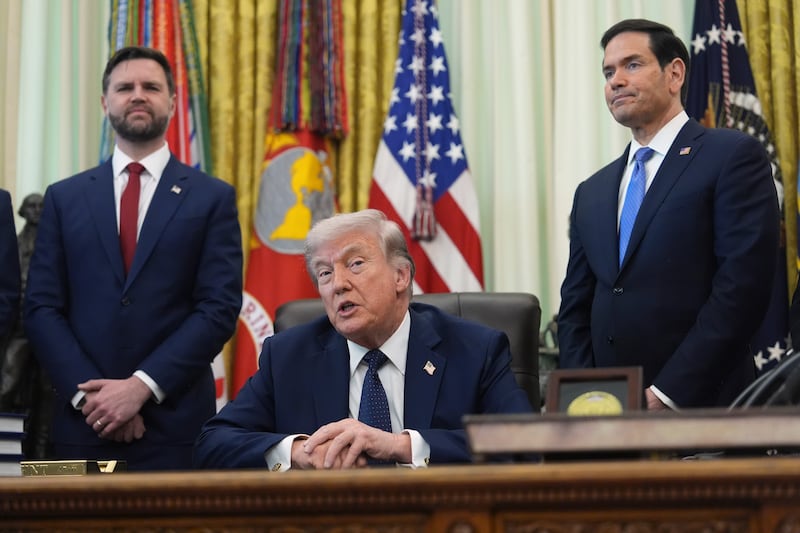
As much as Trump jokes about running for a third term, he’s term-limited, and the Republican Party will have to search for a new leader to carry out their priorities and policies.
With the 2028 presidential race on the horizon, some of Trump’s closest friends and Cabinet members may be put in an awkward situation where they’d be working together but also campaigning in a Republican primary against each other.
Vice President JD Vance has been floated as MAGA’s “heir apparent” to carry on the administration’s goals after Trump leaves office.
Secretary of State Marco Rubio is also seen as a strong contender, particularly since he ran for president in 2016 before ultimately suspending his bid.
Vance, who is 42, and Rubio, who is 55, would usher in a new generation of Republican leaders who would be significantly younger than Trump and former President Joe Biden were when taking office.
Trump has floated both names as options for the next president but largely declined to offer any sort of endorsement for a successor. In February, he said Vance was “very capable” but it was too early to say.
While it’s a ways away, Trump still holds a considerable amount of influence with the Republican base and an endorsement from him would likely help either candidate.
Asked by reporters if Vance would be the heir to the MAGA movement, Trump said he thinks the vice president “most likely” would be and said “in all fairness, he’s the vice president.”
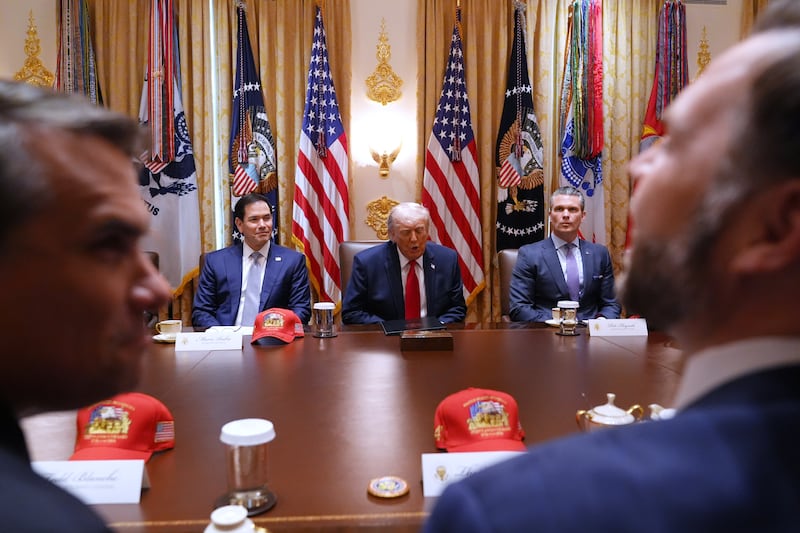
He recently pushed back on a report from The Washington Post that stated he told donors to back Vance. Trump said he heard about the report, thinks Vance is “great,” but said “we’re way too early to even be thinking about that.”
Pope noted that in the eyes of Americans, Vance is more closely aligned with Trump than Rubio just by the proximity of being his vice president.
However, Vance has also broken from the president in recent months and been “kind of cagey” about not really supporting the war with Iran. Rubio, meanwhile, has been on the front lines of negotiations, speaking with counterparts in Iran and other countries allied with the U.S.
Still, the president has floated the idea of a joint Vance-Rubio ticket.
Vance himself has been asked about what the future would look like and the possibility of taking on Rubio in a primary. He said he loves Rubio but they’re both focused on their current roles.
“If I do end up running in 2028, I’m not entitled to it,” he said.
While Utahns don’t rank Trump favorably, the survey finds Vance and Rubio fare pretty well among voters in the state, at least for how they’re conducting their current roles.
About half (49%) of Utahns approve of the job Vance is doing as No. 2 and 44% disapprove.
Rubio earns similar numbers, with 43% approval among Utah voters of his work as head of the State Department and 38% disapproval.
The number of Utahns who say they don’t know enough about the person to either approve or disapprove is different, though.
Just 8% of voters say they don’t know how to rank Vance’s performance, but that grows to 19% for Rubio.
Pope predicted that over the next year, Republicans are going to fracture. While they have been coalesced around Trump and his MAGA framework, once he’s out of office, it will force some in the GOP camp to either stick by his side and carry on his populist policies or break away and chart a new path for the Republican Party.
“It can’t continue forever,” he said. “And it can’t continue when Trump isn’t seen as successful.”