

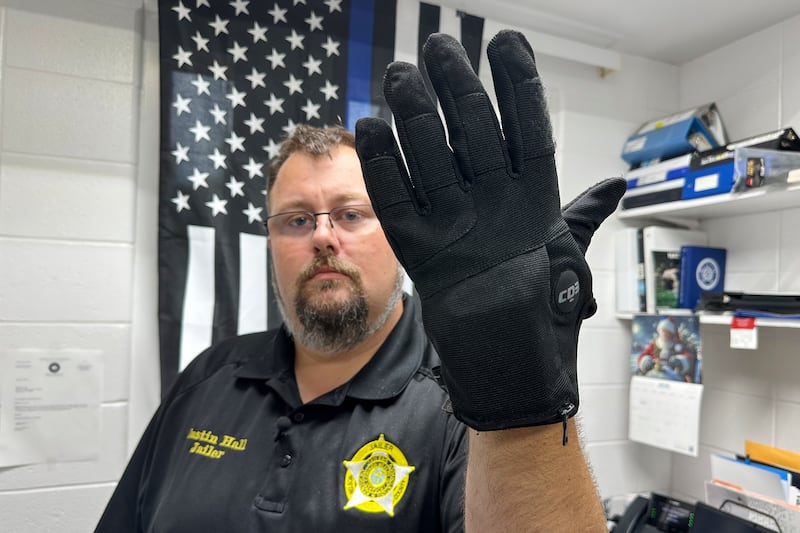

Earlier this week, the Department of Homeland Security posted a notice of its intent to spend between $10 million and $20 million on specialty gloves that convey an electric shock when a button is pushed.
The gloves, termed a “conductive distraction and de-escalation device,” would be issued to Homeland Security investigators and ICE agents. They’re made by a Kentucky company that says it produces “cutting-edge non-lethal tools to empower and protect those who serve.”
But the conversation about the gloves has had nothing to do with protecting law enforcement, but protecting the civil rights of those who might have the gloves used on them.
Jenn Rolnick Borchetta, deputy project director on policing at the American Civil Liberties Union, told Ryan J. Foley of The Associated Press, “Introducing gloves that can so easily be used to deliver terrible pain in encounters is a recipe for harm to the public.”
And Naureen Shah, the ACLU’s director of policy and government affairs for immigration, called the gloves “novel dangerous technology” and told NPR that it was “reckless” to give them to ICE agents, thousands of whom have been hired within the past 18 months.
Both the governor and attorney general of New York have said the use of the gloves would constitute “undue harm” and would violate a person’s civil rights.
Others, however, including border czar Tom Homan, have called the gloves an effective way to support law enforcement agents who need to bring an unruly and potentially dangerous person under control.
Descriptions of what it feels like to receive a shock from the glove have ranged from a “bee sting” to temporary debilitation.
“It’s immediate and sharp, and it will distract you. I call it like a bee sting,” John Peters, president of the Institute for the Prevention of In-Custody Deaths, told The Associated Press.
“I’ve had it used on me. It hurt. Somebody simply grabbed my wrist while wearing the glove. I’m a big guy. I’m 6′3”, about 250 pounds. It made my knees buckle," Kenneth Corey, head of the Policing Leadership Academy at the University of Chicago Crime Lab, told NPR.
Videos of the gloves being used in demonstrations are circulating online and show people wincing and falling to the floor.
The work of law enforcement, to be sure, is not for the faint-hearted, and you can be a strong supporter of those who protect us, and also object to some of the policing tactics and policies. (I am still complaining, 20 years later, about an officer who pulled me over for a minor traffic infraction in a strange city, and verbally berated me in front of my young children.) There is, perhaps, a correlation between respect for the law and fear of those who enforce it, and some officers exploit the latter.
They’re also human beings who, like the rest of us, get angry, and anger can lead to bad choices. Just this week, we have seen video of a volatile exchange between ICE agents and a woman in Falls Church, Virginia, who appeared to have been taunting them before the agents surrounded her and one approached her car with a gun drawn.
Thankfully, no one was injured or killed, but the exchange is a fresh reminder of the inflamed debate over the Trump administration’s immigration policies and the challenges facing those charged with enforcing them.
It’s also a reminder of how quickly things can go south. Just last month, ICE was involved in two fatal shootings, one in Texas and one in Maine.
Both the Falls Church woman and the two men who were fatally shot were in cars at the time of the incident; as such, it’s unlikely that any sort of high-tech gloves would have made a difference in how these incidents played out. But where they might make a difference is in the court of public opinion.
According to polling from the Economist and YouGov last month, about half of Americans strongly or somewhat support abolishing ICE — a figure that is bolstered by 73% Democratic support.
Even more Americans, 54%, say they have “little confidence” in ICE, and 58% say ICE has used too much force.
Although most Republicans (67%) say they do not want to abolish ICE, the share of Republicans who say they have a “great deal” of confidence in ICE fell from 60% in February to 54% in July, according to YouGov.
And there is an even wider partisan divide on whether ICE has used excessive force: 91% of Democrats and 63% of independents said ICE has used too much force, compared to 19% of Republicans.
If gloves that shock suspects into submission are seen as a means of preventing more serious harm to a person being taken into custody, then perhaps they could be revolutionary. But their utility is limited by the proximity of an officer to a suspect, and the circumstances surrounding the event. (Would the availability of a shock glove have changed the outcome of ICE’s encounter with Renée Good?)
As usual, don’t look for the answers in hyperbole — those calling the gloves “a sadistic new toy for ICE’s terror campaign” or those who expect them to solve every problem in policing for the low, low price of whatever Compliant Technologies is selling them for.
They’re a tool, nothing more, nothing less, and their efficacy and value depends on the judgment of the person who dons them.