




Prenuptial agreements used to be the domain of celebrities and the superwealthy. That may be changing: a new Harris poll suggests more than half of engaged or married couples under the age of 45 have negotiated the terms of their divorce before they reach the altar. That’s roughly a fivefold increase in prenups since the 1990s.
Multiple social factors may help explain this trend, including that people are getting married older. The median age at first marriage for women is now 28; for men, it is 30 — which means people are entering marriage with more individual wealth they are inclined to protect.
Women in particular are entering marriage with considerably more wealth than they used to. One surprising YouGov survey in 2025 found that women are now more likely than men to view prenuptial agreements as a “good idea,” citing a desire to protect their financial assets and future children’s financial security.
Then there’s the reality of divorce. People who’ve already married and divorced are far more likely to pursue a prenup in subsequent marriages, and though divorce rates are declining, it’s still much more common than it was 60 years ago. The divorce of a bride or groom’s parents may also play a role. Some researchers believe that millennials’ witness of their own parents’ divorce has led them to view preparing for their own marital crisis as a logical imperative.
Divorce law likely bears some of the blame, too. The rise of no-fault divorce means that in many states a wife or husband who files for divorce can’t legally cite their partner’s infidelity or misconduct as the cause. In some states, judges aren’t allowed to factor marital misconduct into their calculation when dividing assets in a divorce, often leaving an innocent party at risk of substantial loss. Some prenuptial agreements shore up that risk by explicitly penalizing infidelity in a divorce, even when the state won’t.
But then there’s the cultural pressure. Since the ’90s, prenuptial agreements were generally viewed in pop culture as gauche but “cool” — a kind of status symbol for the cynically rich. A prime example is the rapper Kanye West’s 2005 hit “Gold Digger,” in which he raps: “Holla ‘we want prenup! We want prenup! It’s somethin that you need to have / ‘Cause when she leaves ... she gon’ leave with half.”
Prenups remain popular among the uber-wealthy. Billionaire John Morgan, founder of a nationwide network of personal injury law firms, told an interviewer that unless his kids sign a prenup before they marry, he won’t grant their full inheritance. Divorce is “going to happen,” Morgan said, so if his kids refuse to plan for it, they’re “never getting the big haul.”
The rise of the online prenup
Morgan’s assets are exceptional, but his way of thinking no longer is. In recent years, prenups have been rebranded as a sensible, low-drama chore — no different from doing one’s taxes, according to one online prenup company.
In fact, The Wall Street Journal reported recently on the rise of a niche social-media influencer circuit for #PrenupTalk, replete with self-styled experts and podcast hosts who cheerfully tout prenuptial agreements as the only logical route for enlightened couples. It’s all been monetized by ventures such as Hello Prenup, where couples can “complete their prenup on their timeline — without ever leaving the couch!”
This new convenience and “cool” rebranding of prenups may seem like a positive development to some. But the data tells a different story. Far too often, research shows that prenuptial agreements turn into a self-fulfilling prophecy.
For example, in the 2022 State of Our Unions survey, researchers from the Institute for Family Studies found that couples who say they believe “marriage is for life” report higher rates of marital happiness than couples who say “marriage is for as long as you feel fulfilled.” In other words, it appears that those who accept divorce as a viable option are less likely to enjoy their ensuing marriages.
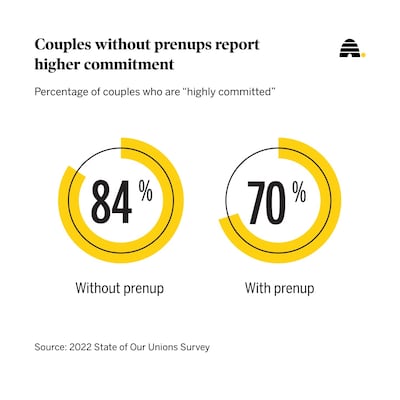
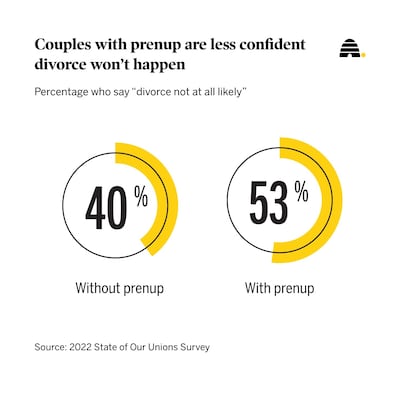
Indeed, the same survey suggests that prenups come at a cost to the marriage itself. The survey found 84% of couples without a prenup say they are “very committed,” compared to 70% of peers with a prenup. Couples who skip one are 10 percentage points more likely to describe their marriage as “very happy” than those who sign one. And confidence in the marriage’s staying power tells a similar story: Just 40% of prenup couples say it’s “not at all likely” they’ll divorce, compared to 53% of those without one.
Why prenups can be ‘corrosive’
The memory of prenup negotiations is “corrosive,” said Laurie Israel, a family attorney from Boston in an interview for the book “Get Married,” who has seen the process harm marriages in the couples she works with.
In her view, “A prenup changes the entire connection and contract of a marriage by taking away one of its major pillars: building a secure financial future together.”
A psychological phenomenon known as the “reversibility paradox” may explain this tendency. Social psychologist Dan Gilbert has studied human happiness and decision-making for decades. Through multiple studies, Gilbert has found that people tend to be much happier with inflexible decisions.
In one now famous example, Gilbert asked Harvard photography students to choose their favorite photograph for framing. He told one group of students their decision was final, while a second group had a few days to reconsider before the photo they chose was shipped off to be framed. In the end, the students who had no “escape hatch,” as Gilbert called it, were significantly more happy with their decision than the second group.
Gilbert later wrote that the human mind is more motivated to love, celebrate and support a decision it has made when it knows there is no other option. In other words, creating the “escape hatch” of a prenuptial agreement before a marriage plants a small seed in the minds of every couple: that maybe this relationship will end. That seed will grow as the natural challenges of married life unfold.
Paradoxically, prenuptial agreements undermine the very thing meant to keep marriages together: commitment. The strongest couples don’t just commit to trying to stay together, they commit to the commitment itself. The legal institution of marriage benefits from a web of accountability — from the family and friends who witness a couple’s vows to the financial and logistical barriers to separation — meant to dissuade couples from breaking that commitment. Prenups, by definition, untangle that web of accountability, the sense that your marriage is an “all-in” commitment.
Couples are, of course, free to cohabitate and build lives together without legally marrying. Perhaps couples who reject “for better or worse” on principle are better off on such a path instead. But for those who long for the satisfaction, meaning, love and security that only lifelong marriage can offer, the choice is simple: Don’t listen to Kanye.