


A version of this article was first published in the Right to the Point newsletter. Sign up to receive the free newsletter in your inbox every Wednesday morning and to vote in subscriber-only polls.
Is President Donald Trump the most targeted U.S. leader in history?
That’s what Fox News reported earlier this month, saying that in addition to the assassination attempts we know about, Trump has faced “threat-related incidents roughly every two to three months in recent years.”
As such, given the ongoing hostilities in the Middle East, security measures that are both strong and creative are called for to protect Trump, but should they ever put the press at risk of being collateral damage?
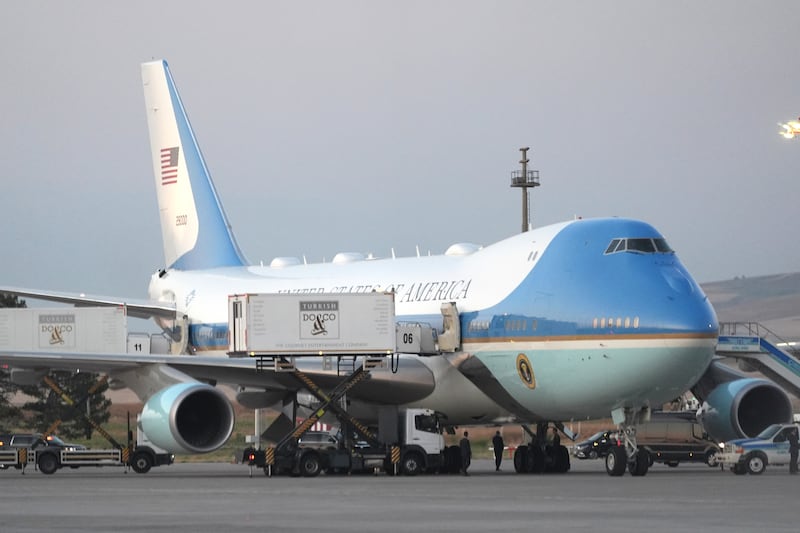
That appears to have happened when Trump flew home from Turkey last month, employing what The Washington Post described as an “elaborate ruse” devised because of an Iranian threat.
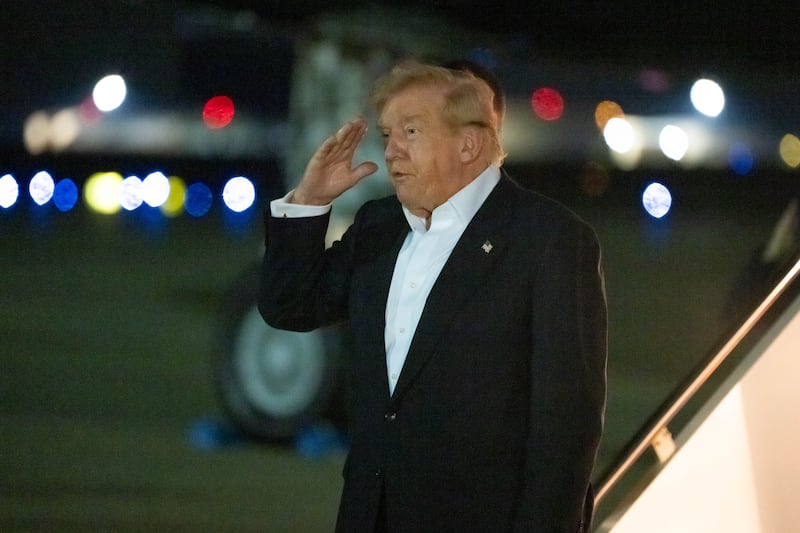
It was first announced that the president would fly in the “old” Air Force One that had been replaced by a Boeing 747-8 given to Trump by Qatar. Trump boarded that jet, but then, the Post reported, “was secretly shuttled minutes later to a smaller plane — an Air Force C-32A — via an airport catering truck typically used to load meals and other supplies preflight.”
Air Force One then flew back to the U.S. with members of the press and an unknown number of White House staff aboard. They were told to keep their window shades down.
The revelations have raised all sorts of questions, including whether the pilots and crew had knowledge of a threat beyond the usual risks of flying with the U.S. president in the Middle East. Presumably, Trump wouldn’t have let his wife or children fly on that plane on that day. Why was it OK for these souls to board?
Given Trump’s volatile relationship with the press, it’s not a stretch to see him as indifferent to whether journalists aboard became collateral damage. That would have been unthinkable with any other president. But it’s a natural supposition of someone who has called reporters terrible, stupid and an “enemy of the people.”
Ari Fleischer, who was the press secretary for George W. Bush, defended the plan, writing on social media, “I’m sorry if the press felt deceived. In an extraordinary situation like that, what was the WH supposed to do? Announce the switch?”
In fact, there is precedent of a better way.
When Bill Clinton faced a similar threat in 2000, he also secretly boarded a smaller plane while Air Force One served as a decoy, flying with presidential aides and the press. But at least one journalist, Susan Page, now at USA Today, was informed in advance and told about the security risks and the steps that were being taken to counter them.
Perhaps Trump’s team trusted the press too little to take that step. But suffice it to say, his relationship with the press won’t benefit from these revelations.
After he returned from Turkey, a reporter asked the president why the press had been asked to keep their window shades down. He responded, in part, “because you’re probably on a dangerous flight because of the sleaze bags that we have to deal with.”
“But if I go, you go. Right?” Trump added. “Perhaps someday you want to change professions.”
It’s time to retire the ‘beer test’
The “beer test” is a political trope that suggests the best candidates are the ones voters “would like to have a beer with.”
But what happens when Americans are no longer drinking beer?
Beer drinking has been in decline for more than a decade, not only in America but other countries. Even in Germany, famous for its “beer gardens,” people are drinking less beer as evidence mounts that no level of alcohol is safe.
But the idea that political candidates need to pass the “beer test” is still surfacing, most recently in a New York Times article about Dan Osborn, an independent Nebraska Senate candidate.
This sent podcaster and writer Matt Taibbi down a beer-test rabbit hole, looking back at usage of the term over time. It appears to have originated with a poll commissioned by the makers of Samuel Adams beer in 2000. (As in the election, George W. Bush won over Al Gore.) It’s also called a likability test, but somehow beer test stuck, despite criticism that it’s sexist, and it also discriminates against people of faith who don’t drink. (Mitt Romney was never going to win the beer test.)
With a sea change in drinking under way, it seems time to retire the term; perhaps an enterprising pizza company could do it by polling people on what candidate they’d like to share a pizza with. Failure to act means something worse than beer will take its place, given that some Americans are drinking less because they’re using marijuana.
Behold one of the more eye-opening headlines of the year: People who switched to cannabis drinks cut their alcohol use nearly in half. That may not be progress.
Recommended Reading
Asma Uddin says that while most people think they want to be left alone while traveling, when they engage with others, they are usually happier.
“There is a category in Islamic law for someone traveling — a ‘son of the road’ (Ibn al-sabil). The wayfarer may have wealth waiting at home, but for this stretch of the journey, he cannot reach it. What matters now is his separation from the ordinary web of people and places that would otherwise sustain him. Until he reaches home, the law says he has a claim on the care of others, enough to continue on his way.”
Don’t ignore the stranger next to you
Mark Zuckerberg and his wife, Dr. Priscilla Chan, have poured more than $125 million into an educational venture designed to help low-income kids. It’s about to close. Naomi Schaefer Riley looks at what the founders of The Primary School should have considered instead.
“From the start, the school was not designed around academic outcomes. Instead, according to The Wall Street Journal, it ‘aimed to support the “whole child” through wraparound services, including free dental checkups, early-intervention screenings and wellness coaching for parents.’ Such an approach is hardly revolutionary.”
The cautionary tale of Mark Zuckerberg and Priscilla Chan
As an academic discipline, sociology is under attack. Samuel J. Abrams, however, is a fan and offers a rousing defense.
“Few Americans major in sociology — the discipline accounts for about 1% of college degrees — but nearly all of us ask sociological questions regularly. Why do young men have so few friends? Why does one congregation thrive while another declines? Why don’t neighbors know each other anymore? Why has confidence in nearly every major institution fallen for decades? Those aren’t political or economic questions but social ones.”
End Notes
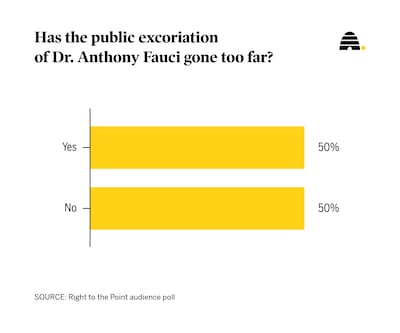
Last week’s Right to the Point poll produced our first ever tie, revealing us to be deadlocked on the issue of Dr. Anthony Fauci. Let’s just say that if we were in jury deliberations, it would be some time before we got to go home.
In other news, Jackie the celebrity bald eagle of Big Bear Lake has passed, six months after the death of the biologist instrumental in the Jackie and Shadow nest cam. I have to think that Sandy Steers would have enjoyed this meme, as whimsical as it is.
But a fight is brewing over Jackie’s remains, with some of her fans not liking the national policy of what happens to eagle remains.
Finally, Alexandria Ocasio-Cortez, the progressive congresswoman from New York, posted on Instagram about freezing her eggs in hopes of having a family one day. The announcement almost seemed like a trap for conservatives who promote marriage and children, but National Review’s Kathryn Jean Lopez responded with compassion, pointing out that wanting a child, and not having a partner ready to have one, “is a miserable place to be at 36.”
That said, I had my last child at 40, and regardless of any political differences people may have with Ocasio-Cortez, we can all hope this ends well for her. The science is remarkable: Just a few weeks ago, the “world’s oldest baby” — a child born from an embryo that had been frozen for three decades — turned 1 year old.