- Glenn Beck said a "spirit of collectivism" threatens America at 250.
- This includes socialism on the left and white supremacy on the right.
- Beck also reacted to growing conservative criticism of Latter-day Saints.
After walking America’s capital on the 250th anniversary of the adoption of the Declaration of Independence, Glenn Beck felt tired of the finger pointing — at least the kind that pointed in just one direction.
Of course, the standard bearer of Tea Party Republicanism disagrees with Democratic positions. But bad policy is not the force he thinks threatens to contaminate the American experiment. It’s something deeper.
Hatred.
A populist moment is tempting both the left and the right with an identity politics that Beck says will likely lead to greater persecution of different groups who are being framed as obstacles to achieving the collective good.
The victims extend beyond people of color and LGBTQ identification. Beck has observed increased animus toward Jews, immigrants, white people and religious sects, including The Church of Jesus Christ of Latter-day Saints.
In an exclusive interview with the Deseret News, Beck explained what he believes the rising trends of democratic socialism and white nationalism have in common: hunger for scapegoats to justify their exclusionary solutions to America’s ills.
“We’re in this spirit of collectivism — and it’s needing a target,” Beck said. “It’s the spirit of evil, and it’s, unfortunately, the spirit of the times. But I don’t want to engage in any of it.”

Beck is the first to admit his own role in occasionally stoking a polarized political climate. That may be why he is taking a proactive stance against the attitude he says is turning Americans against each other at an accelerating pace.
As the onetime king of GOP punditry, Beck built a reputation for emotional appeals to America’s founding. Now, as the nation turns 250 years old, his greatest worry is that love for having an enemy could smother love for America.
America’s populist moment
Over the weekend, Beck found himself speechless when he heard his own voice ringing from a display in the brand new museum beneath the Lincoln Memorial statue.
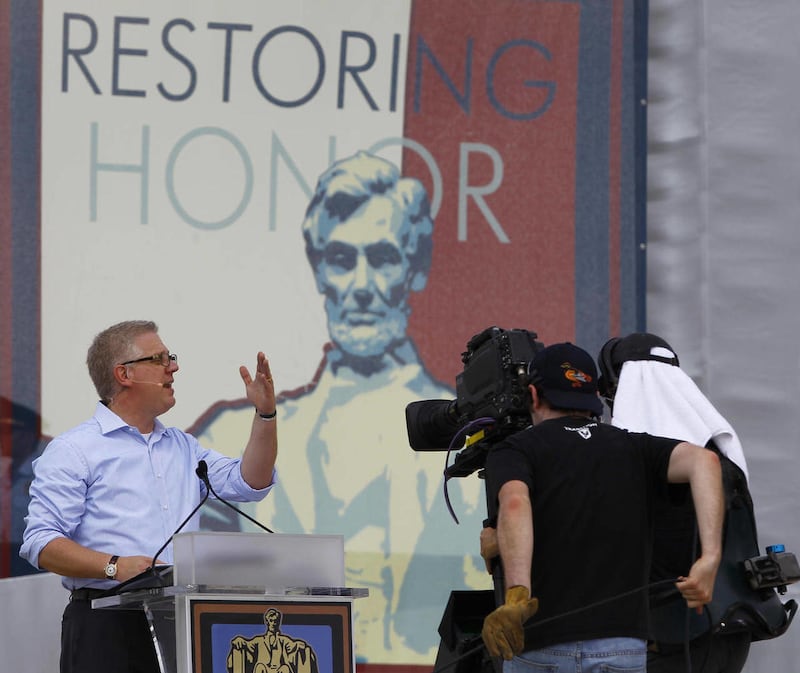
Beck stood with his family, staring in disbelief as the audio of his Aug. 28, 2010, Restoring Honor rally played among a collection of historic events that took place on the steps of one of America’s most recognizable monuments.
At the time, Beck was the bombastic, unpredictable face of Fox News. He was also convinced it was not too late for the country to come together, if citizens would recognize the civic treasures they inherited from America’s birth.
His speech, attended by more than 80,000 people, focused on elevating “the principles that made us great” above the divisiveness of “politics.” He ended with a “testimony” that each member of the audience could “change the world.”
Little did he know that 16 years later his remarks would become part of the monument itself. But the tensions between partisan tribalism and shared values at the core of his concerns have only become more fraught.
The United States of America has entered a “populist moment,” according to Kirk Hawkins, a political science professor at Brigham Young University who specializes in researching populist rhetoric worldwide.
Populism frames political issues with radicalized rhetoric that emphasizes “the will of common people” against a corrupt elite class, Hawkins said, nearly always championing certain identity groups at the expense of others.
“There’s always people that are the enemy ... in that sense, populism is always excluding somebody,” Hawkins told the Deseret News. “Lots of these minority groups make easy targets to blame your problems on in these moments.”
Economic inequality, demographic change and unpopular wars are just some of the issues that create the conditions for populism, Hawkins said. In the case of the U.S., several of these concerns have been “stacking up” for decades.
Democratic candidates with campaigns centered on socialist talking points, like universal programs funded by eliminating billionaires, have become more common, including in Utah, and have won congressional primaries in New York and Colorado.

Many of these candidates received endorsements from New York City’s socialist mayor Zohran Mamdani and the Marxist online influencer Hasan Piker, who has called for violence toward sitting U.S. officials, land owners and executives.
Their leftwing messages blame wealthy Americans and the political influence of Jewish donors for government failure. Surveys show antisemitic sentiment has become a common thread from one end of the political spectrum to the other.
The white nationalist talking points of personalities like Nick Fuentes have filtered into more mainstream conversations on the right, including the candidacy of James Fishback for Florida governor and some young operatives in Utah.
“They’re all using hatred and picking a specific group to be against, ‘I’m against the rich, I’m against the Republicans, I’m against the Democrats, I’m against whoever.’ It’s all the same game, and we have to stop playing this game,” Beck said.
What’s the answer to populism?
One of the best antidotes to extreme ideologies is simply recognizing that the American experiment — of self-government, relying on individual rights and responsibilities — has worked, and will continue to, according to Beck.

As owner of one of the nation’s largest private repositories of founding documents, which he has uploaded into an AI library, Beck hopes this semiquincentennial year gives people the opportunity to “fall in love with our story again.”
“We’ve lost our connection to these founding documents,” Beck said. “We’ve got to find our way back to those because that’s what I’m for. I’m for making a more perfect nation. I’m for recognizing our mistakes and correcting them.”
Beck’s fundamental optimism does not blind him to the missteps of America’s elite class.
Over the years, few commentators have been more consistent in their criticism of those behind the big bank bailouts of 2008, federal deficit spending, globalist plans for an economic reset and the response to COVID-19.
Since the presidency of George W. Bush, Beck has prided himself on turning his ire toward leaders of both parties. As he would with any president, Beck said he is worried about the influence of “outside interest” in the White House.
Financial disclosures recently revealed President Donald Trump earned $2.2 billion during his first year back in office — 3.5 times his income from 2024 — including $1.4 billion from his family’s cryptocurrency businesses.
Cryptocurrency gains came largely from the United Arab Emirates buying nearly half of Trump’s World Liberty Financial, and private individuals buying $TRUMP memecoin, which appeared to earn some buyers access to the president.
However, Beck has found a close ally in Trump as some conservatives have trained their attacks on Beck’s own faith.
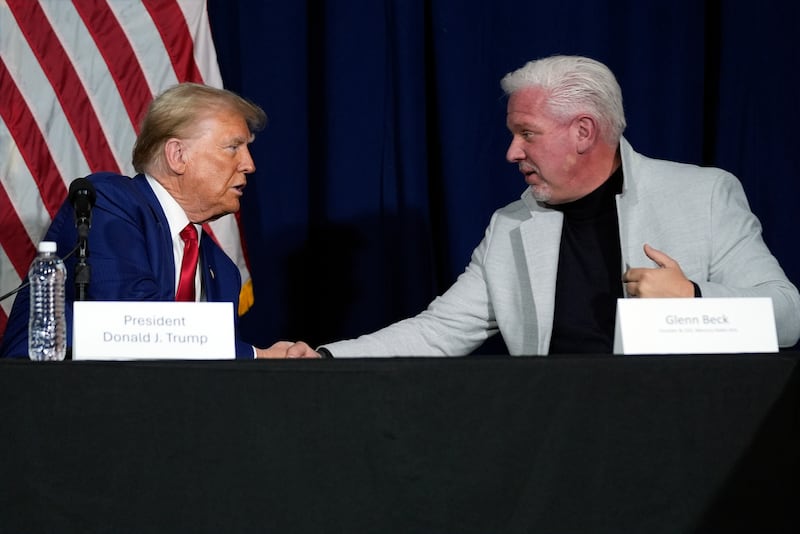
In recent months, commentators like Matt Fradd at the Daily Wire and Allie Beth Stuckey at Blaze Media — which Beck founded — have gone to great lengths to carve Latter-day Saints out of the Christian American community.
“Just because they don’t think we’re on the same team doesn’t make us not on the same team,” Beck said. “No matter the actions of whatever, whomever and whatever they do, I will not distance myself from them.”
Last month, after a midnight phone call with Beck, and lobbying by several lawmakers, Trump reversed a Pentagon designation excluding Latter-day Saints from a list of Christians. Beck is convinced the “Lord needs all of us” to work together despite theological differences.
Beck is counting on divine intervention to help keep the country together just as it helped to found it.
Like any country, America has a “messy” history. But time and time again, returning to its founding principles has allowed Americans to overcome their divisions, Beck said. He hopes, and prays, it will once again.
“I don’t think God’s done with us. I’m hoping. I don’t think he is,” Beck said. “I still feel there’s too many miracles that I have seen that sustain us. ... It’s his graciousness that has kept us together.”