



Scandals in the business world or academia are embarrassing for the people and organizations involved. Even people who know better can get caught up in the moment.
Recent examples include an incident between a CEO and a HR executive at a Coldplay concert or an investigation into a major bank’s practice of cross-selling.
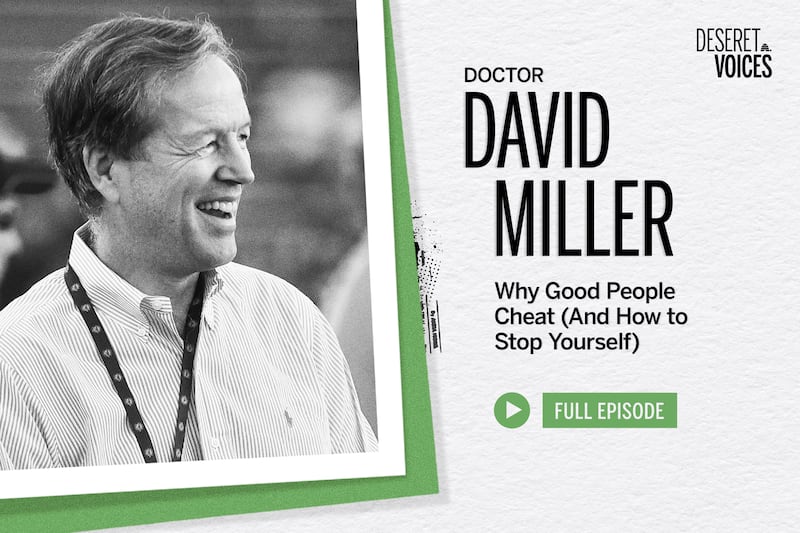
On this episode of “Deseret Voices,” Jane Clayson Johnson asks David W. Miller, the director of the Princeton Faith & Work Initiative and author of “The 5 Questions for Ethical Decisions: How to Succeed Without Selling Your Soul,” what causes someone to make an unethical decision.
Subscribe to “Deseret Voices” on YouTube, Apple Podcasts or Spotify.
Note: Transcript edited by Steven Watkins
Jane Clayson Johnson: David Miller, it’s so nice to have you. Thank you.
David W. Miller: It’s great to be with you, Jane. Thank you.
JCJ: So I suspect most people think they are fairly ethical in their daily lives. Tell me why you wanted to write this book.
DM: Well, precisely because they — and I — think I’m fairly ethical, and yet life and research has told me that we aren’t always as ethical as we think. Good people sometimes do dumb, stupid things. So, I — one of my motivations was to help those who are good apples to stay good and not be tainted by or fall into some of the traps that other folks do.
JCJ: What is your definition of ethics, of ethical behavior?
DM: You know, it’s a question I ask my students and also my corporate advisory work just to sort of break the ice at the beginning, like, “What is ethics?” And you get answers like philosophical thought process, or doing the right thing, or what we ought to do, or what we should do, or what you do when nobody’s looking is another one. I’ve found all those in different ways interesting, but unsatisfactory. So I came up with one — it’s one sentence — and it’s: Ethics is the art and discipline of discerning the right, the good, and the fitting action to take, and having the creativity and courage to do it.
JCJ: Most people don’t wake up in the morning thinking, “I’m going to cheat today,” or “I’m going to have an ethical slip.” But you write in the book it’s not if you’ll be faced with an ethical dilemma, it’s when.
DM: Yeah. No, absolutely. And let’s say — I mean, I have this sort of image of the population at large as a bell curve. On one side of the bell curve, you’ve got the saints, the Mother Teresas of the world. God bless them. I am not one of those, most people are not. On the other side of the bell curve, you’ve got the schmucks, the bad guys, that are always going to try to get over on the system and cheat. It just doesn’t matter why, just how they’re wired.
Most of us live in this what I call the “movable middle.” And based on our own character, our own disciplines, our own habits, and the culture or the organization in which we work, we’re going to either move towards the sainthood direction or towards the — whatever its opposite is. And let’s say you’re Mother Teresa and you never have an ethical lapse of your own, someone you work with will.
JCJ: If they are in the middle, what causes someone to slide toward an unethical choice?
DM: There’s sort of two big categories. One is I would say the external things, things that are environmental that are outside of our control, largely. And the other are things that are internal and within our control, where we have some agency. So let’s say you work for a company that’s in a highly competitive industry, and that your boss says to you — which happened to me once — that “I’ve never missed my numbers, my quota before, and we’re not going to miss it this year.” Essentially he was telling us: Do whatever you can do to book revenue, to make your numbers, even if it’s a little dodgy. I mean he never said, “Go out and cheat,” but it was clear that we were being encouraged, quote-unquote, to do something.
So there’s external things like that. Other external things could be the remuneration. What is rewarded? What are pay scales? What do you get bonuses for in your organization? There’s pressure — even think in the media, there’s pressure to get a breaking story, there’s pressure to get a scoop, there’s pressure to get it out on time and meet a deadline, even if you haven’t confirmed all of your — the evidence and all the data you need. So there’s a whole host of external, or let’s call them environmental things, that are frankly out of most of our control. But then there’s things within our control.
JCJ: Is an ethical failure usually a single decision, based on your research, or a series of small ones?
DM: Usually a series of small ones. We all know the phrase “slippery slope,” and it’s true. One of my closest and dearest friends, and still is, was a guy of the highest — and I talk about him in the book — of the highest moral rectitude. He was a black-and-white guy, and he always tried to do the right thing, so to speak. He ended up getting caught up in the admissions scandal a few years back, you might remember, Rick Singer and the Varsity Blues scandal, where people were scamming their way to get their children into elite universities. And he ended up getting caught up in that. And he would tell — he comes and talks to my students, and you can hear a pin drop. And he says, “You know, it wasn’t just one bad decision in that case, it was slippery slope. At first, I didn’t realize I was kind of being scammed by this, and once I figured it out, it was too hard to go back. I was too embarrassed. What would I say? How do I get out of it?”
Now, there are some people who also — who do have one instance. Maybe they’ve been traveling a lot and they’re exhausted, or maybe they’ve had a couple beers or too much to drink, or maybe they’re kind of going along with the crowd because everyone else is doing it, and they do make that one cataclysmic, destructive decision. So it could be a hybrid, but I would say my research shows most people, it’s a slow process of slow corner-cutting, slow compromises that we can justify and rationalize in the moment, and then later they cumulatively can catch up with us. Sometimes we think, “Well, just this one time I’ll capitulate to the crowd,” or “I’m not going to be that lone voice.”
But one of my favorite stories, and I refer to it in the book and I use it in my teaching also, is Clay Christensen, who was a professor at Harvard Business School, extraordinary guy, Rhodes Scholar, he’s over in England, he’s tall, he’s athletic as it happens, great athlete, basketball player. And they had a league or a tournament and it was the — their team had gotten to the finals, largely due to Clay, because he was just such an extraordinary basketball player as well as person. Now, out of his faith tradition, it honored Sundays as the Sabbath, and the Sabbath being holy, that you shouldn’t work. And in the way he interpreted that is he shouldn’t be playing basketball on a tournament that day.

So Clayton, getting a lot of pressure from his teammates, like, “Come on, just this one time! Like, what’s the big deal? One time!” And in the end, he did not play. He stuck to his values. In the end, his team lost. And in the end, some of his teammates were not happy with him. He later says that lesson taught him one of the most amazing life lessons: that it’s easier to be true to your values 100% of the time than 98% of the time. Because he said once you make that one little exception, you kind of could do another one, and another one, and suddenly those values aren’t really as sincerely held and manifested or lived out as we wish them to be.
JCJ: What role does faith play in moral decision-making?
DM: One of the things that religious traditions offer is moral courage. Moral courage. So if you’re about ready to go into your boss, or you’re the lone voice in a meeting saying, “I don’t think we should do this,” and you might be afraid you’ll be fired or demoted or not be advanced by it, the great religious traditions all at some level are saying — God is saying, “I got your back. It’s going to be OK. Maybe not now, but it’s going to be OK. I got your back.” So I’ve found many people will have an extra element of moral courage, and also wisdom, and not to be sanctimonious, and not to be holier-than-thou and scold other people, and you don’t even have to mention that it — the genesis comes from your faith. But it just becomes part of their DNA. There’s that extra sense of, “I’ll be OK even though this is really scary right now.”
JCJ: Do your students or clients push back on you and say, “I can have good character without being a person of faith”?
DM: They do, and I say, “You’re right! You can! And go for it!” All I’m suggesting is this is an extra tool in your tool kit. And arguably, even if you aren’t spiritually or religiously oriented, which is perfectly fine, you could still look at the wisdom that’s taught there. I mean, if you’re willing to look at Aristotle and say, “Gee, Aristotle has some really good things to say,” well, you could look at Maimonides. You could look at Aquinas. You could look at different religious traditions, whether from the East or from the West. And there’s wisdom there. So even if you don’t believe the doctrinal claims, there’s still a lot of wisdom there that you’re not going to find in a lot of the pop psychology of today and the “it’s all about me and how do I become all I want to be” and those sorts of things.
JCJ: Right, but humans have stress points. I mean, life is messy. I remember you quoted in the book the legend Mike Tyson, who famously said, “Everyone has a plan until they get punched in the face.” What breaks down and clouds our ethical decision-making more than we might realize?
DM: Yeah. You know, I spoke with someone once who was head of security for a large international bank and essentially asked him a version of that question. And he had been in a police environment for much of his career, and he said, “When do you think is the most dangerous time in someone’s career as a policeman, as an officer on the beat, in their career where they might be inclined to shoot too quickly, or too slowly?” And we didn’t know, and he said, “The first five years and the last five years.” “Well, why is that?” First five years, because they don’t know anything; and the last five years, because they think they know everything. So, oddly enough, counterintuitively, the more experience we have, we can kind of get a little comfortable, we can get a little bit cocky, like, “Ah, I’ve seen this. I’m above this. I’m a pro. I’ve been around. I’m smart.” Well, that could be the early signs of pride before the fall, as the saying goes.
JCJ: You write about “little cheaters” doing more damage than big ones. Tell me what you mean by that.
DM: Yeah, there’s some research which actually some of it has come under dispute, so which is kind of interesting. There’s a person, a scholar who wrote about honesty and has since been accused of dishonesty in his academic work. There’s a few of these actually, at very prominent institutions. But the research was interesting, there was a suggestion that the cumulative effect of small cheaters can outweigh the Bernie Madoffs of the world, the ones that we read in the paper. And even think in, whether it’s a warehouse or a retail industry, what the accountants call spoilage, where essentially inventory disappears. Well, how is that happening? Because someone stole just a little bit to take home. So that cumulative effect can really grow.
JCJ: You write in the book — I remember this CEO who talked about having 115,000 employees, most of whom were, you know, honest and smart and hard-working. But even if you had 1% of those employees making a bad choice, that’s a thousand people. I mean, that’s not a small number.
DM: Yeah. I mean, if you go back to Wells Fargo, and this is public domain knowledge, when they had their scandal — you might remember about 10 years ago — when employees in the retail business were making up false accounts, they were signing up customers for credit cards and mortgages that they didn’t want. And finally, the CEO went before a hearing when all this became public, and he said, “Oh, it’s just a few bad apples.” Well, there were several thousand! And they weren’t bad apples, they were under pressure by their bosses to meet quotas. They were afraid that they would get fired if they didn’t meet their numbers. And finally, they just sort of rationalized, “I’ve got to keep my job. I need medical insurance for my kid,” or whatever it might be.
So these things go on in organizations which are devastating. So we need ethical fitness. We need to, just like we can have physical fitness to train for a marathon or train to not be a weekend warrior with our tennis game or our golf game or our running, whatever it is we do, I’ve come to realize we can train to be more ethically aware and have an ethical fitness so that we don’t become one of those 1% that wake up one morning and say, “What was I thinking? Why did I do that?”
JCJ: And what does that look like? What does ethical fitness look like?
DM: There’s individual level and there’s corporate things, organizational things you could do. As an individual, we could develop habits and disciplines to be consciously aware. Like, think as an athlete, the elite athletes, they’re always looking like, “What is my opponent going to throw at me? What defensive strategies and packages are they going to throw at me?” So you could see it coming, and you’re ready when it happens, that you know how you’re going to respond as an athlete, whether it’s whatever the sport is, it doesn’t matter. So that’s what I would call habits and anticipation of what might go on. But it’s also having symbols or things in your office or signs.
Like, here, I have this little salt shaker in my hand. You probably can’t see it. Just like you would have at any restaurant, a salt shaker, and it has a little ribbon on it, and it says, “salt and light.” Now, out of my faith tradition, there’s some wisdom about going out and being salt and light in the world. Well, what is salt? Salt is a preservative, it gives zest to life, it’s a healing agent. You know, you go in the ocean if you have a wound and the salt water helps make it better. So how can we be salt in the world? Well, that’s ethical fitness. But also light. Light is about truth, light overcomes darkness, light points the way, and it illuminates a problem.
So how can I — be it as an ethics professor or as an adviser or a consultant — how can I be salt and light in the places I go? So I think a mixture of sort of visual reminders — some people might have a little Star of David around their neck, or a cross, or something that they could subconsciously just sort of fiddle with and realize the kind of person they want to be, and the kind of person they don’t want to be.
JCJ: In the book, you tell the story of a friend who was a banking executive who kept a letter in his suit coat pocket in case he received an unethical directive from his boss. Can you tell us that story?
DM: Yeah. So I was interviewing him once, and he said, “Well, first I need to tell you that my wife and I agreed in advance, if I ever found myself in a compromising, high-pressure decision where I couldn’t say, ‘Let me think about it,’ that I had to respond on the spot, that we agreed to the following letter.” “What did it say? What did it say?” And it says: To whom it may concern: I hereby resign. Signed, So-and-So. And I ... “You’re kidding!” He had it in his pocket, a tattered letter forever. And I said, “Did you ever use the letter?” And he said, “Yes, three times.” “What happened?” He said, “Once I was fired, and twice I was promoted.”
But that’s ethical preparation. That’s — I talk about three modes of ethics, where we kind of have preventive ethics before something happens, where you have these disciplines, these habits. Then there’s live ethics, when something hits the fan and you’re like, “Oh my gosh! Well, all my preparation has now prepared me to deal with this, hopefully, the right way.” And thirdly, when we do screw up, how do we have restorative ethics? How do we make whole those we have injured?
JCJ: You say good ethical behavior does not restrain us, it refines us.
DM: I think over time — the, you know, the classic question is: Does ethics pay? Does being ethical pay? Well, the answer is — the Germans have a great word, jein, which is yes and no, ja and nein. So, does ethics pay? Sometimes. I believe over the long haul, it pays, absolutely. But sometimes in the short one, you pay for it.
So this refining process, and here, going back to some of these spiritual traditions, most of them have a great accent on sort of the refinement and growth. We’re always becoming someone. We’re not going to be the same our whole life. It’s never too late for us to sort of straighten up our ship and straighten up and fly right, as the saying goes. So this refinement then, also has a certain beauty to it. It’s not just a, “Oh, I’m remembering rules, and I’m being rigid by following rules.” There’s a creativity to it, there’s a beauty to it, there’s a joy to it, a sense of satisfaction that, “Wow, I stood up for and did the right thing.”

JCJ: You write about ethical relativism. How do you see our gratification economy shaping the way people justify their decisions today?
DM: Oh gosh, yeah. The justification is — when we were talking earlier about what are the things that cause people to do — good people to do dumb things or unethical things, justification is one of the key issues. In fact, I sort of tease my students on the first day of class at Princeton, where they’re all, you know, pretty smart kids from all around the world, and to get their attention, I say, “Do you realize all of you have higher odds of going to jail for a white-collar crime or some professional malfeasance — sexual misconduct, financial misconduct, or whatever — than the folks from the local community college five miles down the road?” And they look at me, “How can you say that?” And I said, “It’s because you’re all so doggone smart, and you can rationalize — if you really want it, if you want that promotion, if you want that job, if you want that new shiny object, you’re going to find a way to convince yourself that it’s actually OK, at least just this once.” So I try to get students, and in my clients as well, to think about that: Just because you can doesn’t mean you ought.
JCJ: How are our cultural ethics changing?
DM: Well, everything is just on steroids, first of all, of course because of the internet, because of all the social media, that what may have once happened in an isolated way — and there could perhaps have been a way to gracefully recover from a mistake — now gets broadcast around the world in a matter of seconds. Think of the Coldplay concert a little while ago, where a CEO and his chief HR officer were caught having what appeared to be inappropriate behavior at a concert. Well, within hours, that was all over the world.
We see it, sadly, with a lot of our political leaders — forget what party you sponsor — that our politicians aren’t always giving us the best role models. And frankly, even religious figures aren’t giving us the best role models, or academic figures, people that we’d like to hold in high esteem. I think there is a yearning with the younger folks today and young professionals, they don’t want to live in that world. So, but the problem is to give them a language and a framework that is, frankly, a little bit more old school, where your word is your bond, where you try to be loyal to the right things, and not just loyal to the team, but loyal to higher-order principles.
JCJ: So, in a world where quantum computing and generative AI have more ability than ever to replicate human function, is human ethical judgment more important than ever?
DM: Yes. Just because they’re smarter and they could perform calculations and analyses quicker and better than most people most of the time, doesn’t mean that they’re wiser. So this sense of wisdom and judgment is still a precious domain of humanity. And let’s fast forward a generation, when today you might know how to work through a problem set, you might know how to calculate a certain engineering problem or work your way through it.
Well, so if I look at what AI — I could tell if AI has made a mistake, because I’ve learned how to do it the hard way, the old way, as it were. The concern of many people right now is: Well, what happens when we don’t know how to tell when the AI answer is incorrect, or a bit wide of the mark, or hallucinating? Because it will happen. So judgment, wisdom, I think, are going to be defining characteristics of future leaders, particularly those who have grown up with AI. So for folks my age, I can kind of look pretty quickly and spot something that’s wrong. But what if you never learned it before?
JCJ: You’ve come up with the “Ethical 4 M’s.” What are they?
DM: Right, so at the end of your ethical decision-making, and wrestling with your model, and you come to a conclusion, before actually acting on it, I suggest the 4 M’s. This first M is: What would your mother say? Like, I could just picture my mom going, “Davey, that’s not how I raised you.” Second is: What would your mentor say? The person who’s invested in you, and trained you, and coached you. Would your mentor say, “Well, Davey, you know, you’ve really let me down. That’s not who I thought you were, and in this key moment, you let me down”? The third M is: What would the media say? If the media reported the story accurately, would you be proud of what’s there, or would you be embarrassed if all — everything was in the media? And fourth and finally, if you’re so inclined: What would your Maker say? Whatever your spiritual tradition may or may not be, what would your God say to you?
JCJ: This book is based on 18 years of a class that you taught at Princeton, years before that at Yale. I’m curious what you’re seeing in the next generation when it comes to ethics, and purpose and faith. How are they responding to these ideas?
DM: The students are very driven by wanting to figure out their purpose. And in the class, we talk about that a lot. That was not something I was asking when I was their age, I just wanted to go out and get a good job and get on with life. But they are — they do want to make the world a better place. You know, think of in Judaism, there’s tikkun olam, this sense of repairing the world. They think that way — most of them — that they do. And of course, they want to go out and they want to make a lot of money, and provide for their families and have stimulating careers. But they want to do it ethically, they want their career to have purpose, and for those who do come out of a faith tradition or exploring faith traditions, they realize that somehow has to figure into the mix. Not quite always sure how that works, how do you connect your Sabbath with your Monday, or your tradition with your day-to-day life. But they’re realizing the answer to that question matters, and they start wrestling with it. I mean, I’m so proud of them. The students are thinking of things that I was never asking at their age.
JCJ: What do you think about ethics in the gray zone? Do most of us live there most of the time?
DM: Yeah, there are those situations that you just don’t know the answer. With all the intelligence, with all the experience, with all you’ve done, you just don’t know the ethical — what’s the ethical decision. Maybe you’re choosing between two bads, let alone between a good and a bad. I talk in the book about ethical decision-making frameworks, and it’s important to think about ethical problems in ways which you’re not naturally inclined to do. And there’s three different intellectual traditions, and most of us are predisposed to follow one of those, like, are you a laws and rule and order kind of person, or are you about outcomes-based, or are you about virtue, and so forth?
So I use the image of imagery — I wear glasses, contact lenses, and when you go to the eye doctor, they’ve got that machine, it’s called a phoropter — a little word for the day, the phoropter — and it’s when they put the lenses, they go click, click, click, click, and go, “Oh fine, stop, stop, that’s — I could see 20/20 now.”
So for me, the metaphor, these three different ethical traditions serve to give us ethical clarity. Like a Venn diagram, if we use them all together, we can see the problem differently. See it not just from our first instinct, but from other instincts. That’s why a lot of people talk about the importance of having diverse viewpoints around the table, and not for politically correct reasons, but because you’ll get better questions, people who see the world differently, who’ve had different experiences. And ethics is the same way, someone may raise questions that I might not have thought about.
So this idea of ethical — it’s ethical fitness again, and it helps in the gray zone, because that’s where it’s really hard, where people are — with good hearts — are trying to do the right thing. And if you make the wrong call, it could later cost your career. Someone’s going to say, “Well, what were you thinking? You knew this at the time.” So the ethical gray zone is where the action is, and the book really is sort of stressing that: How do you make ethical decisions when you’re just not quite sure what to do with the best will in the world?
JCJ: David Miller, thank you so much.
DM: Thank you. It’s been a joy to be with you.