



A crucifix at a desk. Electric lights on a buggy in Amish country. Going door to door to proselytize. Wearing a hijab in public. Requiring students to read passages from the Bible.
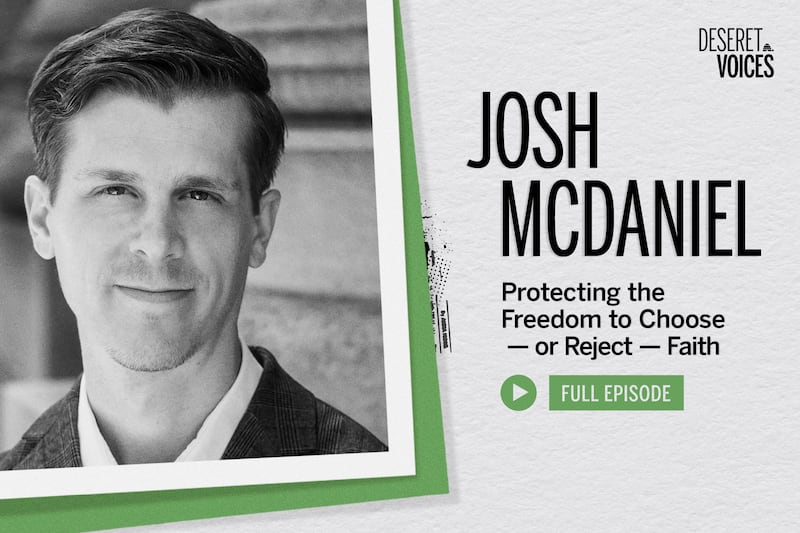
Josh McDaniel, an assistant professor at Harvard Law School and director of the Religious Freedom Clinic at Harvard Law, discusses how these questions of religious liberty have impacted people of different faiths and even people of no faith.
On this episode of “Deseret Voices,” host Jane Clayson Johnson asks McDaniel why he says religious believers are often the canary in the coal mine.
Subscribe to “Deseret Voices” on YouTube, Apple Podcasts or Spotify.
Note: Transcript edited by Steven Watkins.
Jane Clayson Johnson: Josh McDaniel, assistant professor at Harvard Law School and director of the Religious Freedom Clinic at Harvard Law. So nice to have you.
Josh McDaniel: It’s really good to be with you, Jane.
JCJ: How would you describe the landscape for religious liberty in this country right now?
JM: The landscape is a changing landscape. You have a Supreme Court that is looking at and kind of looking at all angles and reconsidering some of the doctrines that have been around for a long time, the Free Exercise Clause and the Establishment Clause of the First Amendment. And the Supreme Court’s giving a really hard look to both of those clauses to try to make sure that we’re striking the balance correctly in terms of how we interpret those clauses and what they protect. Can the government do things to promote religion without running afoul of anti-establishment principles? These are really important questions that I think we’re going to see played out in the courts in the coming years.
JCJ: What does religious freedom actually mean? Give us a working definition.
JM: Religious freedom is the right to be able to outwardly and openly practice your faith and do what your faith requires of you without restriction, in particular from the government. So we have the First Amendment protects the free exercise of religion. And that protects you and me and everyone from the government coming in and taking actions or passing laws or imposing restrictions that prevent us from exercising the most deeply held convictions that we have as a safeguard so that we can live our faith without impingement.
JCJ: Is religious freedom a zero-sum issue that benefits only people of faith?
JM: No, absolutely not. We have protections for religious freedom, not only on the free exercise side, but we have protections that prevent the government from establishing a religion or coercing religious practices. And that would apply equally to somebody whether they’re religious or not. And in addition to that, when court rulings are achieved, or you have these legal victories, securing religious freedom for people of faith, that has a trickle-down effect for other people, people of other faiths, and also people of no faith.
One of the examples of that is in the early 1900s, you had a slew of cases from Jehovah’s Witnesses. Most of us have never thought about whether if you go knock on your neighbor’s door to ask them a question or maybe to circulate a petition. Or maybe your daughter is selling Girl Scout cookies, or maybe you want to talk to them about, “We’ve got some issue with garbage collection on our street.” We normally don’t think when we do that, “Oh, I might get a criminal citation if I go do that, if I go knock on my neighbor’s door.” But that could have very well been the reality that we were in if it weren’t for the Jehovah’s Witness cases where they were going door to door and they were proselytizing and towns throughout America were passing these ordinances saying, “If you want to go knock on somebody else’s door, you need to go get a permit from the mayor’s office first. And if you don’t get that permit from the mayor’s office first, then we can give you the criminal citation for doing that.”
The Supreme Court most recently looked at that in 2002 in a Jehovah’s Witness case, and the court was very clear that we’re not just protecting the rights of Jehovah’s Witnesses in this case. We’re protecting the rights of everyone, whether they’re religious or not, to be able to go door to door and to be able to spontaneously speak with a neighbor, because it’s just that basic and fundamental of a freedom that we really should not have the government being able to interpose itself in between those kinds of day-to-day interactions that we might be having.
JCJ: In years past, it was often liberals who were, you know, protecting these religious liberty issues. And somehow it’s changed. Can you talk about that evolution?
JM: Yeah, so you see this really interesting evolution. If you were to go back to the 1960s, 1970s, 1980s, the main proponents of religious freedom, in particular for minority religious groups, would have been the political liberals. You see this in terms of the court decisions in the Supreme Court, it would have been the liberals that were on the side of the religious claimant in the case, and it would be the conservatives who were on the side of, “Hey, we’re skeptical about allowing exceptions to these generally applicable laws, religious accommodations.”
And the conservatives would be the ones to look for ways to rein in those religious accommodations, oftentimes out of a view of, “It’s judicial activism to be allowing exceptions to these laws based on religious freedom grounds.”
You had this pivotal Supreme Court case in the early 1990s where the Supreme Court weakened religious freedom protections, and you had a bipartisan backlash to that where liberals and conservatives all said, “We don’t think the Supreme Court decision is right.” They banded together and passed the Religious Freedom Restoration Act. And you had both liberals and conservatives across the spectrum nearly unanimously stepping up and defending religious freedom at that time.
But since that time, you’ve had this reversal where it’s now mainly conservatives who are on the side of religious freedom and it’s often liberals who are skeptical of religious freedom and thinking that maybe we need to rein it in and not be so liberal about granting these protections.
JCJ: And why that shift?
JM: A lot of the change happened because of the culture war issues, and in particular, concerns about conflicts between LGBT rights and religious rights. Concerns that a religious landlord might want to exclude LGBT tenants from their property, and would then claim a free exercise First Amendment right in order to have the right to do that.
It was primarily those kinds of issues that caused the left to sour on religious freedom and to turn away from it. And a lot of the work that we’re doing in the Religious Freedom Clinic is to try to remind everyone across the spectrum that the vast majority of cases don’t involve those types of issues, and we need to recognize how fundamental and how important this right is, and that it absolutely is something that we need to preserve to its core.
JCJ: You have said that religious believers are often the canary in the coal mine. What did you mean by that?
JM: Religious minorities often face the brunt of hostile or careless or callous government action where you have government officials that don’t want to be accommodating. It’s often going to be the small minority religious groups, the unpopular religious groups that face that first. And so, at different times in our nation’s history, we’ve seen that be trained on different religious groups. It might have been Quakers in the colonial times or the Revolutionary War times. It might have been Jehovah’s Witnesses in the early 20th century. It might be Muslims or Sikhs or Jews or other religious groups today. But you often see the government taking action against these religious groups, and then that foreshadows other ways that the government might act towards other groups.
And again, I would go back to that example of the way that Jehovah’s Witnesses paved the way in a good way for Black civil rights activists. You could also imagine if we had kind of flipped what happened in that kind of a situation, had the Supreme Court not vindicated the rights of the Jehovah’s Witnesses in those cases and ruled against them, that may have made the path a lot more difficult for the Black civil rights movement to proceed a few decades later without those victories and without that trail blazed by the Jehovah’s Witnesses in those earlier cases.
JCJ: Elder Rob Daines gave a talk at Brigham Young University about religious freedom and said something really interesting. He said, “When it comes to religious freedom, we have legal precedent sufficient for our needs. What we don’t have in enough abundance are people willing to love, sacrifice for, and compromise with those who don’t share their faith or values, not as a strategy, but because of who we are, who they are and who we are called to be.” You agree with that?
JM: Yeah, 100%. I think one of the really interesting things about religious freedom is to look at the intersection of religious freedom and politics or political ideology and how that’s shifted over the years, that could be symptomatic of what Elder Daines is talking about when he says that we need to be Christlike. We need to be loving. People need to understand the value of religion if we’re going to understand why religious freedom is something worth preserving and protecting.
In order to accomplish that, I think Elder Daines is exactly right that we need to be exercising our faith in ways that are showcasing the value of religion, the value that we as people of faith can bring in terms of serving in our communities. If you’re lacking that, and if people don’t understand why religion is important, you can very quickly and easily get into a situation where people just don’t understand why religion is important. They don’t understand why you need to have that freedom to be able to practice your faith, and oftentimes they’re going to look at it as, “Well, you’re just looking for some kind of special privilege other people wouldn’t have.” And for people of faith, that’s really not at all what it’s about.
JCJ: What is it about?
JM: It’s about their relationship with God and being able to do what for them is perhaps necessary for their salvation or necessary to live a life faithful to God.
We have a case representing the Amish in Ohio, and it’s been a really fascinating experience working with them because they can’t email. They can’t pick up the phone. It presents a lot of challenges in terms of how do you even communicate with your clients if we need to tell them something? How do we actually relay that message to them when they don’t have any kind of technology that they can use to communicate with?
The basic facts of the case are that Ohio passed a law requiring all horse-drawn buggies throughout the state to install an electric flashing light on top of the buggy. And if you think about that, that’s really only going to target the Amish. It’s not going to apply to anyone else because they’re the only ones who are driving buggies on the streets. And for the Old Order Amish, it imposes a requirement on them that is just absolutely contrary to their faith. It’s a deal-breaker for them. It’s something that they absolutely cannot do, and I’ve been really amazed seeing the faith and the resilience of this people.
They went about two years under this law where they had no counsel to represent them. And during those two years, they were receiving criminal misdemeanor citations every time that they used their buggies to go to the store or to go to worship services. And we learned through talking to them that they would rather go to jail or lose their farm than violate this religious principle that they had.
JCJ: Why does that Amish case matter beyond the Amish themselves?
JM: It’s important for, obviously for the Amish, but then in any other kind of case where the government is restricting our freedom in any other kind of a way, it shows that the government is able to accommodate and is able to act in ways that are not going to unnecessarily infringe on our beliefs.
JCJ: How do you preserve robust religious liberty without compromising the government’s constitutional obligation to stay neutral among faiths and honor people even without faith?
JM: It’s a tricky balance, and it’s why we have both the Free Exercise Clause and the Establishment Clause of the First Amendment. I would say that I think for a long time, the Supreme Court and more broadly as a society, we weren’t getting that balance right. I think we were erring far too much on the side of, “Well, we don’t want the government to do anything to take the side of religion.” And so the government can’t do anything that would in any way benefit religion. Even to the point that you might have, for example, a funding program that a government, a state government has where it gives out funding to all kinds of schools.
For example, if a state government were to say, “Well, it can go to all of the secular schools, but not the religious schools.” For a long time, I think most courts would have said, “Well, yeah, that’s right. We can’t have any, a single dollar of tax revenue go towards a religion because that’s supporting religion, and that’s putting a thumb on the scale.”
I think what we’re trying to work through now, and what you see the Supreme Court working through in a lot of its recent decisions, is to say, “Well, that’s actually discriminating against religion to exclude the religious groups from something that might be generally available.” Obviously, we wouldn’t want to say that just because we don’t want the government to be supporting religion, that if the fire department sees a fire, but then realizes, “Oh, well, it’s a church building that’s on fire. We’re not going to go put out the fire on the church building because we don’t want government to be using its tax dollars to be helping a church.” That would be getting it wrong in a really egregious way, and so we need to adjust kind of how we’re thinking about it and realize that you often can both make sure that government is preserving religion and protecting religion, in a way that doesn’t choose between religions, that doesn’t prefer one religion over another, or that doesn’t penalize anyone for lacking religious belief. But at the same time, we can also robustly protect religious free exercise protections, allow religious accommodations for people of all faith. I think it can be done. I think it can be balanced in that way.
JCJ: Well, let me ask you more about that, because the Trump administration just recently challenged the longstanding American principle of separation of church and state. And a draft report of the president’s Religious Liberty Commission stated that instead of a separation between church and state there should be “bridge building between church and state.” Is that just a change in rhetoric, or does it represent a fundamental shift in understanding of the First Amendment?
JM: This goes back to what I was saying about realizing that, for example, the Free Exercise Clause of the First Amendment, the Establishment Clause, they’re not at odds with each other. They’re complementary. They’re both intended to be protecting the same thing, which is the right of all people to be able to exercise their faith or not without being restricted or coerced by the government. And you can have the government absolutely building bridges and providing the conditions where every faith and every non-religious organization as well can flourish and can do the good work that they need to do. I see that as a very positive development for the government to be doing that.
JCJ: If the government begins actively bridge building with religion, how do you ensure that those bridges extend not just to the religious majority, but also to smaller communities, to Jews and Muslims and Sikhs and Hindus and even atheists?
JM: That’s part of the reason that organizations like the Harvard Religious Freedom Clinic and many other religious advocacy groups that are out there, we are all very committed to a pluralistic vision of religious freedom. And so that’s something that we always have our ear to the ground on that, and we’re always paying attention to that. And I think it’s something that community members, voters, just anyone. You don’t have to be a lawyer to be kind of following this and following what the government is doing and standing up for that principle of religious freedom for all and equal treatment under the law for everyone. Oftentimes, it doesn’t always need to be handled in a lawsuit. It can just be something where we see something, we say something.
JCJ: Do you see ideological coalitions still existing when it comes to religious freedom?
JM: We worked on a case recently involving a Native American sacred site. You had the Western Apaches had this land in the Tonto National Forest in Arizona that was sacred to them, and the government was going to give it to a mining company to mine for copper. And the coalition of different religious groups and interest groups that you saw coming in to file amicus briefs to support the Western Apaches in that case was pretty incredible to behold. And it was right, left, center, virtually every religious group, including The Church of Jesus Christ of Latter-day Saints, coming out to try to defend that principle on behalf of this religious group that obviously very few share the religious beliefs of this small religious group. But everyone understands that there’s that principle that we need to stand up for.
JCJ: Let me ask you about what’s happening in Texas, because the State Board of Education there approved a mandatory statewide reading list for K-12 public school kids, which requires students to read passages from the Bible. Also, the U.S. Supreme Court rulings have recently seemed to allow for a greater role for religious expression in public life, whether that’s prayer by public employees or religious displays. Are we seeing a shift here in First Amendment jurisprudence, or do you think that this is the Supreme Court just returning to what it believes was the original understanding of the Constitution?
JM: So I would distinguish between what you see from some of the recent Supreme Court decisions and some of these laws like the Ten Commandments law or the required readings law that you mentioned, and I would say that the Supreme Court has not yet passed on those, and I think the answer may very well come out differently for those types of laws.
There was a public school teacher that had a small crucifix at her desk as kind of an expression of her religious beliefs and was disciplined by the school district for having that crucifix at her desk over concerns that that’s then going to send the wrong message to other students. My view of something like that would be that we need to be comfortable with somebody having a crucifix necklace or wearing a hijab or in other ways privately expressing their own faith, even if they’re one of the millions of people that work for the government.
At the same time, for me, there’s a line when it comes to coercing or having required religious instruction in a public school setting. I think there are First Amendment questions about that, and I think practically, just from my own perspective, I’m very skeptical about the government coming in and being the educator when it comes to religion. I feel like you’re inevitably going to run into a situation where the government is going to have to pick or choose which denomination’s view it espouses when it does something like that, and you’re going to run into issues inevitably if the government is doing something like that.
JCJ: I recently saw a cartoon, and I wanted to get your thoughts on it. It says, “Yes, you were a believer, but you skipped the not-being-a-jerk-about-it part.” I’d love your thoughts about that.
JM: That’s a great cartoon. Yeah, I think that has a lot of resonance with what we see in religious freedom cases. I think perhaps in decades past, we’d gone too far in the direction of saying we need to shut religion completely out of the public square as a matter of not offending anyone’s feelings. That may have been taken too far, and you have a lot of people who nowadays are saying, “Well, let’s be kind of more open about religion. Let’s bring it into the public square.” I think you should have the right to do that, and I think we should be comfortable with religion being expressed, but I think to the extent that we allow religion to be expressed, and we recognize those rights, and we do that robustly, I think for the faithful, there needs to be some cause for introspection to think, “OK, hold on, I now have this kind of robust right, but how am I going to use that? How am I going to express my faith? And will I use it as a cudgel against other people? Or is this really about kind of my relationship with God and being able to sincerely pursue that?”
JCJ: What do you wish most Americans understood about religious freedom, about religious liberty issues?
JM: What I wish more people understood is that religion is something that it can almost always be accommodated. It can almost always be allowed to flourish without sacrificing the values and the interests that we might have with whatever we’re trying to do, and it’s one of the kind of neat ways about the way that the law works in this area is courts often require the government to come forward, and they ask the question: “Is there some other way that you could accomplish what you’re trying to accomplish without infringing this person’s religion?” And forcing the government to go through that, you just see in case after case after case, there’s almost always a way to do that.
And to me, I think the broader lesson there is that just, you know, how we can be more accommodating in everything that we’re doing and the good that can come from that, from trying to find ways to accommodate and to kind of make life doable for people that are coming from very different perspectives, might view the world very differently, but we can do it. We can find ways to accommodate each other and not sacrifice anything about our own personal values.
JCJ: Josh McDaniel, assistant professor at the Harvard Law School and director of the Religious Freedom Clinic at Harvard Law. Thank you very much. Really appreciate your time today and these interesting perspectives.
JM: Thank you so much, Jane. It’s great being with you.