
This article is an excerpt from the weekly ChurchBeat newsletter. Sign up to receive the newsletter in your inbox each Wednesday night.
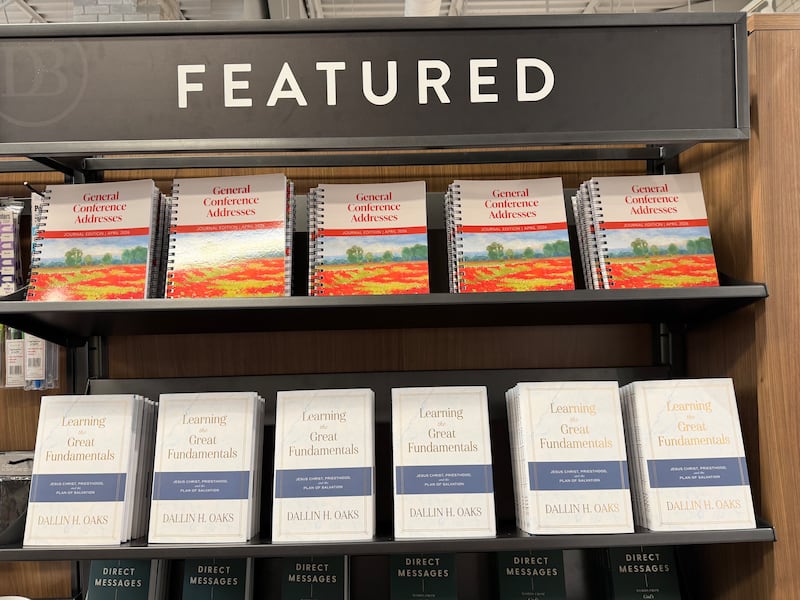
When President Dallin H. Oaks sat down on Sept. 21 to write the introduction to his new book, “Learning the Great Fundamentals,” he was the first counselor in the First Presidency.
Six days later, President Russell M. Nelson died. President Oaks succeeded him, which has made the book his first published while serving as the 18th president of The Church of Jesus Christ of Latter-day Saints.
President Oaks also recently published an essay in the latest edition of Deseret Magazine.
Here’s what you need to know about each publication.
The book
The introduction President Oaks wrote for the book is a personal one.
He notes that when he first read the Book of Mormon as a teenager, it was for its exciting history and not its doctrine. He was not able to focus on gospel learning as a missionary because his National Guard unit was mobilized during the Korean War.
This leads to an interesting portrait of President Oaks.
Imagine him as a recent BYU graduate stationed at Fort Sill, Oklahoma, for a 17-week basic course for field artillery officers. That’s where he read “Jesus the Christ,” the first gospel book he studied intensely, he wrote.
His introduction to the book also shares how he began a systematic study of church doctrine when he was 31 and was called to serve in a stake presidency.
He shares his line-upon-line story of continuing to learn as BYU’s president and a new member of the Quorum of the Twelve Apostles.
It’s a very relatable view of the church’s president and prophet. (For example, I was grateful during a nine-week stay at the Missionary Training Center to turn to my grandfather’s copy of “Jesus the Christ” after completing the Book of Mormon.)
Deseret Book issued an invitation to President Oaks during the winter of 2024-25 to write a book on gospel doctrine. He chose to focus on Jesus Christ, the plan of salvation, and the priesthood and its keys.
The book, released this winter, has 22 chapters on various doctrines. Each chapter is drawn directly from dozens of talks or writings delivered by President Oaks in the past.
The essay
America’s founders wrote a Constitution reliant on a people grounded in religious teachings about right and wrong, President Oaks argues in his 964-word magazine cover essay.
The essay’s release coincided with the church’s worldwide fast for religious liberty, called for by President Oaks and the rest of the First Presidency.
The founders provided the First Amendment to preserve that foundation of moral and religious teaching for the benefit of the people of the United States.
The essay is titled “The First Freedom: Why religious liberty remains the foundation of American self-government.”
In the essay, he quotes John Adams, who said, “Avarice, ambition, revenge, or gallantry would break the strongest cords of our Constitution as a whale goes through a net. Our Constitution was made only for a moral and religious people. It is wholly inadequate to the government of any other.”
President Oaks makes similar assertions.
“Only those principles (of right and wrong) in the hearts of a majority of our diverse population can sustain that Constitution today,” he wrote. “I submit that religious values and political realities are so interlinked in the origin and perpetuation of this nation that we cannot lose the influence of religion in our public life without seriously jeopardizing our freedoms.”
President Oaks wrote that religion:
- Motivates personal service and generous charitable works by Americans, even on behalf of other nations.
- Motivates moral advances, including the abolition of slavery and the Civil Rights Movement.
- Motivates honesty and integrity.
- Motivates voluntary compliance to law.
- Grounds the Constitution in the religious principles of human worth and dignity.
The essay is adapted from a talk President Oaks gave at the Chapman University School of Law in 2011.
So it is, I maintain, that in our nation’s founding and in our constitutional order, religious freedom and its associated First Amendment freedoms of speech and press are the motivating and dominating civil liberties and civil rights. Religious teachings and religious organizations are valuable and important to our free society and therefore deserving of special legal protection.
About the church
Church leaders called on Utah Latter-day Saints to conserve water amid a statewide drought.
After appearing on “Music & the Spoken Word,” Andy Reid shared his best marriage advice for Taylor Swift and Travis Kelce.
The Church of Jesus Christ announced the groundbreaking date for the Coeur d’Alene Idaho Temple.
This ‘American Idol’ winner is headlining the concert at Utah’s biggest event for young adults.
Paul Oscarson, husband of former Young Women General President Bonnie L. Oscarson, died at age 80.
Church News Podcast Episode 302: Historian Spencer W. McBride on U.S. history, church history and religious freedom.
Latter-day Saint leaders were driven from their homes, a historian wrote, but they still insisted on religious liberty for all.
What I’m reading
Fun look at a 30-year-old who faked his way onto a major college football team.
There is a very smart new essay from my colleague and naturalized citizen Mariya Manzhos about her talks with regular Americans while driving across the country with her husband and children. She’s smart and observant and open to learning from others, and that makes this a really generous, thoughtful, highly recommended read.
Bear and Tiger Bachmeier are planning a concert. Here’s what could be on the setlist.
Sports can be a lot like religion.
Six bishops from an ultra-conservative Catholic group were excommunicated after holding unauthorized ceremony.
Catholic nuns are back in court fighting for religious exemptions.
There’s also this:
Behind the scenes