

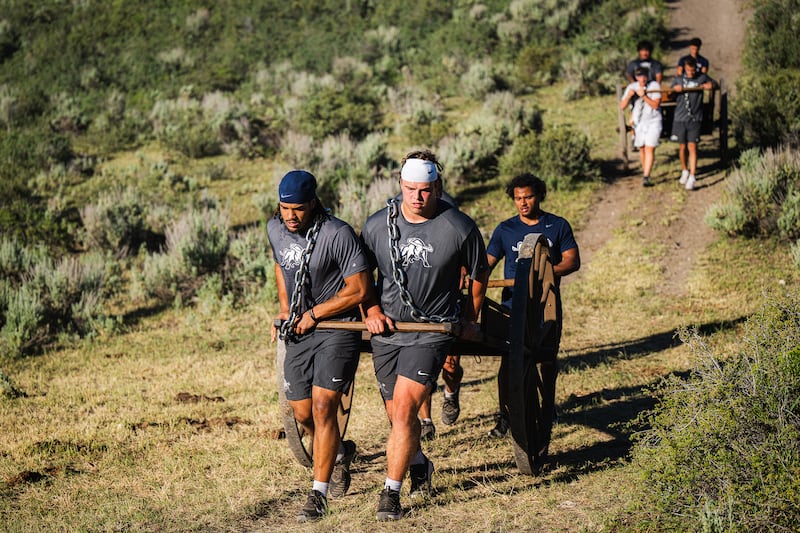

In late May, Utah State head coach Bronco Mendenhall sent out a simple text to his team saying there was to be a team meeting at 5 a.m. the following morning.
There was no explanation of what the meeting was for, just instructions for groups to split into and what shoes to wear.
Even as the team piled onto buses that early morning, players weren’t told where they were going. They didn’t go far; just 10 miles down the road from campus to the American West Heritage Center.
Mendenhall took the team there in hopes of gaining a deeper connection to the state and valley they represent.
“I realized when I arrived in Logan with so many new players and many not from the state, many from other institutions, and this is my home state, that a true college experience is in part the education of the history of the state,” Mendenhall said.
“How did it come about? How did people get here? How was Cache Valley settled? What are some of the stories?”
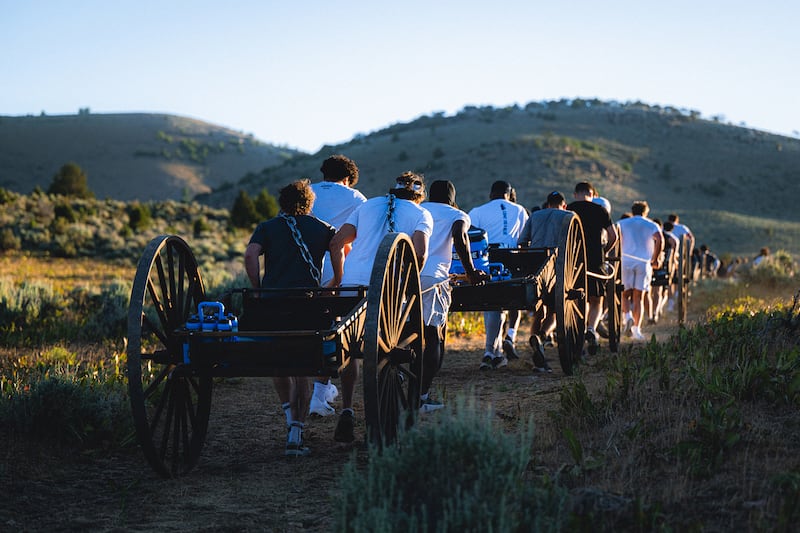
So, the team spent the day pulling handcarts and learning and experiencing the history of the handcart companies that traveled west to Utah.
Mendenhall also conducts a yearly event he calls ‘the interview.’ He describes it as a test each player must pass to play for his team.
This year, he decided to combine the trek with his interview.
“Rather than doing interviews the entire month of June, one at a time or in small groups, I decided that this event would be a team interview,” Mendenhall said. “It was just fascinating. I would say the team thought it was difficult. They completed it much faster than the organizers thought anyone could.
“But I also saw team dynamics, small groups, some working really well, some not working so well, which I bet would be the same as the families coming across to Utah. I saw some really excited about the event, and some maybe grumbling, and some pulling harder than others, and what that did with the cart, and also those just in complete unison, and then those keeping the whole group together.
Continued the coach, “The point is they got an experience of what it was like for a group of people that came to settle this state. They learned about the stories. They got a firsthand experience of what that might have been like in just a small context. They got to know their teammates better. They got to become closer as a true football team. I got to see different leaders emerge, which helped with the leadership council selection, but also, quite frankly, it connected them to this valley.”
In a fast-changing college landscape wherein capital and NIL rule supreme, Mendenhall says he was determined to give his team something more meaningful to play for. He hoped to give them an experience that they could take with them.
“I understand the landscape, and I’ve chosen to participate in that,” Mendenhall said. “I want to help Utah State at the very highest level do that, but without the educational part, without the experiential part, it is no longer college football.”