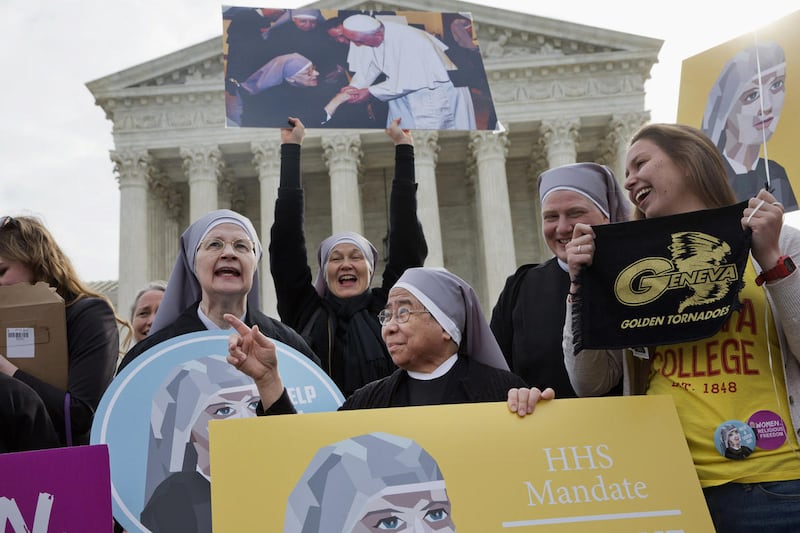

For more than a decade, a group of Catholic nuns who take care of the elderly poor has been enmeshed in a legal battle fighting to exempt them from providing contraceptive services in their health plans due to their religious convictions.
But even after the Supreme Court’s rulings in favor of the Little Sisters of the Poor, the litigation continued.
On Aug. 13, 2025, a federal-district court in Philadelphia sided with Pennsylvania and New Jersey, holding that the Trump administration’s religious and moral exemptions to the Affordable Care Act’s contraceptive mandate were “arbitrary and capricious” under federal law. The ruling invalidated the previous exemptions, once again exposing the Little Sisters and other religious employers to the contraceptive coverage requirement.
The case was back in appellate court on Tuesday, July 7, with Mark Rienzi, president of religious liberty law firm Becket and attorney arguing on behalf of the Catholic nuns, asking the court to block the nationwide ruling that exempted the Little Sisters from the government’s contraceptive mandate.
Rienzi noted that religious accommodations are “the best of our traditions.”
“And one of the reasons they are is they allow us to reach live-and-let-live solutions without having all or nothing fights,” he said at the United States Court of Appeals for the Third Circuit.
Despite nearly 15 years of legal and political battles over the contraceptive mandate, Rienzi said, there has been a point of agreement. Both the Trump and Biden administrations agreed that employers like the Little Sisters of the Poor, who object not only to providing contraceptive coverage but also to the government’s accommodation process, can receive a religious exemption.
He also noted that several Supreme Court justices, including Justices Elena Kagan and former justice Stephen Breyer, suggested the government had the authority to exempt groups like the Little Sisters. Rienzi argued that this broad consensus covers essentially every known religious employer that has challenged the mandate.
“That is a massive heartland and that includes all known religious employer cases to date, and these cases have been going on for almost 15 years now,” said Rienzi, who appeared on Tuesday at the U.S. Court of Appeals for the Third Circuit in Philadelphia.
The district court wanted to find cases “at the periphery” of the broad agreement and “sink the entire ship,” when it comes to religious exemptions.
“I don’t think that’s how APA law (the Administrative Procedure Act) works and I think you’d have to dramatically change how you do ‘arbitrary and capricious’ review to do that.”
Case background

The legal dispute in Little Sisters of the Poor v. Pennsylvania grew out of the requirement under the Affordable Care Act that employers’ health insurance plans cover preventive health services for women, including contraception and week-after pill.
When federal agencies implemented that requirement in 2011, they created an exemption for houses of worship but not for many religiously affiliated nonprofits, including the Little Sisters of the Poor. The Little Sisters argued that their Catholic faith prohibited them from providing, paying for and even facilitating access to contraceptives that they believed would end human life after conception.
In 2013, in response to objections from religious organizations, the Obama administration created an accommodation that allowed eligible nonprofits to notify either their insurer or the federal government of their religious objection. Then, the third-party administrator would provide contraceptive coverage directly to employees, without requiring the religious organization to pay for it.
But for the Little Sisters, even the accommodation of redirecting employees to a third-party contraceptive provider violated their religious beliefs and religious exercise under the Religious Freedom Restoration Act.
In 2016, the Little Sisters’ concerns reached the Supreme Court in Zubik v. Burwell, but the court sent the decision back to the lower courts without issuing a final ruling regarding the exemption for the Little Sisters.
A year later, the Trump administration issued new regulations that expanded exemptions from the contraceptive mandate for employers with sincere religious or moral objections. Those rules allowed organizations such as the Little Sisters to opt out of providing contraceptive coverage altogether.
In 2020, the dispute ultimately reached the Supreme Court again, this time in Little Sisters of the Poor v. Pennsylvania. In a 7-2 ruling, the court held that the Trump administration was right to give legal authority under the Affordable Care Act to create religious and moral exemptions from the contraceptive mandate.
The legal battle entered a new chapter when Pennsylvania, joined by New Jersey, challenged the regulations, arguing that the federal agencies had exceeded their statutory authority and had failed to follow proper administrative procedures.
If the Little Sisters didn’t comply with the federal law, they would have to pay tens of millions of dollars in fines. In August of last year, the district court sided with Pennsylvania and New Jersey.
Are religious exemptions ‘arbitrary and capricious’?
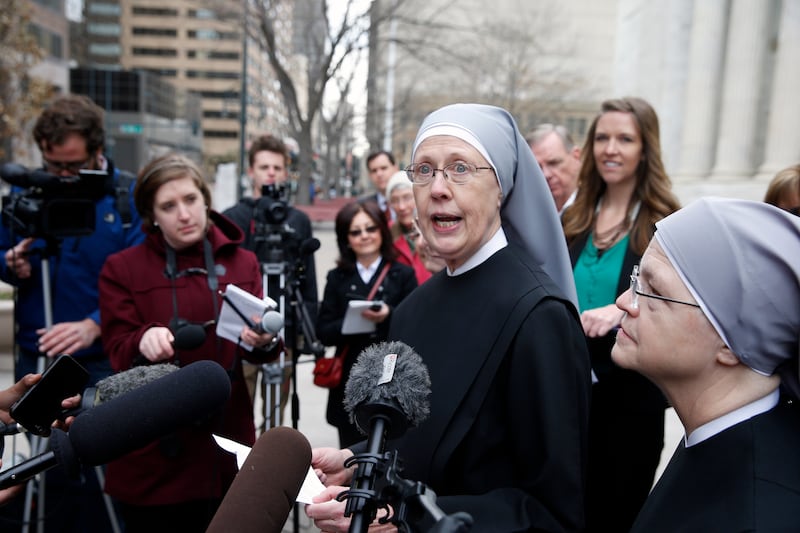
On Tuesday, Eric McArthur, attorney representing the federal government, asked the judges to reverse the district court’s decision. Many of the court’s reasons against the religious exemptions were “so clearly incorrect,” he said, that many of the plaintiffs didn’t defend them on appeal, and that some were in open defiance to what the Supreme Court decided.
He framed the central question as whether the federal departments acted reasonably in extending the religious exception to all employees who had religious objections to the contraceptive mandate.
McArthur described three categories of employers who objected to the mandate: those who objected to the mandate and the accommodation process, which redirected employees to a third-party for contraceptive coverage; those who don’t object to the accommodation and would use it; and those who don’t object to the mandate but would still decline to use it.
The argument of the district court focuses on a perceived mismatch between the government’s justification for the exemption and how broadly it was applied, he said.
“The key flaw in that analysis is that it rests on a basic misunderstanding of what the departments set out to do in this rule,” he said. “It rests on the mistaken notion that their sole objective was to do the bare minimum necessary to satisfy RFRA (Religious Freedom Restoration Act.)”
Rather than trying to fix the existing rules, the departments started from scratch and using their authority under both the Affordable Care Act and Religious Freedom Restoration Act decided that a broad religious exemption was the best way to address the various objections employers had raised.
McArthur argued that there was little evidence that the exemption actually prevented women from getting contraceptive coverage. “ On the other hand, there are real-world benefits to doing that. ... That gets them out of the business of having to have these intrusive inquiries into religious belief,” he said.
Judges raised questions about sincerity of the objection based on religious conviction, and whether publicly traded companies could use a religious exemption.
Attorney Amy Thompson, who argued on behalf of Pennsylvania and New Jersey, focused less on whether religious exemptions should be allowed and more on whether the Trump administration lawfully justified the broad exemptions it adopted.
Her central argument was that the agencies failed to adequately explain their reasoning, making the rule “arbitrary and capricious” under the law. She also noted that the government failed to balance religious liberty with women’s access to contraception.
“Where the agencies are instructed by law and by the Supreme Court in Zubik to balance competing interests, they must actually balance those competing interests,” Thompson said. “And instead here, as Justice Kagan observed, they enacted a rule that was all cost and no benefit by granting an exemption that swept well beyond all religious employer cases to date that had been brought to the courts.”
Ultimately, the exemptions will be costly to the states, she said. Over 120,000 women would lose contraceptive coverage under the exemptions, she argued.
“ Women will either turn to publicly traded, publicly-funded programs for contraception or will forego contraception, which will lead to unintended pregnancies, half of which are publicly funded,” she said.
The case for religious exemptions
Rienzi argued that the government had several options for resolving the long-running dispute over the contraceptive mandate.
Instead of eliminating the mandate entirely or challenging whether Congress had properly given agencies the power to create it, the government chose a middle ground: It kept the contraceptive mandate in place for most employers, but created a religious exemption for groups with faith-based objections, like the Little Sisters. He argued that this approach both protected religious liberty and preserved contraceptive coverage for most workers.
He argued that the government acted within the authority Congress gave it, followed the requirements of the Religious Freedom Restoration Act and carried out the Supreme Court’s guidance on how to handle the issue. “Nothing about that is even close to arbitrary and capricious,” he said.
Rienzi also noted that Pennsylvania wasn’t able to point to any actual harm as a result of religious exceptions — there were no complaints from women or employers dropping coverage, or no increase in their budget for contraceptive services. “That makes perfect sense because there are a lot of ways to get contraception,” Rienzi said. Many people, he said, can get contraception in other ways.
Rienzi concluded his arguments saying that religious accommodations allow for a world where the federal government allows both the contraceptive mandate and religious accommodation for those who want it: “This court can stick with the best of those traditions.”
For Little Sisters, receiving the religious exemption would allow them to continue their “God-given mission,” said Little Sisters’ Mother Loraine Marie Maguire in a statement.
“For nearly 200 years we have welcomed the elderly poor and dying into our homes, and with the population of seniors rapidly growing we cannot allow a government lawsuit to stop us from carrying out our mission. Pennsylvania and New Jersey can keep fighting if they want. All we want is to keep serving.”