



The federal government updated the guidelines Friday that regulate the operation of the Colorado River’s largest reservoirs.
The government order includes mandated water cutbacks in California, Arizona and Nevada and comes as both Lake Powell and Lake Mead have hit record lows, according to the Interior Department.
The decision follows weeks of discussions about the Colorado River — a critical water source for seven states.
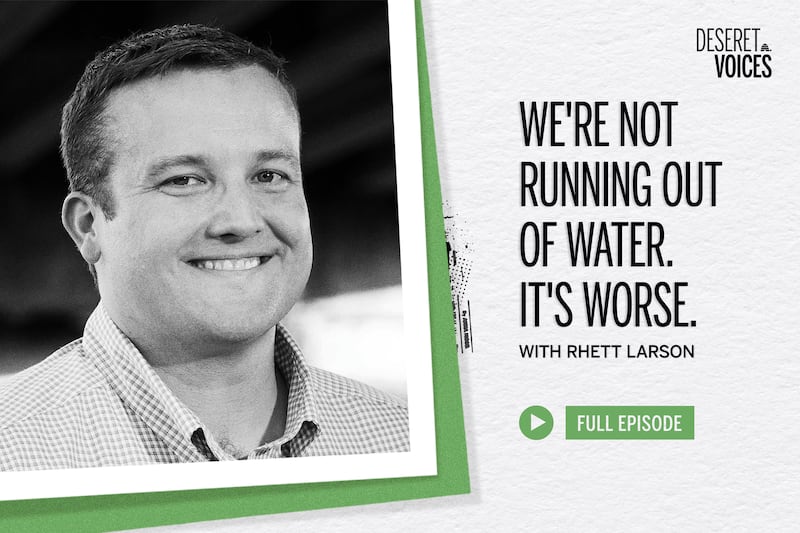
Joining the “Deseret Voices” podcast, Arizona State water law professor Rhett Larson likens the fight around the water in the Colorado River to bickering between siblings at the dinner table.
Larson says “it’s not just about pumps and pipes, it’s about respect and about relationships.”
On this episode of “Deseret Voices,” Larson chats with Jane Clayson Johnson about how to manage the battle over this precious commodity.
Subscribe to “Deseret Voices” on YouTube, Apple Podcasts or Spotify.
Note: Transcript edited by Steven Watkins.
Jane Clayson Johnson: Rhett Larson, welcome to the program. Great to have you.
Rhett Larson: Happy to be here.
JCJ: Lake Powell and Lake Mead, which are the largest reservoirs in the United States, have just hit record-low water levels. If you look at satellite images of Lake Mead 30 years ago, there’s this full, deep blue lake. Now it’s nearly gone. And the same is true at Lake Powell, there’s a dramatic decline in water levels. How alarmed should we be? How alarmed are you?
RL: Well, I’ve spent my entire career trying to tell people to calm down about water concerns, and in the last two years, I’ve spent my time telling people they really need to get worried. So, I am an optimist, and even I am very concerned about where we are at in both reservoirs. The risks that we’re seeing with the drop in these water levels and with the change in our precipitation is such that I’m extremely concerned. I’m concerned about the long-term viability of energy production there, I’m concerned about the dependability of that supply, and I’m concerned about the policies that we’ve used in the past that are just not going — that were designed for a river that no longer exists.
JCJ: You’ve called 2026 a make-or-break year for the Colorado River, which supplies water to 40 million people and more than 5 million acres of farmland across seven states. We’re more than halfway through 2026. What is your assessment?
RL: My assessment is we’re in a lot of trouble.
The water levels in Mead have dropped 40% since 2025. We’re now 30 feet away from power pool in Lake Powell, and it is dropping around 3 to 4 feet a month, which means we are looking at the possibility of reaching power pool only in a few months. And what power pool means is Lake Powell will stop generating electricity. Dropping below power pool in Lake Powell may be effectively dead pool. And dead pool means no water is moving past the dam. And we’re now running into possible risks of reaching dead pool in Lake Mead, which means no water would move past that dam. And that water supply is what grows 90% of your winter vegetables. So if you live in the United States of America and you like affording a salad in the wintertime, you eat Colorado River every time you eat lettuce and cabbage. Any leafy green vegetable you’re eating in the wintertime, you’re eating Colorado River water. And if no water is moving past that dam, you, wherever you are in this country, will ultimately pay the price in both the grocery store and in your nutrition.
The reason 2026 is a make-or-break year is because the rules that govern how we share the Colorado River when there’s not enough water, all of those rules expire at the end of 2026. And we have collectively failed to create new rules. So right now, there’s no real law after 2026. And we are about to have laws imposed on us by the federal government, and that imposition along with the ongoing conflict means that we are likely to descend into litigation after this year, and that will just compound the uncertainty that we already get from Mother Nature with a whole legal uncertainty. So, I’m concerned.
JCJ: What does it mean in practical terms for big cities like Phoenix and Las Vegas and L.A. for drinking water supply and for farmland?
RL: Cities will have no choice to make but to make alternative investments either in conservation or in buying alternative supplies. And whatever choice the cities make, those choices will be expensive, and they’re going to pass those costs on to ratepayers. So your water utility bill will go up. Also, that water goes to generate electricity wherever you are, which means your electricity bills will go up. And all of that water, as I said before, produces an enormous amount of food. And as we cut water to agriculture, which uses, depending on where you’re at in the basin, between 70 and 80% of the water that flows through the Colorado River, as that water gets cut back, you’ll ultimately pay the price in the grocery store.
JCJ: So higher costs across the board. Electricity costs are going up, water rates are going up, food prices are going up.
RL: Absolutely. The phrase that I constantly keep trying to tell people is we are not running out of water. We are running out of cheap water. So we can get you all the water that you want, but you’re going to have to pay for it.
JCJ: So what’s at the heart of this? Is it population growth? Is it too many people moving to the desert? Is it agricultural water use, data centers, climate change, or a combination of all these things?
RL: Well, it’s certainly a combination, but I think people who live outside of the Colorado River, it’s very easy for outsiders to go, “Well, these dummies all moved to the desert. What’s the matter with them? Of course they’re running into this problem.” We grow food in deserts not despite the climate, but because of the climate. If you tried to move our food production from the Colorado River Basin to Georgia, the food production would plummet, because we don’t have floods, we don’t have freezes. And so we have constant sunshine, which means we produce a lot of food. So saying, “Well, you should just grow less food and fewer people should live there.” Growing food and living in the desert is an ancient practice. Living in very cold cities is a new practice for human beings, and it has its own sustainability challenges.
In the past, we’ve been able to rely on a river that was fairly reliable. It’s much more variable now, and part of that is because we’re getting more frequent, more intense El Niño years with climate change. And those El Niño years mean that we might get wet winters, but our air and our soil is so hot and dry that a lot of that snowpack never even makes it to the river. And that has changed the makeup of the river to the extent now that we really have to think about managing what we used to think of as an 18 million acre-foot river, we have to start thinking about managing it more like an 11 million acre-foot river.
JCJ: So, Rhett, break this down for us. How much of the Colorado River goes to agriculture, and does any serious solution here need to involve farming? Are there crops being grown in the desert that simply don’t make sense anymore?
RL: There’s no way forward right now that doesn’t involve less water going to agriculture. So agriculture will use upwards of 70 to closer to 75% of all water in the Colorado River Basin goes to irrigated agriculture. And a 10% reduction in agricultural use doubles the amount of water available for everyone else. Now, the problem with that is that we’re all beneficiaries of what farmers do. They’re the ones that feed us. So you can’t cut water to farmers without all of us paying the price. But it does force us to ask hard questions about which crops are worth it to us. So some crops, like winter vegetables, are grown at a premium, and they’re very critical for national food security and for our nutrition. So those may be crops that are harder for us to turn away from. Other crops, like grove crops, nuts and citrus, they’re premium crops, that’s a lot of money per drop of water used that they generate, and it’s harder for us to temporarily fallow those crops. You can’t just say, “Well, I’m not going to water this part of my grove this year,” because then the trees die and it’s dead infrastructure that’s been grown over years. So where a lot of people point the finger is alfalfa, forage crops, the crops that go to feed dairy cows.
There’s 11/2 million acre-feet every year just to alfalfa in the Colorado River Basin. So there are a lot of very understandable voices going, “Just stop growing alfalfa and the problem’s solved.” That’s not a crazy thing to say, but let me make sure people understand how nuanced and difficult this is. First of all, farmers grow crops for a market. So as long as there’s a market demand for alfalfa, it’s hard to tell farmers don’t grow crops that people are demanding. They’re demanding that. And some people say, “Well, those crops aren’t even feeding people, they’re feeding cows.” But those cows are ultimately feeding people. They’re making milk, butter, cheese, beef. And so turning away from that is still going to have an impact on us. And so if we move away from alfalfa, we’re going to have to embrace higher beef and dairy costs. It doesn’t mean that perhaps growing less alfalfa isn’t going to need to be part of the solution, but it’s not a simple solution.
JCJ: There are big companies critical to our national defense, to our economy, that depend on the Colorado River. What happens if they lose that water supply?
RL: Some of our largest semiconductor manufacturing companies, our largest aerospace companies are all housed in this basin, and these are relatively water-intensive industries. They will not lose their water, and so they will find some source of water one way or another and use the power of their wealth in order to secure that water, which means they’ll go shopping for a water supply. And when those deep pockets start going shopping for water, it means they’re in the market, the same market that your city and your town and your water utility and your energy utility, they’re in the same market that they’re in.
And when there’s not enough of something in a market and everyone goes shopping for it, and then all of a sudden a really rich, desperate person comes into the same market, it’s going to drive the prices up. And so what it’s going to mean is water prices are going to go up, and water is going to get really, really valuable.
JCJ: And that’s Boeing, and Intel, and Raytheon and others. They can afford it and we really can’t.
RL: Right. And so we’re going to have to ask some really difficult questions about how do we continue to facilitate the growth of these really important sectors, important to our national security, important to our economic growth, but still find ways to make water rates affordable. And I know a lot of people will go, “Well, isn’t the answer just data centers? Can’t we all just get mad at data centers?” And here’s what I want to ask people when they point the finger at data centers, which is, what are you mad at? Because the semiconductor manufacturing industry uses more water than data centers, the beverage manufacturing industry uses more water than data centers.
JCJ: Really?
RL: And you’re not mad at them. Yeah. So, but you’re not yelling at them. Why are you not yelling at industries that use more water than the data centers? And oftentimes people will respond and go, “Well because those industries give me things that I want and they create jobs.” And I’m like, “Ah, now we’re getting to your real concern. It’s not that data centers use a lot of water, it’s that you don’t think you’re getting the return that you want on your water investment.”
JCJ: People don’t understand who uses how much water and what they get for it.
RL: Right, and this is a common problem where people will go, “Well, isn’t the solution just less houses? Fewer people live here.” But houses are extremely water efficient. The water that goes down your drain all gets recycled, so some people point at houses, but houses are actually really water efficient. Some people point at golf courses; golf courses are using a lot of recycled wastewater at this stage, they don’t really use that much water.
If you put together every single golf course in the entire Colorado River Basin, it’s less than 150,000 acre-feet. So if you wiped out every golf course in the Colorado River Basin, you would solve no problems. It’s just not enough water. A lot of people would lose their jobs, we’d lose a lot of tourism revenue, but no water problems would get solved.
So people will get — they’ll point at sort of easy culprits because they want to make what is a very, very difficult problem easy. And the answer is the problem’s not easy, and we’re all part of it, and we can all be part of the solution.
JCJ: Those data centers are really at the forefront of our lives right now with the growth of AI. I mean, how do you how do you bring those two pieces together? How do you have all the AI and all the technology and still have the water that you need to really survive?
RL: Well, we do need to have some conversations about use prioritization in the basin. And if we want to prioritize drinking water and municipal growth and industrial growth, we’re going to have to leave some things behind. And if we want to prioritize the tech sector, and we want to produce more semiconductors, and we want to have more data centers, we’re going to have to leave some things behind. And some of those things might be cheap houses and cheap food. And as the tech sector and the AI data center sector should appreciate, people are going to look at that and go, “You guys are newcomers into this, where housing and food are things we pay for everyday.” People are very understandably going to go, “I don’t like this newfangled thing, I’d much rather have cheap food and housing.” And that’s an attitude that the tech sector is going to have to embrace as a real obstacle to them.
JCJ: We had a record-low snowpack this year, a record heat this spring. One more bad season with not much rain or snow, and then what happens?
RL: The federal government would probably need at that stage to step in with some emergency procedures with releases from what we call upper initial units, so things like Navajo and Flaming Gorge dams that would release water from the Upper Basin to prop up those reservoir levels. But that would impact farmers and cities and communities in Colorado and Utah and New Mexico and Wyoming to prop up those water levels. And those water levels are certainly going to get cut flowing down to Arizona, Nevada, and California. So we might be able to find some emergency measures to prevent absolute catastrophe, but it — we’re struggling to talk to each other right now, and if we can’t talk to each other, it’s hard to see how we get over the political obstacles to respond to a hydrologic emergency, and then what is a political and legal crisis can rapidly become a wet water crisis. And so at this stage, the critical issue is we need to learn how to talk to each other better.
JCJ: Right, because seven states have been deadlocked for years over the rules that govern the Colorado River. Tell us exactly what they’re fighting about.
RL: For generations, the fight really was six states mad at California, but the politics have shifted in recent years, and it is now the Lower Basin, Arizona, Nevada, and California have united, and the Upper Basin, Colorado, Utah, New Mexico, and Wyoming have united. And it’s now that division. And the division really is the Upper Basin saying, “We still need to grow into the water that we’ve been promised. You all have been using even more water than you’ve promised — than you’ve been promised. We need to grow into it. And we’re facing a lot of drought conditions, we’re not sure we can deliver to you the water that has been promised.” And we are saying, or the Lower Basin is saying, “We’re 75% of the population of the basin, and 75% of the agricultural production, and 75% of the economic production, and you have a legal obligation to deliver us this amount of water, even if it means you take less water.” And neither side is particularly happy with the other side’s argument, and at this stage, it is fair to say that the negotiations have failed, and we are rapidly careening towards litigation, litigation between the states and potentially litigation against the federal government for the plan they are about to propose.
JCJ: And four states have lawyered up. I mean, they’re preparing for a Supreme Court battle here.
RL: Absolutely, and not just the four Upper Basin states, but Arizona and the city of Phoenix, and the Lower Basin is — unfortunately, the drums of war, or at least the drums of litigation, are sounding now, and I think that’s the direction we’re probably headed unless something dramatic changes things.
JCJ: And what would litigation do to the people who depend on this water every day?
RL: Sometimes litigation forces people back to the negotiation table. If that’s what litigation does, litigation is a positive move. But it’s as likely, if not more likely, that it will rapidly get bogged down into a 10-, 15-, 20-year-long conflict that will cost tens of millions of dollars, and with an uncertain resolution that’s ultimately going to be decided by nine lawyers who live in Washington, D.C., only one of whom has ever lived west of the Mississippi. So it’s a huge gamble to go into litigation and expect it to do what we want it to do, which is catalyze negotiations. And in that interim period, in those 10, 15, 20 years of conflict, Mother Nature may just take the wheel anyway and force us to make decisions that where the court simply doesn’t matter. And so it’s not like litigation gets us out of having to make hard decisions. It just creates an uncertain outcome and leaves a lot of those hard decisions still sitting in front of us.
JCJ: Take us back to the Colorado River Compact, which was written in 1922, when the water flow of the Colorado River was dramatically overestimated. How did that set up the problems that we’re seeing today?
RL: Well, in the latter part of the 19th century, early 20th century, the United States had all of this undeveloped desert land, and they wanted to get a lot of people to move there. Well, a great way to get a lot of smart, hardworking people to move to the desert is to make it a race, and to tell people, “Run as fast as you can into the desert, and if you win the race, you get the most valuable resource you can own in the desert: you get water. So run to the water!”
So people ran, and the first people who grabbed the water got superior priority to anybody who came after them. Well, that meant a lot of people were moving to California, and California started gobbling up the river. So all of the other basin states said, “We don’t want this rule to govern.” So we negotiated the Colorado River Compact that basically split the river between the Upper Basin and the Lower Basin. It gives 71/2 million acre-feet every year to the Upper Basin and 71/2 million acre-feet every year to the Lower Basin. In 1944, we reached a treaty with Mexico that guarantees them 11/2 million acre-feet. Add it all together: 71/2 million acre-feet to the Upper Basin, plus 71/2 million acre-feet to the Lower Basin, plus 11/2 million acre-feet to Mexico. We lose about 11/2 million acre-feet every year to evapotranspiration. That’s 18 million acre-feet that the river that we assume in the law the river has every year. But we know from tree ring analysis that the 1,000-year average amount of water in the river is about 131/2 million acre-feet. And the reason that we promised more water than the average river could deliver is that we based the data in the 1920s on flood years.
And so a lot of the conflict that we’re living with now is based on bad math from the very beginning of the law. And so, and people sometimes go, “Well, why can’t we just sort of tear the system back down again and rebuild a system that makes sense?” And that’s a beautiful dream, but so many property rights are dependent upon that old regime that to tear it down may create just as much uncertainty and conflict as the current system already creates.
JCJ: So the problems we have now, you could say, were based on a bad math equation back 100-and-something years ago.
RL: Had 100 years ago we just said, “You know what? How about every state just gets a percent of the water that’s available in the river this year?” So we’ll just have a flow meter at a certain — at a few places, and we’ll just say this state gets this percentage, and this state gets this percentage, because then it would automatically adapt to drought conditions, we probably wouldn’t even be in this fight anymore. And one of the sort of interesting things for people to think about is when the Congress sent John Wesley Powell, who Lake Powell is named after him, to the western United States to survey the Colorado River Basin, he sent a report back to Congress that said, “You need to draw the boundaries of the states in the western United States based on the river basin. Because if you don’t, you will, quote, ‘sow the seeds of conflict for centuries.’”
And he was right, and Congress heard good advice and ignored it. And instead of making us the state of the Colorado River, they used the river as a boundary line. And when you use a river as a boundary line, you create conflict. And so the closer we get collectively to not thinking of ourselves as Arizonans, or Utahns, or Navajo, or Mexicans, the closer we get to thinking of ourselves as all citizens of the river basin, the closer we get to the way that we’re going to get out of this mess. But the more we go into our respective corners, the harder it is to find a solution.
JCJ: The Colorado River is calling the shots.
RL: Yes.
JCJ: So some of these water rights, as I understand it, date back to the 1850s and ’60s, right? How do you make water rights from the 1800s work with 21st-century water needs?
RL: Now, this is an outstanding question because we built this part of our country on agriculture and mining, but our economies here are rapidly diversifying. And so the tech sector, the tourism sector, service sector, financial sectors, they’re all growing rapidly here, and — but a lot of these old water rights are locked up in farming and mining rights. And you can have these newer, wealthier, growing sectors come in and buy out some of these older rights, but these markets are very inefficient, and people aren’t terribly rational about their water rights. You know, people tend to be pretty rational about their car, right? A car is the value that it is; if you pay me more money than it’s worth, I’ll sell my car.
But water’s different; we feel differently about water. You know, we don’t squirt each other with gasoline in the summertime, we don’t throw each other — we don’t throw lumps of coal at each other in the wintertime, and we don’t baptize anybody in uranium. Water’s a unique resource, and because it’s unique, people are irrational about it. It has cultural meaning, symbolic meaning. And so people don’t tend to want to sell in ways that might make economic sense. And I tell people all the time, if you could summarize the problem, the water problem in the Southwest, it is that we have 19th-century laws, we have 20th-century infrastructure, and we have a 21st-century population, climate and economy.
JCJ: So speak more about that. What do you mean when you say water is a symbol of these other things, like sovereignty and respect? What does that mean?
RL: So again, maybe I’ll go back to being a dad. You know, if I sit down and I get dinner ready for the family, sometimes the kids will come to the table, and their arguments about sharing food will sound like water arguments. Someone will go, “Well, I got here first!” And someone will go, “But I’m the biggest, I need the most!” And someone will go, “But I’m the smallest, I have to grow the most!” And someone will go, “I’m the middle kid that everybody ignores! Why don’t you people pay attention to me?” And that sounds like a water argument. And sometimes when you listen to that argument, you think, “Oh, the food at the dinner table is actually just a symbol through which these kids are making arguments about their place in the family and about being respected and seen.”
And sometimes with water, that’s the argument as well, that what we’re really arguing about is feeling respected, or feeling seen, or having our sovereignty or our culture respected. I’ve worked in water basins all over the world, including in the Jordan River Basin, and the conflicts in the Jordan River Basin between Jordan and Israel and Palestinian territories is very intense. There are lots of engineering solutions, but those engineering solutions don’t address the fundamental question, which is what the water means to the people as a symbol of who they are.
I was once working on an issue where there was a conflict between water users, and somebody said, “I don’t want their water, I want our water.” And when you get into conflicts and you realize, “Oh, this actually isn’t about the water, it’s about what the water means,” those are especially difficult conflicts to overcome because then it’s not just about pumps and pipes, it’s about respect and about relationships.
JCJ: And is there a moral obligation, to your mind, of sharing this finite resource? Is it some sort of stewardship that you see?
RL: There’s no question that there is a stewardship and that there is a an obligation on every water user right now to perhaps consider pulling the beam out of their own eye before they go looking for the mote in their neighbor’s eye, that we begin the water debate by looking first at ourselves and saying, “What am I doing wrong? How can I fix the problem? How am I part of the challenge, and how can I be part of a solution?”
Right now, it seems like everyone wants to run around and point their fingers at everybody else who’s using water irresponsibly, and I think there is an obligation on each one of us to go, “I should look at myself first and ask myself, ‘How do I become a part of a solution, and how have I been part of a problem?’”
JCJ: Well, let’s name names. I mean, California’s the largest user of Colorado River water. Can you solve this crisis without California giving up substantially more water?
RL: I don’t think that there’s any way for this problem to be solved without everyone, from California to Colorado, from the Navajo Nation to Los Angeles, from the United States federal government to Mexico, everyone has to put a commitment on the table that they will be held accountable for, that says, “We will make these sacrifices for the good of the entire basin.” And that means I think California has to do it, Arizona has to do it, everyone has to make enforceable, accountable commitments to help solve the problem.
JCJ: So what does a durable solution actually look like? Is there a model from another river system that gives you hope here?
RL: You know, it’s challenging because I will sometimes hear people say, “Well, why don’t you just act more like Australia?” So Australia, in the Murray-Darling River Basin, was facing a lot of the same challenges that we were facing, and Australia dramatically changed their water rights regime. They moved away from something that looked a lot like what we have towards something that we might have — maybe should have done from the beginning, which is everyone, rather than having quantified rights to water, they just get a share in the available water, and then that share is easily tradable. There’s a market that allows you to trade your shares, like a stock market.
I’ve also had people say, “Well, why don’t you just act more like Israel?” Israel’s exceptionally water efficient. Israel grows all of these crops on very little water. It’s built lots of desalination plants. And I tell people, yelling at the southwestern United States to be more like Australia or Israel is a little bit like yelling at your dog to be more like a bird. We just don’t have very much in common with those countries. Israel — in Israel, the government owns all of the water, and they have a relatively small population that lives mostly close to the coast. So it’s just a completely different environment.
And in Australia, I tell people, if you tried to come into the United States of America and do what you did in Australia, Americans would lose their minds. They would sue. For better or for worse, Americans are very protective of their property rights, and they have a lot of confidence that the judicial system will vindicate those rights. And there are good things and bad things about that cultural difference that we have with Australia, but it is a cultural difference that we have to accept means that solution in Australia is probably not one we can just transplant into the United States.
So what does a durable solution look like? Look, we lose 11/2 million acre-feet every year just to evapotranspiration. The water just flies away. In my mind, we should just accept that that water flies away every year, and we should make everybody in the river basin take their share of that cut, say, “You know what, based on how far your water is moving and how much of the canal is unlined, you’re going to take a little bit less water to account for that 11/2 million acre-feet that flies away every year.” And then we’re going to have what might be called a reverse auction, which is to say, who here is willing to sell out their water right at what price? And then we can have buyers who can come in and buy out farmers who might be looking to sell out at a particular price.
And then we need to have a whole new reimagining about an augmented water supply where the federal government is starting to devote more of the resources it’s been using in the East for flood protection towards the Southwest for drought protection, and that will mean diversifying our supply, more desalination plants, and more flexibility for water exchanges between the different jurisdictions in the Colorado River Basin. That flexibility and augmented supply, plus some of the conservation we would achieve with a reverse auction and accounting for evapotranspiration, might get us pretty close to an agreement that can last.
JCJ: I guess the bottom line is we can’t engineer our way out of this. I mean, water conservation is unavoidable. I mean, that simply has to be part of this equation, using less water.
RL: Yes, there’s no way out of this that doesn’t involve more water conservation, and, you know, one of the interesting things about this conflict is it is the clash of two maxims that we have in water policy that we say all the time. One is, it’s better to be upstream with a shovel than downstream with a right. And that’s the Upper Basin’s advantage: they’re upstream with the shovel. But there’s another maxim we say all the time, which is, listen, water doesn’t flow downhill, water flows to money. And the money’s in the Lower Basin. And so it becomes this clash of the titans, money against hydrology. And ultimately, can money buy our way out of a hydrologic crisis? And it’s either going to be buying really expensive water, like desalinated water, or it’s going to be buying conservation. And most of the low-hanging conservation fruit at this stage has been picked. The Southwest United States is a pretty darn efficient place to live when it comes to water. Most of the extra conservation that we can get now will be expensive conservation.
JCJ: So 25 years from now, do you think Americans will still be able to live and farm and build cities in the Southwest the way they do today?
RL: Yes. I remain optimistic about the future of the southwestern United States. It will be a different future, it may be a future that’s less dependent on the Colorado River and more dependent on alternative supplies. It will certainly be a much more water efficient future, but it’s still a bright future. We have a history of coming up with solutions, and we’ve had a history of solving these problems.
I confess I am concerned that we don’t seem to be as good at it as we used to be. I’m not sure why that is. Part of me wonders if it’s because our economy has diversified so much that back in previous generations, so much of our communal and business and civic leadership was coming from mining and agriculture, and so that’s where a lot of our political leadership came from, and so they were a very water-literate leadership. Now so much of our leadership is coming from these new sectors, and they aren’t as water literate, and so maybe that’s part of the problem.
I also worry that partisan politics has infected water politics, and it’s dividing us in new ways that are making reaching agreements more difficult than they have been in the past.
Nevertheless, I still am optimistic about the future of the Southwest. Water, as many times as I’ve seen it create conflict, most of the time, water is a force for uniting people. As I said earlier, we created our first civilizations on the banks of desert rivers for a reason. Desert rivers are the great incubator of human innovation and collaboration, and I still believe in that. And as a teacher who teaches this next generation, every day that I’m in the classroom, I get more and more hope about that future, because we have an amazing generation of leaders coming.
JCJ: Rhett Larson, water law professor, Arizona State University. Such an interesting conversation, and really appreciate your insights. Thank you.
RL: My pleasure. Thank you.