

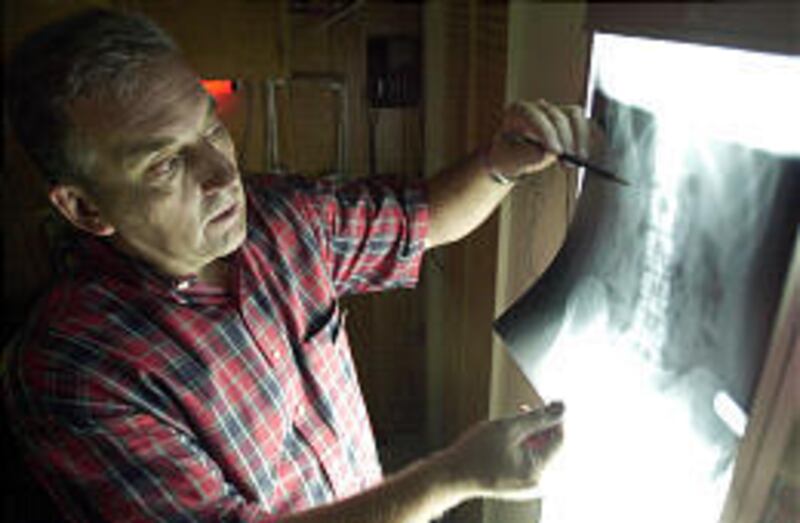
On Nov. 16, 1996, Kelly Jarvis, a Heber City chiropractor, decided to make a little run to Park City to buy a storm door and maybe stop at a local health spa to swim. He never arrived. In the space of a heartbeat, his small Nissan pickup was demolished in a head-on collision with a much heavier vehicle driven by a drunken driver, and Jarvis was battling for his life.
He wasn't yet aware that another, more prolonged battle awaited to meet the financial burdens inflicted along with the physical injuries.
Just a few miles short of his destination, traveling on U-248, he saw a large Suburban on his side of the road, heading right for him. "There was no time to react, no place to go," he says.
The speeds of the vehicles, estimated at 60 mph and 45 mph, respectively, created delta forces 25 times more intense than those in the well-publicized crash that killed England's Princess Diana in Paris in 1997.
Jarvis had just become a statistic, one of the 898 persons injured in accidents involving drunken drivers in Utah that year, according to the 1996 Utah Crash Summary. Eighteen of those people died.
Jarvis avoids naming the man, then 34, who was driving the vehicle that hit him, because after several years he is more concerned with trying to alert the public to the issues of drunken driving than in prolonging the bad feelings that arise among those involved, he said.
However, records in 4th District Court in Coalville show that Christian Lindsay was involved in a DUI accident at the same place and on the same date. He was charged with a Class A misdemeanor on April 29, 1997. He pleaded no contest and was fined $2,500 and sentenced to a year in jail. All but 180 days of the sentence were suspended, based on a requirement for 36 months probation, restitution and therapy to treat alcohol addiction, the record shows.
DUI Utah series
The 4th District Court record has no mention of a previous DUI involving Lindsay in the late 1980s in which a rollover accident occurred. He was convicted of drunken driving in that Utah County case, according to documents filed in 3rd District Court related to his accident with Jarvis. Nor did the Coalville record note that Lindsay subsequently had been arrested for driving on a suspended license.
On the day his vehicle struck Jarvis' vehicle, Lindsay had been drinking in the Olympia Park Hotel in Park City after finishing a work shift at the hotel, according to depositions in the voluminous case record in 3rd District Court, where the insurance issues were hashed out. The record indicates that no one serving drinks or anyone in the group he drank with made any attempt to keep him from leaving the hotel to drive home, even though it was apparent he was inebriated.
A few minutes later, the results were strewn across U-248.
Drunken driving accidents usually have plenty of heartache to go around. Most often, at least two families feel the pain. For Christian Lindsay, this accident also was a turning point, according to his father, Dean Lindsay of Alpine. Recognizing the enormity of his mistake, the driver met the conditions of his sentence and began to build a new life in which DUI has no part.
"I don't want to excuse myself," said Christian Lindsay, Heber City. "Not a day goes by that I don't think of it. I wish it had never happened."
Financial war
Knocked unconscious in the collision, Jarvis dreamed that he had been in a wreck, that he had fully recovered and that he had been given a clean bill of health. In reality, he was being rushed by helicopter to University Hospital in Salt Lake City with a severely fractured leg — bones broken in 11 places. He also had head injuries that resulted in some memory loss and non-specific body damage related to the force of the impact. When he awoke in the hospital in a confused state of mind, he was under the impression that he had been in a second accident.
Over the next few days, Jarvis won the first battle. He lived.
Then the opening skirmishes of the second — much longer — battle began. It was the financial war that adds "insult to injury" for thousands of people hurt in drunken driving accidents every year, Jarvis believes.
According to figures compiled by the Utah chapter of Mothers Against Drunk Driving, the average cost of an alcohol-related fatality in Utah is $3.4 million, which includes $1.2 million in monetary costs and $2.2 million in quality-of-life losses such as lost work time, survivors' loss of companionship and other intangibles. The estimated cost for an injured survivor is $85,000, including $33,000 in monetary costs and $52,000 in quality-of-life losses.
Alcohol is involved in 12 percent of Utah's vehicle accidents. These DUI-involved accidents cost more than $400 million in 1998, including more than $200 million in monetary costs and the same amount in quality-of-life losses. The non-drinking victims of these accidents paid about half those costs, the MADD figures show.
Jarvis' costs were far beyond the $85,000 average for an injured victim, and they began to mount the moment he was put unconscious into the helicopter.
"I was into it $8,000 to $9,000 before I ever got to the hospital," he says.
Soon the battleground was littered with the paperwork (now a big box full) that showed Jarvis that the families involved in this accident were in for the long haul.
Mounting bills
Jarvis experienced repeated hospitalizations for such things as a serious infection in his pinned-together leg, which came unnervingly close to an amputation. He went back to the hospital several times as attacks of devastating sudden weakness related to the "body explosion" that occurred during the collision left him unable to function.
His medical coverage paid the bulk of these costs, although deductibles, co-payments and a number of "uncovered expenses" fell to the Jarvises to pay. And in such cases, a health insurer demands repayment if there is a settlement for their client, Jarvis noted.
His insurer, Blue Cross of Utah, has agreements with certain hospitals, including the one in which Jarvis was treated, that they will pay a set portion of bills and the hospital is supposed to accept that amount as payment in full.
When Jarvis unexpectedly received a "dunner" for alleged unpaid portions of some of his medical bills from a "junkyard dog collection agency in Denver," he was incensed. The collection company gave him 48 hours to respond — with cash. He gave the hospital 36 hours to resolve the problem, which they did, but the stress factor went up another notch.
Besides the skyrocketing medical bills, the Jarvises faced the need to replace his mangled vehicle and months of lost income when he couldn't work to provide for his family of six children. A mechanical chair lift was installed in their home to get him from one level to the other at a cost of about $3,000.
At first he didn't worry. Besides his medical insurance, he had an uninsured drivers clause in his car insurance policy. He was aware that Lindsay, who was driving his father's vehicle at the time, was covered as a permitted driver under the father's vehicle insurance. Jarvis thought it was only a matter of applying to these resources for compensation.
"I was a trusting soul. I thought everything would be taken care of." Then he began to learn some of the things most insurance policyholders don't learn until an accident has occurred.
His own auto insurance granted just $3,000 for personal injury caused by another driver. That limit was reached while the helicopter was still in the air, less than halfway to the hospital, Jarvis noted.
His attempt to collect from the insurance carrier that covered the vehicle driven by the drunken driver steered the Jarvises into a convoluted legal path. Several months after the accident, the insurer, Automobile Insurance Club, an Ohio company, offered a settlement, but in a form that "could never be satisfactory. I was still getting huge medical bills and wasn't sure what the outcome would be," Jarvis said. He hired an attorney but didn't file against the insurance company yet.
The company replaced his vehicle "at low Blue Book value" but balked at fully compensating him for his injuries.
A legal quagmire
Dean Lindsay feels his insurance company made a good faith effort to fulfill its obligations. Because the Jarvises had medical coverage, their demands on the car insurance should have been reduced commensurately, he believes.
His family, he said, did not get by unscathed, financially, in the accident's aftermath. He paid the costs of a lawyer to defend his interests, and his auto insurance had been cancelled before the dust settled.
As the Jarvises tried to negotiate a settlement with AIC, they found themselves served with papers naming them defendants in a case filed by the insurance company. It wanted to collect back the money that had been paid to that point and to void the policy retroactively, claiming that Christian Lindsay's drinking problems had not been honestly reflected in the application.
Court documents indicate that Dean Lindsay felt he did not have full knowledge of the extent of his son's alcohol abuse when he added the son to his vehicle coverage.
At this juncture, the Jarvises sued the insurance carrier and the hotel where Christian Lindsay had been drinking before the accident. The competing cases went into the usual long, protracted process involved in such complex undertakings.
During the court hearings, the vehicle identification number of the Suburban Lindsay was driving when he hit Jarvis was replaced with the number from a second vehicle owned by the father, "perhaps hoping that no one would notice," according to the Jarvis' response in a court document.
Dean Lindsay believes the substitution was inadvertent. Christian Lindsay was not an authorized driver under the insurance policy covering the second vehicle. This controversy created another time-consuming delay while the question of whether the son was actually covered when the accident occurred was resolved.
When the judge allowed the Jarvis' lawyer to collect from the insurance company for the costs of litigating the misrepresented vehicle number, the case took a turn and serious negotiations began, Jarvis said.
Each twist and turn of the intertwined cases took time and put the Jarvises further from a resolution of their worsening financial situation.
Finally, as the legal quagmire continued to get deeper, Jarvis consoled himself that the uninsured drivers provision in his own vehicle insurance policy would kick in. That's what it was for, he reasoned — to protect him if he had an accident in which the other driver's insurance was in question.
A question of law
At this juncture, Jarvis found that the money he thought was assured by his policy could "only be released on a judge's order" based on a decision that the culpable driver was, in fact, not insured. Since that was the current sticking point of the ongoing litigation, it offered no consolation — and no cash — for the Jarvises.
When they complained to the State Insurance Commission, they were told it would take a change in the law to resolve their situation. So, they became involved in trying to push for such a change.
When the plight of the Jarvis family and many others in like circumstances was brought to the attention of state Sen. Howard Stephenson, R-Draper, he sponsored a change in the laws guiding uninsured driver coverage.
The new law kicks in "when both insurance companies are using every means to avoid payment," Stephenson said. "If there is no agreement in 60 days, the uninsured motorist coverage automatically takes effect until the matters can be settled." With that provision applied retroactively, the Jarvises were able to collect enough insurance money to "temporarily pay off the bills."
The new provision is an improvement, but even so, Jarvis notes, "You can expect an attorney to take a third of whatever you recover."
The costs of Jarvis' brush with a drunken driver now tally more than $3 million — high, but not unheard of in such cases. And they aren't over yet. That is not to mention the effects that don't carry a price tag, such as chronic fatigue that has altered his relationships with his wife and children and the adjustments he has had to make in his work schedule and life in general. For instance, his retirement plans included development of some property he owns for a light-industry park. He was going to contribute his own physical effort to the development. That isn't possible now.
Utah law doesn't allow recovery for quality-of-life losses (although "loss of consortium" with a spouse may be part of a settlement) — a matter the Utah Legislature should address, in Jarvis' opinion.
After three years in which the litigants kept the roads hot between Summit and Wasatch counties and 3rd District Court in Salt Lake City, the insurance issues were settled.
Christian Lindsay said he is glad that the insurance finally came through to help the Jarvis family and wishes it hadn't taken so long.
Jarvis cannot discuss the terms of the settlement, but he will never forget his trip through "a morass that nobody knows how to navigate."
E-mail: tvanleer@desnews.com