

Val Ackerman received half of the only scholarship available to the women's basketball team at the University of Virginia in the late '70s.
Today she is president of the 6-year-old professional Women's National Basketball Association, one of the most high-profile women's sports leagues. She is just one of many women who rode the wave of change as Title lX transformed women from an athletic afterthought to a legitimate sports market.
Before Title lX was enacted in 1972 fewer than 300,000 girls played high school sports. Today that number is around 2.8 million. In the past 20 years, the number of women playing college sports has doubled. Before 1972 only golf and tennis had professional women's leagues. Today, women can also make money playing soccer, volleyball, bowling and basketball.
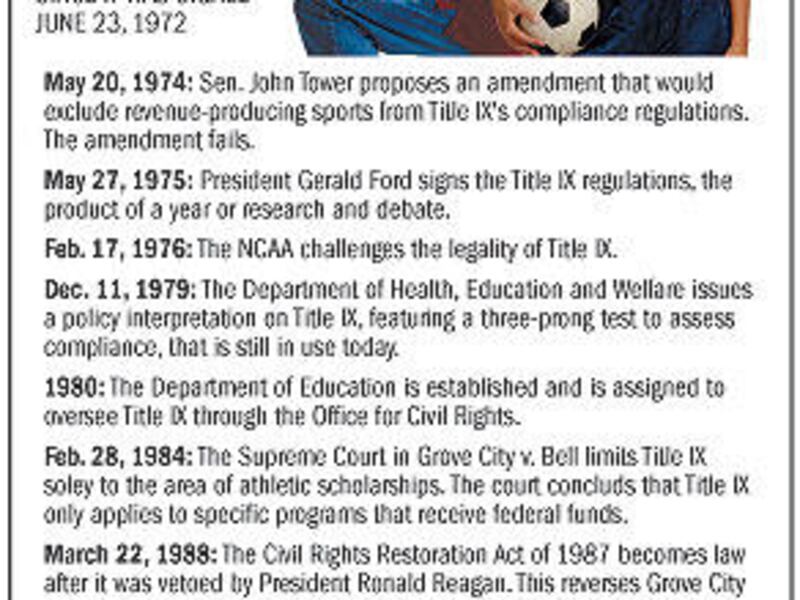
The law has been a hotbed of debate since proponents of women's athletics began using Title lX — which outlaws educational discrimination on the basis of gender — to advance their cause a few years after it was signed by President Richard Nixon. It has been shaped by lawsuits, rewrites and federal regulations and has gone from being lauded as the tool with which women gained athletic equality to being called the weapon used in killing men's opportunities.
And while the value of Title lX depends largely on who is being asked, even those critical of Title lX acknowledge its role in helping transform women from spectators to participants in athletics.
Utah Starzz coach Candi Harvey makes a living in the WNBA, but when she played basketball at Ouachita Baptist University from 1975-79, she didn't have the benefit of a scholarship.
"They didn't offer scholarships," she said. "We had work-study to help us."
Back then, she said, traditional football powers didn't put any resources or time into women's programs so smaller schools like Ouachita Baptist were among the powerhouses. The larger schools offered women only intramural sports.
She said were it not for Title lX she wouldn't be making a living in sports.
"It paved the way for me to have a job as a coach," she said. "We wouldn't have this league (WNBA) if it weren't for Title lX. Nothing but positive has come out of it, and getting your education paid for is the most important."
Norma Carr knows how far women have come because she went to high school and college when myths about women in sports were used as arguments against allowing them to participate. Now the athletic director at Salt Lake Community College, Carr said she was the president of an organization that every year went to the Utah High School Activities Association and asked for sanctioned girls' sports.
"Every year I went and did my little duty and got told no," she said. There were some "fierce battles" over the issue, which included arguments that now seem ridiculous. In fact, most involved in athletics say the benefits to women are numerous. (See accompanying story.)
"They honestly said girls should be home in the kitchen, not playing sports," Carr said. "They said it would make them masculine, especially basketball."
Some male administrators even worried aloud that too much running would damage a woman's reproductive organs.
Carr's recollection is supported by Dorothy Peterson, who was honored by Bingham High School two years ago for her efforts to start women's sports programs. She said girls weren't even allowed to take physical education as seniors when she started teaching in 1964.
That changed when a group of seniors came to her and asked her to champion their cause with administrators, who eventually agreed not only to P.E. classes but a sort of intramural league that allowed the women to play volleyball against teams from the other three high schools.
"We even had a traveling trophy," she said.
After Title lX, regulations were written in the late '70s, however, Carr said those same organizations that had repeatedly denied her requests for legitimacy came to her and asked for help integrating prep sports programs. Girls swimming, basketball, tennis, softball, soccer, volleyball and track were all added as sanctioned high school sports after 1972, with softball being most recent in 1990.
"They wouldn't put basketball in at first because they thought it was too masculine a sport," Carr said. "We were definitely pushing the wave. There was a lot of opposition, even from women, who were old-timers and didn't think women should play sports. And the men really didn't want to share facilities."
Viewmont volleyball and basketball coach Lori Salvo remembers when things changed. Carr was her coach at Davis High, and she was a senior when the very first state basketball tournaments for women were held in 1976. She was also one of the first to receive a scholarship to the University of Utah that fall in volleyball.
"We would have paid to play," she said. "That's how much we wanted it."
Women wanted it so much that decades before Congress and the courts helped advance their cause, female athletes were working among themselves to organize and play sports at the high school and college level. BYU women's athletic director Elaine Michaelis said she grew up playing softball in LDS Church leagues and basketball on a court next to her father's feed store. She played football with the neighborhood children.
"I was a pretty good quarterback," she recalls. Michaelis was working on the executive committee for the Association for Intercollegiate Athletics for Women when Title lX was passed. She was in charge of overseeing eligibility for all of the female athletes in the country. The AIAW began in 1969, and so did more official leagues, with record keeping and contests between women, including the first national championship in volleyball.
"We were just starting to be really effective when the NCAA started to feel the pressure of Title lX, around the late '70s," she said. "Then the presidents of the institutions said (to NCAA administrators), 'You will take over (women's sports).' We fought it because we figured they hadn't cared about us before — why would they care now? We also didn't want to come under the male leadership. We wanted some voice."
The best the AIAW could do was argue for women among the organization's decision makers.
"It was quite a battle to get the NCAA to provide for women leaders, and we're still not where we should be," she said. "We've actually lost a lot of ground as far as women leaders."
Michaelis said Title lX brought support to a movement already under way. She said it offered concrete ways of measuring equality including what was referred to as "the laundry list." That list guaranteed women equality in travel and lodging, coaching, scholarship money, facilities, and much more.
The effects are more tangible on a case-by-case basis.
"It's given me my education," said Salvo, who will coach her daughter in volleyball next year. "That's what I've devoted my life to, and it's not because of the money. I love it, and there's no way it would have happened without Title lX and people like Norma (Carr)."
Carr regrets that Title lX ever needed to be written.
"The sad thing is that there had to be a legislation to force people to do the right thing," Carr said. "If somebody had just used common sense along the way and offered women opportunities, a lot of the problems wouldn't exist. The only way women could get (opportunities) was to have a law to force them."
Next: How Title IX affects male athletes.
E-MAIL: adonaldson@desnews.com