

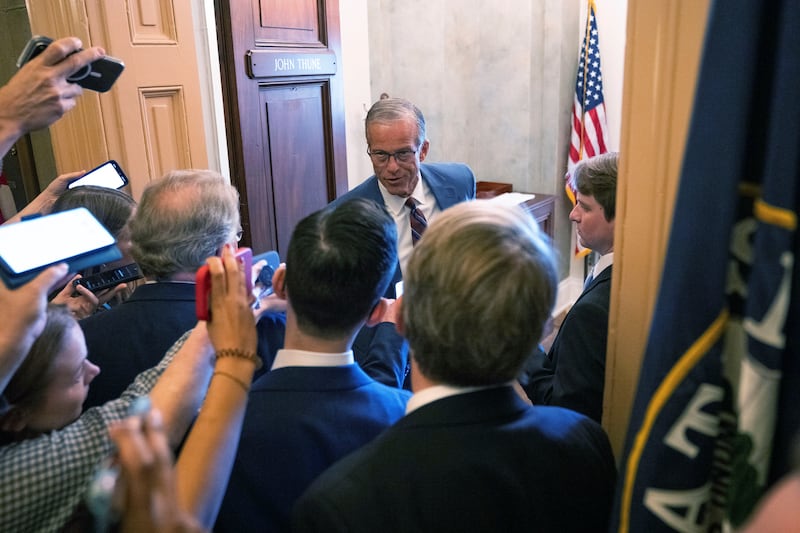

The Senate advanced Republicans’ immigration funding bill, greenlighting a $70 billion spending package to fund federal immigration enforcement agencies for the rest of President Donald Trump’s term.
The package passed in a 52-47 vote early Friday morning after hours of debate and failed amendment votes from Democrats challenging the legislation. Both Utah senators voted in favor of the legislation.
It now heads to the House for consideration where GOP leaders say they expect it to pass without much arm twisting. The House won’t schedule a vote until Monday at the earliest, according to a notice sent to lawmakers on Thursday evening.
The funding package seeks to allocate roughly $70 billion to federal immigration agencies for the next three years, specifically ICE and Border Patrol. The package no longer includes additional funds for the Secret Service, which would have dedicated funds for security enhancements to the White House ballroom project.
The Secret Service is already funded under annual appropriations for the Department of Homeland Security.
But its passage didn’t come without challenges. Senate Republican leaders spent all day Thursday trying to wrangle party members and keep everyone on the same page, working with just a three-vote margin to pass the immigration funding bill on a partisan basis.
Sen. John Curtis breaks with party to dismantle Trump’s anti-weaponization fund
Utah Sen. John Curtis bucked party lines to support a proposal that would have officially dismantled the anti-weaponization fund from the Justice Department. The fund would allow individuals to be compensated if they feel they have been unfairly targeted by the federal government — particularly Trump’s allies.
Curtis joined a handful of other Republicans to vote in favor of an amendment that would prohibit federal money from being used for the fund, seeking assurances that the Trump administration would not reverse course to revive the fund at a later date. The amendment ultimately failed to pass in a 15-84 vote after Democrats accused Republicans of adding language to divert the funds to prevent fraud, which they said would “hand Trump and Vance $1.7B in new money.”
“I don’t understand that,” Curtis said. “You either like the fund or you don’t like the fund. And as you know I have not liked the fund from the beginning, and I was somewhat placated with it being nearly dead, but (supported) giving a chance to make it dead dead.”
Senate Majority Leader John Thune, R-S.D., had warned against supporting those amendments, voicing concerns that language eliminating the DOJ fund would threaten its final passage. If it did pass with that language, there were concerns Trump would veto the entire package.
GOP leaders navigate tricky amendment votes
The vote-a-rama session ended roughly 19 hours of voting on amendments, all of which failed to be attached to the underlying immigration bill.
Democrats sought to squeeze their Republican colleagues, particularly those running in competitive reelection races later this year. Several of those amendments did result in Republican defections, but none garnered enough rebellious votes to pass.
Those problems began right at the onset of the voting session when Senate Minority Leader Chuck Schumer, D-N.Y., put forward an amendment to send the funding package back to the Judiciary Committee to include language killing the anti-weaponization fund. The effort set off an all-out blitz by Republican leadership to keep party members in line, especially as a number of GOP senators want to see the fund nixed themselves.
Republican leaders held the vote open for three hours as they courted senators on the floor, particularly those demanding guardrails on the Justice Department’s $1.78 billion anti-weaponization fund that was announced last month to compensate individuals who say they were targeted by the federal government.
In the end, three Republican senators voted with Democrats to kill the fund: Sens. Susan Collins of Maine, Jon Husted of Ohio, and Dan Sullivan of Alaska. All three are in competitive races in November.
Republican leaders spent the three hours convincing Sen. Bill Cassidy, who staunchly opposes the DOJ fund, to kill the Democratic amendment. Ultimately Cassidy, who lost his primary and is not up for reelection, agreed.
Later in the day, six Republicans joined Democrats in voting for an amendment to prohibit federal funding from going toward construction of the White House ballroom. However, the amendment failed to reach the 60-vote threshold needed to comply with the strict budget reconciliation rules.
Other amendments saw Republican defections but ultimately were not included in the bill.