

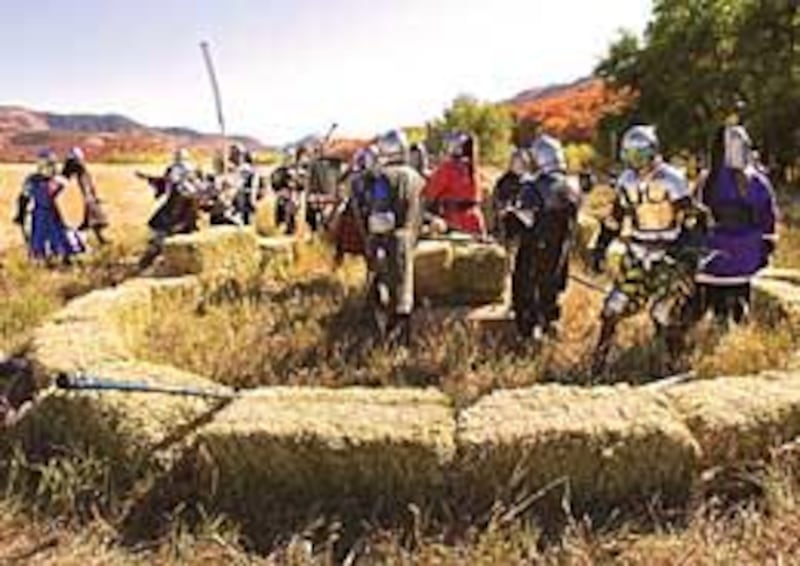
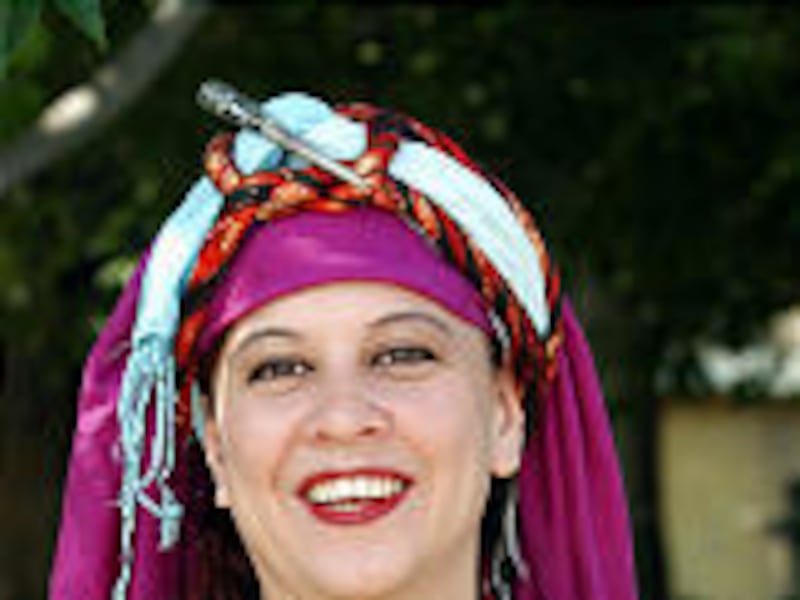
They come for the fighting — and the dancing. They come for the feasting, and because they get to wear cool clothes. They come to play, to socialize, to learn.
Mostly, they come because they have fallen in love with a time so removed from our own that many people never give it a thought — yet it's a time that laid our foundations and shaped our thoughts in important and intriguing ways.
Welcome to the Current Middle Ages — or as some say, the Middle Ages "as they ought to have been."
This is the period researched and re-created by members of the Society for Creative Anachronism. They study martial arts, dance, calligraphy, cooking, stained glass, metalwork, costuming, literature and almost everything else that happened in Western civilization from roughly 400 to 1600 A.D. As they like to say, if someone in the Middle Ages did it, somebody in the SCA does it — everything except die of the plague, of course.
Since it was founded in 1966 in Berkeley, Calif., by some science-fiction and fantasy fans, SCA has grown into an international organization with more than 24,000 dues-paying members. For its purposes, SCA has divided the "knowne world" into 17 kingdoms, each made up of principalities, baronies and shires.
The Kingdom of Artemisia, which includes most of Utah, Montana, southern Idaho, western Colorado and Wyoming, achieved kingdom status in 1997, explains Baron Tryggvar Halfdon (known in the "mundane" world as Jeff Anderson), who leads a part of that kingdom, the Barony of Loch Salann, which encompasses the metro Salt Lake area and has around 120 members. There are three other baronies and a number of shires in Utah.
Loch Salann holds weekly meetings, where the medieval folk socialize, perfect their crafts, practice fighting. Special events, often with other baronies, sometimes involving the whole kingdom, are held five or six times a year.
The way it works it this: Each person chooses a personae who fits the time period and creates a life for that person. "You choose the country and the time period. You develop a name, come up with the clothing," says Halfdon, a 10th-century Viking. "So, I try to do everything a Viking would have done — fighting, card weaving, archery, singing — everything but rowing the boat and pillaging the coast of France."
It's a hobby, he says, and like any hobby, "you can get as deep into it as you want."
"I love the arts and sciences," adds his Baroness, Brenna Chaimbeul (otherwise known as Michelle Carey). The Vikings were known for their rough ways, but they also valued art and culture. "I love making and re-creating the things they would have used during that period. Viking knitting, for example, was done with a single needle."
Some people get so into their characters, "they can tell you what they had for breakfast," says Sir Sean Kirkpatrick Tarragon (Sean Oppenheimer), who is an Irish-born, English-raised knight of the 1350s. He finds this time of the Hundred Years War fascinating. "I like the fashions. I like the mind-set. It was a hundred years of constant struggle, and as an English knight, I get to be in Ireland, England, France. I see all sorts of different political, religious and economic changes."
Sir Sean has been involved with SCA for 22 years. "My parents were into it, and they brought me to fighter practice. I loved it. I was fortunate to find a knight to train me at a young age." He's been at it ever since.
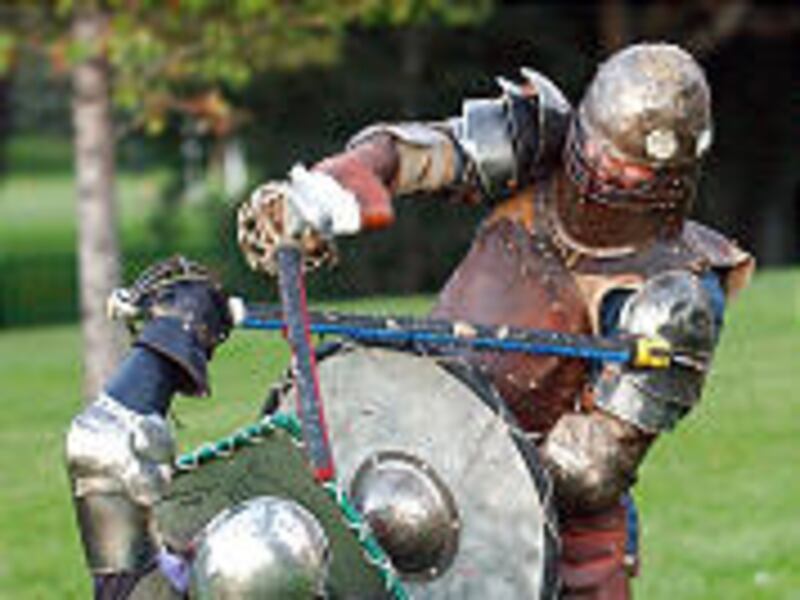
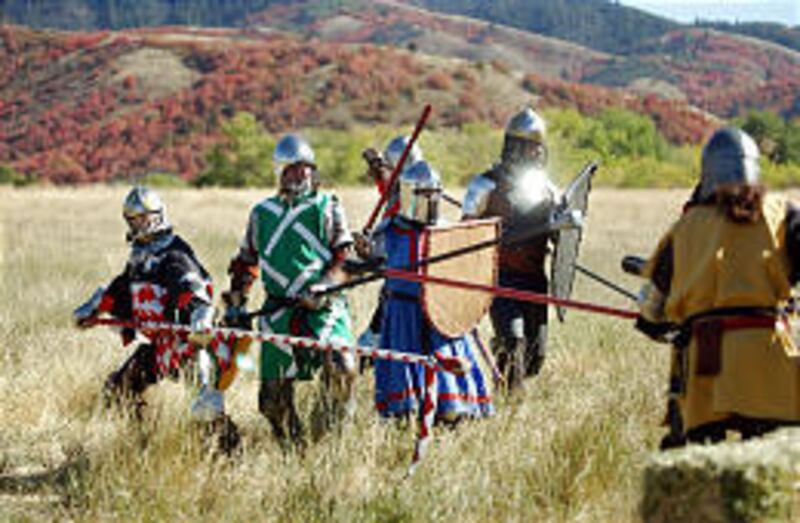
The fighting is the biggest attraction, he admits, "even though it is the least historically accurate thing we do."
The methods are similar. Even the clothes — the chain mail and armor — are similar. But the weapons are not. "We use rattan swords, which fairly accurately simulate the weight and balance of a real sword. But if rattan breaks or snaps, there are no splinters," he says. In this case, safety is the more important factor.
In the battles themselves, combatants follow a strict code. "Honor is the thing that makes this an exciting sport. We rely on the honor of our opponents to accept a good shot," says Sir Sean. If a knight feels he has taken a serious shot to an arm or a leg, he won't use that limb. A "fatal" shot means the opponent will lie down and "die."
Nothing is choreographed, adds Father Robert, Lord Bedlam (Robert Woodruff). "It's a martial art, a sport that has evolved, with rules and standards." Father Robert is a priest hiding in the Black Wing Company of Queen Elizabeth's muskateers. "Catholicism is frowned upon now, you know. But I provide solace and confession" — and he gets to fight.
He got involved with SCA when he was in a "Taming of the Shrew" play with some of the other members. "It's a blast," he says. "We have a great time."
Mistress Jadi (Lea Benson), a Timurid Persian from the 1420s, got involved with the group with her parents in Georgia. "This is my fourth different kingdom. I've been here a little over a year." But that's one of the exciting things about it. "You can go all over the country and feel welcome. Any time I go on a trip, I try to find out if something's going on in that area."
She also loves the fact that "I'm learning something new all the time. It's a chance to try something new without having to be perfect. I've done embroidery for years, but I wanted to try leatherwork." So, she found a master leatherworker, who was "very tolerant of novices."
That educational aspect is very important to SCA members and one reason why group members frequently participate in programs and fairs in the community. Typical is a Renaissance Faire, held recently at St. Joseph's Villa. "It was a lot of fun," says recreational therapist Hailey Hadean. "We had more response than we've ever had." The event included dancers, jugglers, music, feasting, a town crier and more. "The residents were so impressed by the full suits of armor they wore."
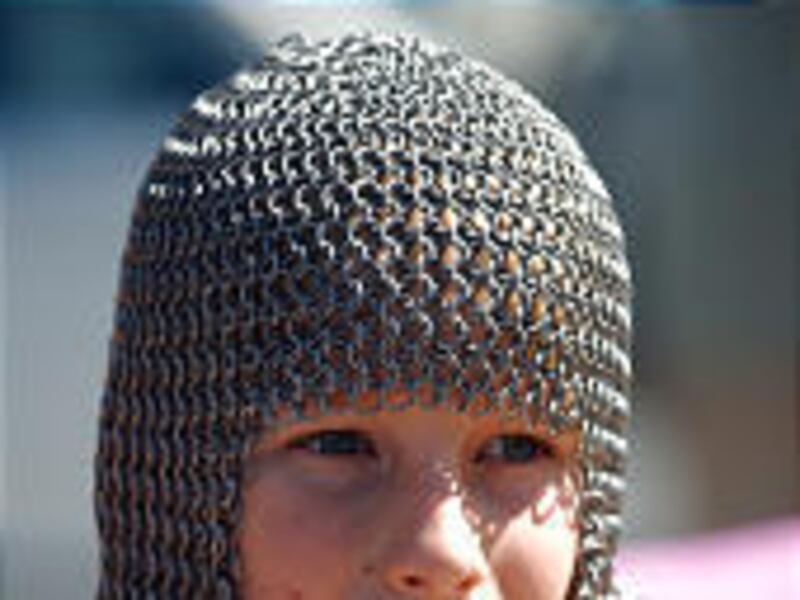
And well they should be, says Sir Michael the Lucky (Michael Huston), a late 14th-century English knight. "Armoring was at its height in those days. And it was built so that anything they could do in street clothes, they could do in armor. They could turn out chain mail practically overnight, and we still don't know exactly how they did it."
Learning about and preserving those old skills is important, he says. "We take a lot of skills for granted. But you miss a couple of links in the chain, and the skill is gone."
Most SCA members have two or three crafts or skills they are interested in. "Anyone who is interested in only one thing, such as the fighting, will probably not stay long. Me, I don't have enough hours in the day, or days in the week, or weeks in the year or years in my life to do all that interests me. Now, I'm hoping to get into illumination and manuscripts."
Sir Michael has been in the society "probably 10 years longer than anyone else here." It's a great family activity, he says. "We have adolescents, teens, little kids. It's a great way to instill the meaning of honor, that your word means something."
Over the years, he has seen subtle changes in the organization. "But the core remains the same. It's still honor and chivalry. Every time we meet in battle, our honor's on the line. You kind of hope that spills over into other parts of our lives."
SCA information
The Society for Creative Anachronism is a nonprofit, educational organization dedicated to researching and re-recreating the Middle Ages in the present. Many groups meet weekly to talk, dance, study, fight, learn and revel, and members of all ages are welcome. For more information, go to www.sca.org.
Information about local chapters can be found at www.artemisia.sca.org and www.lochsalann.org.
E-MAIL: carma@desnews.com