

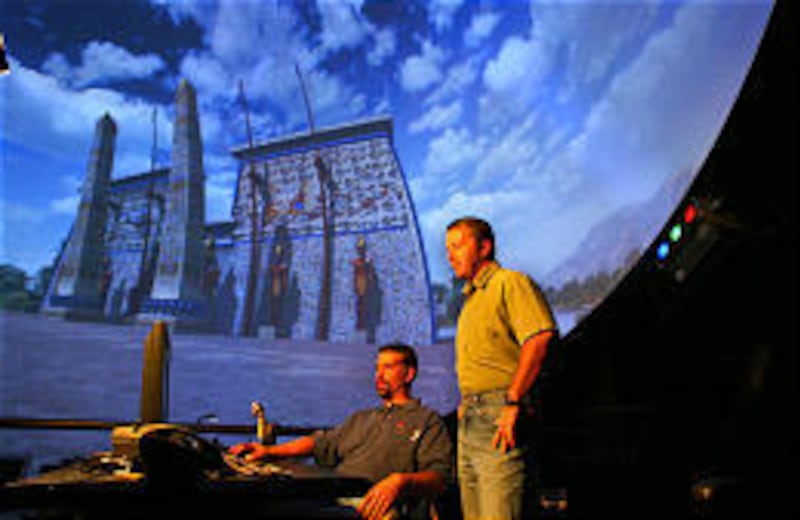
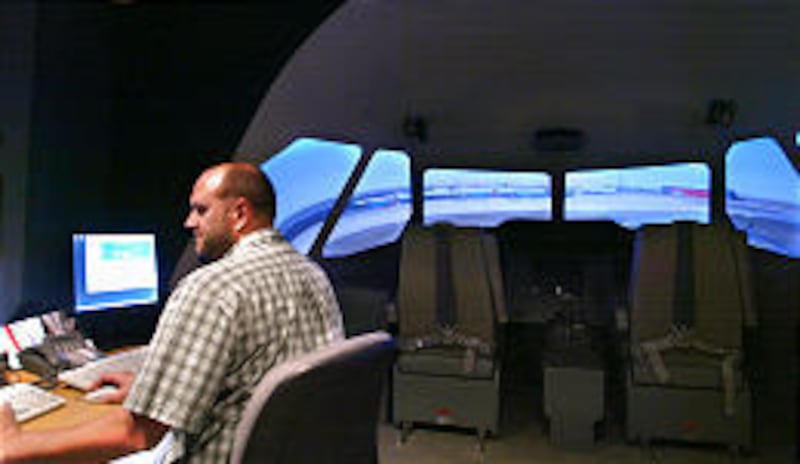
From the cockpit inside an EP-1000CT, the view is ominous. Brisk winds push a blanket of heavy snowfall across the runway. What's worse, murky, vision-dimming fog obscures the guide lights. Forget about seeing the clouds.
It's going to be a rough ride.
But there's no need to worry, because the EP-1000CT is a simulator.
That's the magic Salt Lake-based Evans & Sutherland Computer Corp.'s powerful technologies can create, enabling pilots to train without putting either themselves or huge planes in jeopardy.
But while the poor weather in the simulator was only an illusion, the storms of the past few years have been all too real for people associated with E&S. Several years without a profit and a series of employee layoffs have been a recent company staple.
Yet, just as the EP-1000CT can furnish fair weather for the training pilots, the company's top official and analysts believe E&S is heading in the right direction, with a clear view of a promising horizon.
"We have been around a long time and made a real contribution to the technology of computer graphics and simulation, and we intend to keep doing that," said James R. Oyler, president and chief executive officer. "We have some really unique new products that will be introduced next year, and I think they have the potential for making the company bigger and better than it has ever been."
It has been bigger in the past. In the late 1990s, E&S was profitable and had more than twice the number of employees it has now. Revenue was about $200 million in 1999, but had shrunk to $123 million last year. The net loss in 2000 was nearly $70 million, but that had been cut to $11.7 million in 2002.
"If you look at raw numbers, they peaked in about 1997 to '98. You've got to wonder why a computer company would peak before the IT sector peaked in 2000," said Jerry Weltsch, principal analyst at Frost & Sullivan in Palo Alto, Calif.
"But this is not a typical IT company. It's focused on the training and simulation world, more specifically in aerospace, a sector that tanked hard. They have a lot of eggs in that basket, which was healthy in the mid- to late '90s."
"It's a company that did go through years of tough times from about the 2000 to 2002 time range, but the past year has been a boon for the company, all things considered," Weltsch said. "They've been going through a semi-long-term restructuring process that has been completed, and they've had some final layoffs, a result of any restructuring process, when things get shaken out. But they're set to move forward."
A new way
In some ways, the "perfect storm" analogy could describe what hit E&S. While making a transition from proprietary to less-expensive, off-the-shelf components — a mean trick for any company — it was stung by troubles in the commercial and military sectors, the main markets for its aviation simulation business.
The company's early technology had to be proprietary — E&S was starting an entirely new industry, working from scratch — but an evolution to more-standard, PC-based components was needed for the company to confront competitors' lower-cost offerings.
Its Harmony product was the first, but getting it into production and getting the software to run on it proved difficult.
"Being the first to do that in the simulation business, we had a lot of challenges with it and, although we did get that product working, it took longer than we had thought it would and it was more expensive to do than we thought it would be," said Oyler, E&S's top executive since December 1994.
"We lost money during that period, and we were just coming out of that when 2001 came along and the environment changed again."
The year 2001 spelled trouble for E&S, resulting in what Oyler calls "the most severe downturn in all of our markets at the same time ever in the history of the company."
The commercial aviation business slumped, of course, in the aftermath of the Sept. 11, 2001, terrorist attacks. But military funding, long a source of steady business, was funneled into day-to-day operations, including the war in Iraq. That was a surprise for companies like E&S because it was occurring at a time of overall spending increases by the military.
"We were very profitable until the 1998 time frame, and then we had a situation where we introduced simultaneously new technology as, in our markets, a lot of changes were going on in how the purchasing or type of contracts were done," Oyler said. "We were introducing new technology into a new market environment, and we had a couple of years of problems with that. So we lost money during that time, but we were coming out of that when this whole 2001 situation started. So we've had kind of a double-whammy of economic conditions on top of that situation."
The move to standard, PC components is complete, with E&S applying them "in ways that make us different," Oyler said. "When you transition from a proprietary base to more standards-based technologies, most companies don't make it. It has been a tough transition, but we've made it."
Weltsch said margins have dropped dramatically in the industry because of the proliferation of off-the-shelf PC technologies. E&S, he said, had to make the switch to PC components and otherwise lower costs in order to hold its own against competitors — including in-house operations at its biggest customers.
"That's where a lot of the restructuring and layoffs came from," he said. "The costs of their (competitors') solutions were coming down so dramatically, E&S had to match it. They couldn't win contracts by competing against others with similar solutions if their product was many times the cost of the others."
Fallout
But that transition has come at a cost as hundreds of workers lost their jobs. The latest round was announced in September, leaving the company with nearly 400 workers — down from more than 1,000 at peak levels.
Oyler believes the company is "now sized for the marketplace" and that the company has handled well its component transition and the declining markets. Analysts agree.
"We have been around a long time, and we have been very successful innovating and staying current over many, many years, such as very few companies have. The last couple of years, starting from '98, when you combine the product issues with then the whole technology market and the airlines and other factors, it's probably been the four or five hardest years in our history," Oyler said.
"Nevertheless, we have worked through that. Our new products are gaining market share, and we'll return to profitability in the fourth quarter, and we did what we had to do."
Not everyone agrees. Internet chat rooms are laden with criticism about the company's missteps and perceived missteps, much of it from former employees who squarely blame Oyler. His response? "You're always going to have some people who disagree.
"You always feel personally when you make a reduction. But at the same time, you do the best you can with assessing where the business is going, what the strategy is going to be and what the technology needs to be. Anybody in the technology industry who claims they're perfect is blowing hot air. There's no way to always be right. It's too hard, and it changes too fast and the environment changes so quickly. Even great companies go through difficult periods," Oyler said.
He notes that International Business Machines Corp.'s struggles 10 years ago made that company a target for critics, but IBM has rebounded. "And I think we have a lot of new things we've started during this period that haven't had a chance to pay off," he said.
Expected upturn
Along the way, E&S has worked to shorten its development cycle to meet the needs of ever-changing markets and changed the way it contracts with larger customers to better protect its interests.
Now the company believes it will be profitable as soon as the fourth quarter and throughout next year, although the commercial and military markets aren't expected to be fully recovered until 2005. For E&S overall, market share is growing, but market size is not.
"A lot of the cutbacks have been focused in the military area, and those two in general are where a lot of the problems have come from, but we expect that to turn up in 2005," Oyler said. "We don't expect a big upturn in purchasing from either the airlines or the military until 2005, but it will turn up. It's just a matter of being positioned, bringing out the new products and keeping the costs down until the upturn comes."
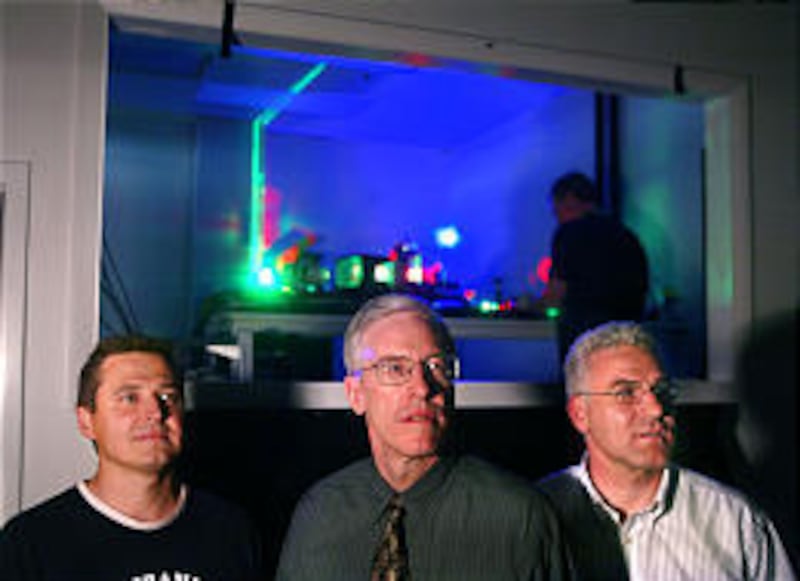
Other business sectors are even more promising. The company's planetarium business nearly tripled this year, and strategic visualization — used by ABC television to show Baghdad and other locales during the Iraq conflict — is growing rapidly. Deliveries of a new product, a laser projector, will start next year.
"All three of these, especially strategic visualization and the laser projector, have enormous potential — the potential to make the company more profitable than it has ever been in its history," Oyler said.
Analysts see promise there, also. And huge growth in those three sectors may leave simulation — now about 90 percent of E&S — closer to 50 percent in a few years, Oyler said.
Obstacles that could derail the company's comeback are lagging markets and technical issues that could delay product rollouts. "But the risk is in the timing of the upturn and not so much, at this point, in the technology," Oyler said.
Cautious optimism
Adam Hutt, general partner/investment manager for Leviticus Partners LP, a New York investment partnership, believes E&S has turned a corner.
"E&S fits into the criteria I look for in an investment: A company has to have long operating history — a real pedigree — new products coming out, be in a decent financial position and can't have a lot of debt. You get everything on one package, without a lot of risk. And E&S clearly has a chance to take advantage of numerous growth opportunities," said Hutt, who owns some E&S stock.
"E&S has been around a long time and, as far as I can tell, the quality of their products are right up there. They have a terrific reputation in their circles. They've been struggling to get their costs down, evidenced by the most recent round of (job) cuts. But I think they're on track for profit in the next few quarters. Once they do that, they'll be in great shape."
He believes E&S technology has value, and he has heard some good industry buzz about the laser-based simulation system.
"We've been successful in finding companies whose stocks are dramatically undervalued compared to potential rewards," Hutt said. "There is a lot of unknown upside potential."
Still, he said, it's a "show me" situation. "If they misstep again, they're gone," he said. "I don't mean bankrupt; I mean bought. They're not going out of business, but if everything messes up and goes wrong, they will be bought."
Technical glitches with the first version of Harmony in 1999 hurt the company's situation on the military side, but Weltsch said the bugs have been worked out with the next generation of Harmony. He's particularly high on both the Harmony 2 product and the EP (short for "environment processor"), which he said have "really rejuvenated" the company.
"I'll put it this way: Any company that goes through the restructuring E&S has gone through, it's all about improving profitability. If they can't do that, I don't know if it can really survive in the long term," Weltsch said. "But it is well-positioned to achieve profitability in the next year. I believe it will."
He thinks E&S has "learned their lessons" and will maintain its technology base to meet customer and potential customer needs.
"Generally, this is a company that has fallen on tough times, but it's done a lot of great work in the last year to recover from that," Weltsch said. "They are in a good position for growth. I expect them to do well in the coming year and improve on the successes they've had in the past year."
Back inside one of those successes, the EP-1000CT pilots can slip through realistic images of mountains, skies and other outdoor features. Night scenes of approaches at Salt Lake City International Airport even include the moving lights of I-15 traffic.
A push of a few buttons brings on the simulated bad weather. A few more takes it away. But, underneath it all, the lay of the land underneath remains the same. It's a staying power Oyler could appreciate.
"Things change very quickly in the advanced-technology business. We're a 35-year-old company, and there aren't very many 35-year-old technology companies," he said.
"That's older than Intel, older than Microsoft. If you go back and put together a list of technology companies that were around back in 1968, there aren't many still left."
E-mail: bwallace@desnews.com