

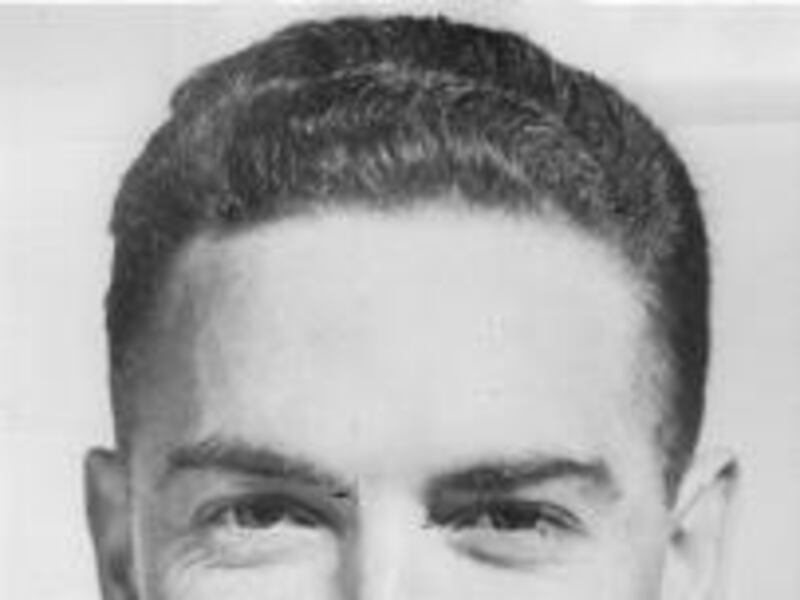
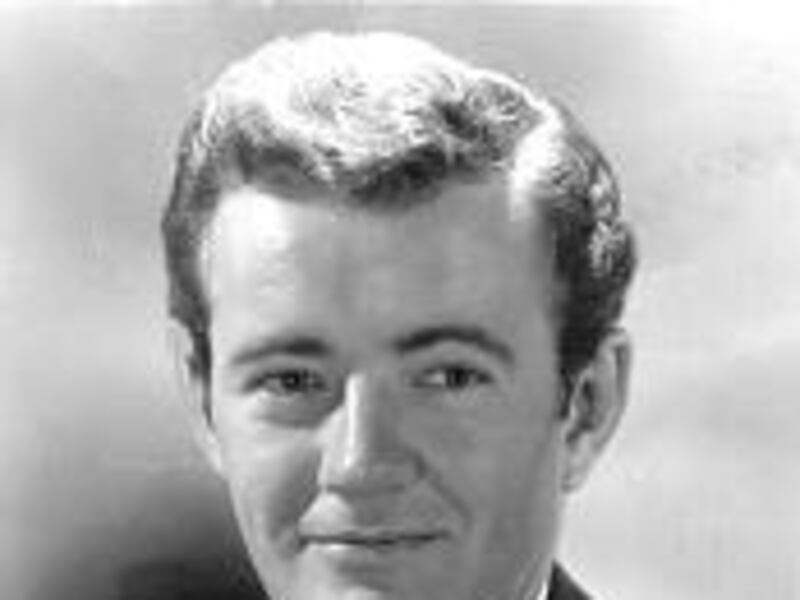
They say World War II veterans are falling permanently out of the ranks at the rate of about 1,500 a day now. And one of them fell on Saturday, Aug. 23, at the age of 83.
He had been only a private (later sergeant), but his name at one time was more prominent than most four-star generals.
He was Marion Hargrove.
As in Private Hargrove.
As in "See Here, Private Hargrove," a collection, published in 1942, of columns he wrote for the Charlotte, N.C., News about his experiences after being drafted in 1941.
It is a remarkable artifact of its time. Hargrove's death in Long Beach, Calif., of complications from pneumonia, is a reminder how much the period and people — which collectively have become known, for good or ill, as the Greatest Generation — differ from the generations that have followed.
The book was an instantaneous and gargantuan success. It went into five reprintings in three months and uncountable printings and editions after that. (Though no longer in print, it is abundantly available in inexpensive used copies from antiquarian book sites on the Internet.)
Two movies were based on it, "See Here, Private Hargrove" in 1944 and "What Next, Private Hargrove?" in 1945. It made Hargrove hundreds of thousands of dollars, back when a hundred thou was serious money. And all because the author was able to tell his fretful countrymen that this new conscription, the first in peacetime, had not only a humane side, but a funny one.
Legions of men followed Hargrove into the services during World War II and later could bear witness to the truth of his comical observations. When handed his uniform by a supply clerk, Hargrove says, "I wear a size nine." The clerk replies, "The expression is wore a size nine.'" Welcome to the Army.
Hargrove, who eventually became a movie and TV script writer, wrote only two more books. His last, published in 1956, was a novel about the army, "The Girl He Left Behind, or, All Quiet in the Third Platoon." It is a look, by the representative of the private soldier of World War II, at what the Army had become in the years of the Eisenhower peace.
There is a feeling in "The Girl He Left Behind" (which was also filmed under that title in the same year) that the Army has gone to hell. No one hollers at anyone anymore.
The central figure, Andy Sheaffer, is a mama's boy who is not willing to commit himself to anything until a tough sergeant named Hanna, who makes it clear that the Army doesn't have time to pamper such poor attitudes, whips him into shape — a service Andy comes to appreciate.
Andy and Pvt. Hargrove have much in common: likable, cheerful, bright, something less than moderately ambitious. But whereas Hargrove gets caught in the draft during a world war and, once in the Army, decides to make himself as comfortable as possible through goldbricking and other finagling, Andy determines to push the draft off completely: "He intended to educate himself into the safe haven of middle age."
For various reasons, including shame, that doesn't work for Andy, but 10 years later the tactic was turned into an art by a new generation of collegians for whom shame was not a consideration.
The kind of lazy work-dodging that the author admired in "See Here, Private Hargrove" he criticizes in "The Girl He Left Behind." The book laments the passing of the Army's rough ways that Hargrove poked fun at.
A fellow basic trainee, a man named Hanson, who had been in civilian life for 10 years but returned to the Army, tells Andy that the old Army's methods were best. " 'They knew what they were doing,' said Hanson. 'The way they do it now, you're going to come out of the Army just as soft and civilian as you went in.'"
Eventually, Hanna holds sway, to the point that, at the end, Andy wants to volunteer for advanced infantry training, while still retaining the devil-may-care, insouciant air that makes him and his previous incarnation, Pvt. Hargrove, so delightful. There's a direct line from Pvt. Hargrove through Andy Sheaffer to TV's charming scamp "Maverick," for which Hargrove wrote scripts.
Hargrove had spent a couple of weeks at Fort Ord, Calif., as background research. During an interview in August 1989, just before the 50th anniversary of the outbreak of World War II, he said he was not really upset at what he saw at Fort Ord, whatever feeling might have come through the novel:
"I found that I was already a relic," he said, adding a comment that veterans of any era can appreciate: "It's sort of an endearing attitude that the Army was good only when you were in it."
As for the time that made him famous, he said: "I have a nostalgia for the period and the period before it, but not for the Army itself. That's fine for people who are 21 years old. . . .
"Everybody was so young. The whole world was younger then. People were fresh out of the Depression and filled with idealism. At the same time there was both a great naivete and a sophistication that people coming along later didn't have. . . .
"The world I grew up in as a kid was not as crowded a world. It was a more leisurely, thoughtful civilization," in which children on soft summer nights could play tag under glowing street lights, lightning bugs winking against the dark shrubbery in the distance, without fear of molestation or vehicular homicide.
And all unaware that one day not far off, they would all have to do mighty battle with one of the world's great evils.
Hargrove's history
Marion Hargrove was a feature writer and editor of his high school newspaper in Charlotte, N.C., when he left school early and became assistant to the city editor and features editor at the Charlotte News. He was drafted in July 1941 and began writing about his Army experiences for the Charlotte News while stationed at Fort Bragg, N.C.
Early the next year, Hargrove met playwright Maxwell Anderson, who had come to Fort Bragg to research Army life for a play; Anderson later used Hargrove as a model for the Southern soldlier in "The Eve of St. Mark."
Impressed with Hargrove's columns, Anderson showed them to a New York editor, and in July 1942, they were published as "See Here, Private Hargrove" (Anderson wrote the forward). The book became an unexpected No. 1 best-seller (12 hardcover printings before year's end, selling more than 400,000 copies; the subsequent 25-cent paperback sold another 2.2 million copies).
"See Here, Private Hargrove" was made into a hugely successful film in 1944, starring Robert Walker. Walker also starred in a less-popular sequel the next year, "What Next, Corporal Hargrove?"
Hargrove didn't write his second book, "Something's Got to Give," until two years after the war, in 1947. He later wrote one more novel, "The Girl He Left Behind" (which was also made into a movie), and he became a successful television and film writer.
His TV credits include episodes of "Maverick," "The Waltons," "I Spy," "Fantasy Island" and "77 Sunset Strip." In 1962, he won the Writer's Guild award for his screenplay adaptation of "The Music Man," and he also wrote or co-wrote several comedy films in the '60s. — Combined wire services
E-MAIL: Roger K. Miller, a journalist for many years, is a free-lance writer and reviewer for several publications and a frequent contributor to the Deseret Morning News.