

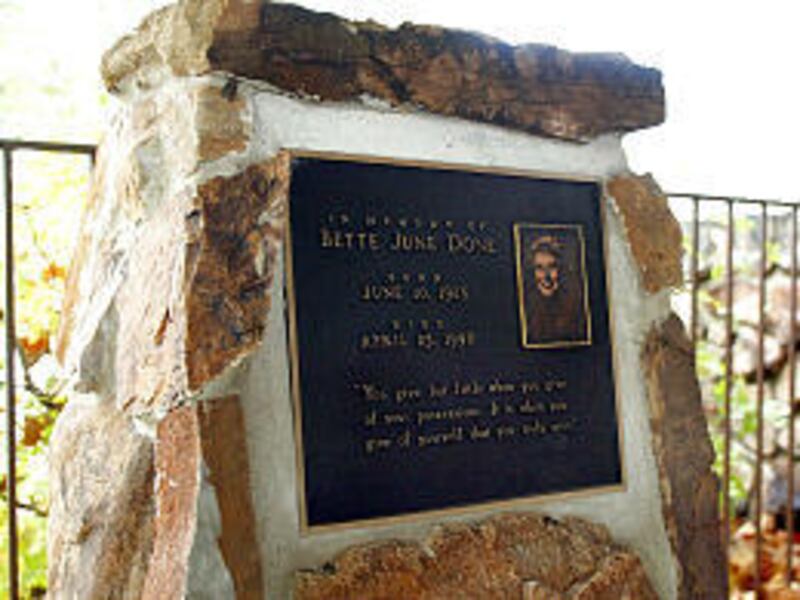
PROVO — A stone marker outside the Utah State Hospital chapel honors Bette June Done, a food services worker whom a patient stabbed to death with a butcher knife 13 years ago.
Done was the last person in the state mental hospital to die at the hands of a patient. Current employees wonder who's next.
"Someone's going to get killed," said a former staffer who didn't want his name used.
Workers known as psychiatric technicians — basically orderlies who tend to patient needs — say the hospital doesn't provide a safe working environment for those who care for mentally ill criminals and other potentially violent patients. They say they're routinely punched, kicked and threatened with hand-made weapons.
Psychiatric technicians, who earn $9 an hour and receive full benefits, also say management turns a blind eye to assaults, reprimands them for subduing aggressive patients and retaliates against those who speak out about problems. At least two workers have filed whistle-blower complaints with the state.
"It was definitely unsafe," said Ashley England, a former psych tech who was kicked into a concrete wall during what she described as a "riot" in the girls youth unit. The attack put her out of work for a week with headaches and dizziness. "You went to work every day not knowing what was going to happen."
Utah Labor Commission inspections of working conditions the past two years reveal a repeated pattern of safety violations and an air of resentment among hospital administrators.
Eight former and current workers, most of whom did not want their names used for fear of reprisal, described several potentially life-threatening incidents in the past couple of years:
A patient swinging a vacuum by the handle at staff members.
A patient swinging a sock full of batteries at another patient.
A patient throwing pool balls at other patients and staff.
Serious safety violations
The Utah Occupational Safety and Health Administration, an arm of the Utah Labor Commission, has issued citations to the hospital twice in the past 18 months for failing to adequately protect workers from violent patients. The second citation, issued in July, outlines "serious" safety violations, including situations UOSH maintains the hospital did not correct after a January 2002 report. Findings in the initial citation include:
Lack of managerial concern for employees' emotional and physical health and safety.
No medical or psychological counseling programs for injured workers.
Uncontrolled patient access to staff areas.
Inadequate staff on some shifts.
Failure to report violent incidents to police.
A UOSH review of state hospital injury records shows that 94 Workers Compensation Fund claims were filed as a result of workplace violence last year. There were 121 in 2001 and 103 in 2000. The hospital employs about 700 people. The report further says that as many as 10 injury-causing assaults per year go unreported due to incomplete record-keeping.
According to UOSH, the actual number of assaults is higher.
After 2000, the hospital recorded only injuries requiring medical attention that led to Workers Comp claims. Reported assaults numbered 325 in 1999 and 233 in 2000. UOSH noted in the report that an administrator said it would be impossible to document all acts of patient aggression because "there were simply too many to worry about and it would take too much time."
The only "dependable" conclusion, according to UOSH, is that there are an "unacceptably elevated" number of employees being hurt by patients.
UOSH citations, however, have no teeth. Though UOSH may assess private businesses as much as $7,000 per serious safety violation, state law prevents it from fining state agencies. The hospital is contesting the citations.
UOSH compliance officers declined to answer specific questions, citing the ongoing appeals.
"It's a very sensitive issue," said Larry Patrick, UOSH administrator. A hearing before an administrative law judge is scheduled for April.
Love it or leave it
Hospital superintendent Mark Payne strongly disagrees with the characterization of the facility as unsafe.
"I feel safer here than I do in downtown Provo. I know the patients here. We have their histories. I don't know who I'm walking past downtown."
Former state hospital superintendent and prison psychiatrist Bob Verville says steps can be taken to minimize patient aggression, but "things are going to happen." Patients, particularly in the forensic unit where convicted criminals and those incompetent for trial live, are in the hospital partly because they pose a threat to themselves and others.
"How do you eliminate the risk of people who are dangerous?" said Verville, now a drug rehabilitation counselor. "By the nature of their being there, they're dangerous."
Payne said the potential for violence is inherent in the job. Employees who feel unsafe, he said, are invited to transfer to another unit. Few, if any, do.
"We do all we can to avoid incidents," he said.
The Utah State Hospital is not accustomed to scrutiny from the state. The Utah Public Employees Association called for a management audit after Done's death in 1990, but the Legislature did not authorize one.
The last time the hospital underwent a performance audit was in 1980, state auditor general Wayne Welsh said.
Hospital administrators were defensive when UOSH questioned them about hospital operations, and investigators noted in the report that there was an air of resentment. Management attributes the dissension to a handful of workers who are "out to get" the hospital and told state labor regulators the complaints didn't need looking into.
Seven psychiatric technicians unsuccessfully sued the hospital earlier this year. But according to the report, they were not the same ones who initiated the 2003 inspection. Investigators randomly interviewed 15 current and two former employees.
Management said staff members need to come to terms with the fact that the job is hazardous or find another place to work. That attitude bothered state labor regulators. "Little compassion or understanding of employee concerns with workplace violence were exhibited," the report says.
"I know that's the perception. That's not our philosophy," Payne said. The hospital strives to protect both workers and patients, he said.
Hospital vs. prison
A patient punched Payne in the face on his first day as a psychiatric technician in 1975. But he said he has never felt his life was in danger in the 28 years he has worked there.
"I could make it so nobody ever got hurt. How do you do that? You lock everybody up. Then you have a prison."
Psychiatric technicians say there are no consequences for patients who assault staff or other patients. It takes a doctor's order to confine or place an aggressive patient in restraints. The hospital resorts to seclusion and restraint only if absolutely necessary.
Payne said the hospital must look at the origin of the patients' behavior. "Do you punish them because they have voices in their heads?"
The balance between a safe working environment and the rights of patients to be free from undue restraint and seclusion is difficult. The zero tolerance policy UOSH seems to be after, he said, is unrealistic.
"We have to continually help people understand we are not correctional," Payne said. "We are therapeutic."
The hospital's forensic unit has housed some of the most infamous killers in Utah history, including Gary Gilmore, Ted Bundy and Ron Lafferty.
Currently, the unit has 10 patients, including two murderers and an arsonist who courts found guilty of crimes but mentally ill. There also are three transfers from the Utah State Prison. Approximately 60 other patients at the hospital, such as accused Triad Center killer Di Kieu "Lisa" Duy, have not been found competent to stand trial on a variety of charges from murder to forgery.
Brian David Mitchell, accused of kidnapping Elizabeth Smart, spent a month at the hospital this year undergoing a psychiatric evaluation. Robert Allen Kartchner, the Orem man accused of attempting to kidnap and kill several Utah Valley boys, is also undergoing psychiatric evaluation there. But except for high-profile cases, competency evaluations are now conducted in jails because of budget cuts.
The Utah State Hospital is accredited by the Joint Commission on Accreditation of Healthcare Organizations, which evaluates and accredits some 16,000 health-care facilities and programs in the United States. It initially received a score of 82 out of a possible 100 on its 2002 performance review. JCAHO found the hospital below standard in several areas, including patient rights, medication use, assessing staff competence and implementation of safety plans. Follow-up evaluations, however, resulted in the score being bumped to 94.
One on one
The state hospital traces its roots to 1885 when it was known as the Territorial Insane Asylum. Though its mission was to treat the mentally ill and return them to the community, it was nothing more than a warehouse in its early days. By 1955, the population reached 1,500 patients.
Today, the hospital has 384 beds, though limited state funding doesn't allow it to fill them. The average length of stay is nine months, administrators say.
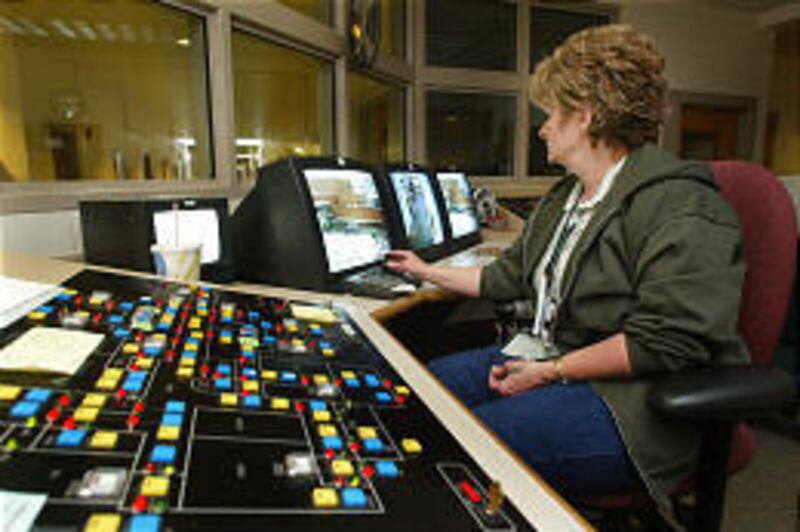
The 4-year-old forensic unit is housed in the most secure building on the 300-acre campus. It resembles a youth detention center. A glass-encased central control room equipped with surveillance cameras monitors activity inside and outside the building. Workers there also manage access through the facility's only entrance.
There are no security guards posted in the building, though officers patrol the campus as a whole.
Workers say the forensic unit is understaffed and psychiatric technicians sometimes find themselves alone with two dozen patients. Payne described staffing levels as "minimally adequate."
One forensics worker was recently attacked when left alone on the floor. According to the UOSH report, hospital administrators say those situations are rare and "may even be contrived . . . to make management look bad."
Each employee in forensics carries an electronic panic button that allows them to summon help in an emergency such as a violent patient. Don Rosenbaum, a unit director, said the buttons are used about four times a month.
All employees undergo situation intervention training, or SIT, which teaches them how to gently subdue an unruly patient, first verbally and then physically only if absolutely necessary, and never alone.
"If they're using their own methods, that's inappropriate," Payne said.
Workers say SIT only works in slow-developing situations. The techniques aren't useful with a suddenly violent patient or when the worker doesn't have help, they say.
One forensics employee told UOSH what hospital management advised him to do should he find himself alone with a combative patient: "You should turn around and run like hell and hope the patient isn't faster than you because they could really hurt you if they hit you from behind."
Payne said he would hope his administrators don't dispense that kind of advice. "But there is a bit of truth to that." The hospital, he said, does not want workers trying to restrain an aggressive patient alone. That could mean turning and running, he said. Pushing the panic button, Payne said, would bring help "within seconds." Employees say the devices don't always work. Payne said he recalls only once that the system went down.
The forensic unit isn't the only one in which violence occurs. In the girls youth unit, patients broke light fixtures for an "ongoing source of weapons used against employees. Employee injuries occurred during attempts to take the broken parts away from patients and subdue them," according to the UOSH report.
Though the hospital eventually replaced the light fixtures, UOSH considered it a serious violation that it wasn't done in a timely manner.
Payne said the hospital didn't have $40,000 for new tamper-proof lights and it took about 18 months to work through government appropriations channels to obtain the money.
Provo attorney Justin Heideman represented seven employees who sued the hospital earlier this year over what they say are unsafe working conditions. A 4th District Court judge dismissed the complaint, saying the workers' remedy was with the Workers Compensation Fund, not in the court.
But Heideman said he believes workplace violence has become worse, and he's contemplating reviving the lawsuit in federal rather than state court. He said he has an office safe full of razors, metal bars and home-made knives patients wielded. "I'm shocked and dismayed at the level of violence that is constantly occurring in the Utah State Hospital and the total lack of prevention programs."
In 1990, Bette June Done was simply eating lunch when Don Michael Lyons allegedly plunged the knife into her abdomen.
Authorities sent him to the hospital after he had walked away from a St. George mental health center, donned a fireman's uniform, stolen a van, led police on a high-speed chase and threatened officers with an ax. He was working in the canteen as a waiter at the time of the stabbing.
Lyons was found incompetent to stand trial on a second-degree murder charge and was returned to the hospital where he continues to reside.
E-MAIL: romboy@desnews.com