
A version of this article was first published in the Right to the Point newsletter. Sign up to receive the newsletter in your inbox every Wednesday morning and to vote in subscriber polls.
If you listen to the radio a lot, you’re likely familiar with Big Lou, a fictional persona who sells life insurance. “Big Lou’s like you, he’s on meds, too,” the narrator cheerily tells us. In another ad, he says, “Big Lou’s like you, although he’s only on wife No. 2,” assuring potential male customers that they can buy enough insurance to cover their current wife and their “previous mistakes.”
For the record, Big Lou, I always change the station when your ads come on, because no, not all of us are on meds, and also, I’m uncomfortable with people making light of divorce. But divorced people have long been a punchline in America. It’s only recently that widows have joined their ranks.
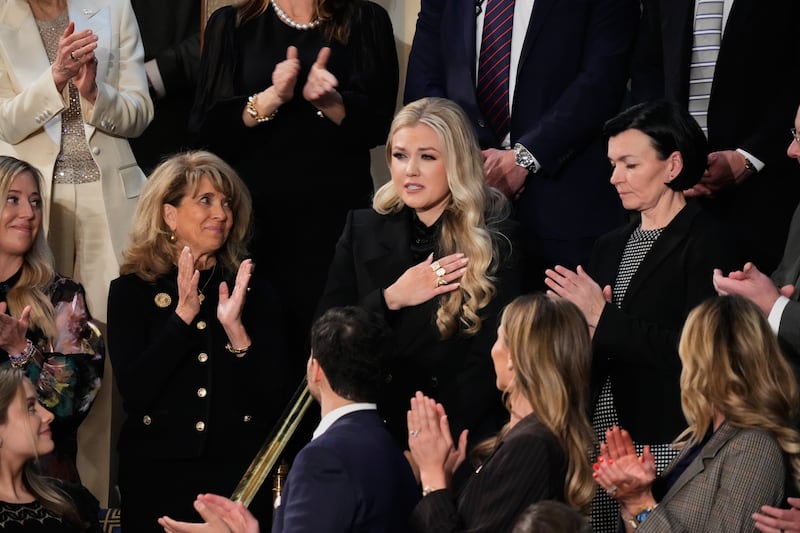
First came the social media pile-on of Erika Kirk, which began after her husband’s murder in September 2025 and continues at a feverish pace. Podcaster Matt Walsh summed it up perfectly on X.
The evisceration of Erika Kirk began as what has been called “grief policing" — being critical of how people respond to the death of a loved one. But it soon turned into full-blown mockery, which blew up again after Kirk was photographed leaving the White House Correspondents’ Association dinner in tears after it was cut short by a gunman who apparently sought to assassinate President Donald Trump. (Kudos to Walsh for going all in on defending Kirk this week.)
Then there is the Jimmy Kimmel “joke,” which the commentator Sasha Stone has said is more akin to the “Two Minutes Hate” of George Orwell’s “Nineteen Eighty-Four.” Kimmel has said plenty to provoke the ire of conservatives over the years, but his line about Melania Trump having a “glow like an expectant widow” crossed a bright line even before the events of Saturday night.
For one thing, you don’t make jokes that suggest a president who has twice (now three times) survived assassination attempts is about to die. Second, you don’t mock widows, or people about to be widows. Or widowers, for that matter.
There was a time when widows were a protected class, as evidenced in scripture. The Bible is replete with admonitions for widows to be given special consideration, not just because of their grief, but because of their economic circumstances. And God himself is described as a “defender of widows” in Psalm 68.
But now we live in a culture where the right to tell a tasteless joke can become more valued than the moral imperative to treat a president’s wife or a bereaved mother with dignity.
Trump, of course, has said or published callous statements that have drawn the ire of both his supporters and his critics. But it cannot be too late to reset the decency bar. At the very least, can we be kind to those who are suffering or will suffer?
In the case of the Kimmel line, for which the president and first lady have said the comedian should be fired, it’s just another joke in long set of boundary-pushing comedy, and Stone makes the argument that we should ignore it, rather than give oxygen to the show.
“All that does is feed (Kimmel’s) greatest fantasy, that he matters, that he’s the guy who got to Trump.” The show’s writers knew that line would get attention, would cause the president’s supporters to get out their pearls.
With the mockery of Kirk, there seems to be something darker at play, a moral unraveling with discrete threads: distance from religion, distance from wisdom, distance from once universally acknowledged standards of decency.
I’d say we’re living in a Big Lou world, but I don’t think even Big Lou wants to live there.
Is Canada more moral than America?
In light of the online behavior surrounding Erika Kirk, it’s not so surprising that Americans told Pew Research Center last year that they don’t think much of the morals and ethics of their fellow Americans.
“The United States is the only place we surveyed where more adults (ages 18 and older) describe the morality and ethics of others living in the country as bad (53%) than as good (47%),” a Pew report released last month said.
The researchers speculate that politics are to blame, noting that “previous research has shown that rising numbers of both Republicans and Democrats say people in the other party are immoral.”
Fair enough. But shouldn’t all of us rise up to object to Canada being deemed the most moral of nations? Canada, where the standards for medical assistance in dying get more relaxed seemingly every year?
According to The Christian Science Monitor, “Canada — which usually ranks similarly to the U.S. in such surveys — finished first. Some 92% of Canadians rated fellow Canadians as having somewhat good or very good ethics and morals.”
Even behavioral scientists asked about this finding seemed perplexed, with one, Joshua Conrad Jackson of the University of Chicago, telling the publication, “There’s no paper out there that explains this. We don’t really know what’s going on in the survey.”
More research is needed, as they say in academia.
Tweet of the week
This is the feel-good video of the week. I’ll be ordering a Pittsburgh Steelers terrible towel.
Recommended Reading
Eva Terry took us into a recent New York Times conversation in which guests Hasan Piker and Jia Tolentino were shockingly OK with stealing, with Tolentino, who writes for The New Yorker, even admitting that she has shoplifted from Whole Foods multiple times.
“Piker said that the wage system in the U.S. amounts to a form of theft. Thus, taking a few items from Whole Foods is negligible, he explained. As for what Tolentino believes shouldn’t be morally acceptable, she said private schools should be ‘mostly illegal,’ and New York City should charge for street parking.”
Valerie Hudson read the 22-point manifesto posted online by the AI company Palantir Technologies and thinks all Americans should read it — not because it’s good, but because it’s so disturbing.
She writes: “I am glad our tech lords love to monologue; they are telling us what they have in mind for us peasants. When someone tells you who they are, believe them. And act on that knowledge.”
Our tech lords have plans for us, and they’re chilling
Colleges are placing students in courses beyond their ability out of misplaced compassion, with predictable results, writes Naomi Schaefer Riley, looking at the problems of remedial education.
“The most obvious solution to too much remedial education is making sure that kids learn foundational math in high school and don’t graduate unless they do. It’s crazy that the same California taxpayers footing the bill for public schools where students aren’t learning math are then also footing the bill for these same students to take the same courses over again in public colleges.”
The ‘soft bigotry of low expectations’ is harming students again
End Notes
You don’t have to be a long-distance runner, or even a fan of the sport, to be awed by an athletic feat two men accomplished this week in the London Marathon.
Sabastian Sawe of Kenya won the marathon in 1 hour, 59 minutes and 30 seconds on Sunday, wearing a pair of ultra-light shoes made by Adidas. Ethiopia’s Yomif Kejelcha finished just 11 seconds behind him. It was the first time a marathon had been run in under two hours.
It’s hard for me to envision anyone running that fast for a few miles, let alone 26.2, and the video is amazing.
So, I guess I’m buying a terrible towel and a pair of Adidas.
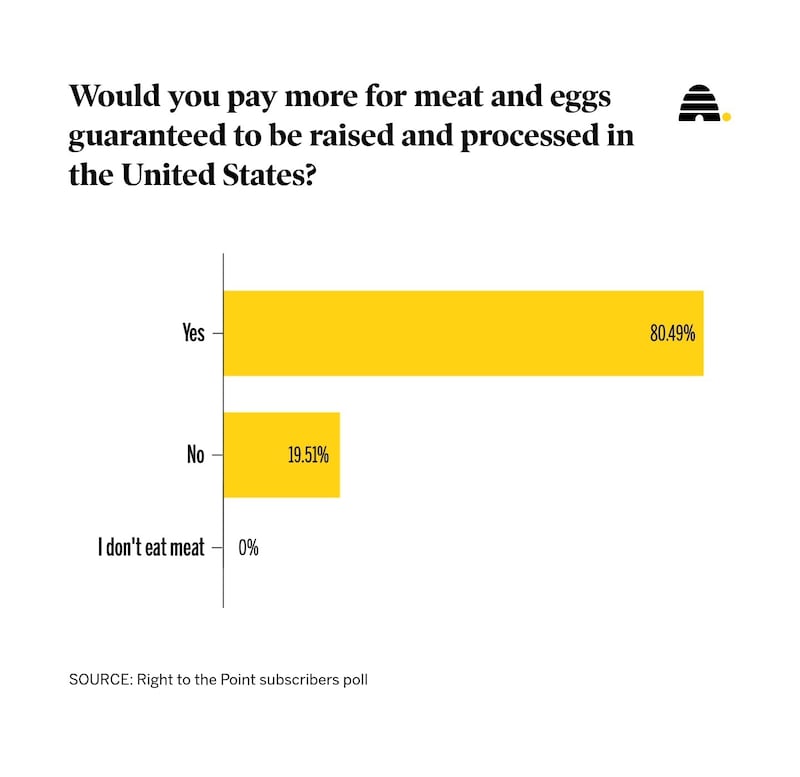
Meanwhile, here are the results from last week’s Right to the Point poll question, which was about the importance of meat and eggs being raised in America.
Not a lot of vegetarians in this community, it seems, which will be good news to the USDA.